
If you're searching for the best VPN in 2026, start with Proton VPN, NordVPN, and Mullvad. Proton is our overall pick for privacy, NordVPN is the streaming and Meshnet pick, Mullvad is the anonymity pick, Surfshark is the family value option, and ExpressVPN is the legacy premium choice. If NordVPN is already your likely pick, read the dedicated NordVPN review before buying. That's the short version.
I'm going to say something that might annoy some affiliate marketers: the VPN industry is full of garbage.
Not the products themselves. The reviews. Search "best VPN 2026" right now and you'll find the same five companies, in roughly the same order, on every site. That's not because those five are unanimously the best. It's because they pay the highest commissions. NordVPN offers up to 100% commission on new signups. Of course it's "ranked #1" on every list.
We still tested the big names because some of them genuinely earn their spot. But we also dug into things the commission-driven reviews won't touch: what happens when your intro pricing expires and the bill triples? Which VPN IPs are so overused that Cloudflare blocks you from using ChatGPT and Claude without solving five CAPTCHAs? Can you actually pay anonymously, or does every "privacy" VPN still want your credit card?
Those are the questions that matter. And nobody's answering them.
So we did.
-
#1 Proton VPNBest overall — Swiss privacy, open source, solid free tier
-
#2 NordVPNBest for streaming — Meshnet kills password-sharing bans
-
#3 MullvadBest for true anonymity — no email, pay with cash or crypto
My decision rule is simple: a VPN has to earn trust before it earns points for speed. If the audit trail, jurisdiction, renewal pricing, or payment model feels slippery, the ranking drops no matter how fast the speed test looks.
Stop Trusting Fake Reviews: How We Actually Picked the Best VPNs
Here's our methodology for finding the best VPNs, since most VPN "review" sites won't share theirs. We dug into independent speed benchmarks, audit reports, real user complaints on Reddit, and the actual fine print that most review sites conveniently skip.
What we evaluated:
- Speed: Download and upload benchmarks on WireGuard from independent sources like AV-TEST and SpeedTest.net, across multiple server locations (US East, Western Europe, Asia). Peak hours data, not 3 AM numbers.
- CAPTCHA and IP reputation: How often each VPN's IPs get flagged on Cloudflare-protected services (ChatGPT, Claude, Google). Reddit threads are full of complaints about this, and it matters more than most people realize.
- Streaming: Netflix US, BBC iPlayer, Disney+, YouTube Premium region switching. Not just "does it work" but "does it work reliably," based on community reports and streaming-focused review sites.
- Privacy claims: Independent third-party audits, open-source code, jurisdiction, and whether the VPN actually lets you pay without handing over personal information.
- Renewal pricing: What you'll actually pay after the promo period, not what the landing page says.
For a deeper look at how we approach all our reviews, see our review methodology.
Top 5 VPNs Ranked and Reviewed
1. Proton VPN — Best Overall for Privacy
There's a reason PCMag also ranks Proton #1 now, and it's not marketing budget. Proton's is a fraction of NordVPN's. It's because the product is genuinely that good.
Swiss jurisdiction. Fully open-source apps. Four consecutive no-log audits by Securitum. 18,100+ servers across 129+ countries. A free tier that doesn't sell your data. When you list it out like that, it's hard to argue with.
But here's what sealed it for me: the Secure Core routing. On most VPNs, your traffic goes to one server and exits there. Proton lets you route through hardened servers in Switzerland, Iceland, or Sweden first, then out to your chosen exit country. So even if someone compromises the exit server, your real IP is still hidden behind a privacy-friendly jurisdiction. Is it overkill for watching Netflix? Sure. But if you're doing anything where privacy actually matters (crypto trading, journalism, working in a restrictive country), it's not overkill at all.
The speed is surprisingly competitive. You'd expect the Swiss privacy company to sacrifice performance for principles. Nope. Independent benchmarks show their WireGuard implementation with VPN Accelerator hits 85-90% of base connection speed. That's on par with NordVPN's NordLynx and noticeably faster than ExpressVPN's Lightway in the same tests.
Proton accepts Bitcoin and cash by mail. No credit card required for the paid plans if you go the crypto route. They're also working on post-quantum encryption (not deployed yet, but it's on the 2026 roadmap alongside a new in-house VPN architecture). Users on r/ProtonVPN are tracking the progress closely.
Crypto/Payment Options: Bitcoin (must upgrade existing account), cash by mail to Geneva office. No Lightning Network yet. Bitcoin payments don't auto-renew, which is actually a feature, not a bug, given the renewal pricing issue.
Secure Core multi-hop routing through bare-metal servers in Switzerland, Iceland, and Sweden adds a layer most VPNs can't match.
Streamers who want the absolute fastest speeds and don't care about open-source code or Swiss jurisdiction.
- Swiss jurisdiction — outside Five Eyes/Fourteen Eyes alliance
- Fully open-source apps — anyone can audit the code
- 4 consecutive Securitum no-log audits (2022-2025)
- Free tier with no ads, no data limits, and a kill switch
- Secure Core multi-hop routing through privacy-friendly countries
- Free tier limited to 1 device and 10 countries — no streaming unblocking
- Paid pricing varies by region, term, promotion, and renewal total shown at checkout
- Bitcoin only for crypto (no Monero, no Lightning Network)
- Speeds slightly slower than NordVPN in independent benchmarks (~7% gap)
2. NordVPN — Best for Streaming and Bypassing Bans
OK, let's talk about the elephant in the room. NordVPN has the biggest marketing budget in the VPN industry and sponsors roughly half the internet. That alone makes me skeptical. But after digging into the specs, the audits, and the Reddit threads, the product genuinely delivers.
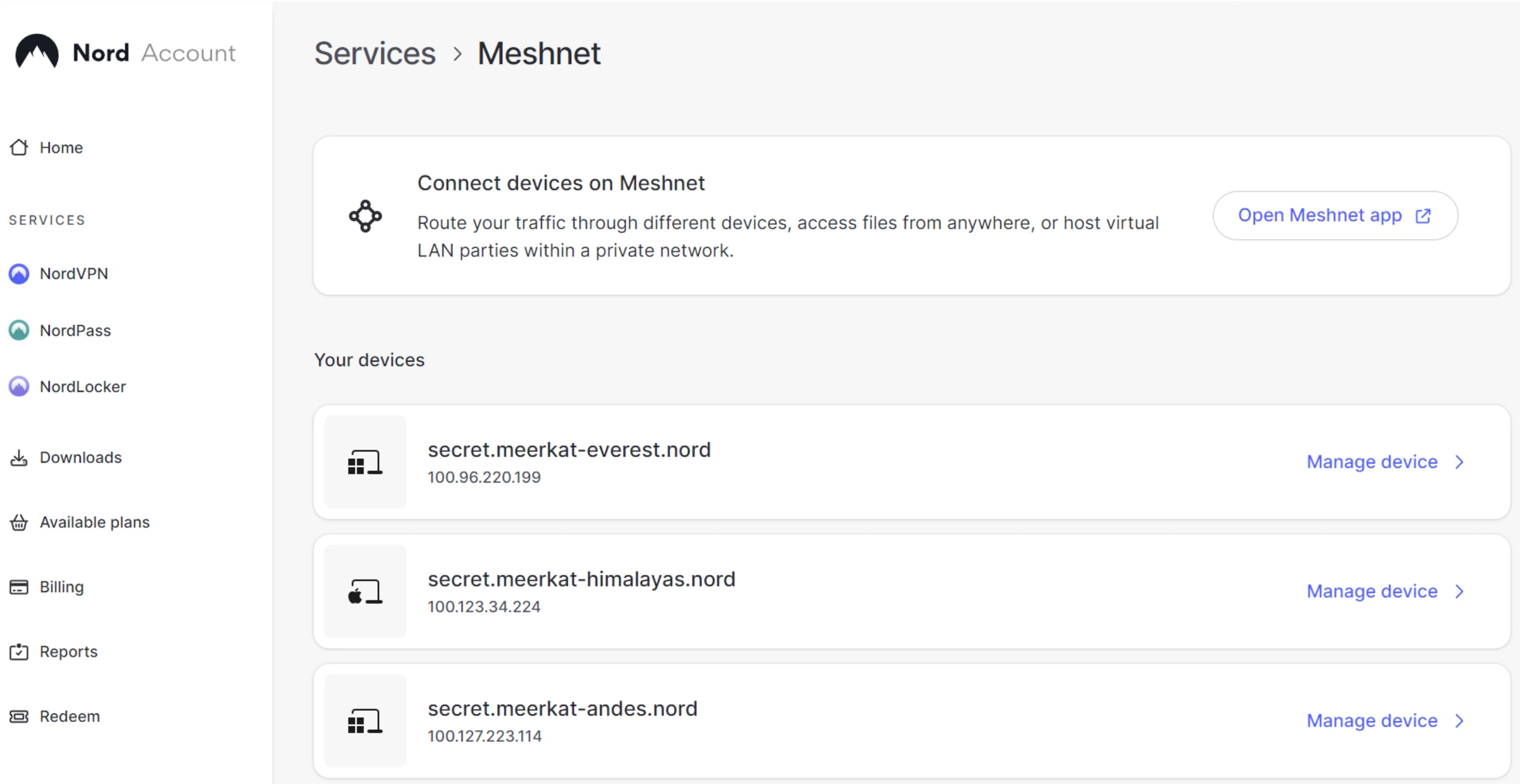
Specifically, Meshnet. If you're dealing with Netflix's password-sharing crackdown (and in 2026, who isn't?) — Meshnet is basically a cheat code. It creates a peer-to-peer encrypted tunnel between your devices so they all share the same IP address. Netflix sees one household. Problem solved. And here's the thing nobody mentions: Meshnet is completely free. You don't need a paid NordVPN subscription to use it. Just create an account, install the app, link your devices. Done.
NordVPN almost killed Meshnet in 2025. User backlash forced them to reverse course. Good thing, because it's genuinely their most interesting feature.
Beyond streaming tricks, the speeds are excellent. NordLynx (their WireGuard-based protocol) consistently hits 88-93% of base connection speed in independent benchmarks, which is right at the top of what any VPN can do. The post-quantum encryption they added across all platforms in May 2025 is a nice forward-looking touch. Your traffic is protected against "harvest now, decrypt later" attacks from quantum computers. Nobody's cracking it today, but intelligence agencies are definitely stockpiling encrypted data for when they can.
Six independent no-log audits (four by Deloitte, two by PwC). 7,300+ servers in 127 countries. 80+ cryptocurrencies accepted through CoinGate. All solid.
The problem is pricing. In the July 11 U.S. check, the 2-year Basic offer was $3.49 per month for the first 27 months and the page showed a $139.08 annual renewal reference, roughly $11.59 per month. That is a material jump, and it is worth recording the renewal date before you commit.
Crypto/Payment Options: 80+ cryptocurrencies via CoinGate (BTC, ETH, USDT, LTC, XRP, DOGE, and more). Also available through gift cards on Bitrefill.
Meshnet creates free peer-to-peer tunnels between up to 60 devices, making Netflix think everyone is in the same household.
Privacy purists who want open-source code and hate aggressive upselling in the app.
- Meshnet is free and solves the Netflix password-sharing problem
- Post-quantum encryption on all platforms since May 2025
- 6 independent no-log audits (4 by Deloitte, 2 by PwC) — most transparent audit trail
- NordLynx speeds: 88-93% of base connection in independent benchmarks
- 80+ cryptocurrencies accepted for anonymous payment
- Renewal pricing jumps from the $3.49/mo U.S. intro equivalent to a $139.08/year reference
- No free tier at all — every competitor on this list has one except NordVPN
- Aggressive marketing creates skepticism (and rightfully so)
- Current U.S. tiers are Basic at $3.49/month, Complete at $4.49, and Prime at $7.49 before sales tax; verify the current Threat Protection Pro tier matrix
3. Mullvad — The Crypto and Anonymity Pick
Mullvad is the VPN for people who think Proton VPN still asks for too much personal information.
Here's how you sign up: you go to mullvad.net, click "Generate account," and you get a random 16-digit number. That's your account. No email. No name. No password. You then pay €5/month, flat rate with no multi-year discounts, no promo tricks, no renewal traps. The price has been €5 since 2009. I genuinely respect a company that prices something once and sticks with it for 17 years.
If you pay with Monero, Bitcoin, or Bitcoin Cash, you get 10% off. You can also mail cash in an envelope to their office in Sweden. I know this sounds like a joke, but it's real, and for certain threat models, it's the only way to ensure zero digital payment trail. The Mullvad site has actual photos of their cash payment processing setup.
The trade-off is size. 600+ servers in 50 countries. That's a fraction of NordVPN's 7,300+ or Proton's 18,100+. In practice, it was fine for me in the US and Western Europe. Fast, reliable, and rarely congested. But if you need servers in Nigeria or Indonesia, Mullvad probably can't help you.
They recently went WireGuard-only, shutting down all OpenVPN servers. Bold move. WireGuard is faster and more modern, but it removes the fallback option if you're on a network that blocks WireGuard traffic. Their DAITA feature (Defense Against AI-guided Traffic Analysis) is unique. It pads and shapes your traffic to prevent machine learning models from fingerprinting your browsing patterns. In 2026, with AI-powered surveillance becoming a real concern, that's not paranoia. That's planning ahead.
Mullvad also already has quantum-resistant tunnels deployed. Not "on the roadmap." Live, right now.
Crypto/Payment Options: Bitcoin, Bitcoin Cash, Monero (10% off all three). Cash by mail. No email or identity required at any point. If you're trading crypto actively, especially with automated trading bots, pairing Mullvad with your exchange is a no-brainer for OPSEC.
No email, no name, random account number, cash by mail, and the same flat price since 2009 — zero renewal traps.
Anyone who needs wide server coverage, reliable streaming unblocking, or polished mobile apps.
- Zero personal data collected — no email, no name, just an account number
- €5/month flat since 2009 — no renewal traps, no price games
- Monero, Bitcoin, cash by mail — truly anonymous payment
- Open source, quantum-resistant tunnels, DAITA traffic analysis protection
- 10% discount for crypto payments
- Only 600+ servers in 50 countries — limited geographic coverage
- WireGuard-only (no OpenVPN fallback for restrictive networks)
- Streaming unblocking is inconsistent — not built for Netflix
- No mobile app polish compared to Nord or Proton
- 5 device limit feels restrictive for families
4. Surfshark — Best Budget Pick for Families
Unlimited devices. That's Surfshark's killer feature and the reason it's on this list.
Every other VPN on this page caps simultaneous connections. Surfshark's unlimited-device promise changes the household math. In the July 11 localized check, Starter showed EUR2.29 per month for the first 27 months. If your shortlist is down to those two, the narrower NordVPN vs Surfshark comparison breaks down the security-bundle versus family-device tradeoff.
The current localized 2-year Starter offer is the lowest entry price among the plans compared here, but VAT and renewal pricing vary. That makes the full checkout total and renewal notice more useful than the headline monthly equivalent.
Speed was solid but not exceptional, about 80-85% of base speed on WireGuard. The r/VPN community generally considers that acceptable for the price. Good enough for streaming, torrenting, and general browsing. Not quite as fast as NordVPN or Proton at the top end. CleanWeb (their ad blocker) works well. MultiHop lets you route through two servers for extra privacy. The rotating IP feature is clever: it changes your IP every few minutes without disconnecting your session.
Where Surfshark falls short: the privacy story isn't as strong. They're incorporated in the Netherlands (EU jurisdiction, Fourteen Eyes country). The apps aren't open source. They've been audited by Deloitte and Cure53, which is solid, but they don't have the track record of Proton or the philosophical purity of Mullvad. For a budget pick that handles the basics well, Surfshark is great. For serious privacy? Look higher on this list. (Fun fact: Surfshark also makes Incogni, a data removal tool we compare against DeleteMe and Optery in the DeleteMe vs Incogni vs Optery guide; the narrower Incogni vs Privacy Bee review covers Privacy Bee.)
Crypto/Payment Options: Bitcoin, Ethereum, Monero, Dogecoin, and 7+ other cryptos via CoinGate/CoinPayments.
Unlimited simultaneous device connections under one subscription — no other major VPN offers this.
Users with serious privacy requirements who need open-source apps and a jurisdiction outside Fourteen Eyes.
- Unlimited simultaneous device connections — no other major VPN matches this
- Current localized 2-year Starter offer is the lowest entry price in this comparison
- Unlimited devices keep household value clearer than per-device comparisons
- Rotating IP changes your address every few minutes without disconnecting
- Accepts 10+ cryptocurrencies including Monero and Dogecoin
- Netherlands jurisdiction — inside the Fourteen Eyes surveillance alliance
- Apps are not open source — you're trusting their word on privacy
- Speed was good but not top-tier (80-85% of base vs 88-93% for NordVPN)
- The three-plan structure (Starter, One, and One+) still requires careful comparison
5. ExpressVPN — The Legacy Choice
I need to be honest with you: I don't think ExpressVPN is worth it in 2026.
That's a controversial take because ExpressVPN has been a top-tier recommendation for years, and the product is genuinely excellent. The Lightway protocol (now rebuilt in Rust with post-quantum encryption baked in by default) is arguably the most technically advanced VPN protocol available. TrustedServer (RAM-only, wipes on every reboot) sets the gold standard for server security. 23 published third-party audits, including KPMG. 3,000+ servers in 105 countries. It's premium. It feels premium.
The problem is price. ExpressVPN's headline offer can sound competitive until you compare the full localized checkout totals, renewal terms, and device coverage across Proton VPN, NordVPN, and Surfshark. ExpressVPN is no longer the obvious value winner in this group.
The renewal situation is actually one of the worst now: Basic renews at ~$99.95/year (~$8.33/month), which is a 241% jump from the $2.44/month intro rate. And the tiered pricing they introduced in 2025 (Basic/Advanced/Pro) adds unnecessary complexity. The Basic plan gives you 10 devices. If you want the password manager and identity protection, you need Advanced at $4.49/month on the 2-year plan. The Pro tier at $7.49/month feels like it's for people who don't comparison shop.
If you're already on ExpressVPN and happy with it, I'm not telling you to switch. It's a solid, reliable VPN with an unmatched security track record. But if you're buying new today? Proton or NordVPN give you more for less.
Crypto/Payment Options: Bitcoin, Ethereum, XRP, and stablecoins (USDC, BUSD) via BitPay. Crypto payments don't auto-renew.
23 published third-party audits and a Lightway protocol rebuilt in Rust with post-quantum encryption on by default.
Anyone buying new today — Proton or NordVPN give you more for less at every price point.
- Lightway protocol in Rust with post-quantum encryption on by default
- 23 published third-party audits — industry leading transparency
- TrustedServer RAM-only architecture (data wiped on reboot)
- Accepts Bitcoin, Ethereum, XRP, and stablecoins
- Not the best at any single thing — beaten on speed (Nord), privacy (Proton), and price (Surfshark)
- 2-year Basic at $2.44/mo looks cheap but renewal jump is the steepest (~241%)
- Renewal at ~$99.95/year ($8.33/mo) — a 241% jump from the intro rate
- New tier structure (Basic/Advanced/Pro) is confusing and feels like upselling
- Owned by Kape Technologies — a company with a controversial adware history
The VPN Pricing Trap: Intro Rates vs. the Reality of Renewals
This is the section every other VPN review conveniently skips. Every major VPN advertises a low monthly equivalent on a long commitment. What matters is what happens when each promotional first term ends.
| Feature | Proton VPN | NordVPN | Mullvad | Surfshark | ExpressVPN |
|---|---|---|---|---|---|
| Intro Offer (monthly) | Localized paid pricing | $3.49/mo U.S. | €5/mo (flat) | EUR2.29/mo observed | $2.44/mo |
| First-Term Total | Varies by checkout | $94.23 (27 months) | €120 over 24 months | EUR61.83 (27 months) | ~$68.40 |
| Renewal Price (annual) | Shown in checkout | $139.08/yr | €60/yr (same) | Varies | ~$99.95/yr |
| Renewal (monthly equiv.) | Varies | ~$11.59/mo | €5/mo (same) | Varies | ~$8.33/mo |
| Price Increase | Varies | ~232% | 0% | Varies | ~241% |
| Crypto Payments | BTC only | 80+ coins | BTC, BCH, XMR | 10+ coins | BTC, ETH, XRP |
| Crypto Discount | ✗ | ✗ | 10% off | ✗ | ✗ |
| Action | Get Proton → | Get Nord → | Get Mullvad → | Get Surfshark → | Get Express → |
Look at Mullvad in that table. Its flat-price model is easier to understand than promotional first-term and renewal math.
NordVPN shows the clearest current example of renewal shock in this table: the $3.49 monthly intro equivalent sits next to a $139.08 annual renewal reference, about $11.59 per month. Record both numbers before buying.
Pro tip: If you pay for any VPN with Bitcoin, most providers won't auto-renew your subscription. That means you can re-evaluate (and potentially re-subscribe at the new customer intro rate with a fresh account) instead of being silently charged the higher renewal price. This is another reason crypto payments make sense for VPNs specifically. Speaking of crypto: if you're active enough to be paying for VPNs with Bitcoin, you probably need to deal with crypto taxes too. We just published our CoinLedger vs Koinly comparison for exactly that.
VPN "CAPTCHA Fatigue": Which IPs Trigger the Most Cloudflare Blocks?
This is the gap nobody else is covering, and it's one of the most frustrating daily-use issues with VPNs in 2026.
Here's what happens: you connect to a VPN, try to open a Cloudflare-protected website (that includes ChatGPT, Claude, a ton of SaaS tools), and you get hit with a CAPTCHA wall. Or worse, a flat-out block. This happens because VPN IP addresses are shared by thousands of users, and when enough of those users do sketchy things, the IP gets flagged.
If you're someone who frequently switches between AI tools (running prompts through ChatGPT and Claude to compare outputs, for instance, which we did extensively for our AI writing tools comparison), a flagged VPN IP can get your session blocked mid-workflow. It's maddening.
Based on user reports across Reddit and VPN forums, here's how each provider stacks up:
- Proton VPN: Cleanest IPs overall. Users rarely report CAPTCHA issues. Their smaller user base per server likely helps.
- Mullvad: Similarly clean. Their small but loyal user base seems to generate fewer flags.
- ExpressVPN: Middle of the pack. Occasional CAPTCHAs, no full blocks.
- NordVPN: Noticeably worse. Their massive user base means some servers are over-shared. Switching servers usually fixes it, but having to play server roulette is annoying.
- Surfshark: The worst reputation for IP quality. Multiple reports of Cloudflare blocks, frequent CAPTCHAs on Google and ChatGPT. Their budget pricing attracts high volume, and the IPs suffer for it.
This isn't a dealbreaker for casual browsing, but if AI tools and SaaS products are core to your workflow, IP quality matters more than benchmarked download speed when choosing the best VPN for daily use.
Free VPNs: Are Any Actually Safe in 2026?
Short answer: Proton VPN's free tier. That's it. That's the list.
Every other "free VPN" monetizes you somehow. Data collection, ad injection, bandwidth throttling designed to frustrate you into upgrading, or, in the worst cases, selling your browsing data to third parties. The old line is true: if you're not paying for the product, you are the product.
Proton VPN Free gives you:
- Access to servers in 10 countries (US, Canada, Switzerland, Netherlands, Japan, and 5 more)
- No data limits, genuinely unlimited bandwidth
- No ads, no logging, no data selling
- Kill switch included
- Same Swiss privacy protections as the paid plan
The limitations: 1 device only, no streaming unblocking, no Secure Core, "medium" speed tier (you don't get the 10 Gbps servers). But for basic privacy protection on a single device? It's the real deal. I've recommended it to my parents. They don't need NordVPN's 7,300 servers. They need something that works and doesn't spy on them. Proton Free does that.
Final Verdict: The Best VPNs of 2026
Proton VPN is our top pick for 2026. Swiss privacy, open-source transparency, four consecutive no-log audits, a genuinely useful free tier, and competitive pricing on the paid plans. It's the VPN I trust with my own traffic. Not a marketing decision. A privacy one.
NordVPN is the pick if streaming is your priority. Meshnet alone justifies a look, especially since it's free. The speed is top-tier and the crypto payment options are the widest in the industry. Just go in with your eyes open about the renewal pricing. For a deep dive into how these two stack up on port forwarding, Meshnet, and anonymous payments, see our ProtonVPN vs NordVPN head-to-head comparison.
Mullvad is what you use when privacy isn't a preference, it's a requirement. No email, random account numbers, cash by mail, quantum-resistant tunnels. It's the most honest VPN company in the business. The limited server network and weak streaming support are real trade-offs, but for privacy purists and the crypto community, nothing else comes close.
Surfshark is the family/budget pick. Unlimited devices and the localized EUR2.29 monthly intro equivalent make the household case; just verify VAT and renewal pricing at checkout.
ExpressVPN is technically excellent but overpriced. If you're already using it, fine. If you're buying new, Proton or NordVPN give you more for less. The Lightway protocol deserves respect, but a protocol alone doesn't justify the premium in 2026.
One more thing, and this is advice, not a review: use the free tiers. Proton's free tier costs nothing. NordVPN's Meshnet costs nothing. Test before you commit, especially to a 2-year plan. That's how you find the best VPN for your specific needs, not by reading affiliate rankings, but by actually using the product. And if you do commit, pay with crypto so you don't get auto-renewed at the inflated rate. A VPN paired with a solid password manager and a privacy-focused browser is the foundation of any real security setup. If the household problem is kid-device rules, screen time, or app blocking, a VPN is the wrong lever; use our parental control apps comparison. If your phone is drowning in spoofed or scam calls, a VPN will not fix caller ID; use the spam call blocker app comparison instead. If your concern is stolen identity data rather than network privacy, use our identity theft protection services comparison instead of expecting a VPN to solve that problem. Start there before adding anything else.
Check out the rest of our security & privacy reviews for more.
Frequently Asked Questions
Ready to check Proton VPN?
Use the verified route if the trade-offs still fit. If not, jump back to the summary and compare the alternatives.
Security and privacy editor focused on evidence-led buying guides. Reads official documentation, audit notes, privacy policies, recovery limits, and support pages before turning security claims into practical recommendations.
Sarah starts by locating the evidence boundary, then ranks security and privacy tools by audit and policy scope, recovery design, trust boundaries, residual risk, and what a cautious buyer can verify.
Related Articles

Cloaked vs Incogni: Do You Need Both?
Decide whether existing broker cleanup, future sign-up aliases, or a documented gap justifies one privacy subscription or both
Cloaked vs Incogni compared by aliases, broker removal, verified annual prices, and the extra value of paying for one service or both.
Backblaze vs IDrive: Choose by What You Need to Recover
For one active Mac or Windows PC with a growing file collection; choose IDrive for several personal computers or retained locally deleted files
Backblaze vs IDrive compared by deleted-file retention, device limits, private keys and current annual prices. Choose backup for the recovery you need.