

-
#1 IncogniBest overall — Deloitte-audited, 420+ brokers, works in 35 countries
-
#2 OpteryBest free option — run a scan before paying anything, see real exposure
-
#3 DeleteMeBest premium US service — human-assisted workflow, broad public list, higher annual price
The first decision is not which service claims the largest broker list. The real buying risk is prepaying for a year before you know whether your exposure justifies recurring cleanup. Incogni Standard is $15.98 month to month or $7.99 per month when billed $95.88 annually. DeleteMe Solo is $129 per year. Privacy Bee's top tier is $799 per year. Compare the amount charged today, not only the monthly headline.
The manual route is repetitive by design: separate opt-out workflows, identity checks, follow-up messages, and records that may reappear later. A paid service is not buying a guaranteed permanent deletion. It is buying recurring administrative work, monitoring, and a clearer place to track what the provider says it has done.
This roundup covers four of the main options, ranked on what actually matters: which brokers they cover, whether the removal requests are verified, what you'll actually pay, and who each service is realistically built for. The fine print on their privacy policies matters too, because a data privacy service with a sketchy privacy policy is its own kind of irony.
If you live in California, read the California DROP vs paid data removal guide before paying anyone. It explains when the free state portal should come first and when a paid service still fills a real gap. If your shortlist is already narrowed to the three biggest comparison names, use the focused DeleteMe vs Incogni vs Optery guide next. It separates audit proof, free exposure reports, and premium US coverage more directly than this broader roundup.
All 4 Services Side by Side
| Feature | Incogni | Optery | DeleteMe | Kanary |
|---|---|---|---|---|
| Automated removal | Yes | Yes (paid tiers) | Partial (human-assisted) | Yes; scope varies by tier |
| Brokers covered | 420+ | 375+ on Core | 976 on public list | Top data brokers + Google cache/social leaks |
| Free scan available | No | Yes, detailed scan | No | Yes |
| Annual cost (1 person) | $95.88 Standard | Free / $39 Core | $129 | Free / $9.99 Professional / $50 Advanced |
| Works in EU/UK | Yes (35 countries) | Check current country support | US-focused; verify eligibility | Community/Professional US; Advanced US/UK |
| Published audit of removal operations | Yes - Deloitte ISAE 3000 | No | No | No |
| Family plan | Yes | Yes | Yes ($229/yr) | Add members at 50% |
| Best for | Best overall | Free scan + entry-level | US power users | App-first privacy workflow |
| Action | Try Incogni → | Try Optery → | Try DeleteMe → | Try Kanary → |
How I ranked these services
The published counts are not interchangeable. Incogni says it covers 420+ broker sites. Optery ties 375+, 555+, and 630+ to specific paid tiers, then lists 945+ separately for Ultimate custom requests. DeleteMe's 976 figure is its public removal list. Kanary describes high-risk sources across brokers, Google, and social services instead of publishing one equivalent total. We did not hand the top rank to whichever company showed the largest number.
The scores prioritize four practical decisions: public process evidence, whether coverage fits your country and plan, whether you can inspect exposure before paying, and how clearly the first bill is explained. An annual monthly equivalent is treated as an annual prepayment, not a month-to-month subscription. None of these scores claims measured deletion success. A controlled outcome test would require the same profile, a documented baseline, and months of follow-up across every service.
Incogni: the strongest public process-assurance trail here
The Deloitte ISAE 3000 limited-assurance material on Incogni is publicly available and worth reading. Among the official sources checked for this roundup, it was the clearest independent process evidence tied to removal operations rather than generic security controls.
That matters because a progress label is not proof of a removal outcome. Deloitte's limited-assurance material gives Incogni a public process trail around defined removal operations. It does not prove that every broker deleted every field for every subscriber, but it is stronger evidence than a provider asking readers to trust a marketing dashboard alone.
Incogni publishes 420+ covered broker sites and says its service is available in 35 countries. Its public product material describes per-broker request status and recurring requests. Because this is an evidence-led update, those remain documented product capabilities; no dashboard or deletion result was tested for this refresh.
What it doesn't have is a free exposure scan. Family plans are available, but households still need to compare the total at checkout. My default is Incogni when public process evidence matters more than seeing exposure before paying. For a detailed head-to-head against Privacy Bee, see our Incogni vs Privacy Bee comparison. The large premium-tier gap is difficult to justify for a typical solo subscriber.
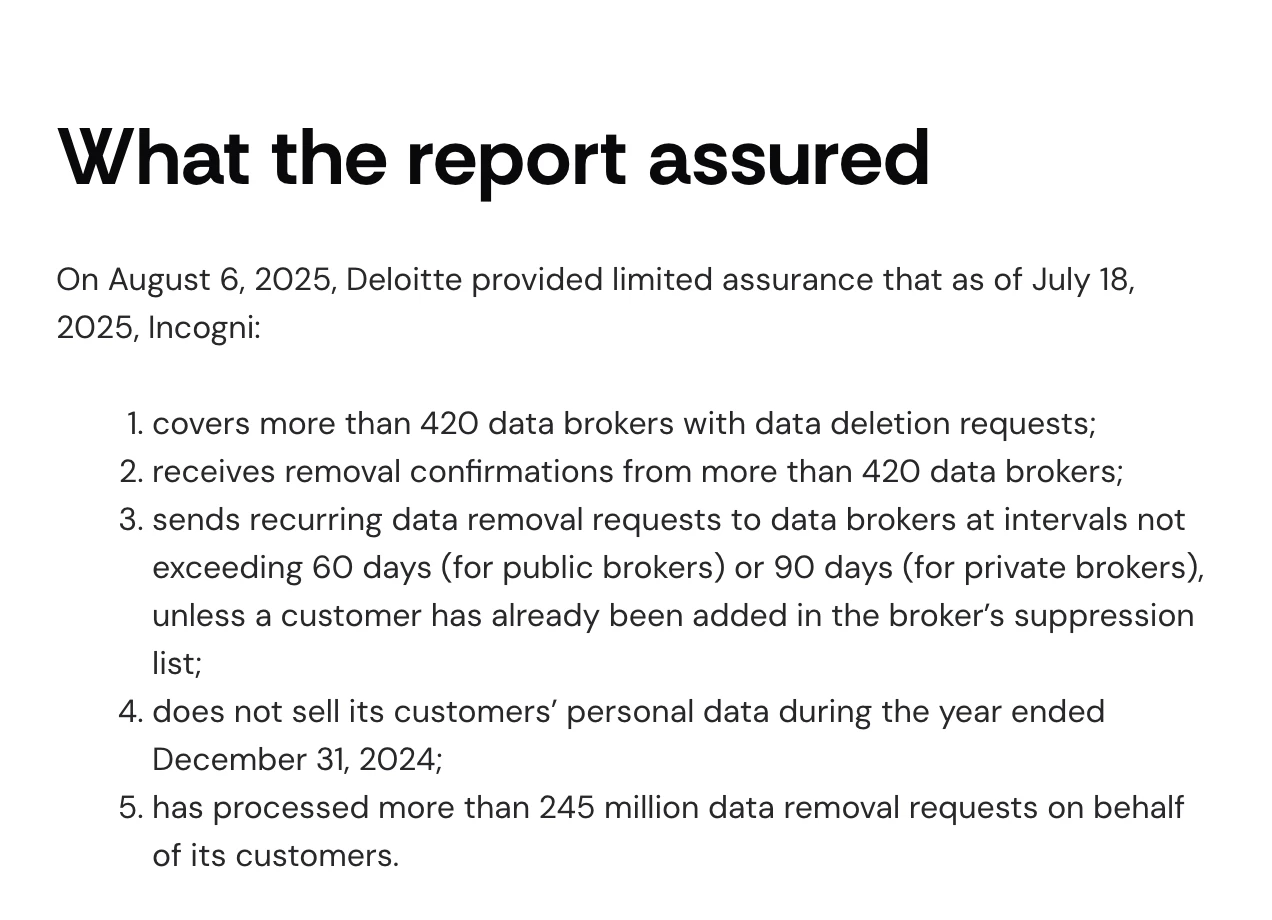
Publishes Deloitte ISAE 3000 limited-assurance material covering defined removal-operation controls and recurring request cadence.
Users who want a free scan before paying — Incogni requires a subscription upfront with no preview of your exposure.
- Published Deloitte ISAE 3000 limited assurance report on removal operations
- Publishes 420+ covered broker sites
- Official availability covers 35 countries rather than only the US
- Public product material describes per-broker request status
- Straightforward monthly and annual Standard pricing
- No free scan before you pay — you're buying blind
- Family pricing exists, but promo and renewal math needs checking at checkout
- Published coverage is not proof that every personal record was found or removed
- The lower monthly equivalent requires a $95.88 annual payment upfront
Optery: Run the Free Scan First
Optery's free tier is built to show what is out there before you pay. Its official page describes exposure reports with screenshots and View Links across hundreds of sites, rather than only a generic exposure score. We did not open an account or verify a personal scan, so treat that as a documented product workflow, not a measured result.
The strategic value is diagnostic. A scan can turn an abstract privacy concern into a list you can inspect before committing money. That is why I would start with the free report when exposure visibility matters, then pay only if the findings identify a cleanup job worth delegating. The tradeoff is that a free report shows what Optery says it found; it does not prove that a paid removal will succeed, and the appropriate tier still depends on the remaining list.
On the paid side, Optery's Core plan is $39/year and covers automated removals from 375+ sites, scaling to 555+ on Extended and 630+ on Ultimate. Ultimate separately lists custom removal requests across 945+ sites. That is still a narrower geographic story than Incogni's international coverage, but Optery remains the lowest-priced paid on-ramp in this category.
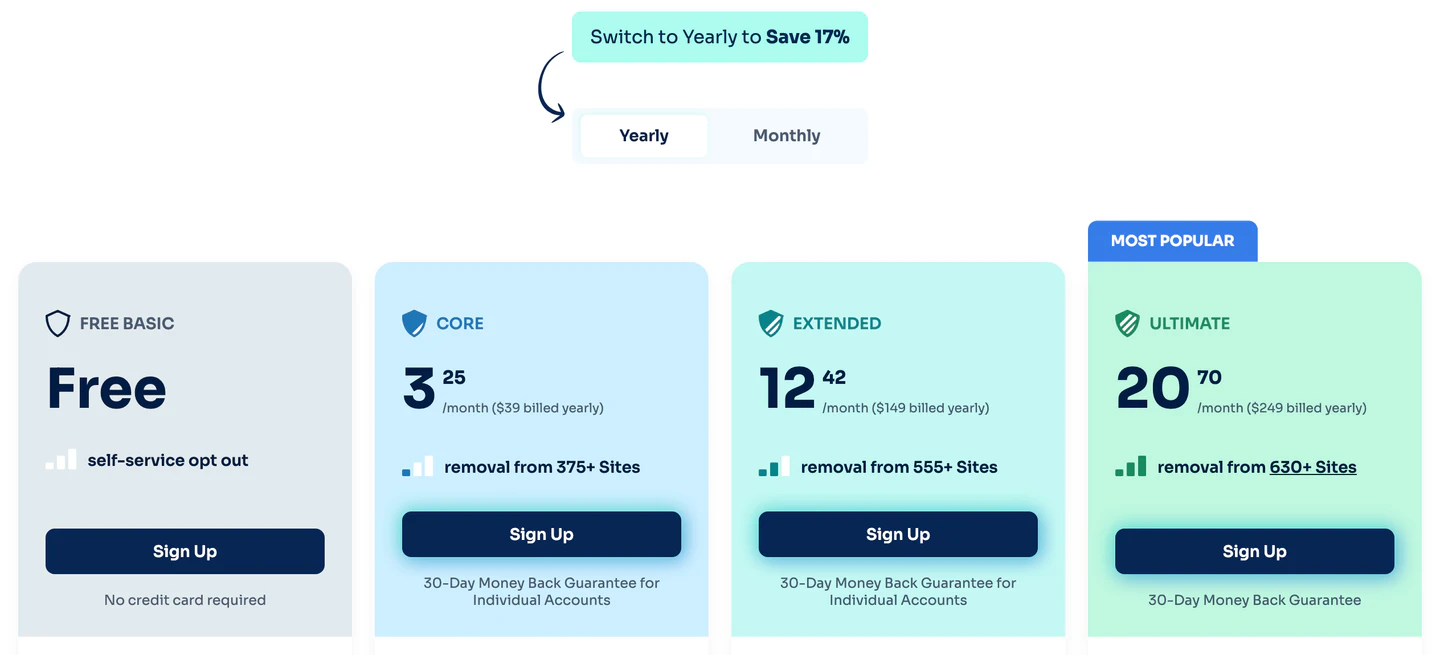
Official product material describes a free exposure report with screenshots and View Links before a paid removal commitment.
Users outside the US who need broad international GDPR coverage — Incogni handles that better.
- Free Basic gives a documented scan-first path before paying
- Official material describes screenshots and View Links in exposure reports
- Entry-level paid plan is the most affordable in the category
- Family plans available
- Good option for US users who want to verify exposure before committing
- Core is machine-only automation; human-assisted QA starts on higher tiers
- Country support should be verified before paying outside the US
- No comparable public removal-operations assurance was found in the sources checked
- Higher-tier plans get expensive quickly
DeleteMe: Premium Price, Premium Frustrations
DeleteMe is the long-running premium name in this group. Its current help material describes a hands-free service that searches for listings, submits opt-outs, monitors reappearances, and reports progress rather than asking the subscriber to manage each broker request.
The official Solo price is $129 per year, above Incogni Standard's $95.88 annual bill and Optery Core's $39 annual price. DeleteMe's public coverage page separately lists 976 data brokers. That is the largest published list here, but it is still scope evidence rather than proof that one subscriber's record was removed from every listed broker. Verify country eligibility before paying outside the US.
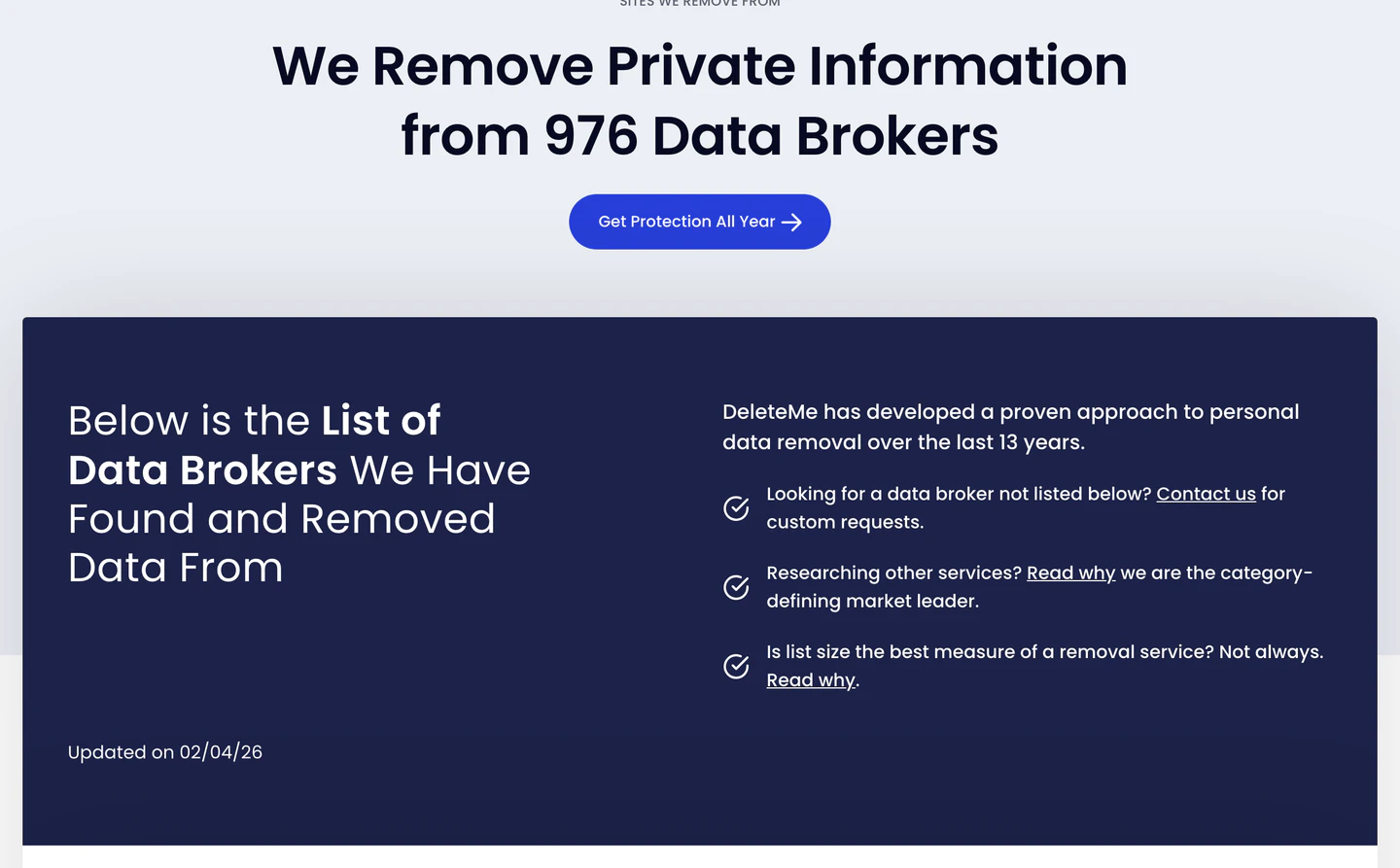
DeleteMe's onboarding documentation says subscribers can provide names and aliases, current and past addresses, phone numbers, and email details. That makes the service easier to justify for a complicated data footprint. It does not prove better removal outcomes than an automated competitor, because this update did not submit the same profile to each service and track results over time.
DeleteMe's current help article says family plans receive a better per-person discount and longer subscriptions save more, but it no longer itemizes static Duo, Family, or extra-member totals. DeleteMe's help center separately says Privacy Reports show what the service found, what it removed, and ongoing progress. I did not open an account or inspect a live report, so this ranking treats that as a documented workflow rather than a tested reporting advantage.
The limitation is proof. I found current official workflow and coverage documentation, but not a comparable public independent assurance report covering DeleteMe's removal operations. That does not show the service fails. It means the premium recommendation rests more heavily on the company's published process and coverage than Incogni's does.
Official help material documents a hands-free workflow, support for aliases and prior addresses, ongoing monitoring, and privacy reports.
People outside the supported service footprint, anyone who wants a free scan first, or readers who require independent removal-operations assurance.
- 976 brokers on the current public removal list — widest published list in this comparison
- Official help material describes a hands-free removal workflow
- Onboarding supports aliases and current or past address details
- Privacy Reports and ongoing monitoring are publicly documented
- Family plan available at reasonable incremental cost
- No comparable public independent removal-ops assurance was found in the sources checked
- Country eligibility needs checking outside the US
- $129/yr costs more than Incogni Standard and Optery Core
- No free scan or trial before paying
Kanary: The Family Plan That Makes Sense
Kanary takes a different route from broker-count competition. Its current official material frames the product around the highest-risk public exposures across data brokers, Google, and social services, with a mobile app at the center of the free and Professional workflows.
Kanary's current pricing is specific: Community is free, Professional is $9.99 per month, and Advanced is $50 per month. Added family members are listed at 50% off. Community and Professional are US-only on the public page, while Advanced is listed for the US and UK.
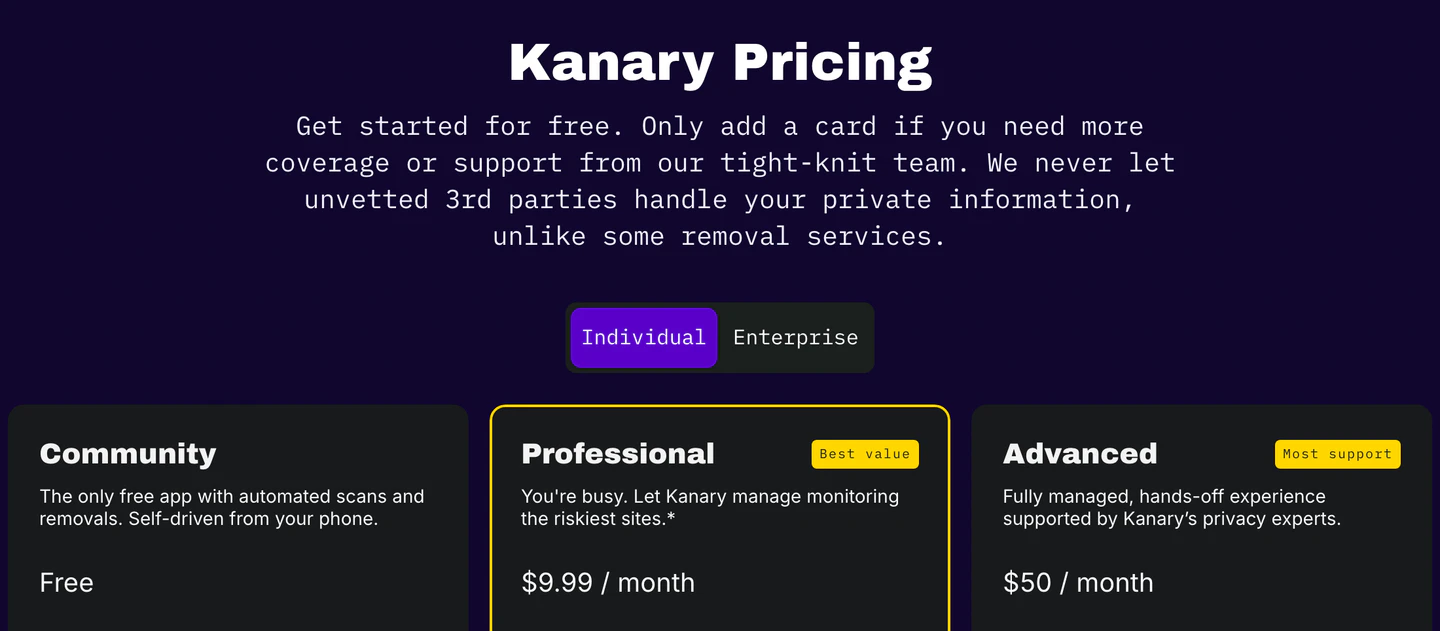
Kanary also documents scans across Google search results, social settings, and data broker exposure. That wider scope is the reason to consider it: the product is not limited to sending requests against a static broker list.
The Professional tier lists managed scans of high-risk sites plus progress email and scan notifications every 30 days. The public page also says removals remain self-guided from the app on that tier, while Advanced is the fully managed option. That distinction matters before comparing $9.99 with a hands-off subscription.
The limitation is again proof and geography. I did not find a comparable public independent removal-operations assurance report in the official sources checked, and the lower two personal tiers are US-only. For people who want public process assurance and broad country availability, Incogni still wins. For a mobile-first scan and cleanup workflow, Kanary is the more distinctive alternative.
Combines a free mobile workflow, Google and social exposure checks, and clearly separated self-guided and fully managed tiers.
People outside the listed US/UK availability or anyone who wants one broadly international, assurance-backed removal subscription.
- Free Community tier with self-guided scans and removals
- Scans Google search results and social privacy exposure, not just broker databases
- Professional tier adds 30-day managed scans of high-risk sites
- Family members can be added at 50% off
- No comparable public independent removal-ops assurance was found in the sources checked
- Community and Professional are listed as US-only
- Professional removals remain self-guided from the app
- Advanced costs $50 per month before family add-ons
Can You Do This Yourself for Free?
Yes. Many people-search and data-broker sites publish their own opt-out routes, so paying a subscription is not the only legitimate path. The difficulty is keeping track of separate instructions, identity checks, follow-ups, and records that can reappear.
The manual option makes the most sense when your exposure list is short and you are willing to revisit it. This update did not measure a universal time requirement, because the workload depends on how many listings apply to one person, which brokers respond, and how often the records return.
For a large or recurring list, automation may be worth paying for. For someone who wants to understand where the data sits, a scan-first route plus manual opt-outs is still reasonable. Start with the highest-risk public listings, document what you submitted, and choose a recheck schedule that matches your exposure rather than assuming one universal cadence.
One practical hybrid approach is to run Optery's free scan, manually opt out of the highest-priority results, then subscribe to one paid service only if the remaining list is too large to manage. This lets you verify a small part of the process before committing money and gives you a baseline for judging the paid workflow without stacking multiple subscriptions.
How to choose a data removal service
Broker count vs. process evidence. A larger list documents scope, not a personal removal outcome. Public assurance, visible reports, and clearly described recurring work help explain how a provider handles that list, but none guarantees that every record will disappear.
International coverage. Incogni publishes the broadest country availability in this group. Kanary lists Community and Professional for the US and Advanced for the US and UK; DeleteMe and Optery require closer country checks. Do not infer eligibility from a global-looking homepage.
Recurring work. Providers describe ongoing scans, requests, or monitoring because public records can reappear. The cadence and scope vary by product and plan, so check what continues after the first report instead of treating the initial cleanup as the whole subscription.
Household vs. individual. If more than one person in your home needs coverage, check whether the service sells true household coverage or just discounted add-ons. Kanary now lists family members at 50% off rather than the older flat household pricing, while Incogni and DeleteMe both have family options that need to be compared at checkout.
The service's own privacy policy. To remove your data from brokers, you have to hand identifying information to another company. Read what each provider collects, why it needs those fields, who receives them, and what happens after cancellation. A privacy service that does not explain retention and deletion clearly deserves more scrutiny regardless of brand size.
Cancellation and data deletion. Check the current retention language at the moment you subscribe and request deletion directly if the provider offers that route. I did not run cancellation or post-cancellation deletion tests for this update, so this guide does not assign a winner on an unverified workflow.
Frequently Asked Questions
Verdict
Incogni is the right choice for most people. It is the only service in this roundup where I found published independent assurance material covering defined removal operations, it publishes 420+ covered broker sites and 35-country availability, and Standard costs $15.98 month to month or $95.88 when billed annually. The lack of a free scan is a real gap, but its public process evidence makes it the cleanest default.
Run Optery's free scan first if exposure visibility will change your decision. Seeing actual results is more useful than buying from a broker-count headline, but the scan is still a starting point rather than proof that every relevant record was found.
If you want to see exposure before paying, run Optery's free scan. If you want a mobile-first privacy workflow with Google and social exposure checks, Kanary is worth a look. If you're a US power user who wants maximum broker coverage and human oversight, DeleteMe is the premium option, even if $129/year is hard to justify when Incogni's audit puts it ahead on trust.
Data removal is one piece of a broader privacy picture. If you want broker removal bundled with email aliases, phone masking, and identity theft insurance in one subscription, our Cloaked review covers that all-in-one approach. If your main concern is credit fraud and recovery help after exposure, compare the broader identity theft protection services before you pay for another monitoring product. If you haven't reviewed your VPN and password manager setup, those are worth addressing alongside broker removal. Our guides to the best VPNs and the best password managers cover those in the same level of detail.
Ready to check Incogni?
Use the verified route if the trade-offs still fit. If not, jump back to the summary and compare the alternatives.
Security and privacy editor focused on evidence-led buying guides. Reads official documentation, audit notes, privacy policies, recovery limits, and support pages before turning security claims into practical recommendations.
Sarah starts by locating the evidence boundary, then ranks security and privacy tools by audit and policy scope, recovery design, trust boundaries, residual risk, and what a cautious buyer can verify.
Related Articles

Venice AI vs Proton Lumo vs Duck.ai: Which Private AI Chat Fits?
Private AI chat decision guide
Venice AI, Proton Lumo, and Duck.ai compared by privacy architecture, saved-history protection, provider exposure, plan limits, model access, and price.

Malwarebytes vs Bitdefender vs Norton
Paid antivirus decision guide
Malwarebytes, Bitdefender, Norton, and Microsoft Defender compared by paid antivirus value, real-time protection, renewal risk, bundle scope, and lab evidence.