
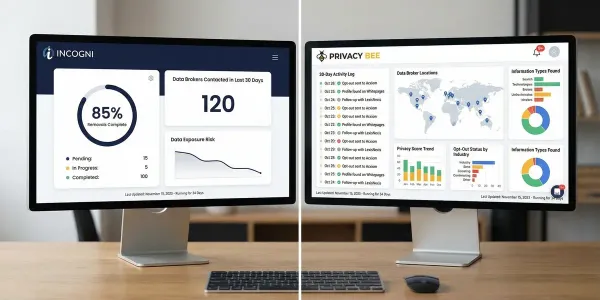
-
#1 IncogniBest overall — 420+ brokers covered by Deloitte limited assurance
-
#2 Privacy BeePremium option — detailed dashboard, dark web monitoring, higher price
Incogni is the better default for most buyers. Its Standard plan costs $15.98 month to month or $7.99 per month billed $95.88 annually, and its removal operations have published Deloitte assurance. Privacy Bee makes more sense only when detailed reporting, broader custom-site work, and human-led support justify a much higher tier.
Privacy Bee currently lists Essentials at about $8 per month, Pro at $18 per month, and Signature at $67 per month when billed annually. That puts the top tier at roughly $804 per year, about $708 more than Incogni Standard.
This comparison is evidence-led. It uses official pricing, coverage definitions, public product documentation, and published assurance material; it does not claim an authenticated removal benchmark or a completed subscription test.
If your shortlist is not Privacy Bee and you are comparing the bigger three-name category instead, read the focused DeleteMe vs Incogni vs Optery comparison. The decision changes when Optery's free exposure scan and DeleteMe's larger public broker list enter the room.
How data brokers work, and the shared blind spot
Before comparing Incogni and Privacy Bee, separate searchable listings from closed broker databases. The proof available to a removal service changes with the type of source.
Data brokers come in two flavors:
Public brokers, sites like Spokeo, WhitePages, BeenVerified, where anyone can search your name and see your address, phone number, and relatives. These are the easy targets. The removal tool finds your listing, sends a deletion request, and can actually verify it worked by checking if your profile disappears from the public search.
Private brokers aggregate data behind closed databases that cannot be checked through a public name search. A service can document the request and a broker's confirmation, but it cannot independently inspect the underlying database.
That creates a shared limit: neither vendor can verify a private database in the same way it can revisit a public people-search profile. Applicable privacy-law requests and broker confirmations still matter, but they are not the same as independently observing the record disappear.
The useful comparison is therefore coverage definition, process evidence, human remediation, reporting visibility, and price, not a promise of perfect deletion.
Incogni vs Privacy Bee: head-to-head
| Feature | Incogni | Privacy Bee |
|---|---|---|
| Best Annual Price | $95.88/yr Standard | $96/yr (Essentials) |
| Premium Tier Price | $179.88/yr (Unlimited) | $67/mo annual billing (~$804/yr) |
| Brokers Covered | 420+ (Deloitte limited assurance) | 516 people-search sites on Essentials; 1,121 sources on Pro/Signature |
| Geographic Reach | 35 countries (US, EU, UK, CA, CH+) | Global Response Team on Pro/Signature |
| Published Operations Assurance | Deloitte ISAE 3000 limited assurance | No comparable public assurance located |
| Dashboard Detail | Minimalist / hands-off | Highly detailed |
| Dark Web Monitoring | ✗ | ✓ |
| Browser Extension | ✗ | Included; verify current browser support |
| Re-scan Frequency | Every 60-90 days | Continuous monitoring |
| Corporate Backing | Surfshark (Nord Security) | Independent startup |
| Action | Try Incogni → | Try Privacy Bee → |
Data Broker Coverage & The "Blind Request" Problem
Incogni's August 2025 ISAE 3000 limited-assurance report covers its 420+ broker scope, more than 245 million processed removal requests, and recurring intervals no longer than 60 days for public brokers or 90 days for private brokers. It is a bounded assurance engagement, not a guarantee of every future deletion.
Privacy Bee's current pricing table separates 516 people-search sites on Essentials from 1,121 broader sources on Pro and Signature. That is not directly comparable to Incogni's 420+ data-broker count because the vendors group people-search affiliates, marketing sources, custom sites, and broader data sources differently.
The practical trust difference is easier to compare than the headline counts. Incogni publishes third-party assurance around its removal operations. Privacy Bee publishes a more detailed product breakdown, but I did not find a comparable public removal-operations assurance report during this check.
Geographic Availability
Incogni works in 35 countries: the U.S., Canada, UK, all 27 EU member states, Switzerland, Norway, Iceland, Liechtenstein, and the Isle of Man. It uses CCPA for U.S. residents and GDPR for Europeans, both of which carry real legal teeth.
Privacy Bee's Pro and Signature pages now describe a Global Response Team and broader custom-site remediation. The public plan page does not make that coverage directly comparable with Incogni's country list, so non-U.S. buyers should confirm the specific jurisdiction and exposure before choosing a tier.
Dashboards & Reporting
Privacy Bee's public product material emphasizes granular removal categories, monitoring, and analyst workflows. That is the stronger fit for someone who wants more service detail than a set-and-forget status summary.
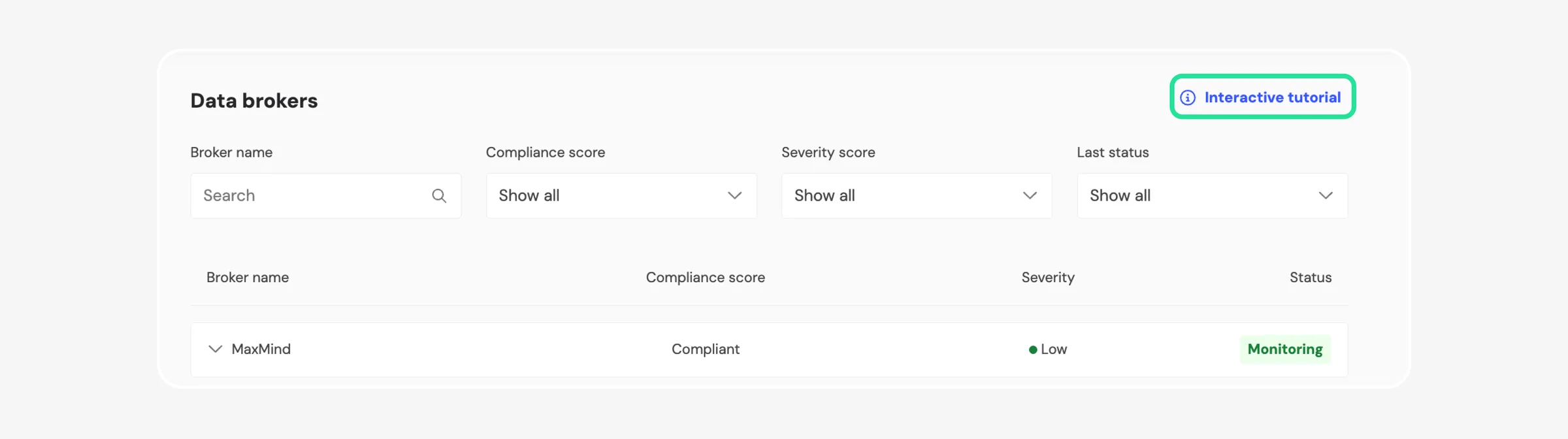
Incogni's public detailed view exposes broker type, compliance score, severity, request count, and status. Its buying proposition is still more automated and lower-touch than Privacy Bee's higher tiers.
More reporting does not prove a better removal outcome on its own. It does make the workflow easier to inspect, which can justify part of Privacy Bee's premium for an active exposure case.
Extra Features & Security
Incogni's edge is the Deloitte assurance report. Full stop. The published ISAE 3000 report doesn't just verify broker counts. It also covers recurring request cadence and data-handling claims. That's a meaningful trust signal in an industry where you're handing over your name, address, and personal info to a company that promises to protect it.
Privacy Bee counters with monitoring and human-led remediation on higher tiers. Those features can matter for a public figure or an active exposure case, but they should be compared with the cheaper standalone tools the buyer already uses before treating the top tier as necessary.
Privacy Bee also lists a privacy browser extension on its plan table. Browser support can change, so verify compatibility with your current browser before upgrading for that feature alone. If you're rethinking the browser itself, our best privacy browsers guide covers which ones block trackers by default.
Pricing Breakdown (The $700 Elephant in the Room)
Let's lay this out clearly because the two companies package their coverage differently.
Incogni:
- Standard: $15.98 month to month, or $7.99/month billed $95.88 annually
- Unlimited: $14.99/month billed $179.88 annually, with custom removals
- Family plans available for both tiers
Privacy Bee:
- Essentials: about $8/month billed annually (about $96/year)
- Pro: about $18/month billed annually (about $216/year)
- Signature: about $67/month billed annually (about $804/year)
The entry-level prices are nearly identical, but the coverage labels are not. Privacy Bee Essentials focuses on people-search sites, while its Pro tier expands into broader data sources and custom-site work. Incogni Standard uses a single 420+ data-broker count and a more automated workflow.
Privacy Bee Signature is roughly 8.4 times the annual cost of Incogni Standard. That premium buys higher-priority human support and a wider remediation scope, not a directly comparable eightfold increase in verified removals.
Which tier actually earns the upgrade?
Start with Incogni Standard when the job is recurring removal from the service's published 420+ broker scope. Unlimited earns its higher $179.88 annual total only when you already know about exposures outside that standard list and want to submit custom removal requests. Paying for Unlimited before identifying a custom target mostly buys optional capacity.
Start with Privacy Bee Essentials when the concern is searchable people-finder profiles. Its current plan table identifies 516 people-search sites and affiliates, with a mostly automated workflow plus deletion guides where automation is unavailable. Pro is the meaningful scope upgrade: it expands to 1,121 listed sources, custom-site coverage, broader monitoring, and work by the Global Response Team. That is a different service boundary, not merely a faster version of Essentials.
Reserve Signature for an active high-risk case. Privacy Bee positions it for executives, high-risk families, and people dealing with complex exposure. The plan adds expedited handling, escalation paths, U.S.-based analysts, and more complex takedown work. Its support documentation also says Signature is non-refundable, unlike the 30-day guarantee described for Essentials and Pro. That makes a pre-purchase conversation about the exact exposure more important than the headline feature count.
The practical ladder is simple: use Incogni Standard for the lower-cost default, Privacy Bee Essentials for a people-search-focused workflow, Privacy Bee Pro for broader custom-site remediation, and Signature only when speed and analyst involvement solve a documented risk. Incogni Unlimited sits between those choices for buyers who need custom requests without Privacy Bee's larger service package.
Incogni: The Full Picture
Publishes a Deloitte ISAE 3000 limited assurance report covering 420+ brokers, recurring requests, and removal confirmations.
Users who want granular per-broker dashboard visibility — Incogni's interface is deliberately minimal.
- Published Deloitte ISAE 3000 limited assurance report on removal operations
- 420+ broker scope covered by limited assurance
- Works in 35 countries (CCPA + GDPR coverage)
- Standard offers monthly billing or a lower $95.88 annual total
- Backed by Surfshark / Nord Security — real legal infrastructure
- Dashboard is too minimal — no per-broker breakdown
- No dark web monitoring (use Have I Been Pwned instead)
- Unlimited tier ($180/yr) needed for lesser-known data aggregators
- Can't verify private broker deletions (industry-wide issue, not Incogni-specific)
Incogni is the lower-friction pick. The Deloitte report gives its published broker scope and request cadence a clearer evidence trail than a marketing count alone. That matters when the service requires personal details to file requests on the buyer's behalf.
The dashboard could use work. I'd genuinely like to see which specific brokers confirmed deletion versus which are still pending. That level of detail exists in Privacy Bee and it would make Incogni's already-strong value proposition even better. But for a set-it-and-forget-it privacy tool, $95.88 per year remains the cleaner value.
Deloitte's report covers recurring requests at intervals no longer than 60 days for public brokers and 90 days for private ones. Recurrence is central to the subscription value because listings can return after an initial opt-out.
Privacy Bee: The Full Picture
The most detailed per-broker dashboard in the data removal space, with dark web monitoring and manual removal on higher tiers.
Anyone who does not need the human-led remediation and priority support behind a plan that reaches about $804/year.
- Most detailed dashboard in the data removal space
- Dark web monitoring with 24/7 alerts
- Manual removal services on higher tiers for stubborn brokers
- Browser extension and privacy-preference controls are included
- No comparable public removal-operations assurance located
- Signature tier reaches about $804/year — roughly 8.4x Incogni Standard
- Essentials is limited to the people-search-site scope shown on the pricing table
- Published coverage categories are not directly comparable with competitor broker counts
- Browser compatibility should be checked before upgrading for the extension
Privacy Bee's case is strongest for an executive, public figure, high-risk family, or active exposure case that needs human-led remediation and expedited support. Its current plan table reserves the deepest analyst involvement and complex takedowns for Signature.
For the average person trying to clean up a normal digital footprint, the value proposition weakens above the Essentials tier. The higher plans are easier to justify for custom removals, active exposure, or a public-facing threat model than for routine automated opt-outs.
The transparency gap is narrower than the old version of this article suggested, because Privacy Bee now publishes a detailed category breakdown. Incogni still has the stronger independent process evidence through its Deloitte assurance report, while Privacy Bee provides more granular product and service scope.
The remaining evidence gap is specific: Privacy Bee publishes detailed scope and service material, but this check did not locate a public removal-operations assurance report comparable with Incogni's. That distinction matters more than a blanket claim that either service is more transparent in every respect.
Final verdict
If you're still deciding between services and want to see how Incogni compares to Optery, DeleteMe, and Kanary, our full data broker removal services roundup covers all four with the same depth.
Use Incogni if: You want a lower-cost recurring workflow with a defined 420+ broker scope and published Deloitte limited assurance. Its $95.88 annual Standard plan is the cleaner default when custom human remediation is not the main requirement.
Use Privacy Bee if: You're a public figure, executive, or someone with an elevated threat model who needs granular visibility and human-led remediation. The Signature tier makes more sense when its roughly $67 monthly annual-billing rate is a defensible security expense, not a casual consumer upgrade.
For most ordinary buyers, Incogni at $95.88 per year is the better investment. Data removal is a marathon, not a sprint. Brokers re-scrape your information constantly. The sustainable strategy is a lower-cost automated tool that repeats removal requests in the background. Paying about $804 per year makes sense only when Privacy Bee's wider human-led scope solves a real exposure problem. If you handle crypto, protecting your exchange accounts matters too. See our CoinLedger vs Koinly comparison for keeping your transaction data organized and private.
Both services still face the same industry limitation with private brokers: a closed database cannot be inspected like a public people-search listing. Paying roughly 8.4 times more buys a wider service scope and more human remediation, not 8.4 times more independently verified deletion.
Keep the roughly $708 annual difference unless Privacy Bee's higher-touch work solves a specific exposure problem. A solid VPN, a password manager, and one of the better authenticator apps solve different parts of the privacy and account-security job; the expensive removal tier should not replace those basics.
Frequently Asked Questions
Ready to check Incogni?
Use the verified route if the trade-offs still fit. If not, jump back to the summary and compare the alternatives.
Security and privacy editor focused on evidence-led buying guides. Reads official documentation, audit notes, privacy policies, recovery limits, and support pages before turning security claims into practical recommendations.
Sarah starts by locating the evidence boundary, then ranks security and privacy tools by audit and policy scope, recovery design, trust boundaries, residual risk, and what a cautious buyer can verify.
Related Articles

Venice AI vs Proton Lumo vs Duck.ai: Which Private AI Chat Fits?
Private AI chat decision guide
Venice AI, Proton Lumo, and Duck.ai compared by privacy architecture, saved-history protection, provider exposure, plan limits, model access, and price.
Malwarebytes vs Bitdefender vs Norton
Paid antivirus decision guide
Malwarebytes, Bitdefender, Norton, and Microsoft Defender compared by paid antivirus value, real-time protection, renewal risk, bundle scope, and lab evidence.