

Identity theft protection is a strange category because the product sounds preventive, but the hardest work usually starts after something has already gone wrong.
A monitoring alert is useful. A bureau score is useful. A dark web scan can be useful. None of those things magically stops a fraudster from using data that has already escaped into the world. The real question is more practical: when a bank account, bureau file, address, phone number, email, or child's Social Security number becomes part of the problem, who helps you see it quickly and clean it up without making the situation worse?
That is why I did not rank identity theft protection services by the biggest insurance number on the public page. Insurance limits matter, but they are not the same as recovery. I looked for a service that makes sense before a crisis, still makes sense during a crisis, and does not hide the fact that you still need basic security hygiene.
My short version: Aura is the best starting point for most families, LifeLock is the safer brand if financial-account monitoring and restoration language matter most, IdentityForce is the bureau-and-recovery specialist, Identity Guard is the budget Aura-owned alternative, and Experian IdentityWorks is the bureau-first pick.
If your bigger problem is that your home address and phone number are already scattered across people-search sites, start with our data broker removal guide, the focused DeleteMe vs Incogni vs Optery comparison, or the California DROP vs paid data removal guide if you are eligible for the free state portal. If the daily symptom is scam calls rather than credit-file alerts, use the spam call blocker app comparison before buying a full monitoring bundle. If the weak spot is account access, read our password manager comparison and authenticator app guide before buying another monitoring subscription. A VPN can help with privacy on hostile networks, but it will not clean up stolen identity data.
-
#1 AuraBest overall for families - broad monitoring, 3-bureau credit, child coverage, and security tools
-
#2 LifeLockBest for financial-account monitoring - mature restoration brand with tiered reimbursement language
-
#3 IdentityForceBest recovery specialist - strong credit and restoration focus with a 30-day trial
If you only want the default starting point, compare Aura first and read the incident caveat before you buy. The right choice is not the service with the loudest promise. It is the service that matches the failure you are actually trying to manage.
How I ranked the services
The ranking starts with recovery, not marketing breadth. If a service mostly tells you that something bad happened but does not give you a clear restoration path, it drops. If the product makes bureau monitoring easy but hides next-cycle terms, child coverage limits, or bureau coverage, it drops. If the subscription looks cheap until you realize the useful features sit one level higher, it drops.
I weighted five things: how useful the service looks during an identity-theft event, how wide the monitoring coverage is, how family coverage actually works, how clearly the public page explains the bill, and how much trust friction the buyer has to accept.
Reddit threads in r/IdentityTheft and r/personalfinance were useful as anxiety signals, not proof that a brand works. People were not asking for prettier dashboards. They were asking what to do after a fraud alert, whether a family member was really covered, whether a file freeze was enough, and whether paying for monitoring changes the recovery process. That is the right buyer lens.
I also checked the FTC's identity theft recovery guidance because it keeps this category honest. A paid service can help organize monitoring and recovery, but an official recovery checklist at IdentityTheft.gov, bureau freezes, fraud alerts, bank calls, password resets, and police reports are still real work.
Identity theft protection comparison
| Feature | Aura | LifeLock | IdentityForce | Identity Guard | Experian IdentityWorks |
|---|---|---|---|---|---|
| Starting price | $12/mo annual individual | $10.42/mo annual Core | $19.90/mo | $7.50/mo annual | Free; Premium $24.99/mo |
| Best for | Families | Financial monitoring | Recovery depth | Budget coverage | Credit-first buyers |
| Credit monitoring | 3 bureaus | Tiered | 3 bureaus on credit plan | 3 bureaus on Ultra | 3 bureaus on Premium |
| Family coverage | 5 adults, unlimited kids | Add or family plans | Family plans | 5 adults, unlimited kids | Family $34.99/mo |
| Recovery angle | Broad all-in-one bundle | Restoration specialists | Dedicated restoration | White glove on Ultra | Credit bureau alerts |
| Main caveat | 2026 incident caveat | Plan complexity | More expensive | Feature tiers | Narrower bundle |
| Action | Check plans | Check plans | Check plans | Check plans | Check plans |
Buyer decision guide: how to choose
The wrong way to shop this category is to start with the biggest reimbursement number. That number can matter after a failure, but it does not tell you whether the service will make day-to-day monitoring clear, whether your household members are included in the way you expect, or whether the recovery path is understandable when you are already stressed.
Start with the failure scenario. If the risk is a parent trying to cover adults and children under one account, Aura deserves the first look because the household story is cleaner than the rest. If the child-safety job is screen time, app rules, or social-risk alerts rather than identity recovery, use our parental control apps comparison before treating identity monitoring as the whole answer. The tradeoff is trust friction: Aura's 2026 incident does not make the service unusable, but it does mean the buyer should pause, read the company's statement, and decide whether that risk changes the purchase.
Financial-account misuse moves LifeLock up. The reason is not elegance. It is that LifeLock talks like a restoration and financial-monitoring service, with account alerts and reimbursement language closer to the center of the product. The wrong buyer for LifeLock is the person who wants a tidy all-in-one household security suite and does not want to parse a busy matrix before choosing.
A real recovery event, not just nervous monitoring, makes IdentityForce more interesting. Its advantage is the seriousness of the restoration story. The tradeoff is narrower everyday convenience. I would avoid it as the first pick for a buyer who mainly wants bundled privacy tools, but I would shortlist it for someone who wants a service that sounds built around the messy part after an alert.
Overbuying is where Identity Guard becomes the pressure release. It is the budget-aware alternative when you want identity monitoring from the Aura family but do not need Aura's broader security bundle. The failure to avoid is buying the cheapest entry point and assuming it represents the strongest version of the product. Read the feature ladder, because the useful version may be higher than the headline.
For a narrow, bureau-file-focused risk, Experian IdentityWorks can be enough. This is the cleanest choice for a buyer who wants monitoring from a bureau brand and does not need a full household privacy stack. The wrong buyer is a family expecting it to replace password discipline, data broker removal, browser privacy, and recovery planning.
My decision rule is simple: choose Aura for a normal household, choose LifeLock for financially exposed buyers, choose IdentityForce for recovery seriousness, choose Identity Guard when budget pressure is real, and choose Experian only when the main job is bureau-file visibility. Skip the whole category if you are unwilling to do the boring work around freezes, strong account access, and FTC recovery steps.
The 5 services I would compare first
1. Aura - best overall for families
Aura is the service I would compare first for a household that wants one subscription instead of separate subscriptions for monitoring, privacy, and basic security tools. The household bundle is the cleanest reason. Aura lists 5 adults, unlimited kids, 3-bureau monitoring, identity theft protection, instant file lock, financial transaction alerts, antivirus, VPN, password manager, and data removal on the public card.
The math is also easy to understand at first glance: Individual is $12/mo when billed yearly or $15/mo billed monthly, Couple is $22/mo yearly or $29/mo monthly, and Family is $32/mo yearly or $50/mo monthly. Aura also states a 14-day trial and a 60-day money-back guarantee on yearly subscriptions.
The catch is trust. Aura published a March 2026 security incident update saying an employee corporate account was accessed for about one hour after a targeted phishing attack. Aura says its product was not hacked, no Social Security numbers, passwords, or financial information were compromised, and fewer than 20,000 active Aura customers were impacted. That is a meaningful distinction, but it still belongs in the buying decision. A company selling identity protection has less room for vague security communication than a normal app.
My take: Aura wins because the family bundle is genuinely broad and the coverage story is strong. It does not win because the category is without risk. If the March 2026 incident changes your comfort level, LifeLock or IdentityForce are the next places I would look.
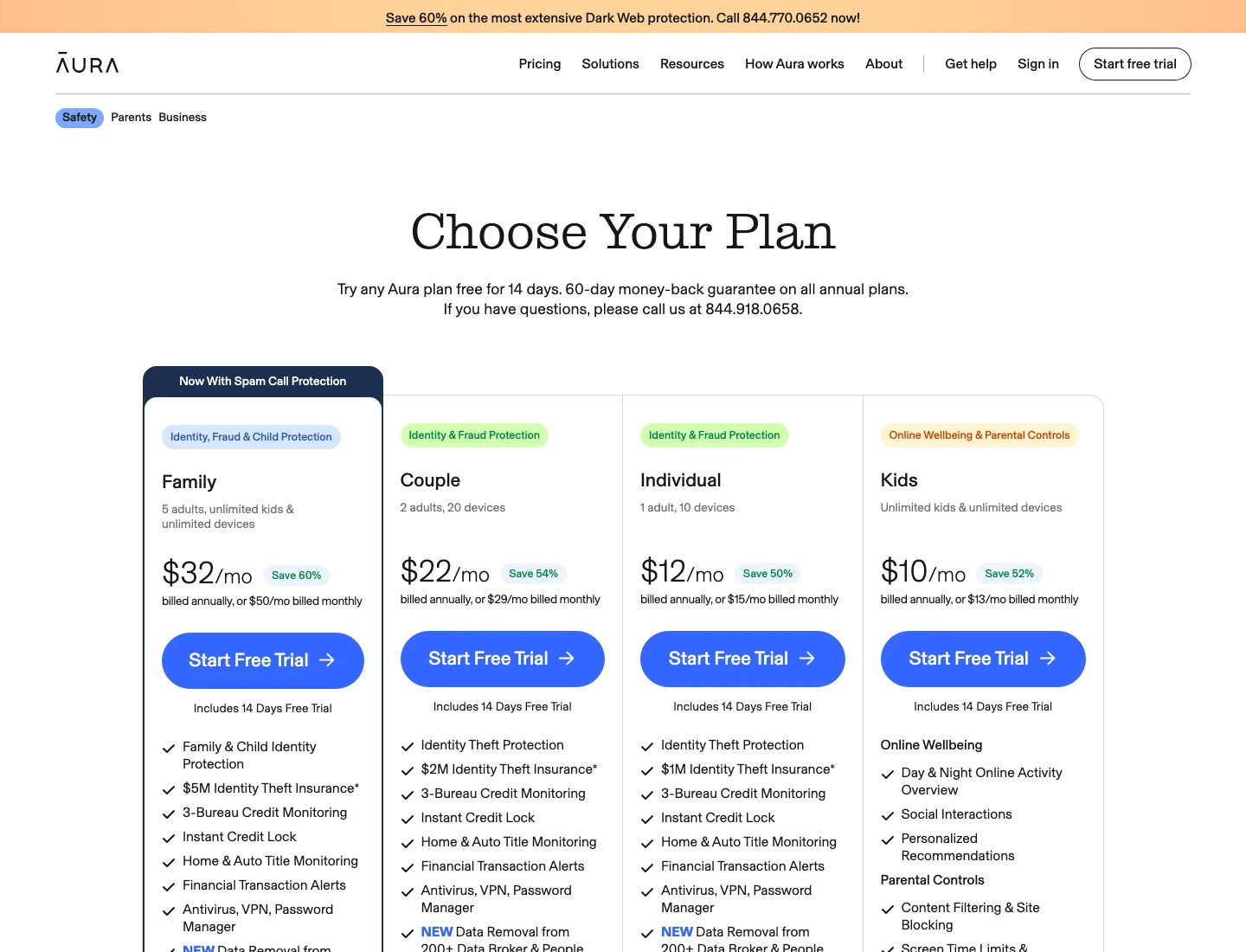
Aura combines family identity monitoring, 3-bureau credit monitoring, child coverage, password manager, VPN, antivirus, and data removal under one household plan.
Privacy-sensitive buyers who cannot get comfortable with Aura's March 2026 security incident should compare LifeLock and IdentityForce first.
Aura scores highest on family fit and monitoring breadth because the public plan cards bundle household coverage with 3-bureau monitoring and security tools; the trust score is lower because the March 2026 incident is a real buyer caveat.
- Family plan lists 5 adults, unlimited kids, 3-bureau credit monitoring, and child identity protection
- Includes useful adjacent tools: VPN, antivirus, password manager, and data removal
- Annual pricing is straightforward: $12/mo Individual, $22/mo Couple, $32/mo Family
- 14-day free trial and 60-day money-back guarantee on annual plans
- Aura's March 2026 incident creates a trust caveat that buyers should read before paying
- Monthly family pricing jumps to $50/mo if you avoid annual billing
- Child members do not receive every adult feature, according to Aura's plan footnotes
- Monitoring still cannot prevent all identity theft or fraud
2. LifeLock - best for financial-account monitoring
LifeLock is the brand most people already know, which is both useful and dangerous. The useful part is that the product language is mature: restoration specialists, reimbursement levels, bureau and financial alerts, loan lock, and household options. The dangerous part is that a famous brand can make buyers stop reading the subscription differences.
The current LifeLock public page shows Core at $10.42/mo paid yearly or $12.49/mo paid monthly, Advanced at $16.67/mo yearly or $19.99/mo monthly, and Total at $29.17/mo yearly or $34.99/mo monthly. The page also shows bigger reimbursement language as you move up: Core lists up to $1.05M total reimbursement with up to $25K for stolen funds, Advanced lists up to $1.2M with up to $100K stolen funds, and Total lists up to $3M with up to $1M stolen funds.
That is where LifeLock makes sense. If the buyer is more worried about bank accounts, new-account applications, property, investments, and restoration language than a bundled VPN or password manager, LifeLock deserves a serious look. It feels less like a digital safety suite and more like a fraud response product.
The tradeoff is matrix complexity. Household terms, bureau coverage, report cadence, scam reimbursement, and restoration benefits can change meaningfully by level. If you are buying LifeLock, do not buy from the headline alone. Choose by the account types you need watched.
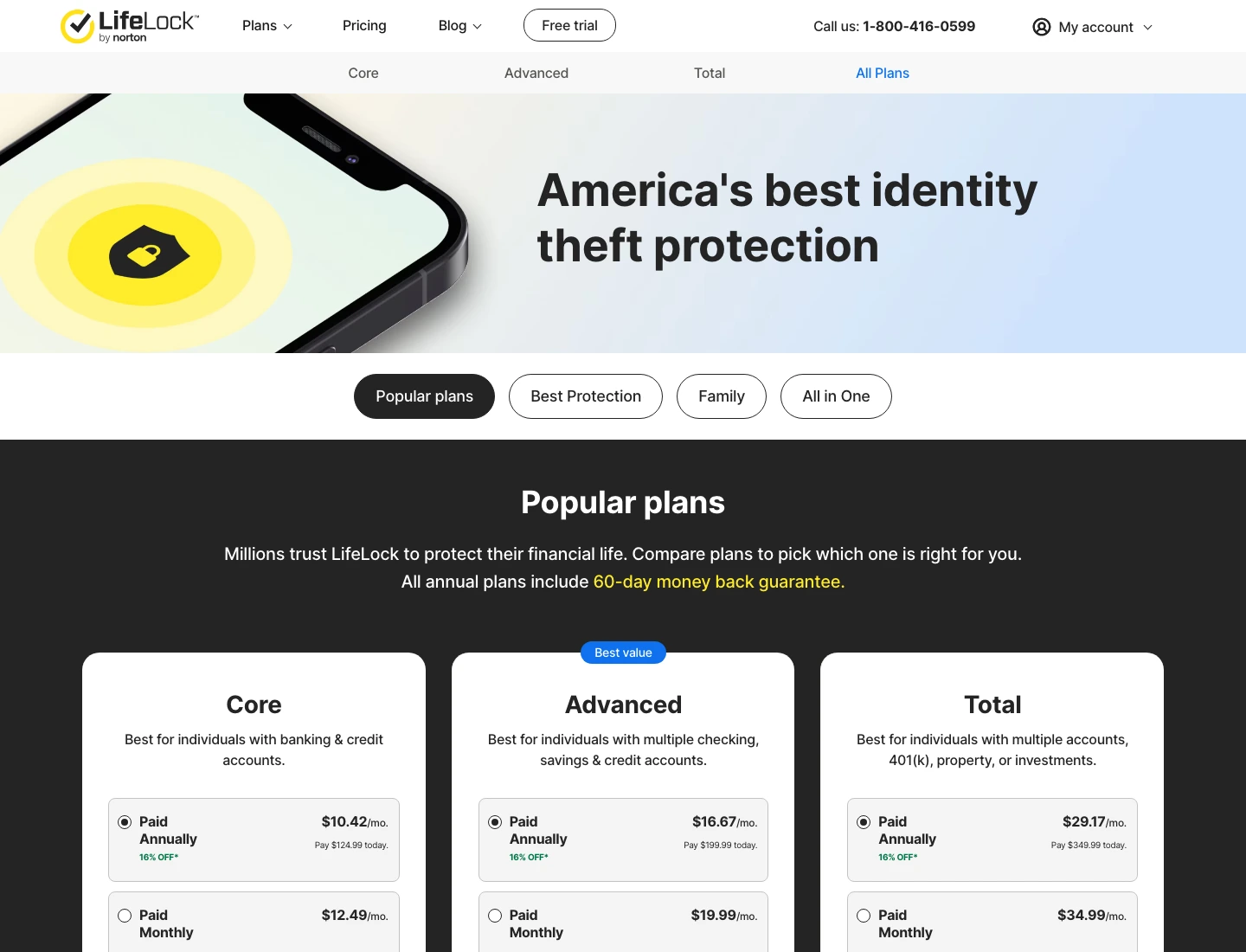
LifeLock's plan structure is strongest when the buyer cares about financial-account alerts, restoration specialists, and reimbursement tiers.
Families that want one broad digital safety bundle with VPN, password manager, and data removal included should compare Aura first.
LifeLock earns strong recovery and financial-alert scores because its tiers are built around account monitoring and restoration; pricing clarity and family cost drop because the plan matrix needs careful reading.
- Core, Advanced, and Total tiers make the escalation path clear
- Strong restoration and reimbursement positioning for buyers worried about financial fraud
- Advanced and Total are better fits for buyers with multiple checking, savings, credit, property, or investment accounts
- Family plans exist for households that want LifeLock's restoration model
- The plan matrix is easy to misunderstand if you only read the headline price
- Not as clean as Aura for an all-in-one family digital safety bundle
- Best protection requires higher tiers
- Annual and monthly prices differ enough that billing choice matters
3. IdentityForce - best recovery specialist
IdentityForce is the one I would look at if the buyer's first priority is recovery seriousness rather than bundle breadth.
The official page lists UltraSecure Individual at $19.90/mo or $199.90/year, and UltraSecure+Credit Individual at $34.90/mo or $349.90/year. The bureau-focused option adds daily TransUnion reports and scores, 3-bureau monitoring and alerts, and quarterly 3-bureau reports. The page also states a 30-day trial and describes dedicated restoration specialists.
This is not the cheapest path. It is also not the broadest lifestyle-security bundle. But it is cleaner than many competitors when the purchase is really about restoration support, bureau depth, and a serious recovery posture.
The buyer who should compare IdentityForce is someone who already knows the basics: freeze bureau files when appropriate, use a good password manager, turn on app-based two-factor authentication, and avoid treating a monitoring dashboard as a magic shield. If that describes you, IdentityForce's recovery-forward positioning is easier to respect.
The reason IdentityForce ranks third is that it solves a narrower, more serious job than the broad bundles. It feels built for the buyer who is afraid the cleanup will become confusing, slow, and document-heavy. That is a valid fear. Recovery is where weak services become frustrating because alerts are only useful if the next step is obvious.
The tradeoff is that IdentityForce is not the service I would pick for a household that wants one simple digital safety hub. It loses to Aura on bundle breadth and to LifeLock on mainstream recognition. It wins when the wrong purchase would be a pretty dashboard that leaves the buyer improvising during a messy identity-theft event.
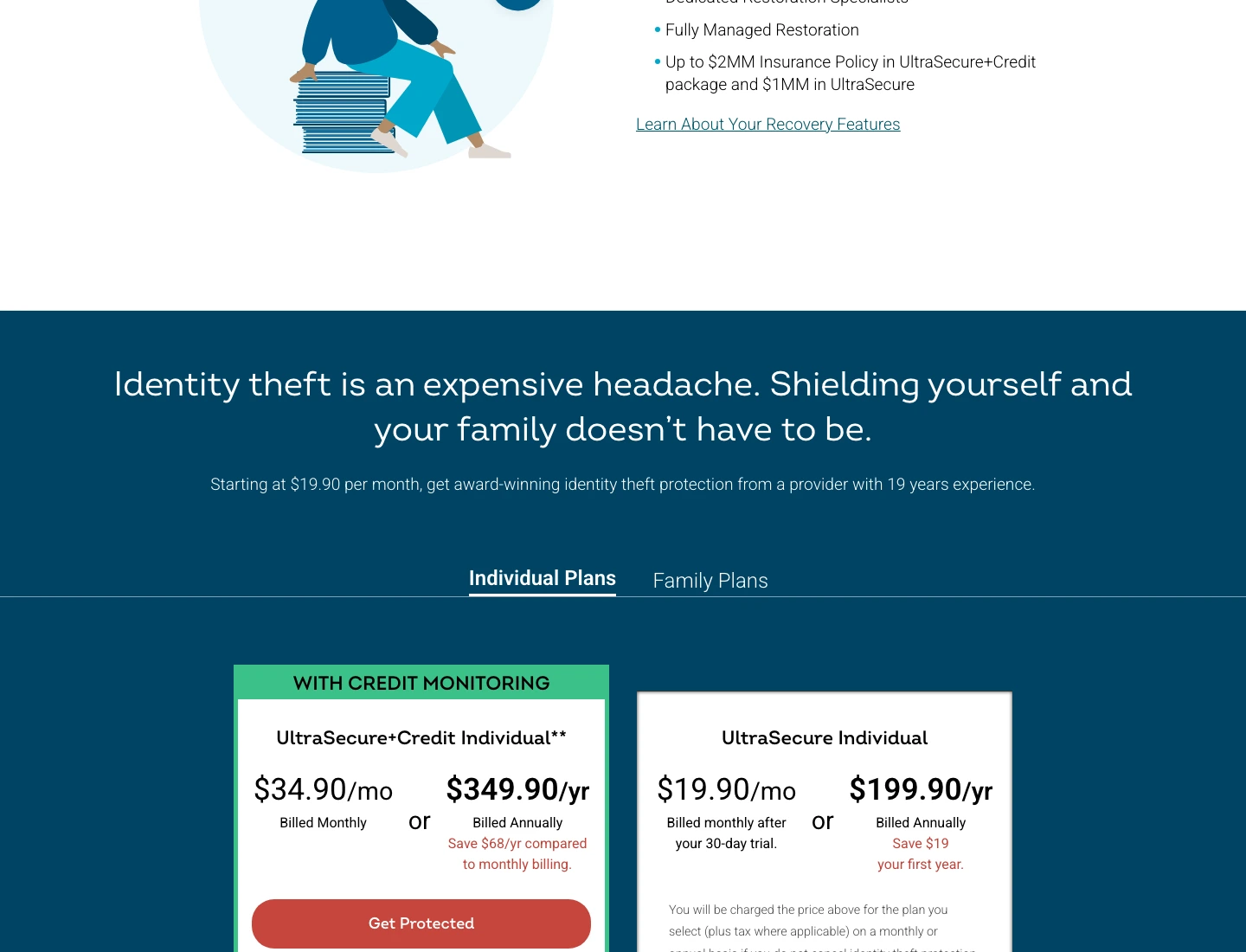
IdentityForce puts dedicated restoration and credit-monitoring depth closer to the center of the product than the broader bundle competitors.
Buyers who mainly want the cheapest family plan or bundled VPN/password/data-removal tools should not start here.
IdentityForce scores highest on recovery and credit depth because the public plan page emphasizes dedicated restoration, daily TransUnion reports, and 3-bureau monitoring on the credit tier; value is lower because the useful credit plan is $34.90/mo.
- UltraSecure starts at $19.90/mo with a 30-day trial
- UltraSecure+Credit adds daily TransUnion reports and 3-bureau monitoring
- Dedicated restoration specialist language is prominent
- Annual billing discounts are clearly shown on the official page
- The credit-heavy plan is $34.90/mo or $349.90/yr
- Less attractive if you want one bundled family security suite
- Family pricing requires additional comparison beyond the individual cards
- The dedicated pricing URL was less accessible than the public plan detail page during verification
4. Identity Guard - best budget alternative
Identity Guard is the less flashy Aura-owned option, and that is why it belongs here. It is easier to recommend when the buyer wants identity and bureau-file protection without paying for Aura's full digital safety bundle.
The official page shows three individual yearly options: Value at $7.50/mo, Total at $16.67/mo, and Ultra at $25/mo. The monthly figures shown beside them are $8.99, $19.99, and $29.99. Ultra is the option where the product starts to feel more complete because it adds stronger bureau protection, 3-bureau monitoring, monthly score, Experian file lock, and 3-bureau yearly report.
The reason Identity Guard does not rank higher is simple: it is cheaper because it is a narrower decision. Value can be enough if you want basic identity monitoring, but many buyers comparing this category are worried about bureau files, financial fraud, and restoration. For that, the cheaper headline level is not the real comparison.
My take: Identity Guard is a good budget stop before Aura or LifeLock. It is not the service I would use to pretend the whole household is fully covered on the cheapest level.
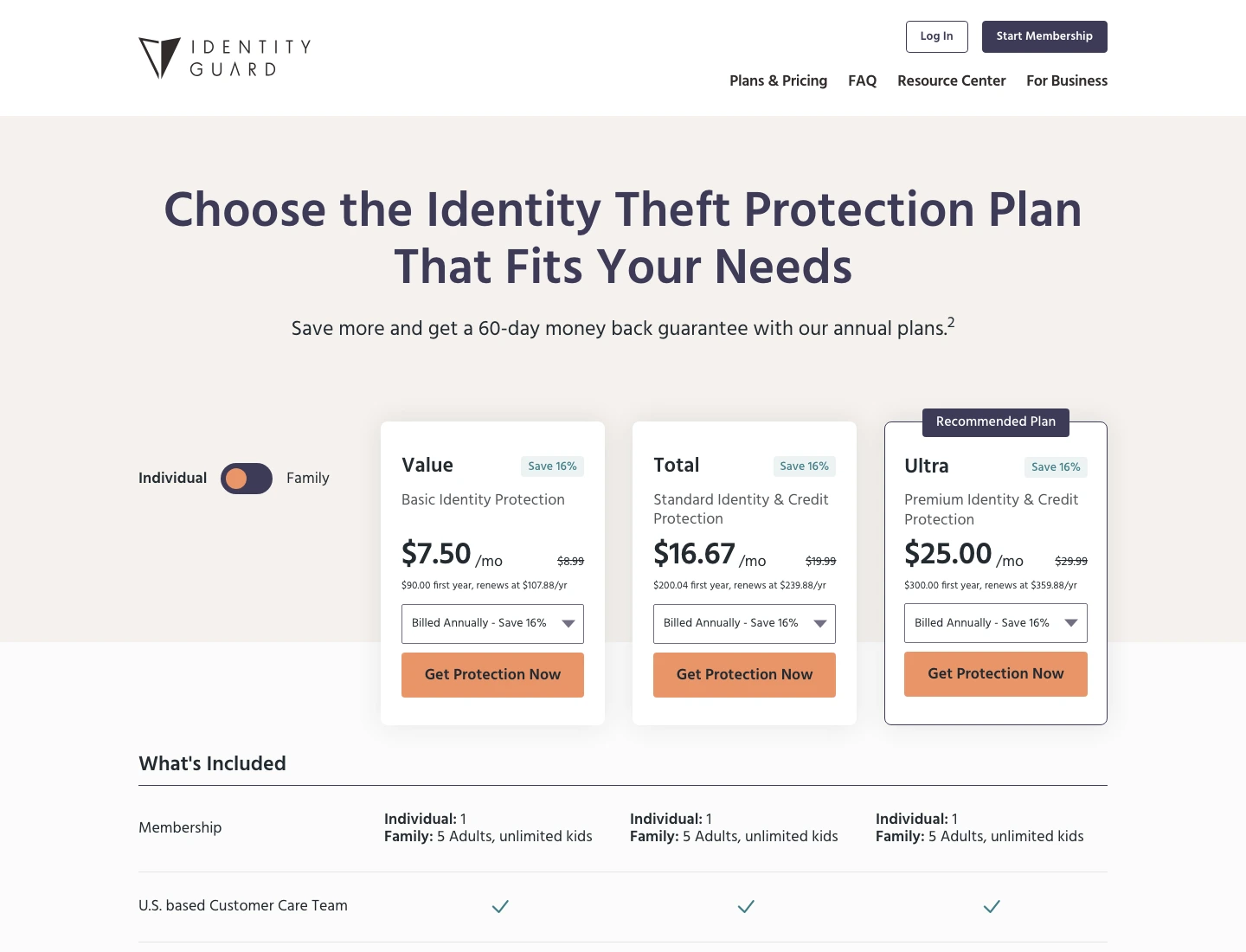
Identity Guard gives price-sensitive buyers a cheaper entry point into identity monitoring, with stronger credit features higher up the stack.
Buyers who want the most complete household bundle or the strongest recovery positioning should compare Aura, LifeLock, and IdentityForce first.
Identity Guard scores well on budget value because the Value plan starts at $7.50/mo annually; credit depth and feature depth stay lower because the stronger credit features sit on higher tiers.
- Lowest paid starting price in this comparison
- Clear Value, Total, and Ultra plan structure
- Family coverage lists 5 adults and unlimited kids
- Ultra adds 3-bureau credit monitoring and stronger credit tools
- The cheapest plan is not the best representation of the category
- Aura is broader for families that also want security and privacy tools
- White glove fraud remediation is limited to Ultra according to the plan footnote
- Buyers need to read plan tiers carefully before choosing Value
5. Experian IdentityWorks - best credit-first choice
Experian IdentityWorks is the cleanest choice when the buyer's mental model is bureau monitoring first, identity protection second.
The public page shows a no-cost Basic option with Experian report access, FICO Score, Experian monitoring and alerts, and a FICO Score tracker. Premium starts with a 7-day trial and then $24.99/mo. Family also starts with a 7-day trial and then $34.99/mo, with Premium for one additional adult and identity monitoring for up to 10 children.
This is a sensible product for a bureau-focused buyer. It is not as broad as Aura, not as restoration-branded as LifeLock, and not as recovery-specialized as IdentityForce. But if you trust Experian, want a simple monthly subscription, and care more about 3-bureau monitoring than bundled privacy tools, it is a legitimate comparison point.
The main weakness is also obvious: Experian is a reporting bureau. That makes the bureau side feel native, but it does not turn the product into a full household security suite. If your threat model includes breached passwords, exposed home addresses, weak browser privacy, malware prevention, and family account security, pair this comparison with our privacy browser guide, paid antivirus comparison, and data broker removal coverage before deciding.
The reason to include Experian is not that it beats the broader identity-protection services. It does not. The reason is buyer fit. Some readers do not want a bundled security suite; they want direct bureau-file visibility from a company already sitting inside the reporting ecosystem. For that reader, Experian is easier to understand than a bigger bundle.
The tradeoff is scope. Experian is the wrong buyer match if the failure scenario includes a child's information, reused passwords, exposed addresses, account takeover, or a family member who needs guided recovery after a fraud scare. It can be a useful layer, but it should not be mistaken for a full household response system.
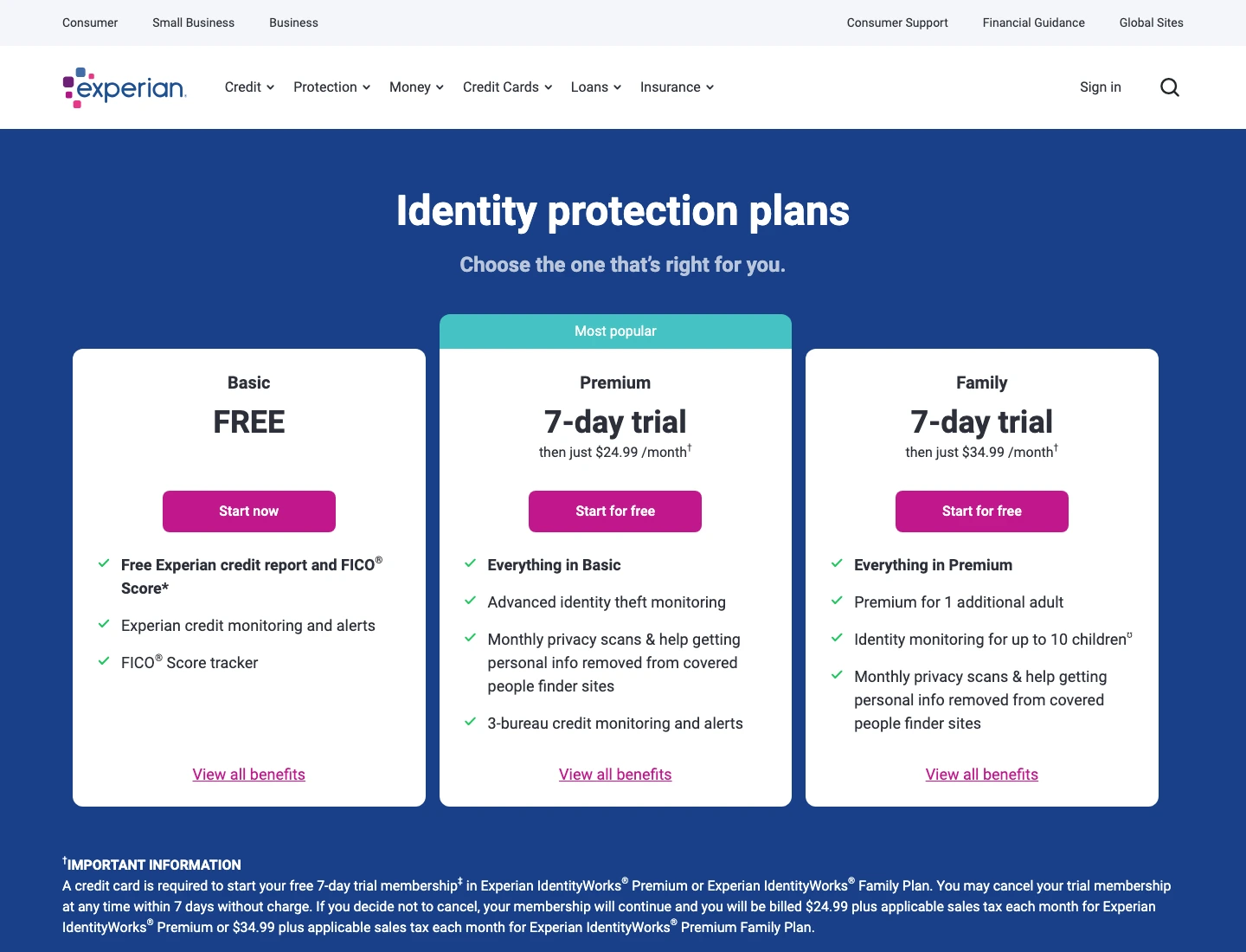
Experian is strongest when the buyer wants credit bureau monitoring and a simple monthly price before broader identity security features.
Families that want all-in-one security, privacy, password, and recovery coverage should not treat Experian as a full Aura replacement.
Experian scores well on credit depth and simplicity because its free, Premium, and Family tiers are easy to understand; family fit and recovery breadth are lower because the product is narrower than the all-in-one services above.
- Free Basic tier includes Experian credit report and FICO Score
- Premium lists 3-bureau credit monitoring and alerts
- Family plan is a simple $34.99/mo after a 7-day trial
- Good fit for buyers who already think in credit-bureau terms
- Narrower than Aura for household digital safety
- Not as recovery-forward as LifeLock or IdentityForce
- Family plan covers one additional adult plus up to 10 children, not a five-adult household
- Credit bureau monitoring is useful, but it does not replace security hygiene
What I would do before paying
Before buying any identity theft protection service, freeze your bureau files if your main fear is fraudulent new accounts. It is one of the highest-value steps, and it addresses a different problem than monitoring. Monitoring tells you about activity. A freeze makes many new-account openings harder.
Then fix the boring account-security layer. Use a password manager, turn on app-based two-factor authentication, compare hardware security keys for your email and password manager accounts, and stop reusing passwords across email, banking, and shopping accounts. If your email account is weak, every identity protection alert arrives at the wrong foundation.
I would also write down the recovery fallback before buying anything: where you will file an FTC report, which banks you will call first, where your password manager recovery key lives, and which adult in the household owns the cleanup work. That sounds mundane, but it removes panic from the first hour after an alert. The worst failure in this category is not a missing feature. It is a buyer who receives a scary warning and has no sequence for what happens next.
Then check family coverage like a skeptical operator, not a nervous shopper. Does the service cover the adults you actually need covered? Are children included in the same way or only partially? Does recovery help apply to each person? Are alerts understandable enough that a non-technical family member will act on them? Those questions reveal more than the marketing page because they expose the tradeoff between a reassuring subscription and a useful response system.
Finally, decide what you are actually paying for. Aura is the household bundle. LifeLock is the familiar financial-monitoring and restoration brand. IdentityForce is the recovery and bureau specialist. Identity Guard is the budget alternative. Experian IdentityWorks is the bureau-first choice. Those are different jobs.
Aura is the strongest default for families because the public plan combines identity monitoring, 3-bureau credit monitoring, child coverage, and adjacent security tools at a reasonable annual price. The March 2026 security incident keeps it from being a no-caveat pick.
See pricingFinal verdict
Risk warning: if I were choosing for a normal household, I would start with Aura and then read the March 2026 incident statement before paying. If that trust tradeoff feels acceptable, Aura's family subscription is the strongest combination of coverage, value, and everyday security tools.
If the buyer is more financially exposed than household-focused, I would compare LifeLock and IdentityForce next. LifeLock has the stronger mainstream restoration brand and financial-account framing. IdentityForce has the cleaner recovery-specialist feel. If budget is the blocker, Identity Guard is the sensible downgrade. If bureau monitoring is the only real goal, Experian IdentityWorks is enough for some buyers.
Wrong-buyer warning: do not buy Aura if the 2026 incident is a dealbreaker, do not buy LifeLock if you hate plan complexity, do not buy IdentityForce if you mainly want a simple family bundle, and do not buy Experian if you need broad household protection. The right service should reduce confusion during a bad event. If it adds a new layer of confusion, skip it.
The bad purchase is not picking the fifth-best service. The bad purchase is paying for monitoring while leaving your bureau files open, your email account weak, your passwords reused, and your recovery sequence improvised.
Frequently Asked Questions
Ready to check Aura?
Use the verified route if the trade-offs still fit. If not, jump back to the summary and compare the alternatives.
Security and privacy editor focused on evidence-led buying guides. Reads official documentation, audit notes, privacy policies, recovery limits, and support pages before turning security claims into practical recommendations.
Sarah starts by locating the evidence boundary, then ranks security and privacy tools by audit and policy scope, recovery design, trust boundaries, residual risk, and what a cautious buyer can verify.
Related Articles

Venice AI vs Proton Lumo vs Duck.ai: Which Private AI Chat Fits?
Private AI chat decision guide
Venice AI, Proton Lumo, and Duck.ai compared by privacy architecture, saved-history protection, provider exposure, plan limits, model access, and price.
Malwarebytes vs Bitdefender vs Norton
Paid antivirus decision guide
Malwarebytes, Bitdefender, Norton, and Microsoft Defender compared by paid antivirus value, real-time protection, renewal risk, bundle scope, and lab evidence.