

A crypto trading bot can automate an instruction. It cannot make the instruction sensible.
That distinction matters because the bill is certain while the trading result is not. A $50 monthly plan costs $600 a year before exchange fees, slippage, tax-record work, or one bad parameter enters the picture. The smallest account often has the hardest hurdle to clear.
Pionex is my default pick for learning exchange-native automation without a separate bot subscription. 3Commas is the stronger choice when multi-exchange control is already a defined requirement. Bitsgap is the narrower grid-focused alternative. If you cannot explain the strategy, maximum loss, monitoring routine, and shutdown path before connecting an account, skip all five for now.
This is an evidence-led buyer guide. I checked five official pricing pages, the public 3Commas and Bitsgap security pages, Pionex's U.S. Webot migration material, five current rendered evidence captures, and the live Get Daily Toolbox affiliate routes on August 24, 2026. I did not create accounts, connect API keys, fund an exchange, run bots, backtest strategies, contact support, request refunds, or measure profits.
Still choosing the exchange underneath the automation? Start with our crypto exchange comparison. For the category's sharpest operating-model decision, use the focused Pionex versus Bitsgap guide. Anyone expecting a high trade count should also plan the recordkeeping with our CoinLedger versus Koinly comparison.
-
#1 PionexBest low-drag default: exchange-native bots without a separate bot subscription
-
#2 3CommasBest advanced control layer: multi-exchange automation and deeper order tooling
-
#3 BitsgapBest grid-focused alternative: public trial plus clearly capped paid plans
How I ranked these crypto trading bots
The ranking uses one shared rubric: Fixed-Cost Drag (30%), Operating Control (25%), API/Custody Fit (20%), Price & Limit Clarity (15%), and Beginner Legibility (10%). Fixed-Cost Drag asks how much the software must earn back before the strategy contributes anything. Operating Control covers the visible depth of automation and account management. API/Custody Fit examines whether the product adds an outside credential layer or asks the buyer to keep funds in its exchange context.
Price & Limit Clarity rewards a purchase page that shows the charge, cadence, and meaningful caps together. Beginner Legibility is not a claim that setup is easy; it measures whether a new buyer can understand the public operating model before funding or connecting an account.
The scores are purchase-fit judgments built from public evidence. They do not measure execution quality, profitability, uptime, support, withdrawal speed, market safety, or strategy performance. Those questions require controlled account-level testing, and this guide does not pretend otherwise.
The guaranteed hurdle: fixed cost before strategy
Subscription drag gets smaller as an account grows, but that does not make a larger account safer. It only changes the arithmetic. A $29 monthly bot plan is $348 a year. Against a $2,000 allocation, the software alone equals 17.4% of the starting capital. Against $20,000, it is 1.74%. Neither number includes trading fees or losses.
Annual billing can reduce the displayed monthly equivalent while increasing today's commitment. 3Commas Starter shows $15 per month on annual billing and $20 month to month. Bitsgap Basic shows $23 versus $29. Those discounts matter only after the buyer has established that the product solves a real operating problem. Prepaying does not improve a strategy.
A no-subscription option has a different cost shape rather than no cost. Exchange fees scale with activity, and exchange-native automation means assets sit in that exchange's custody context. An API-connected service adds a recurring plan and credential operations but may let the trader control accounts on supported outside exchanges. That is the real first fork in this category.
| Feature | Pionex | 3Commas | Bitsgap | Coinrule | Cryptohopper |
|---|---|---|---|---|---|
| Best job | Low-drag exchange-native automation | Advanced multi-exchange control | Grid-focused multi-exchange work | Readable conditional automation | Visual strategy-building workflow |
| Current entry reference | Old official global page: free bot use; 0.05% spot fee | Starter $15 annual equivalent; $20 month to month | Basic $23 annual equivalent; $29 month to month | Starter Free; Investor $359 billed yearly | Three-day Explorer trial; then paid |
| Operating model | Bots inside the exchange context | API-connected control layer | API-connected cloud service | Connected-exchange rule layer | Connected-exchange cloud platform |
| Main limit or risk | Custody plus regional fee and product differences | Subscription plus API-key lifecycle | Free path is mainly evaluation, demo, and manual scope | Strategy, exchange, and volume caps | Short trial and VAT where applicable |
| Skip if | You want to keep trading on another exchange | You cannot name the advanced control you need | One exchange-native bot is enough | You need broad capacity at a modest price | You expected the old free Pioneer plan |
| Action | Check Pionex | Check 3Commas | Check Bitsgap | Check Coinrule | Check Cryptohopper |
1. Pionex: best low-drag default
Pionex takes the separate bot invoice out of the basic purchase. The bots run inside its exchange environment, so the user is not paying a third-party control service and is not handing that service an outside exchange API key. The tradeoff is equally important: using the bots means accepting the Pionex or Webot product and custody context.
The still-public global fee article says 12 trading bots are free to use and gives a 0.05% spot-trading fee reference. The source is dated March 8, 2021. It is useful evidence of the published model, not a current universal promise. Separate Pionex.US material dated December 2025 describes Webot as the Pionex.US upgrade, so U.S. readers should check the live Webot product, availability, and fee schedule before moving funds.
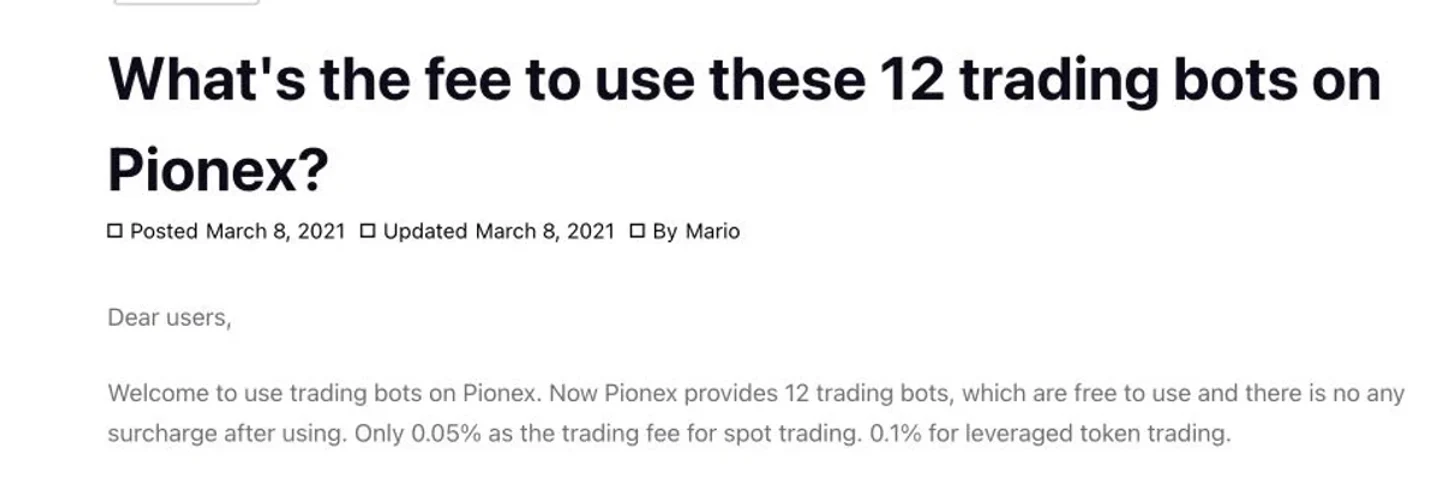
Pionex ranks first for the default small-account buyer because a recurring bot bill creates a difficult hurdle before the buyer knows whether the strategy fits. It is not automatically the safest option. Exchange custody, regional availability, trading fees, the chosen asset, and the bot's parameters remain real risks.
The basic bot job stays inside the exchange context, removing a separate SaaS plan and third-party API connection.
Skip it if you want to keep funds and trading on another exchange or need one multi-exchange control surface.
Pionex wins the default recommendation by removing separate subscription drag. Its dated global fee source and exchange-custody tradeoff keep it from scoring higher.
- No separate bot subscription in the public exchange-native model
- No third-party service needs an outside exchange API key for the basic job
- The public fee reference makes the variable-cost model easy to understand
- Good starting point for comparing native automation with paid control layers
- Funds must sit in the Pionex or Webot exchange context to use the bots
- The public global fee evidence is old and cannot be treated as universal
- U.S. readers face a separate Webot product and availability context
- No public price page can prove bot performance, support, or withdrawal experience
2. 3Commas: best for defined advanced-control needs
3Commas is the strongest counterargument to the Pionex default. It sells an outside control layer rather than an exchange destination. The official pricing cards show demo access, webhooks, and exchange connections across the plans, with bot and account capacity increasing as the price rises.
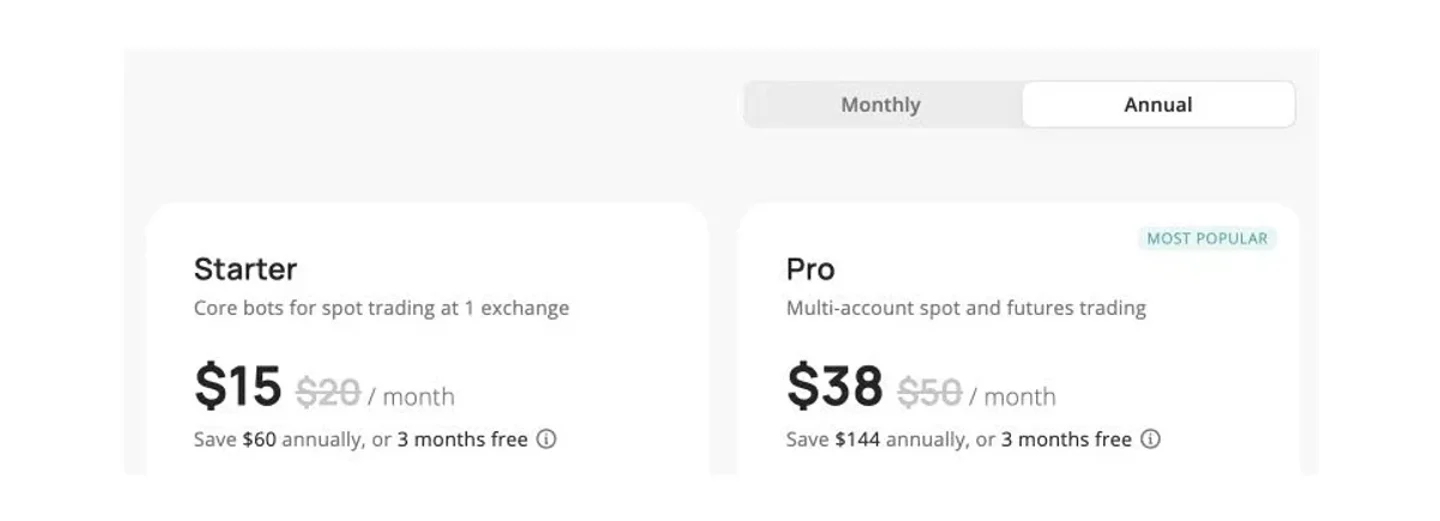
The annual view currently shows Starter at $15 per month, Pro at $38, and Expert at $105. The same cards show month-to-month references of $20, $50, and $140. Starter lists one exchange connection, five DCA bots, two signal bots, and two grid bots. Pro increases that capacity and is the more plausible comparison point for someone buying a genuine multi-exchange control layer.
Its official security page describes 3Commas as non-custodial software using transactional API access rather than withdrawal access, with IP allowlisting, Sign Center, and Fast Connect among the controls. Those are vendor claims, not an independent security audit. They also do not remove the user's operational responsibility. On exit, the documented routine includes stopping bots and orders and revoking the exchange API key.
The wrong buyer starts with Starter because it looks inexpensive, then discovers that one exchange and small bot caps do not match the intended setup. The right buyer can identify the exact order controls, bot capacity, and exchange connections that justify Pro or Expert before paying.
Its public plan matrix ties price to exchange connections and distinct DCA, signal, and grid bot caps.
Skip it if one native exchange bot covers the job or if API-key monitoring and offboarding will be neglected.
3Commas earns second place through visible control depth and a clear plan matrix. The subscription and API-key lifecycle make it a specialist, not the default.
- Plan cards expose exchange and bot-capacity differences
- Strong public case for multi-exchange and advanced order control
- Official security material describes IP allowlisting and key controls
- Monthly billing remains available before an annual commitment
- The subscription must be earned back before strategy profit matters
- Annual prices require prepayment and Starter has tight capacity
- API keys create an ongoing setup, monitoring, and revocation routine
- Vendor documentation does not prove real-world safety or execution quality
3. Bitsgap: best grid-focused multi-exchange alternative
Bitsgap makes the most sense when grid-oriented automation across outside exchanges is already the job. The official security page says funds remain on the connected exchange and that Bitsgap connects through API keys. That avoids moving assets into a new bot exchange, but it adds the same credential and shutdown discipline any API-connected service requires.
The annual view shows Basic at $23 per month, Advanced at $55, and Pro at $119. The month-to-month references are $29, $69, and $149. The page also advertises a seven-day Pro trial without a credit card and lists 17 supported exchanges. Its $0 tier is not a general free replacement for the paid live-bot plans: the visible scope centers on Evedex COMBO bots, demo bots, and manual trading.
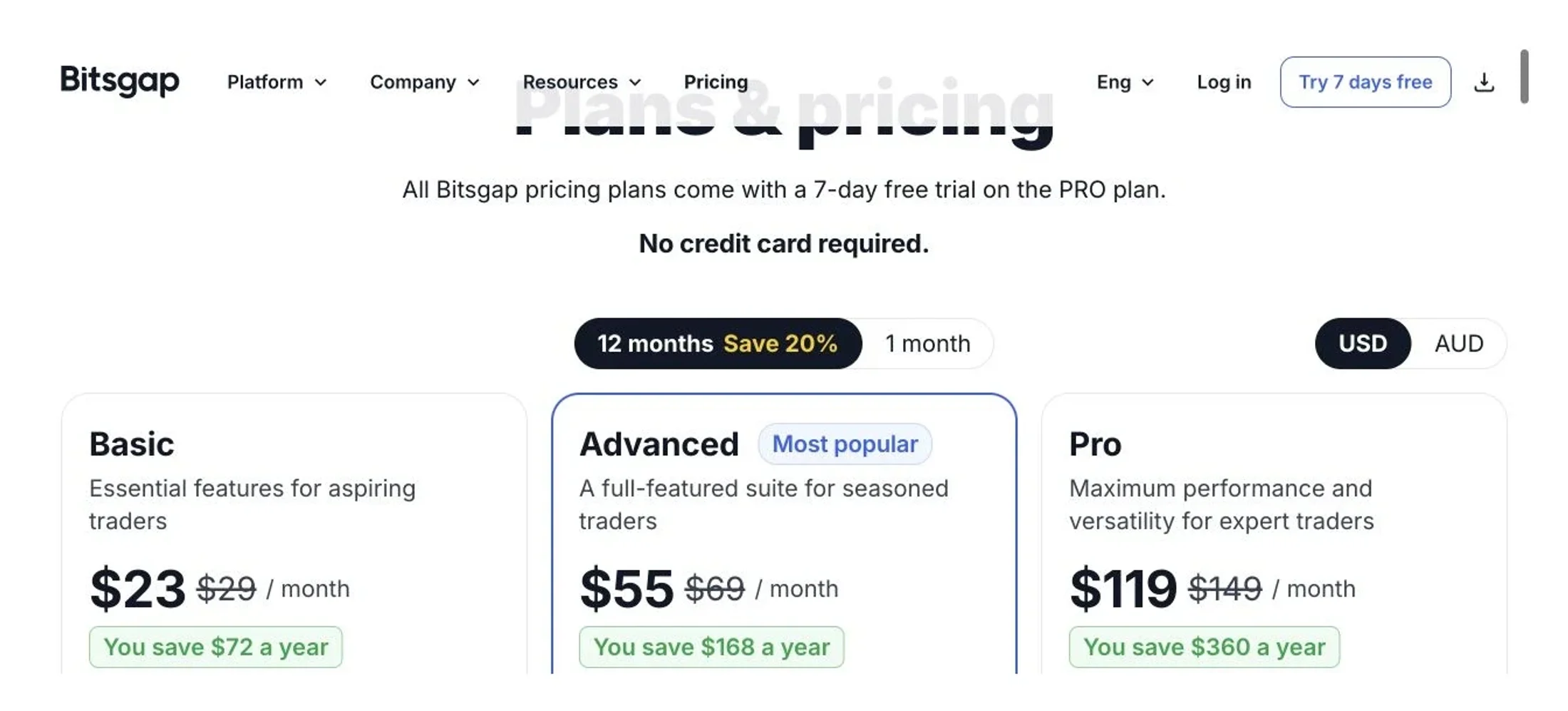
The seven-day trial is valuable for checking navigation, exchange support, and whether the grid workflow is intelligible. It is not enough to establish durable strategy performance across market conditions. Treat it as product evaluation, not a compressed profit test. Bitsgap stays third because that evaluation path and grid focus are useful, but the tradeoff is another recurring commitment and API-key routine.
A visible seven-day Pro trial and clear plan ladder make the operating surface easier to evaluate before payment.
Skip it if a single exchange-native grid bot is enough or if the subscription is large relative to the trading allocation.
Bitsgap offers a clearer evaluation path than most paid specialists and a strong grid-focused case, but live value still carries subscription and API operations.
- Seven-day Pro trial is listed without a credit card
- Annual and month-to-month references appear together
- Official page lists 17 supported exchanges
- Useful specialist when grid control across exchanges is the actual requirement
- The free tier does not replace the main paid live-bot plans
- Annual savings require a larger upfront commitment
- API connections require permission review and eventual revocation
- A seven-day trial cannot prove long-term strategy performance
4. Coinrule: best for readable conditional rules
Coinrule's appeal is conceptual clarity. Buyers who naturally think in “if this happens, do that” conditions may find a rule layer easier to reason about than grid ranges or a dense professional terminal. The purchase decision still depends on the caps attached to that clarity.
Starter is currently free and lists two running strategies, one connected exchange, and $3,000 in monthly trading volume. The annual view shows Investor at $29.99 per month with $359 billed yearly, Trader at $59.99 with $719 billed yearly, and Pro at $749 with $8,988 billed yearly. The former Fund label from our stale record is no longer the current top-plan name.
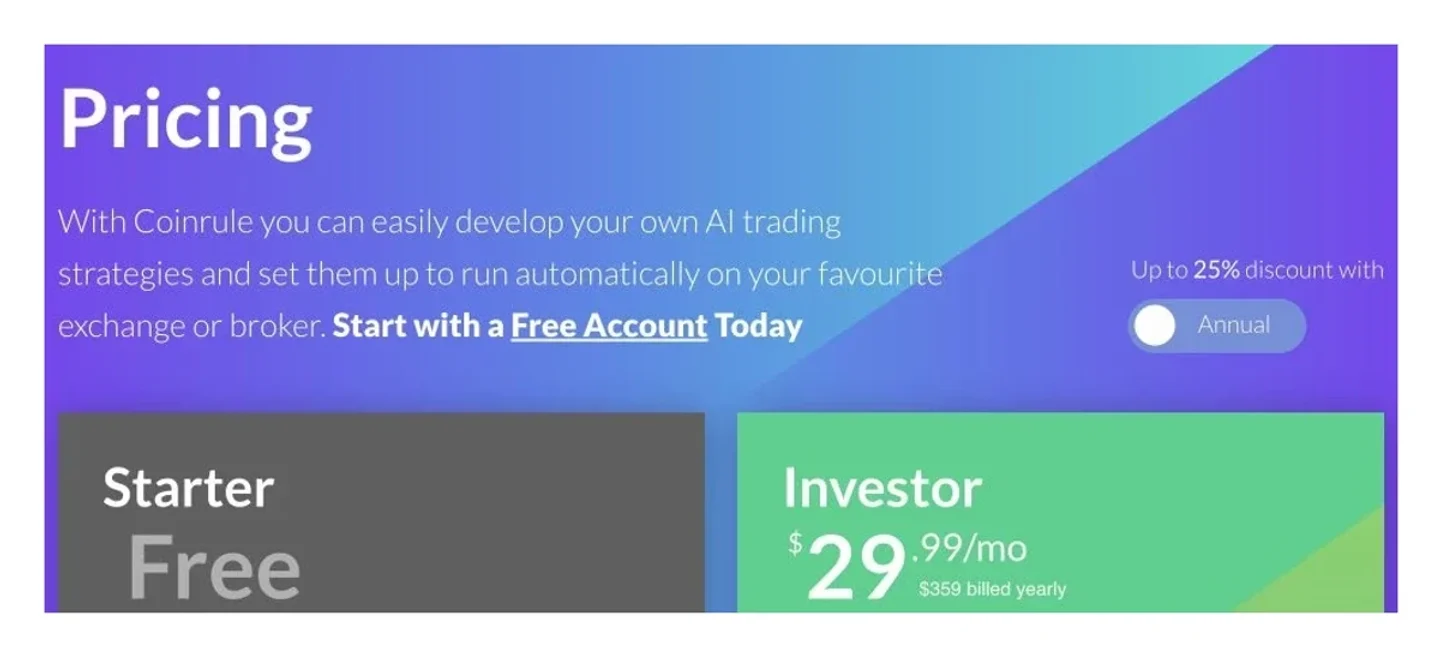
Starter can answer a useful question: does this rule model match the way you plan automation? It cannot answer whether a larger plan will be profitable. Before upgrading, map the required exchange count, concurrent strategies, and monthly volume to the live card. A readable interface is not a reason to ignore a capacity mismatch.
The free plan exposes the core conditional-rule model before the buyer commits to the annual paid ladder.
Skip it if strategy, exchange, or trading-volume limits will force an immediate jump to a much higher plan.
Coinrule's free entry and readable rule concept are attractive, but the sharp capacity and price jumps make it a narrower fit than the top three.
- Free tier exposes the core rule model
- Official pricing lists strategy, exchange, and volume caps
- Investor and Trader annual totals are visible
- Good conceptual fit for simple conditional automation
- Starter is limited to two running strategies and one exchange
- Paid annual plans require $359 or $719 upfront
- Pro jumps to a specialist-level $8,988 yearly charge
- Public plan details do not prove execution or strategy quality
5. Cryptohopper: best for visual strategy exploration
Cryptohopper is the strategy-builder specialist in this group. Its public plan ladder increases strategy-check frequency and expands the available operating surface. That breadth can be valuable to a buyer who already knows why a visual builder matters. It can also become an expensive way to explore a strategy that was never clearly defined.
The annual view currently shows Explorer at $24.16 per month, Adventurer at $57.50, and Hero at $107.50. Month-to-month prices are $29, $69, and $129. The current page offers a three-day Explorer trial and says prices exclude VAT where applicable. It no longer presents the free Pioneer plan described by the old version of this article.

Three days is enough to inspect the builder and public workflow. It is not enough to judge a strategy across different market regimes. The safest interpretation is product-fit evidence only: can you understand the rule path, configure safeguards, and document how to stop it? Cryptohopper ranks fifth because its visual depth is distinctive, but the drawback is a short evaluation window before paid access. If the workflow remains unclear, the broader feature list is a liability rather than an advantage.
Its public ladder makes strategy interval differences and the paid product shape visible before checkout.
Skip it if you expected a permanent free plan or need more than three days to understand the workflow before paying.
Cryptohopper offers broad strategy-building depth, but the missing free plan, short trial, VAT qualifier, and paid entry make it the narrowest default here.
- Three paid tiers show a clear capability ladder
- Monthly billing is available before annual commitment
- Visual strategy design is a distinct specialist use case
- The official page clearly flags VAT where applicable
- The old free Pioneer plan is no longer shown
- Three days is a short evaluation window
- Annual equivalents require prepayment and may exclude VAT
- Feature breadth can overwhelm a buyer without a defined strategy
How to choose the right operating model
Start with a one-page operating note, not a platform account. Name the exchange and assets involved, the rule the automation will follow, the maximum allocation, the maximum acceptable loss, the person responsible for monitoring it, and the exact event that stops it. Then add the credentials or custody move the platform requires. This exercise exposes a vague purchase quickly. If the only written goal is “make passive returns,” the category is not ready for evaluation. If the note says “maintain this defined range on these two supported exchanges and close all orders when this boundary breaks,” the shortlist can be judged against a concrete job.
Choose Pionex when the priority is learning exchange-native automation without a second subscription and you accept its custody and regional product context. Check the live schedule before funding; the screenshot above deliberately shows that the public global reference is old.
Choose 3Commas when an outside control layer solves a specific multi-exchange or order-management problem. Start with flexible access unless the longer commitment is justified after the workflow is proven.
Choose Bitsgap when grid-focused control across supported exchanges is the main requirement. Use the trial to test product fit and API setup, not to manufacture a short-term performance conclusion.
Choose Coinrule when simple conditional logic is easier for you to audit than a grid or terminal. Prove the two-rule entry model first, then verify that exchange, volume, and strategy caps match the intended workload.
Choose Cryptohopper when visual strategy construction matters enough to justify paid access. Put a cancellation reminder beside the three-day trial and record the VAT-inclusive charge shown at your checkout.
What grid, DCA, and rule bots actually automate
A grid bot places orders across a defined price range. It can repeatedly buy and sell inside that range, but a strong move beyond the boundaries can leave the position behaving very differently from the neat diagram used at setup. The important inputs are the range, spacing, order size, fees, and a documented response when price exits the range.
A DCA bot schedules or conditions repeated purchases. Automation can make the routine consistent; it cannot determine that the asset is good, that the allocation is affordable, or that continued buying is wise. A recurring mistake remains a mistake.
A conditional rule bot triggers an action when stated conditions are met. Its advantage is auditability: the buyer can inspect the condition and action. The weakness is the same as any rule system. A condition that worked in one period may behave badly in another, and several individually sensible rules can interact in unexpected ways.
Paper or demo trading is useful for checking whether a rule fires, whether the interface is understandable, and whether the operator notices an error. It does not reproduce every live fill, fee, liquidity constraint, interruption, or emotional response. Treat it as workflow QA, not profit proof.
The connection and shutdown checklist
Before connecting an API-based bot, create a dedicated exchange key if the exchange supports it, grant only the permissions the documented workflow needs, leave withdrawals disabled, enable the strongest account authentication available, and use IP restrictions when the exchange and bot support them. These steps reduce exposure; they do not make a connected account risk-free.
Write the exit before the launch. For an API-connected service, the practical sequence is to stop the bots, inspect and cancel unwanted open orders, disconnect the service, revoke the API key at the exchange, and confirm that the key no longer works. Cancelling a subscription alone is not credential revocation.
Exchange-native automation has a different exit. There may be no third-party API key to remove, but the buyer still needs to stop the bot, understand any open orders or assets left by the strategy, and decide whether to withdraw funds from the exchange. The absence of a SaaS connection does not eliminate custody or market risk.
Finally, plan the record trail before activity multiplies. Export and tax availability vary by platform and jurisdiction, so this guide makes no tax conclusion. It does recommend checking whether your exchange and reporting workflow can preserve the transaction history you will need. For the software side, compare the current CoinLedger and Koinly workflows. For assets that should not remain in an active trading account, review our hardware wallet guide.
Final verdict
Pionex is the best starting point in this comparison because it removes the separate bot subscription and third-party API layer from the basic exchange-native job. That advantage is narrow and honest: it does not prove better trades, and the buyer must verify current regional fees and accept the exchange-custody model.
3Commas is the better purchase when advanced multi-exchange control is already justified. Bitsgap is the stronger grid-focused specialist. Coinrule earns consideration for readable conditional automation. Cryptohopper belongs on the shortlist only when its visual strategy tooling is worth a paid entry and a brief trial.
The most important recommendation is also the cheapest: if you cannot write down the strategy, maximum acceptable loss, monitoring schedule, fixed annual software cost, API permissions, and shutdown steps, do not connect the bot yet.
Frequently Asked Questions
Ready to check Pionex?
Use the verified route if the trade-offs still fit. If not, jump back to the summary and compare the alternatives.
Crypto and productivity editor focused on cost, custody risk, setup friction, exports, fees, and workflow drag. Prioritizes verifiable numbers and clear skip criteria over hype.
Lucas starts with total operating cost, then ranks tools by setup and recurring friction, custody or export, reversibility, and whether the decision still makes sense when the exit path is included.
Related Articles

Best Tokenized Stock Platforms for EU Users
EU stock-token platforms compared by legal wrapper, total cost clarity, shareholder rights, trading hours, and self-custody exit
Kraken xStocks, Robinhood Classic Stock Tokens, and Crypto.com compared for EU users by ownership, fees, rights, market hours, and wallet withdrawal.

MiCA Deadline: Kraken vs Coinbase vs Crypto.com in EU
Post-deadline EEA exchange verification guide
Kraken, Coinbase, and Crypto.com compared for EEA users after the July 1 MiCA deadline: entities, restrictions, fees, and safe transfer checks.