

Staking is supposed to be passive income. Put your tokens to work, earn rewards, don't think about it. That's the pitch.
The reality? Most staking platforms skim between 10% and 35% of your rewards before you see a dime. Coinbase, the platform most beginners default to, takes a 35% commission on staking rewards. That's over a third of what you earned, gone before it hits your account. And most "best staking platforms" articles don't mention this because they're earning affiliate commissions from the same platforms they're reviewing.
I spent the last two weeks pulling fee data from six major staking platforms, three centralized exchanges and three DeFi protocols. Official docs, not cached blog posts. The APY numbers these platforms advertise are real, but they mean nothing without context. A 5% APY with a 35% commission and 3% network inflation is basically... 0.25% real yield. That's worse than a savings account.
Here's the honest math on staking in 2026, including the fees and inflation numbers nobody else bothers to calculate.
One caveat before the yield math: if you are buying crypto for retirement instead of active income, read our crypto IRA comparison first. Custody rules, platform fees, and tax treatment can matter more than a few extra staking basis points.
-
#1 KrakenBest CEX staking — lowest commission (15%), 20+ assets, flexible or bonded
-
#2 LidoBest liquid staking — stake ETH and keep it liquid via stETH
-
#3 Rocket PoolBest decentralized option — zero protocol fee, true decentralization
The fee reality nobody talks about
Every staking platform shows you an APY number. Big, green, attractive. What they don't show you, unless you dig into the fine print, is how much of that APY they keep.
Here's the actual commission structure across the six platforms I compared:
- Coinbase: 35% of rewards (26.3% with Coinbase One at $29.99/month)
- Kraken: ~15% of rewards (varies by asset, up to 20% for some)
- Binance: ~10% of rewards
- Lido: 10% of rewards (split between node operators and DAO treasury)
- Rocket Pool: 0% protocol fee (node operators set their own commission, typically 5-15%)
That Coinbase number isn't a typo. If the Ethereum network pays 4% APY to validators, Coinbase shows you roughly 2.6% after their cut. Kraken shows you about 3.4%. Rocket Pool shows you the full network rate minus the individual node operator's small commission.
Over a year, on $10,000 staked in ETH, the difference between Coinbase and Rocket Pool is roughly $140. Not life-changing. But compound it over three years and you're looking at $500+ left on the table just because you picked the wrong platform.
Real yield vs. advertised APY — the number that actually matters
This is the part that drives me crazy. Every staking article just lists APY numbers without context. A 12% APY sounds amazing until you realize the token inflates at 10% per year. Your "yield" is really 2%, and that's before the platform takes their cut.
For Ethereum specifically (the most-staked asset by far), the math in March 2026 looks like this:
- Network staking rate: ~3.4% APY
- ETH net issuance inflation: ~0.5-0.7% annually (post-merge burn offset)
- Real yield after inflation: ~2.7-2.9%
- After Coinbase's 35% cut: ~1.7-1.9% real yield
- After Lido's 10% cut: ~2.4-2.6% real yield
- After Rocket Pool's ~0% protocol cut: ~2.7-2.9% real yield
ETH is actually one of the better staking assets because Ethereum burns transaction fees, offsetting much of the new issuance. Most other PoS chains have significantly higher inflation rates that eat into your staking returns.
Bottom line: if you're staking for yield, the platform's commission matters more than you think. Threads on r/CryptoCurrency regularly point this out, and the math backs them up. A 10% vs 35% fee difference compounds into real money over time.
The 6 platforms worth considering
1. Kraken — The CEX sweet spot
I keep coming back to Kraken for staking because the fee structure is the most reasonable of any major exchange. A ~15% commission on rewards is less than half what Coinbase charges, and Kraken actually tells you the commission rate upfront. No digging through help center articles required. If you're still comparing custodial platforms before you stake, our best crypto exchanges guide breaks down where Kraken, Coinbase, Binance, and the rest actually make sense, and the focused Kraken vs Coinbase comparison covers the exchange choice before staking enters the picture.
You get two options: flexible staking (withdraw anytime, lower rates) and bonded staking (lock for 3-28 days depending on the asset, higher rates). The bonded option on ETH currently sits around 3-4% APY after Kraken's cut. Over 20 assets supported, including ETH, SOL, DOT, ATOM, and ADA.
One thing worth mentioning: Kraken's flexible staking only stakes roughly 50% of your deposited assets. The rest stays liquid for instant withdrawals. That means the APY on "flexible" is effectively halved compared to what the network pays. They disclose this, but it's buried in support docs, not on the staking page.
Kraken also survived every major regulatory crackdown so far. They paid a $30 million settlement with the SEC in 2023 over their staking program but restructured and kept going. The fact they're still operating staking services, legally, in 2026 is actually a trust signal at this point.
Use it if you want CEX staking with reasonable fees. Skip it if you need more than 20 staking options or want DeFi-level yields.
Lowest major CEX commission at 15% with both flexible and bonded options across 20+ assets.
Anyone wanting 100+ stakeable assets — Binance offers five times the selection.
- Lowest major CEX commission at ~15% of rewards
- Flexible and bonded staking options for 20+ assets
- Real-time reward tracking in the dashboard
- Survived regulatory scrutiny — still operating legally in 2026
- Flexible staking only deploys ~50% of your funds (halved yield)
- Bonded staking locks funds for 3-28 days depending on asset
- Fewer stakeable assets than Binance (20+ vs 100+)
- Not available in all US states
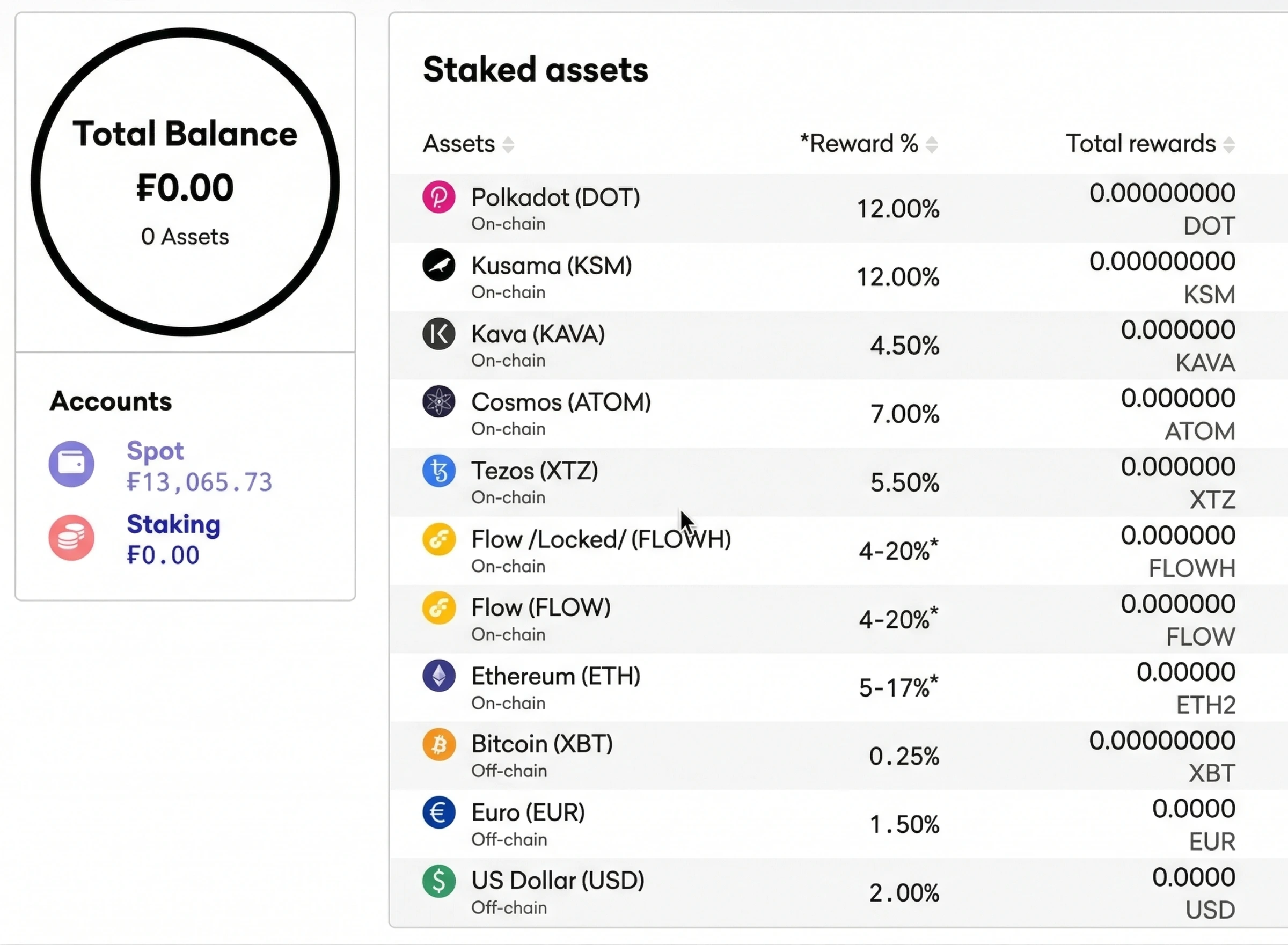
2. Coinbase — Convenient, but that 35% commission stings
Coinbase is the platform most Americans default to for staking because it's already where they bought their crypto. And honestly? It works fine. The staking interface is dead simple: find a supported asset, tap "Stake," done. Rewards show up automatically. No technical knowledge required.
But that 35% commission is brutal.
On Ethereum, the network pays roughly 3.4% to validators. After Coinbase takes their cut, you're looking at about 2.2%. Kraken would give you around 2.9% on the same ETH. That's a meaningful difference on any balance above a few thousand dollars.
Coinbase One subscribers ($29.99/month) get the commission reduced to 26.3%. But $360/year for the subscription only makes sense if you're staking over $15,000. Otherwise the subscription cost eats into the savings. And you still pay more than Kraken charges with zero subscription.
I do like the instant unstaking feature, even though it costs 1% of your balance. If ETH suddenly drops 30% and you need out fast, that 1% fee to skip the unbonding period is worth it. Kraken's bonded staking doesn't offer this.
Coinbase is publicly traded (NASDAQ: COIN), holds insurance on custodied assets, and hasn't had a major security breach. That matters. But paying 35% for the privilege of easy UI? Hard to justify when better options exist.
Use it if you're already on Coinbase with a small balance and simplicity matters most. Skip it if you're staking more than $5,000. The fee difference adds up fast.
Two taps to stake with instant unstaking available — the easiest staking interface for complete beginners.
Anyone staking more than a few thousand dollars — the 35% commission is the highest of any major platform.
- Easiest staking interface — literally two taps
- Publicly traded company with regulatory compliance
- Instant unstaking available (1% fee)
- Wide asset support including ETH, SOL, ADA, ATOM, DOT
- 35% commission on rewards — highest of any major platform
- Coinbase One subscription ($29.99/mo) needed to reduce to 26.3%
- APYs displayed already have the commission baked in (misleading)
- You don't control your keys — Coinbase custodies everything
3. Binance — Most assets, most complexity
Binance supports over 100 stakeable assets, which is more than every other platform on this list combined. If you hold anything beyond the top 10 PoS coins, Binance is probably your only CEX staking option. They also run promotional "locked" staking events with rates hitting 20-50%+ APY, though those last a few days and have strict caps.
The fee structure is relatively clean. Binance takes roughly 10% commission on staking rewards, the lowest of the three CEX options here. On ETH, that puts your net APY around 3.0-3.1%, which is competitive with most DeFi options once you factor in gas fees.
But there's always a "but" with Binance. The platform is banned or restricted in several countries. US users technically have Binance.US, which is a completely separate entity with a limited feature set and a troubled history (the entire executive team quit in 2023). If you're in the US, Binance staking isn't really available to you in any meaningful way.
For non-US users, though, it's genuinely solid. The "Simple Earn" product combines flexible and locked options in one interface. Flexible lets you withdraw anytime with lower rates. Locked terms (30, 60, 90, 120 days) give progressively higher APYs. Auto-subscribe features let you compound rewards automatically.
The elephant in the room: Binance paid $4.3 billion in fines to the DOJ in 2023. Their founder CZ stepped down as CEO. Regulatory pressure hasn't disappeared. Your funds on Binance are probably safe. They haven't been hacked and hold significant proof-of-reserves. But the geopolitical risk around this platform is real.
Use it if you're outside the US and want the most staking options with competitive fees. Skip it if you're American or uncomfortable with Binance's regulatory history.
100+ stakeable assets with the lowest CEX commission at roughly 10% — more selection than everyone else combined.
US users — Binance.US is effectively a shell with limited features, and the regulatory risk is real.
- 100+ stakeable assets — largest selection by far
- ~10% commission — lowest CEX fee on this list
- Simple Earn combines flexible and locked options cleanly
- Auto-compound available for hands-off staking
- Effectively unavailable to US users (Binance.US is a shell)
- $4.3B DOJ fine and ongoing regulatory pressure globally
- Promotional rates are misleading — they expire in days
- Complex interface with too many staking products to navigate
DeFi staking — cut out the middleman (mostly)
CEX staking is convenient but you're trusting a company with your keys and paying their commission. DeFi staking puts you in control: your wallet, your keys, the protocol's smart contract, and that's it. Lower fees, more control, but also more responsibility. You handle the gas fees, the wallet security, and the smart contract risk.
If you've never used a non-custodial wallet before, start with a hardware wallet and get comfortable with self-custody first. DeFi staking without understanding wallet security is like driving without a seatbelt.
4. Lido — The liquid staking giant
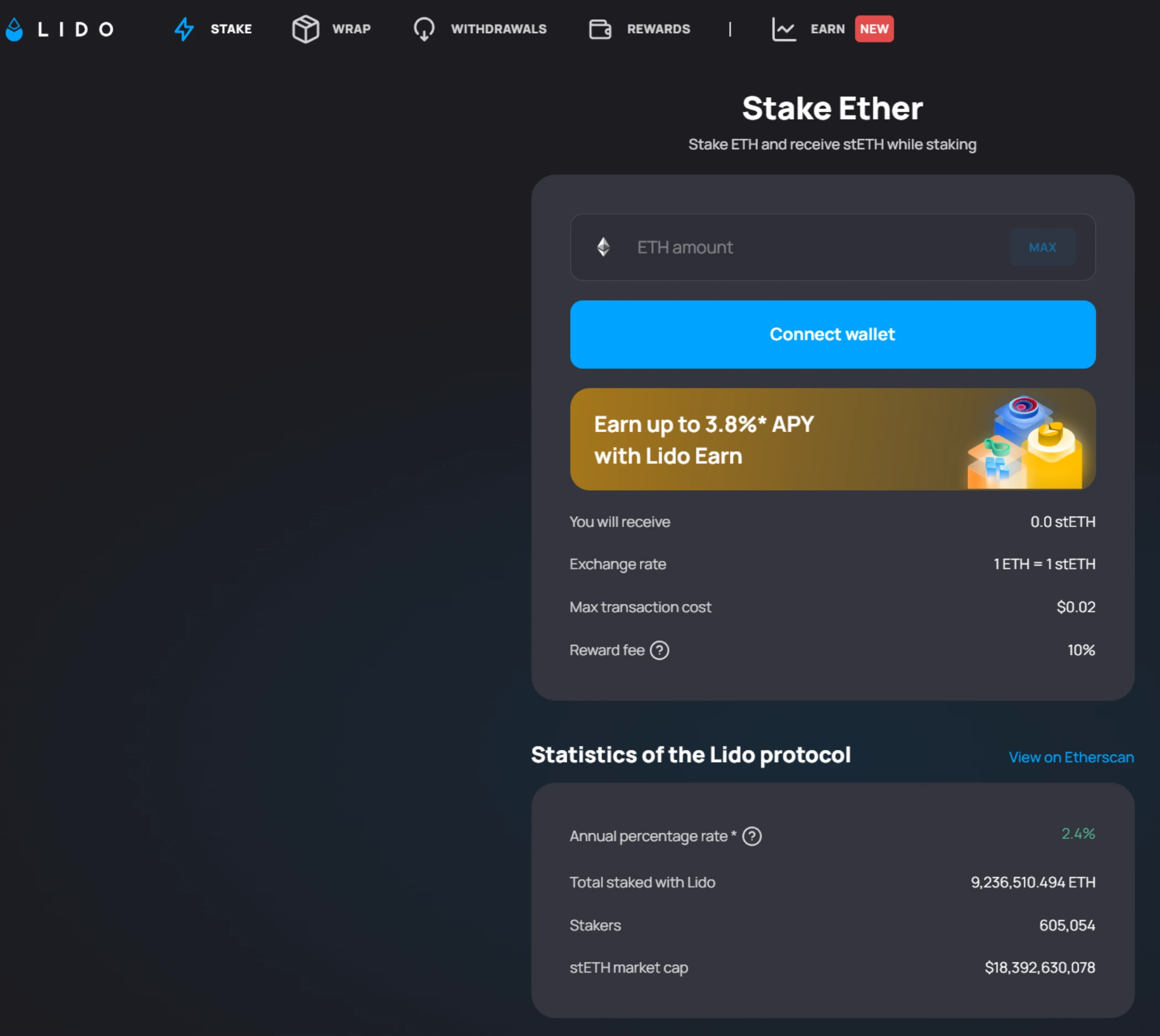
Lido dominates liquid staking. Over $38 billion in total value locked, 800+ node operators globally, and about 28% of all staked ETH runs through Lido's protocol. It's the 800-pound gorilla of staking and it got that way for a reason: it works, it's battle-tested, and the stETH token it issues is the most liquid staking derivative in DeFi.
Here's how it works: you deposit ETH into Lido's smart contract, receive stETH in return. stETH represents your staked ETH plus accumulated rewards, and its value relative to ETH slowly increases over time as rewards accrue. You can hold stETH in your wallet, use it as collateral on Aave, trade it on Curve, or just sit on it. Meanwhile, your original ETH is being staked across Lido's validator network.
Current ETH staking APR through Lido: approximately 3.4%, with Lido taking a 10% cut (split between node operators and the DAO treasury). That leaves you roughly 3.0-3.1% net APY. Competitive with Binance, significantly better than Coinbase.
The risk? Smart contract risk and concentration risk. The r/ethereum community has debated this endlessly: Lido controls 28% of staked ETH, which many argue is too much power for a single protocol. A smart contract bug or governance attack on Lido could theoretically impact the entire Ethereum network. Lido has been audited by multiple firms (Quantstamp, MixBytes, Sigma Prime) and has never been exploited, but the systemic risk is real.
stETH briefly depegged to ~0.93 ETH during the 2022 Terra/Luna collapse. It recovered within weeks, but anyone who panic-sold during the depeg locked in a 7% loss. Liquid staking tokens can depeg. Know this going in.
Use it if you want ETH staking with liquidity and don't mind the concentration risk. Skip it if Ethereum decentralization is a priority for you. Rocket Pool is the answer there.
$38B+ TVL and stETH is the most liquid staking derivative in DeFi — accepted everywhere, no lock-up period.
Anyone concerned about Ethereum centralization — Lido controls 28% of all staked ETH.
- $38B+ TVL — most battle-tested liquid staking protocol
- stETH is the most liquid staking derivative (accepted everywhere in DeFi)
- 10% fee — way cheaper than any CEX
- No minimum deposit, no lock-up period via stETH liquidity
- 28% of all staked ETH — centralization concern
- stETH can depeg during market stress (happened in 2022)
- Smart contract risk — audited but never zero-risk
- Only supports ETH (and Polygon via stMATIC) — limited asset support
5. Rocket Pool — True decentralization, zero protocol fee
If Lido is the Coinbase of liquid staking (biggest, easiest, most centralized), Rocket Pool is the Kraken: smaller, more principled, and genuinely decentralized. Anyone can run a Rocket Pool node with just 8 ETH (vs the 32 ETH required for solo staking), and the protocol itself takes zero commission.
Wait, zero? Where's the catch?
Node operators set their own commission rates (typically 5-15% of the rewards they generate for the pool). As a regular user staking rETH, you're effectively paying that operator commission, but it's lower and more transparent than Lido's flat 10% or Coinbase's 35%. The Saturn One upgrade, activated February 2026, improved the protocol's fee structure and validator economics significantly.
Current rETH APY sits around 2.4-3.0% depending on operator commissions and network conditions. Slightly lower than Lido's stETH, but you're supporting a genuinely decentralized validator network. Rocket Pool has thousands of independent node operators versus Lido's curated set.
The trade-off is liquidity. rETH is accepted in DeFi but has significantly less liquidity than stETH. On a $10,000 swap, rETH might have 0.1-0.3% more slippage than stETH. For most holders, this doesn't matter. You're holding rETH for the yield, not actively trading it. But if you need to exit a large position quickly, Lido's stETH is objectively better.
Rocket Pool hasn't been exploited since launch. Multiple audits (Sigma Prime, Consensys Diligence, Trail of Bits). The protocol is fully open-source and governed by its DAO.
Use it if Ethereum decentralization matters to you and you don't need maximum liquidity. Skip it if you want the widest DeFi composability. stETH is accepted in more protocols.
Zero protocol fee with thousands of independent node operators — genuinely decentralized, not just marketing.
Anyone needing maximum DeFi composability — rETH has significantly less liquidity than Lido's stETH.
- Zero protocol fee — only individual operator commissions (5-15%)
- Genuinely decentralized — thousands of independent node operators
- Saturn One upgrade (Feb 2026) improved economics significantly
- Run your own node with just 8 ETH (vs 32 ETH for solo staking)
- rETH has less DeFi liquidity than Lido's stETH
- Lower APY (~2.4-3.0%) than Lido due to decentralization overhead
- More complex to use as a node operator — not beginner-friendly
- RPL token requirement for node operators adds capital overhead
6. Bybit — Yield hunting with fine print
I almost didn't include Bybit. The staking rates they advertise are genuinely eye-catching: promotional APYs of 30%, 50%, sometimes 100%+ on specific assets. And technically, those numbers are real. For about 48-72 hours. With a cap of $500-$2,000 per user.
Once you strip away the promotional rates, Bybit's regular staking sits at competitive but unremarkable levels. Their "Easy Earn" flexible product offers decent rates on BTC and ETH, and they support over 190 assets across various earn products. The fee structure is opaque. Bybit doesn't publicly disclose their commission percentage the way Kraken and Coinbase do. That alone is a yellow flag.
The platform also runs "DeFi Mining" products that route your funds into various DeFi protocols. This gives you DeFi yields without the wallet complexity, but you're adding Bybit as a custodial layer between you and the protocol. If the underlying DeFi protocol gets exploited, Bybit's not making you whole. Their terms make that clear.
Bybit hasn't had a major security breach and their proof-of-reserves show full backing of user funds. But they also operate in a regulatory gray zone: no clear US licensing, headquartered in Dubai, and subject to restrictions in multiple jurisdictions.
Use it if you like chasing promotional rates and understand the caps. Skip it if transparent fee structures matter to you.
190+ assets with promotional APYs of 30-100%+ — genuinely high short-term rates with strict caps.
Anyone who values transparent fees — Bybit does not publicly disclose their staking commission percentage.
- 190+ assets supported across earn products
- Promotional rates genuinely high (30-100%+ APY short-term)
- DeFi Mining gives DeFi yields without wallet complexity
- No major security breaches to date
- Promotional rates expire in 48-72 hours with strict caps
- Commission percentage not publicly disclosed — opaque fees
- Regulatory gray zone — restrictions in multiple jurisdictions
- DeFi Mining products don't protect against underlying protocol exploits
Side-by-side comparison
| Feature | Kraken | Coinbase | Binance | Lido | Rocket Pool | Bybit |
|---|---|---|---|---|---|---|
| Type | CEX | CEX | CEX | DeFi | DeFi | CEX |
| Commission | ~15% | 35% | ~10% | 10% | 0% protocol | Undisclosed |
| ETH APY (net) | ~2.9-3.4% | ~2.0-2.6% | ~3.0-3.1% | ~3.0-3.1% | ~2.4-3.0% | ~2.5-3.0% |
| Assets supported | 20+ | 10+ | 100+ | ETH only | ETH only | 190+ |
| Lock-up required | Flexible or 3-28 days | Flexible + instant unstake | Flexible or 30-120 days | None (liquid stETH) | None (liquid rETH) | Flexible or locked |
| US available | Yes (most states) | ✓ | ✗ | ✓ | ✓ | Restricted |
| Self-custody | ✗ | ✗ | ✗ | ✓ | ✓ | ✗ |
| Minimum stake | Varies | None | Varies | None | None / 8 ETH (node) | Varies |
| Action | See pricing | See pricing | See pricing | Visit site | Visit site | See pricing |
The tax gotcha most staking guides skip
This matters if you're in the US. Staking rewards are taxed as ordinary income the moment you gain "dominion and control" over them. Not when you sell. When you receive them.
So if you're staking ETH and earn 0.5 ETH in rewards over the year at an average price of $3,000, you owe income tax on $1,500, even if you never sold a single token. Then, if you later sell that 0.5 ETH for $2,000, you owe capital gains on the $500 profit. Or you can claim a capital loss if it dropped.
Starting 2026, IRS Form 1099-DA requires exchanges to report all digital asset transactions. Coinbase and Kraken will both be sending these forms. DeFi platforms like Lido and Rocket Pool won't, which means you're responsible for tracking those rewards yourself. As I covered in our crypto tax software comparison, tools like CoinLedger and Koinly can import staking transactions and generate the right forms. Don't sleep on this.
One quirk: if your staking rewards are locked and you can't actually access them (some bonded staking has this), the IRS may not consider them taxable until the lock-up ends. But "may not" isn't "definitely won't." Consult a tax professional if you're staking serious amounts.
Staking security — what to actually worry about
The risks are different depending on whether you're staking on a CEX or a DeFi protocol. People confuse them constantly.
CEX risks: Exchange insolvency (see: FTX, Celsius), regulatory seizure, hacking. Your tokens are custodied by the exchange. If they go down, your staked assets go with them. Mitigation: stick to regulated, publicly traded, or well-audited exchanges. Keep your hardware wallet ready for withdrawal if things look shaky.
DeFi risks: Smart contract bugs, governance attacks, oracle manipulation, validator slashing. Your tokens are locked in code, not held by a company. The code has been audited but audits aren't guarantees. Exploits happen. Mitigation: stick to protocols with $1B+ TVL, multiple audits, and long track records (Lido and Rocket Pool both qualify).
Both: Token price volatility is the biggest risk for everyone. You can earn 5% APY staking a token that drops 40% in value. Your "yield" is meaningless if the underlying asset craters. This isn't a staking-specific risk, it's a crypto risk. But it's worth stating because some people seem to think staking somehow protects them from price drops. It doesn't.
If you're tracking your portfolio across multiple staking platforms, make sure your tracker supports staking rewards as a separate category. CoinStats and Delta both handle this reasonably well.
The verdict
Staking in 2026 is straightforward, but the platform you pick determines whether you're earning 1.9% or 3.1% on the same ETH. That's a 63% difference in yield — just from choosing a different platform.
For most people, Kraken is the right answer. Reasonable 15% commission, solid asset selection, regulatory compliance, and you don't need to manage a wallet or worry about smart contracts. It's the best balance of fees, convenience, and trust.
If you're comfortable with DeFi and self-custody, Lido gives you lower fees and liquid staking — stETH is accepted everywhere in DeFi and the protocol is about as battle-tested as they come. Rocket Pool is the principled choice if Ethereum's decentralization matters to you, even though the yield is slightly lower.
Coinbase is fine for tiny balances where convenience outweighs fees. But the moment you're staking more than a few thousand dollars, you're leaving money on the table. And Bybit? Unless you're actively hunting short-term promotional rates, there are better options.
One last thing: whatever you stake, track it for taxes. The IRS isn't guessing anymore. 1099-DA makes staking rewards visible. Get a crypto tax tool and automate it.
Frequently Asked Questions
Ready to check Kraken?
Use the verified route if the trade-offs still fit. If not, jump back to the summary and compare the alternatives.
Crypto and productivity editor focused on cost, custody risk, setup friction, exports, fees, and workflow drag. Prioritizes verifiable numbers and clear skip criteria over hype.
Lucas starts with total operating cost, then ranks tools by setup and recurring friction, custody or export, reversibility, and whether the decision still makes sense when the exit path is included.
Related Articles

Best Tokenized Stock Platforms for EU Users
EU stock-token platforms compared by legal wrapper, total cost clarity, shareholder rights, trading hours, and self-custody exit
Kraken xStocks, Robinhood Classic Stock Tokens, and Crypto.com compared for EU users by ownership, fees, rights, market hours, and wallet withdrawal.

MiCA Deadline: Kraken vs Coinbase vs Crypto.com in EU
Post-deadline EEA exchange verification guide
Kraken, Coinbase, and Crypto.com compared for EEA users after the July 1 MiCA deadline: entities, restrictions, fees, and safe transfer checks.