
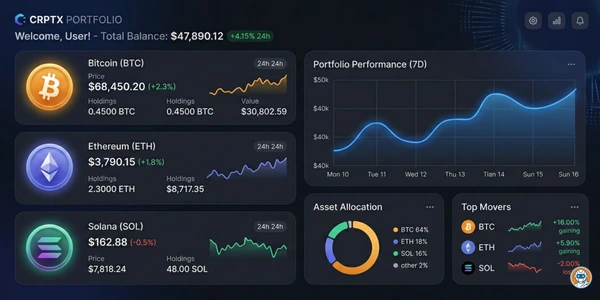
Coins on Coinbase. Tokens in MetaMask. Staking rewards on Lido. NFTs in Phantom. Some random airdrop on Arbitrum you forgot about until someone mentioned it on Reddit.
That's the reality of holding crypto in 2026. And somehow, after years of billion-dollar funding rounds and "we're building the future of finance" pitch decks, there still isn't a single app that tracks all of it correctly. If you're still deciding where those coins should actually live, start with our best crypto exchanges roundup first, then come back here for tracking.
I've burned entire weekends trying to reconcile portfolio numbers across apps. The DeFi tracker doesn't see your Coinbase holdings. The exchange tracker doesn't see your DeFi positions. And CoinMarketCap just ate three of your transactions for no apparent reason.
So I compared six portfolio trackers to find the least painful option for three types of people: casual holders who just want to see their balance, DeFi users who need protocol-level visibility, and everyone in between who's tired of spreadsheets. None of them do everything. But a couple come surprisingly close.
-
#1 CoinStatsBest all-around — 120 chains, 300+ integrations, generous free tier
-
#2 DeBankBest for DeFi — paste any wallet, 1,300+ protocols, completely free
-
#3 CoinGeckoBest for price watchers — 18,000+ coins, no account needed
All-in-One Trackers: CEX + DeFi in One Place
These try to do everything. Track your Binance spot, your MetaMask tokens, your staking rewards, your LP yields. The pitch is one dashboard for your entire crypto life. The reality is more complicated.
CoinStats — The Least Bad Option (and That's a Compliment)
CoinStats is the tracker I keep coming back to after trying the others, and I don't mean that as glowing praise. It's the one that breaks the least often and covers the most ground. In a category where everything is mediocre, "least bad" is genuinely the highest compliment.
The numbers are solid: 120 blockchains, 300+ exchange and wallet integrations, 1,000+ DeFi protocols. The free tier gives you 10 portfolios and 20,000 transactions. That's enough for most people who aren't running a trading bot. And unlike Delta, you get 10 full portfolios, not 10 total assets.
Where it actually shines is the built-in swap feature. Zero fees on the free tier for token swaps inside the app. That's unusual. Most trackers either don't offer swaps or charge a spread. CoinStats is essentially subsidizing swaps to keep you inside the ecosystem.
The catch? Users on r/CryptoCurrency and r/CoinStats consistently complain about paywall creep. Features that were free get quietly moved behind the $13.99/mo Premium wall. The charts are weak enough that most serious users jump to TradingView anyway. And paying customers still see upsell prompts, which is mildly insulting when you're already on the paid plan.
Worth knowing: Premium is $13.99/month after trial or can be billed annually, while Degen is $62.91/month when billed annually. Verify the final billing period and total in checkout before upgrading.
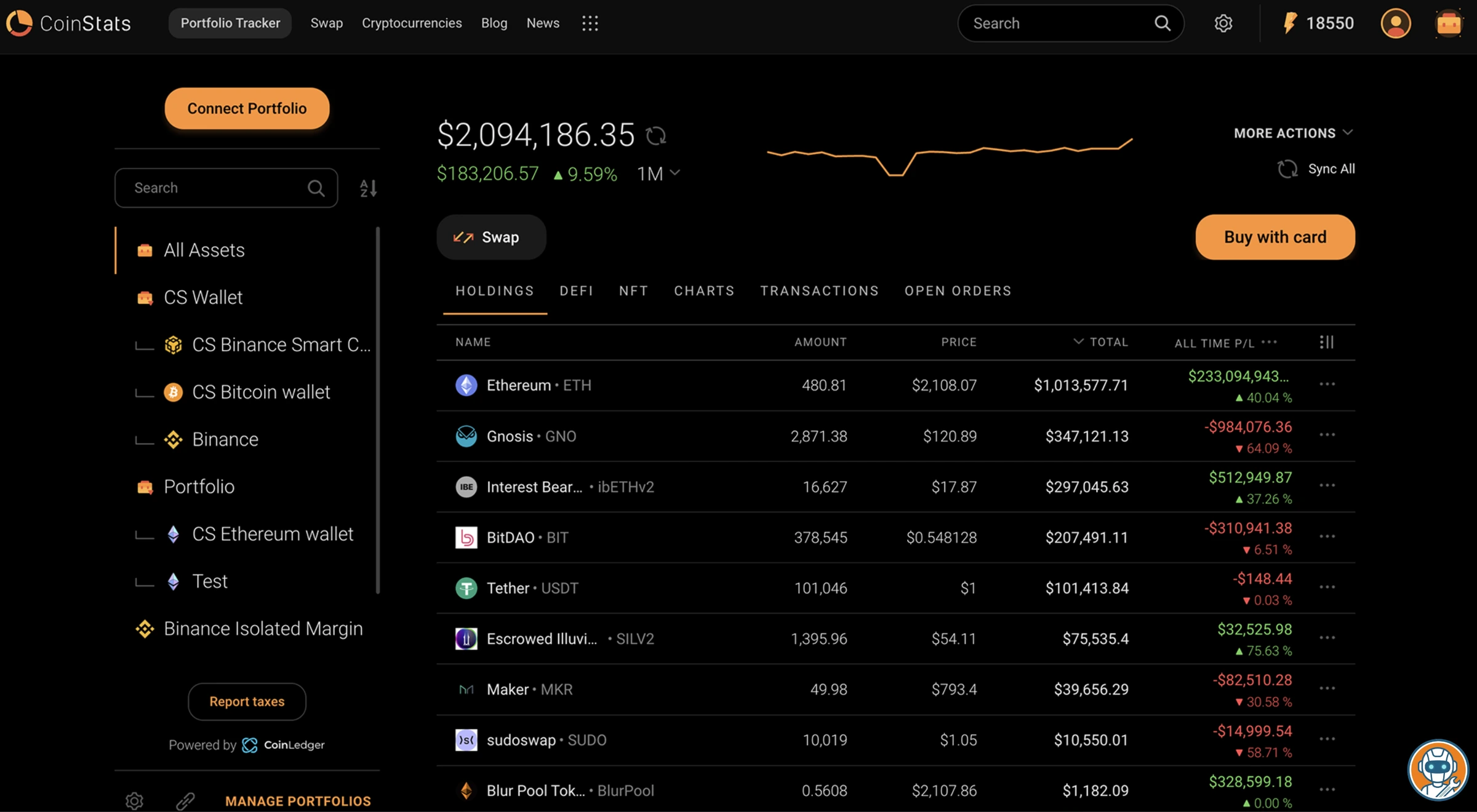
120 blockchains, 300+ integrations, and built-in zero-fee token swaps on the free tier — widest coverage available.
Anyone who wants clean charts or hates upsell prompts — even paying users see upgrade nudges.
- 120 blockchains and 300+ exchange/wallet integrations — widest coverage of any tracker on this list
- Free tier includes 10 portfolios and 20,000 transactions. That's generous compared to Delta's 10-asset cap
- Built-in token swaps with 0% fee on the free tier. No other tracker does this
- Premium and Degen give buyers separate upgrade paths instead of one oversized paid tier
- Paywall creep is real — Reddit users report formerly free features getting locked behind Premium
- Charts are basic. Anyone doing technical analysis will immediately open TradingView instead
- Paying users still see upsell prompts for higher tiers. If I'm already paying $14/mo, stop selling me
- Daily sync limits on the free tier (40 per portfolio) mean your balance can be hours behind
Use it or skip it? Use it. It's the best general-purpose tracker available right now, especially on the free tier. Just know that you're signing up for an app that will relentlessly try to upsell you.
Delta — The One for Stock Traders Who Also Hold Crypto
If you're the kind of person who tracks Apple stock, a Bitcoin position, and some ETH staking rewards in the same mental bucket, Delta is built for you. Owned by eToro, it's the only tracker here that handles traditional assets alongside crypto.
The interface is genuinely beautiful. On mobile especially, Delta looks and feels more polished than anything else in this category. And Delta AI (introduced in 2025) gives you market summaries and "Why Is It Moving" explanations for price swings. Useful if you don't want to check Twitter every time something pumps.
But here's the problem that nobody in the marketing materials mentions.
The free tier caps you at 10 assets. Not 10 portfolios. Not 10 exchanges. Ten individual assets. If you hold BTC, ETH, SOL, ADA, DOT, LINK, AVAX, MATIC, UNI, and AAVE, you're full. Delta PRO currently costs $6.99 per month or $53.88 per year, and Lifetime PRO+ is $299. Regional pricing can vary.
And the speed issues are bad. Reddit threads from 2025 and 2026 consistently describe Delta as "close to unusable" on loading times. Broker connections break. Features stay labeled "coming soon" for years. It's frustrating because the actual tracking and the UI are excellent when they work.
Only tracker that handles crypto and traditional assets (stocks, ETFs, commodities) in a single view.
Crypto-only holders — the 10-asset free tier is brutally restrictive and the app has persistent performance issues.
- Only tracker that handles crypto AND stocks/ETFs/commodities in a single view. Real multi-asset tracking
- Best-looking mobile app in the category. Smooth animations, clean layout, genuinely pleasant to use
- Delta AI market summaries and 'Why Is It Moving' feature save time vs checking Twitter for context
- Unlimited broker connections even on the free tier — the 10-asset cap is the only restriction
- Free tier limited to just 10 assets total. That's brutally restrictive for anyone holding more than a handful of coins
- Loading speeds described as 'close to unusable' by multiple Reddit users. Not a one-off complaint
- Broker connections break regularly and require manual reconnection. Defeats the purpose of automated tracking
- Features labeled 'coming soon' for years. Promised functionality that never ships erodes trust
Use it or skip it? Skip it unless you specifically need crypto + stocks in one app. The 10-asset free tier is a dealbreaker for crypto-only users, and the performance issues undermine the entire point of a portfolio tracker.
DeFi-Native Trackers: For Wallet-First Crypto Users
If most of your crypto lives in self-custody wallets and DeFi protocols, not on Coinbase or Binance, you need a different kind of tracker. CoinStats and Delta are built around exchange APIs. These tools are built around on-chain data. Big difference.
DeBank — Paste Your Address, See Everything (on EVM)
DeBank doesn't ask you to create an account. Doesn't need an API key. Just paste any Ethereum-compatible wallet address and it shows you every token, every DeFi position, every NFT, across 35+ EVM chains. It tracks 1,300+ protocols. All free.
The r/defi community swears by DeBank, and for good reason. Nothing else comes close to this level of protocol coverage. Your Aave lending position, Uniswap LP, Lido staking, Convex yields, GMX perpetuals. DeBank surfaces all of it in one page. You can even research whale wallets by pasting their address. That's how most on-chain analysts use it.
The limitation is right in the name: EVM only. No Solana. No Bitcoin. No Cosmos. If your portfolio includes anything outside the Ethereum ecosystem, you're missing a chunk of it. DeBank also sells optional VIP, identity, and other in-app products separately from the free core tracker.
Paste any wallet address and instantly see every DeFi position across 1,300+ protocols — no account needed.
Anyone holding Solana, Bitcoin, or assets outside the Ethereum ecosystem — DeBank is EVM-only.
- No account needed — paste any wallet address and see the full breakdown immediately. Zero friction
- 1,300+ DeFi protocol support across 35+ EVM chains. Best protocol coverage of any tracker
- Completely free for portfolio tracking. No premium tier required for the core feature
- Whale watching and wallet research built in. Paste any address, including known fund wallets
- EVM chains only. No Solana, no Bitcoin, no Cosmos. If you hold SOL or BTC, DeBank can't see it
- No centralized exchange support. Your Coinbase and Binance balances are invisible here
- Optional VIP and identity products add separate in-app pricing beyond the free core tracker
- Social feed features feel tacked on and distract from the core portfolio tracking
Use it or skip it? Use it if you're an EVM DeFi user. Nothing matches DeBank for protocol-level visibility. Skip it if you need Solana, Bitcoin, or CEX tracking. You'll need a second app for that.
Zerion — DeBank but With Solana (and a Price Tag)
Zerion started as a DeFi dashboard and evolved into a full non-custodial wallet with built-in portfolio tracking. It covers 50+ chains, including Solana, which DeBank still doesn't support. That alone makes it worth considering if your portfolio stretches beyond EVM.
The free tier is decent. Auto-detect tokens across all supported chains, 500+ DeFi protocol tracking, NFT tracking, and basic analytics. Premium Individual costs $99 for one wallet for one year; bundle pricing for additional wallets is shown in the purchase flow.
Useful if you need Solana DeFi tracking alongside Ethereum. Harder to justify if you're purely EVM.
50+ chains including Solana — the only DeFi tracker that covers non-EVM ecosystems alongside Ethereum.
EVM-only users — DeBank does the same thing for free, and Zerion's premium pricing is steep for a single wallet.
- 50+ chains including Solana — covers non-EVM ecosystems that DeBank misses entirely
- Built-in wallet means you can track AND transact from the same app without switching
- 500+ DeFi protocols tracked for free. Strong baseline without paying
- Clean interface with P&L per position on Premium. Good data presentation
- $99/yr covers one wallet; multi-wallet bundle pricing requires the purchase flow
- No centralized exchange integration at all. Coinbase, Binance, Kraken holdings are invisible
- Premium features limited to EVM wallets even though the free tier supports Solana. Feels inconsistent
- Primarily a wallet app now — the tracker is powerful but clearly secondary to the wallet pitch
If those missing exchange balances are the dealbreaker, sort the exchange choice first. The focused Kraken vs Coinbase comparison covers when Kraken should be the account you connect, when Coinbase is still the easier ramp, and why Binance.US changed the fee benchmark.
Use it or skip it? Use it if Solana DeFi is a big part of your portfolio and you need it alongside EVM tracking. Skip it if you're EVM-only. DeBank does that better and free.
Free Trackers: For People Who Just Want to See Numbers
Not everyone needs 120-chain coverage and DeFi protocol tracking. Some people just want to know: what's my portfolio worth right now? These two cost nothing. The tradeoffs are real, though.
CoinGecko — 18,000 Coins, Manual Entry, Zero BS
CoinGecko isn't really a portfolio tracker. It's the best crypto price database on the internet that happens to have a portfolio feature. And for a specific type of person — the one who checks prices daily but doesn't need automated syncing — it's perfect.
18,000+ coins. Trust Score system that rates exchanges by actual liquidity, not reported volume. Portfolio tracking is free. CoinGecko Premium offers monthly or yearly billing, a 14-day trial for first-time subscribers, and a 20% annual discount; checkout shows the current amount.
The catch is obvious: manual entry only. No exchange API connections. No wallet sync. You type in what you bought, when, and at what price. For 5-10 holdings that you update occasionally, that's fine. For 50+ tokens across multiple wallets? Forget it.
18,000+ coins tracked with Trust Score exchange ratings — the cleanest price data with zero security risk.
Anyone with more than a handful of holdings — it is manual entry only with no exchange API or wallet sync.
- 18,000+ coins tracked — more than any other app on this list. If a token exists, CoinGecko probably has it
- Trust Score rates exchanges by real liquidity instead of fake reported volume. Actually useful data
- Portfolio tracking is completely free with no feature paywall. Premium only adds research reports
- No API keys or wallet connections needed. Zero security risk from the portfolio feature itself
- Manual entry ONLY. No exchange API support, no wallet sync, no auto-imports. You type everything
- Guest portfolios limited to 10 coins. Need a free account for more, but even then it's all manual
- No DeFi tracking, no staking visibility, no yield data. Just spot prices and your typed-in holdings
- No tax integration or export features. Not useful for anything beyond checking your balance
Use it or skip it? Use it for price watching and quick portfolio checks. Skip it the moment you need automated tracking or hold more than a handful of positions.
CoinMarketCap — Free, Popular, and Falling Apart
Twenty thousand coins. Exchange API support. Multiple portfolios. All free. CoinMarketCap's portfolio tracker sounds great on paper. The problem is it barely works in practice.
Reddit and app store reviews from late 2025 into 2026 paint a consistent picture: assets disappearing from portfolios without explanation, entries that don't save, prices that lag behind by minutes or hours, and app freezes that require force-closing. CMC acknowledges some of these bugs in their support forums but fixes come slowly.
There's also the Binance question. Binance acquired CoinMarketCap in 2020 for $400M. Does that influence which coins get featured or how they're ranked? CoinMarketCap says no. Users remain skeptical. Independent analyses have flagged suspicious ranking changes that benefited Binance-listed tokens.
The portfolio tracker is a free add-on to what's primarily a price data website. And it feels like one.
20,000+ coins with exchange API support and zero paywall — the only completely free tracker with automated syncing.
Anyone who needs reliable data — assets randomly disappear, entries fail to save, and prices lag behind real-time.
- 20,000+ coins tracked. Largest database alongside CoinGecko
- Exchange API connections actually supported, unlike CoinGecko's manual-only approach
- Completely free — no premium tier for portfolio features at all
- Brand recognition means wide community support and third-party integrations
- Assets randomly disappear from portfolios. This is a documented, widespread bug that persists into 2026
- Entries fail to save. You add a transaction, close the app, come back — gone. Multiple Reddit threads confirm
- Owned by Binance since 2020. Users and researchers have flagged potential ranking bias toward Binance-listed tokens
- Price data sometimes lags minutes behind actual market prices. For a price tracker, that's a fundamental failure
Use it or skip it? Skip it for portfolio tracking. Use it for quick price checks and market data, sure. It's still the most visited crypto site. But don't trust it with your actual portfolio numbers. Too many people have watched their entries vanish.
Side-by-Side Comparison
| Feature | CoinStats | Delta | DeBank | Zerion | CoinGecko | CoinMarketCap |
|---|---|---|---|---|---|---|
| Free Tier | 10 portfolios / 20K txns | 10 assets total | Free core tracker | Free (basic) | Fully free | Fully free |
| Paid Price | $13.99/mo (annual) | $6.99/mo or $53.88/yr | Optional products priced separately | $99/yr for one wallet | Premium checkout varies | N/A |
| Chains | 120+ | Not specified | 35+ (EVM only) | 50+ (incl. Solana) | 18,000+ coins | 20,000+ coins |
| CEX Support | ✓ (300+ exchanges) | ✓ (brokerages too) | ✗ | ✗ | ✗ (manual only) | ✓ |
| DeFi Protocols | 1,000+ | Limited | 1,300+ | 500+ | ✗ | ✗ |
| Wallet Sync | ✓ | ✓ | ✓ (paste address) | ✓ (built-in wallet) | ✗ | ✓ |
| Stocks/ETFs | ✗ | ✓ | ✗ | ✗ | ✗ | ✗ |
| Tax Integration | Basic | ✗ | ✗ | ✗ | ✗ | ✗ |
| Mobile App | iOS + Android | iOS + Android | Web + iOS | iOS + Android | iOS + Android | iOS + Android |
| Action | Visit Site → | Visit Site → | Visit Site → | Visit Site → | Visit Site → | Visit Site → |
Quick Decision Guide
You hold crypto on exchanges (Coinbase, Binance, Kraken) and want one dashboard: CoinStats. Nothing else combines exchange API support with decent DeFi coverage on a single free tier.
You're a DeFi user on Ethereum, Polygon, Arbitrum, Base: DeBank. Free, no account needed, best protocol coverage available. It's not even close.
You use Solana DeFi alongside EVM chains: Zerion. Only option that covers both. The price stings but the alternative is using two separate apps.
You track crypto AND stocks: Delta. Only game in town for multi-asset. Just budget for PRO because the 10-asset free tier is useless.
You just want to check prices and do your own spreadsheet: CoinGecko. Cleanest data, zero cost, zero risk from API connections.
You want it all for free and don't mind bugs: CoinMarketCap, with the understanding that your data might randomly disappear.
The honest state of crypto portfolio tracking in 2026? Still fragmented. Still frustrating. I use CoinStats as my primary tracker and DeBank for DeFi visibility. Two apps. That's the minimum for anyone with a non-trivial portfolio. If someone builds one app that actually does both well, I'll be the first to switch.
Not holding my breath.
What About Tax Tracking?
None of these six tools are built for tax reporting. CoinStats has basic tax features, but it's nowhere near what you'd get from dedicated software. If you need to file crypto taxes (and with the new 1099-DA form now mandatory, most US holders do), check our CoinLedger vs Koinly comparison or the full crypto tax software roundup. Use a portfolio tracker for daily monitoring and a tax tool for filing season. Trying to combine both into one app is how you end up with a bad version of each.
Frequently Asked Questions
Final Verdict
CoinStats wins by being the least broken all-around option. That's the bar in 2026, apparently. 120 chains, 300+ integrations, a free tier that's actually usable, and built-in swaps with no fees. It's not perfect (the paywall creep is annoying, the charts are mediocre, and the paid tier still shows you upsell prompts), but if you forced me to pick one app for someone who holds crypto on exchanges and in wallets, CoinStats is the answer.
For DeFi, DeBank is the no-brainer for EVM users. Free, fast, and tracks more protocols than anything else. The EVM-only limitation is real, but if that's where your money lives, nothing touches it.
The rest are situational. Delta for stock traders. Zerion for Solana DeFi. CoinGecko for price purists. CoinMarketCap for people who enjoy watching their portfolio entries vanish into thin air.
I've been tracking crypto since 2019 and every year I expect this problem to be solved. Every year it isn't. The best advice I can give? Pick CoinStats + DeBank, accept the two-app reality, and spend the time you save not building spreadsheets on literally anything else.
Ready to check CoinStats?
Use the verified route if the trade-offs still fit. If not, jump back to the summary and compare the alternatives.
Crypto and productivity editor focused on cost, custody risk, setup friction, exports, fees, and workflow drag. Prioritizes verifiable numbers and clear skip criteria over hype.
Lucas starts with total operating cost, then ranks tools by setup and recurring friction, custody or export, reversibility, and whether the decision still makes sense when the exit path is included.
Related Articles

Best Tokenized Stock Platforms for EU Users
EU stock-token platforms compared by legal wrapper, total cost clarity, shareholder rights, trading hours, and self-custody exit
Kraken xStocks, Robinhood Classic Stock Tokens, and Crypto.com compared for EU users by ownership, fees, rights, market hours, and wallet withdrawal.

MiCA Deadline: Kraken vs Coinbase vs Crypto.com in EU
Post-deadline EEA exchange verification guide
Kraken, Coinbase, and Crypto.com compared for EEA users after the July 1 MiCA deadline: entities, restrictions, fees, and safe transfer checks.