

The phrase “tokenized stock” hides the only question that matters: what contract do you actually hold? On one platform it is a transferable tracker certificate. On another it is a derivative that cannot leave the app. On the third it is a stock-linked token issued on one chain. None is the same as buying a normal share in your own name.
Kraken xStocks is my best overall pick for eligible EU users who genuinely want an on-chain product. Its xStocks can move to a compatible wallet, the exposure is described as 1:1 collateralized, and the EU distributor sits inside an inspectable CySEC investment-firm structure. The cost is the compromise: EEA users use fiat Convert rather than a normal Kraken Pro order book, and Kraken's risk disclosure describes a 1% price component.
Robinhood is better if you will never self-custody. Its 0.10% FX fee on each order is the cleanest public cost here, and it advertises more than 2,000 Classic Stock Tokens. Crypto.com is the 24/7 specialist, with roughly 1,500 stock and ETF tokens and Cronos withdrawals, but “0% commission” does not answer the complete execution-cost question.
I checked official product, fee and legal pages, a Robinhood KID, CySEC's register, ESMA tokenisation guidance, current search competitors, public screenshots, GDT's 30-day qualified-click report, and live affiliate routes on August 18, 2026. I did not open an account, pass a suitability test, fund an order, compare live quotes, trade, sell, receive a dividend, or withdraw a token. This is an evidence-led buyer guide, not a funded test or investment advice.
If you are selecting a crypto account rather than a stock-linked token, use the MiCA exchange guide or Kraken vs Coinbase comparison. Custody-first readers should also open the non-custodial exchange guide, hardware wallet comparison, and crypto tax software guide.
-
#1 Kraken xStocksBest overall when a real self-custody exit matters
-
#2 Robinhood Classic Stock TokensBest cost clarity and catalog if app lock-in is acceptable
-
#3 Crypto.com Tokenized StocksBest for 24/7 access and Cronos-native use
Start with Kraken xStocks if the token must leave the exchange. Check Robinhood if the fee and catalog matter more than a wallet. Use Crypto.com only when 24/7 trading or Cronos utility is the actual job.
These are not ordinary shares
All three products track public stocks and ETFs, but none gives the normal package of direct ownership, issuer communications, and voting rights. That does not make them fake. It makes them different financial claims with extra counterparties.
ESMA has described the category carefully: equity-linked tokens may be DLT-based derivatives or synthetic claims backed by stock. They can add always-on access and fractionalization, but typically do not confer shareholder rights. The point is not that every product is unregulated. It is that “stock” in the name can make a buyer misunderstand the contract.
A platform's crypto authorization is not enough by itself. The exact instrument, issuer, distributor, KID or prospectus, and client agreement decide the protection. A familiar app can offer products under different legal regimes.
Kraken vs Robinhood vs Crypto.com
| Feature | Kraken xStocks | Robinhood Classic Stock Tokens | Crypto.com Tokenized Stocks |
|---|---|---|---|
| What you hold | Backed tracker certificate; not a direct share | MiFID II derivative with Robinhood Europe | Foris derivative tracking a stock price |
| Public cost signal | 1% price component; fees or spread can apply | 0.10% FX on each buy and sell | 0% commission; other charges may apply |
| Market window | Mostly 24/5; selected assets 24/7 | 24/5 | 24/7 positioning; liquidity limits apply |
| External wallet | Yes, compatible wallets | No, not currently | Yes, through Cronos |
| Catalog signal | 100+ stocks and ETFs | 2,000+ stocks and ETPs | About 1,500 stocks and ETFs |
| Best job | Self-custody and on-chain use | Clear cost inside one app | 24/7 and Cronos utility |
| Action | Check Kraken | Check Robinhood | Check Crypto.com |
How I ranked them
The rubric gives 25% to Legal Clarity, 25% to Exit Control, 20% to Total Cost Clarity, 15% to Market Access, and 15% to Buyer Safeguards. If direct stock ownership is the goal, a traditional broker should win before this comparison starts. A tokenized product has to justify its extra structure with extended hours, crypto funding, faster settlement, or a usable on-chain exit.
Catalog size is not the decision. A list of 2,000 tickers is not useful if the wrapper or exit does not fit. Likewise, 24/7 access does not guarantee deep liquidity or a tight quote when the underlying US market is closed.
1. Kraken xStocks: best when the token needs to leave
Kraken's legal page says an xStock is not a direct equity investment, carries no voting rights, and gives no legal claim to the underlying company's shares or liquidation assets. Each token is described as 1:1 backed. Backing supports price exposure; it does not make the holder a shareholder.
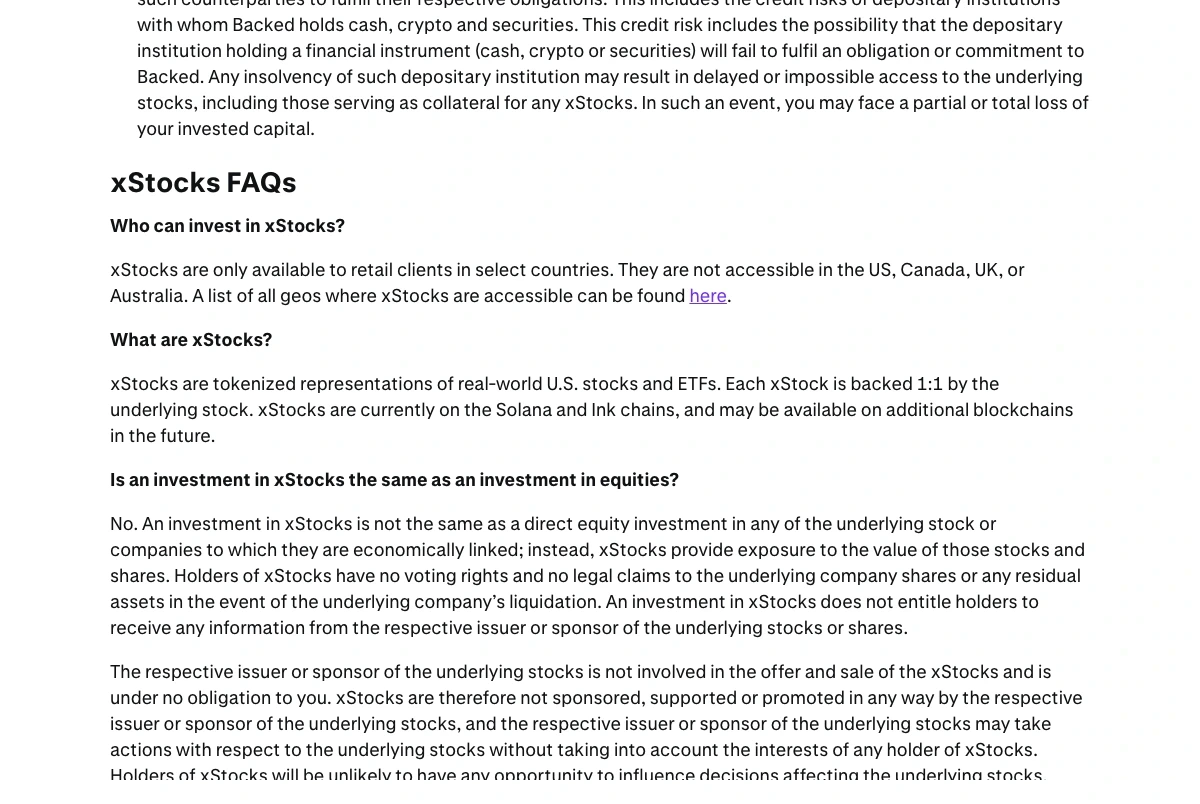
Kraken wins because xStocks can be withdrawn to a compatible self-hosted wallet. Tokenholders can also redeem with Backed for an additional fee or sell on Kraken. That creates more than one exit path and gives the token a purpose outside the distributor's app.
The fee story needs careful reading. Kraken says USD or USDG purchases have no added trading fee, while other assets can trigger a 1% Instant Buy/Sell fee and spread may be included. Its risk page says the purchase price includes market price plus a 1% component. EEA clients buy, sell, and convert with fiat through kraken.com; normal Kraken Pro order books and API trading are unavailable, except Pro Convert.
CySEC's register lists Payward Europe Digital Solutions (CY) Limited under licence 342/17 and names eu.kraken.com as an approved domain. That is evidence about the entity, not a promise against issuer, custodian, chain, liquidity, or market loss.
xStocks can leave the exchange for a compatible wallet.
Skip if you want direct shares, voting rights, Pro order-book execution in the EEA, or the simplest cost.
Legal disclosure and portability outweigh Convert-only friction.
- Withdrawable to compatible wallets
- 1:1-backed certificate structure
- Public EU entity details
- 100+ stock and ETF tokens
- No direct equity or voting rights
- 1% price component and possible extra friction
- EEA Convert-only limitation
- Issuer, custodian and chain risks
2. Robinhood: clearest fee, but no wallet exit
Robinhood puts the wrapper and fee in one screen. Classic Stock Tokens are derivative contracts with Robinhood Europe, not underlying securities, and cannot currently be sent to another wallet or platform.
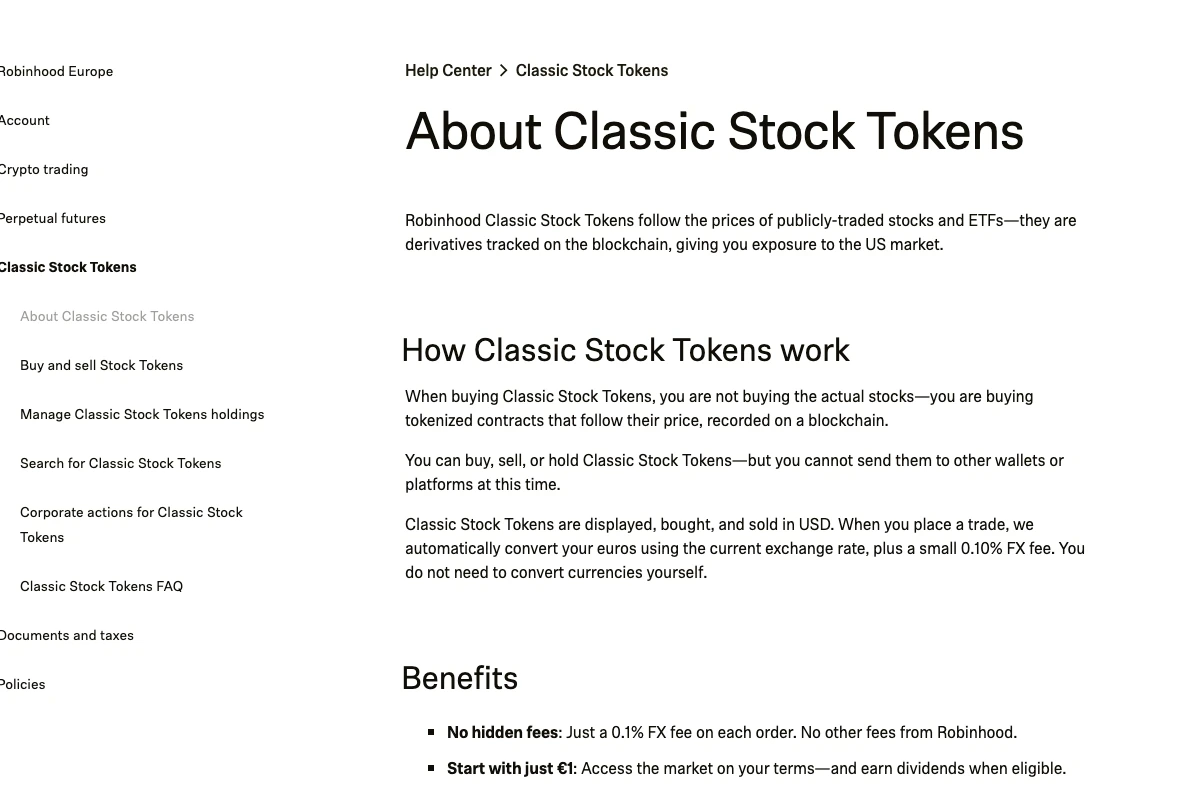
Orders are shown in USD, EUR is converted automatically, and Robinhood charges 0.10% FX on each order with no other Robinhood fee stated. A round trip therefore has two explicit conversions. Its KID illustrates €20 total cost on a €10,000 one-year example, matching that 0.2% two-sided structure.
Robinhood advertises more than 2,000 stock and ETP tokens from €1 and 24/5 trading. Eligible dividends are mirrored as contractual payouts, but there are no voting rights. Sale proceeds can be reused immediately, while EUR withdrawal has a T+1 business-day hold.
The blockchain adds less control if the product remains locked inside one app. Robinhood can still be rational if you want an explicit fee and broad catalog. Its KID also warns that position closing can be suspended in difficult pricing conditions and insolvency can cause loss.
A simple fee and more than 2,000 advertised tokens.
Skip if you need external-wallet transfers or direct shareholder rights.
Fee clarity nearly wins, but app lock-in removes tokenization's strongest feature.
- 0.10% FX on each order
- 2,000+ advertised products
- Explicit MiFID II derivative and KID
- 24/5 access from €1
- No wallet transfer
- No direct ownership or vote
- Counterparty insolvency risk
- Possible closing suspension and T+1 cash hold
3. Crypto.com: best 24/7 and Cronos specialist
Crypto.com's June 2026 material advertises roughly 1,500 tokenized US stocks and ETFs, 24/7 access, instant settlement, a $1 minimum, and Cronos withdrawal. It also says the buyer receives economic price exposure, not direct ownership, voting rights, or issuer communications.
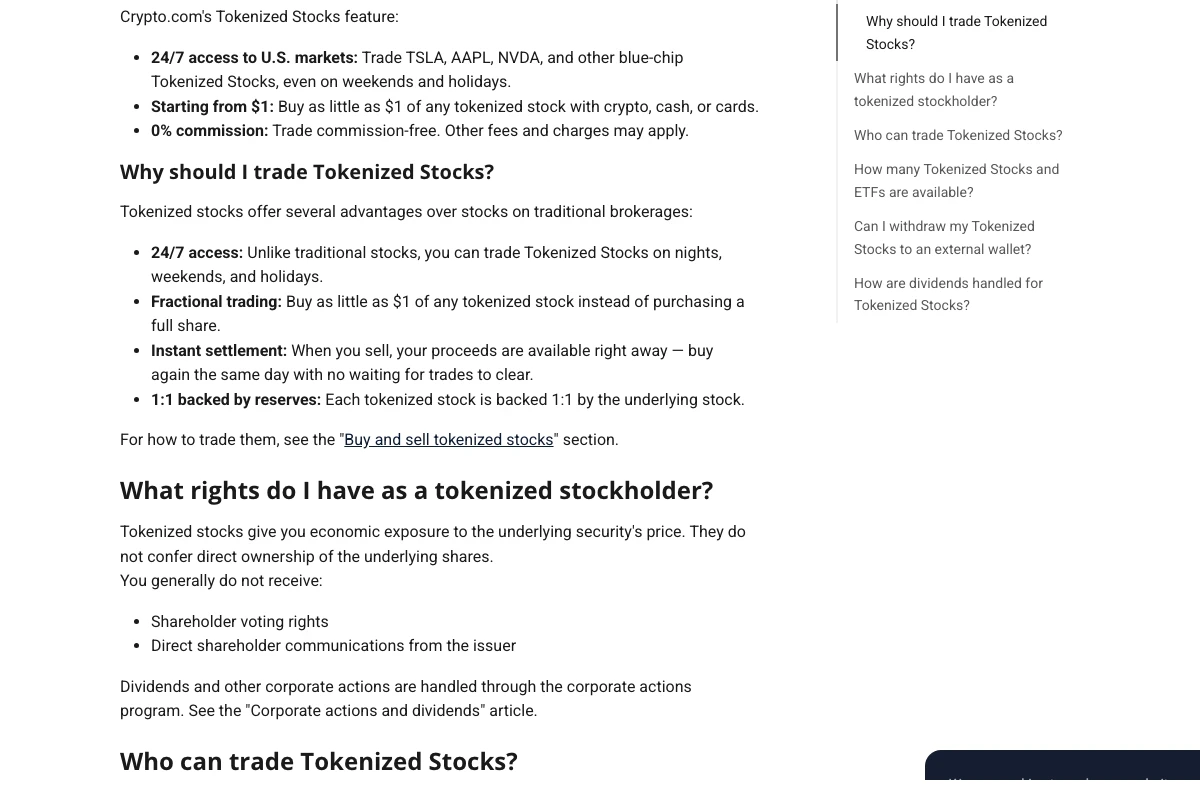
The wallet route is narrower than Kraken's. Tokens are issued on Cronos EVM and can be withdrawn to Cronos, where they may be used as collateral or in liquidity pools. That is real portability, but DeFi adds chain, contract, liquidity, and user-error risks unrelated to the stock price.
Crypto.com advertises 0% commission and says other fees and charges may apply. Without matched funded quotes, I would not call it cheapest. The delivered quote, spread, funding route, withdrawal, or on-chain swap can change the bill.
The 24/7 claim has a liquidity qualifier. The buy/sell guide says one-time orders outside regular US hours depend on liquidity; for some tokens only a limit order may be available. Existing users may still prefer it, but a new buyer should make the app prove the quote.
Broad access and a real Cronos withdrawal route.
Skip if you need the clearest total cost, chain-agnostic portability, or direct shares.
Strong access, but a newer product and incomplete total-cost answer.
- About 1,500 stocks and ETFs
- 24/7 positioning from $1
- Cronos withdrawals
- Corporate-action handling documented
- 0% commission is not zero total cost
- No direct ownership or voting rights
- Jurisdiction and liquidity limits
- Cronos and DeFi risks
What a €10,000 round trip reveals
A matched funded trade is the only fair way to name the cheapest platform, and I did not execute one. Still, the published numbers show why the marketing labels are not comparable.
Robinhood is the easiest calculation. A €10,000 buy carries a maximum disclosed entry cost of €10 at 0.10%, and selling the same €10,000 value carries another €10. Its KID therefore illustrates €20 total cost, or 0.2%, before market movement. Currency conversion happens on both sides, so a buyer who trades frequently repeats the FX cost.
Kraken's 1% price component would equal €100 on a €10,000 purchase before any separate funding, withdrawal, redemption, or blockchain cost. The exact comparison is not as simple as subtracting €20 from €100, because Kraken's delivered quote, asset used to pay, jurisdiction, and exit route can change the result. The useful conclusion is narrower: do not import Kraken Pro's spot-crypto fee schedule into an EEA xStocks decision.
Crypto.com's 0% commission line produces no honest euro total from public marketing alone. The confirmation quote is part of the evidence. A buyer should record the underlying stock price, the app's quoted token price, payment method, timestamp, and estimated sell proceeds before approving. Repeat the preview during regular US market hours and outside them. A wider after-hours quote can matter more than a zero commission line.
Withdrawal changes the calculation again. Kraken and Crypto.com can add network or redemption costs when the token leaves the platform. Robinhood avoids blockchain withdrawal costs because it does not provide that exit at all. That is cheaper only if portability has no value to you.
Dividends and corporate actions are contractual substitutes
All three platforms describe a way to mirror dividends or corporate actions, but the result is not the same as receiving a normal shareholder dividend directly from an issuer.
Kraken says dividends are automatically reinvested into more of the same xStock. Your token balance increases rather than receiving a separate cash payment. That is convenient for compounding, but it changes the record you need for tax and cost-basis tracking. The product's issuer and distributor also decide how splits, mergers, delistings, and other events flow through the certificate terms.
Robinhood says eligible holders can receive payments that reflect dividends after taxes, possible fees, and other costs. The customer agreement calls that entitlement part of the derivative contract. You still do not become a voting shareholder, and the platform controls the operational treatment of halts and events.
Crypto.com routes dividends and splits through its corporate-actions program. Its help page says contractual payouts can arrive in the app or on-chain. That is useful, but it means an on-chain holder still depends on the issuer's event processing and the platform's terms. “On-chain” does not make a real-world dividend autonomous.
Before buying a stock specifically for its dividend, read the current event policy and ask four questions: Is the payout cash or more tokens? Which taxes and fees are deducted? What happens if the position sits in a wallet? How are fractional entitlements rounded? If the public documents do not answer those questions, do not build a yield calculation from the underlying stock's headline dividend rate.
A wallet exit moves risk; it does not remove it
Self-custody protects against one narrow problem: losing access because the distributing exchange account is unavailable. It does not remove the issuer, custodian, underlying-stock, chain, smart-contract, oracle, liquidity, or redemption dependencies.
For Kraken, the token depends on Backed's certificate structure and the institutions holding the collateral. Kraken's disclosure says a depositary failure can delay or prevent access to underlying stocks and can cause partial or total loss. If the token is in your wallet, you control the key but still rely on those off-chain links.
For Crypto.com, moving a token to Cronos adds operational control and operational responsibility. The address and network must match, the wallet must support the asset, and any DeFi protocol adds another contract and liquidity layer. A position used as collateral can be liquidated even when the underlying company remains healthy.
Robinhood keeps the exit centralized. That removes wrong-chain transfer risk, but concentrates control and counterparty exposure in the app and derivative contract. The best model depends on which failure you are trying to reduce. “Self-custody” is not a universal safety score.
How to choose the right tokenized-stock route
- Pick Kraken when you have named the compatible wallet and chain you plan to use. Portability must be part of the workflow, not a feature you admire and never touch.
- Pick Robinhood when positions will stay inside one app and you want the cleanest public round-trip fee. Accept the derivative counterparty and the lack of wallet transfer before funding.
- Pick Crypto.com when you already use the app and specifically want weekend access or Cronos utility. Preview the quote during regular and off-hours before trusting the commission label.
- Pick none of them when your goal is long-term direct share ownership, voting rights, conventional broker statements, or a simple EU index-fund plan.
When a traditional broker is better
If you want direct beneficial ownership, voting rights where available, conventional custody statements, and a mature securities-transfer process, start with a regulated broker. Tokenization is a different route to price exposure, not an automatic upgrade.
A broker is also simpler if you do not plan to self-custody, trade outside US hours, fund from crypto, or use an on-chain protocol. Without one of those jobs, you accept extra issuer, custodian, chain, contract, and liquidity dependencies without using the feature that justifies them. Long-term index investors should compare an EU-domiciled UCITS ETF first.
Six checks before buying
- Name the instrument: derivative, tracker certificate, debt security, or direct security token.
- Name the counterparties: app, distributor, issuer, custodian, and redemption agent.
- Price a round trip: trading, FX, spread, funding, withdrawal, network, and redemption.
- Check the exit: app sale, wallet transfer, issuer redemption, and venue portability.
- Read the ugly events: dividends, splits, delisting, halts, insolvency, and suspended redemption.
- Start small: compare the shown quote with the underlying market before scaling.
Final verdict
Kraken wins for legal clarity plus a usable self-custody exit; Robinhood remains the better fee-clarity pick.
Try freeChoose Kraken when you have a real on-chain reason. Choose Robinhood when predictable public cost and catalog matter more than portability. Choose Crypto.com when 24/7 or Cronos use is the job. For everyone else—especially a long-term investor who wants shareholder rights—a traditional broker remains cleaner.
EU tokenized stock platform FAQ
Ready to check Kraken xStocks?
Use the verified route if the trade-offs still fit. If not, jump back to the summary and compare the alternatives.
Crypto and productivity editor focused on cost, custody risk, setup friction, exports, fees, and workflow drag. Prioritizes verifiable numbers and clear skip criteria over hype.
Lucas starts with total operating cost, then ranks tools by setup and recurring friction, custody or export, reversibility, and whether the decision still makes sense when the exit path is included.
Related Articles

MiCA Deadline: Kraken vs Coinbase vs Crypto.com in EU
Post-deadline EEA exchange verification guide
Kraken, Coinbase, and Crypto.com compared for EEA users after the July 1 MiCA deadline: entities, restrictions, fees, and safe transfer checks.

Stablecoin Cards Compared: Rewards, FX, and Custody Traps
Stablecoin-funded payment cards compared by everyday spend cost, reward caps, FX and conversion fees, custody model, region availability, and tax friction
Coinbase Card, Bybit Card, Crypto.com Prepaid Card, and Nexo Card compared by stablecoin spend cost, rewards, FX fees, custody, and region fit.