
-
#1 Proton MailBest overall — bigger ecosystem, IMAP Bridge, SOC 2 + ISO 27001 audited
-
#2 TutaBest for privacy maximalists — quantum-safe encryption, subject line encryption, published EUR3 entry plan
Every Proton Mail vs Tuta comparison I've read follows the same formula: list a few features side by side, declare both "excellent for privacy," and leave you no closer to a decision. Nobody reads the audit reports. Nobody checks what actually gets encrypted. Nobody tells you that one of these services has already deployed quantum-resistant cryptography while the other hasn't.
I read the published audit material, compared the encryption protocols, and rechecked the official plan pages. This is an evidence-led comparison, not a claim that every account workflow was tested hands-on.
The 30-Second Verdict
If you want the most complete encrypted email experience with desktop client support, a bundled ecosystem, and enterprise-grade audits, choose Proton Mail. The combination of IMAP Bridge, SOC 2 compliance (July 2025), ISO 27001 certification, and the Proton ecosystem (VPN, Drive, Pass, Calendar) makes it the practical choice for most users. Switzerland jurisdiction doesn't hurt either.
If you prioritize encryption that's actually ahead of the curve, subject line privacy, and a published EUR3/month entry plan, go with Tuta. TutaCrypt's quantum-safe encryption is live and default since March 2024. Subject line encryption closes a real gap that PGP-based services cannot fix. Compare the current localized Proton checkout before assuming the same price gap at every tier.
For most users, Proton Mail wins on practicality. If your threat model is extreme, Tuta encrypts more of your data.
Encryption: PGP Legacy vs Post-Quantum Future
This is where the two services diverge the most, and where most comparisons get it wrong. The r/ProtonMail community debates this endlessly.
Proton Mail uses OpenPGP under the hood. It's been around since 1991, attacked by everyone from academics to intelligence agencies, and it's still standing. Proton's implementation is solid. Emails between Proton users are end-to-end encrypted automatically. Emails to external PGP users work seamlessly. For non-PGP recipients, you can send password-protected messages that expire after a set time.
But PGP has a fundamental limitation that dates back to 1991: it doesn't encrypt subject lines. The subject, sender name, and recipient addresses are treated as metadata, visible to Proton's servers, visible in transit headers, and potentially visible to anyone with access to server logs or network traffic. This isn't a bug Proton can fix. It's baked into the PGP specification.
Tuta rejected PGP entirely. They built their own encryption protocol from scratch, and the latest version, TutaCrypt (default for all users since March 2024), is a hybrid system combining x25519 (classical elliptic curve) with ML-KEM-1024 (post-quantum, formerly CRYSTALS-Kyber). This means Tuta encrypts everything: body, attachments, subject line, sender name, and recipient names.
The quantum-safe part isn't theoretical paranoia. Right now, nation-state actors are widely believed to be harvesting encrypted traffic, storing it today to decrypt it once quantum computers become capable enough. This is called "harvest now, decrypt later." Tuta's ML-KEM-1024 implementation means that even emails sent today are protected against that future threat. Proton Mail has not yet deployed post-quantum encryption for email, though Proton VPN added it in 2023.
The trade-off? Tuta's proprietary protocol hasn't been through as many years of adversarial scrutiny as PGP. And by rejecting PGP, Tuta cannot interoperate with the broader PGP ecosystem. You can't exchange encrypted emails with a PGP user on Thunderbird or GPG. Users on r/degoogle frequently cite this as the biggest trade-off. Proton can. For individual privacy, Tuta's approach is technically superior. For ecosystem compatibility, Proton wins.
Privacy & Jurisdiction: Switzerland vs Germany
Both companies are based in privacy-friendly European jurisdictions. But "privacy-friendly" means very different things when you look at the legal frameworks.
Proton Mail is operated by Proton AG in Geneva, Switzerland, now backed by the Proton Foundation, a non-profit. Switzerland is outside the EU, outside Five Eyes and Fourteen Eyes intelligence-sharing alliances. Swiss privacy law requires a Swiss court order to compel data disclosure, and Swiss courts have historically set a high bar for international cooperation requests. That said, Proton has complied with Swiss legal orders, most notably in the 2021 French climate activist case where they provided IP address logs. Proton now publishes a transparency report documenting all such requests.
Tuta is operated by Tuta GmbH in Hanover, Germany. Germany has strong constitutional privacy protections (Article 10 of the Grundgesetz) and benefits from GDPR. But Germany is also a member of the Fourteen Eyes alliance, which means intelligence agencies can share data with partners like the NSA and GCHQ. In 2020, a Cologne court ordered Tuta to implement a monitoring function on a specific mailbox, not to decrypt existing emails (which Tuta cannot do), but to capture future incoming unencrypted emails before encryption. Tuta complied, as they were legally required to.
In practice, the jurisdiction difference matters less than you'd think. Neither company can decrypt your stored emails. The encryption is real on both sides. What they can provide is metadata: IP addresses, account creation timestamps, email addresses of contacts. If metadata exposure is part of your threat model, use Tor or a VPN when accessing either service.
Security Audits & Trust: Who Shows Their Work?
This is where I get blunt. Audit reports are the receipts. Marketing claims without audits are just words.
Proton Mail has gotten serious about audits. In July 2025, Proton achieved SOC 2 Type II compliance, which is what Fortune 500 procurement departments actually ask for. They also hold ISO 27001 certification. Their open-source apps have been audited by Securitum multiple times (same firm that audits Proton VPN). All audit reports are published. Proton's codebase is fully open source on the client side. You can inspect the web app, desktop app, and mobile apps on GitHub.
Tuta has published a 2023 security audit by SySS GmbH, a German penetration testing firm. It was clean, but it's a single point-in-time assessment, not a continuous compliance framework like SOC 2. Tuta's clients are open source on GitHub, but unlike Proton, they haven't pursued the certifications that business buyers care about. If you're an individual, this doesn't matter. If your company's compliance team needs to sign off on your email provider, Proton's SOC 2 and ISO 27001 are the paperwork that gets you approved.
Both services have closed-source servers. This is the uncomfortable truth that neither company's marketing emphasizes. You're trusting that their server-side code does what they claim. The open-source clients mitigate this somewhat (you can verify that encryption and decryption happen client-side before data reaches their servers), but full server-side transparency remains an unsolved problem for both.
Features & Usability: Ecosystem vs Simplicity
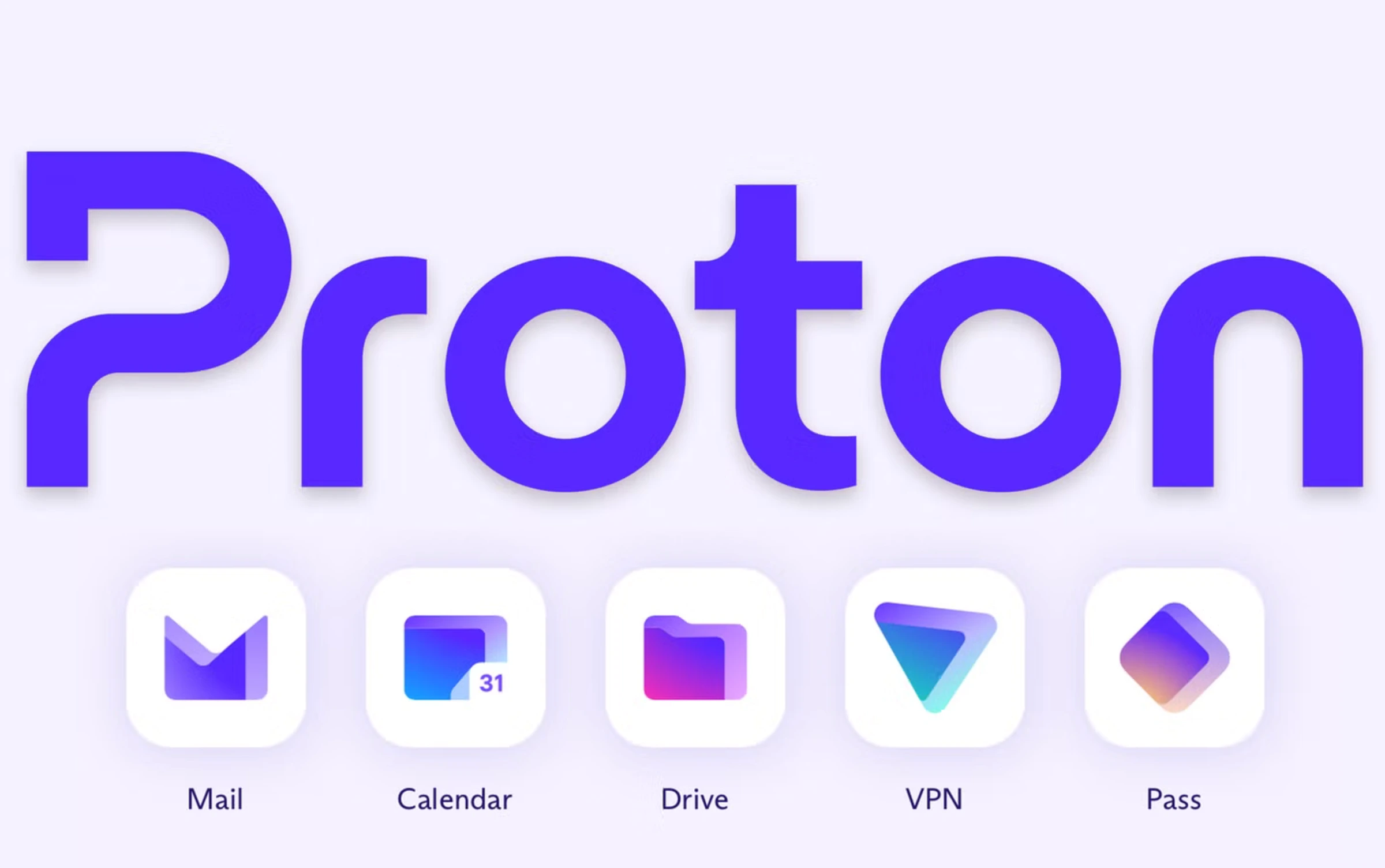
Proton Mail's biggest advantage isn't any single feature — it's the ecosystem. A Proton account gives you Proton VPN, Proton Drive (encrypted cloud storage), Proton Pass (password manager), and Proton Calendar. Proton Unlimited bundles that ecosystem, with pricing varying by term, region, and current promotion.
Then there's IMAP Bridge. This desktop app creates a local IMAP/SMTP server that decrypts your mail, letting you use Proton Mail with Thunderbird, Outlook, Apple Mail, or any standard email client. For power users who refuse to live in a webmail tab, Bridge is essential. It's available on all paid plans.
Tuta takes the opposite approach: simplicity and encryption purity. No IMAP support, deliberately. Their argument is that routing decrypted emails through third-party clients weakens the security model because those clients don't enforce Tuta's encryption guarantees. It's a defensible position from a security standpoint, but it means you're locked into Tuta's own apps for web, desktop, and mobile.
Tuta's apps are clean and fast. The desktop app (built on Electron) is snappy enough. The mobile apps are responsive. But compared to Proton's polished, feature-rich interface (which now includes a full calendar, contact management, and drive integration), Tuta feels intentionally sparse. Whether that's a pro or a con depends on whether you want an ecosystem or just an encrypted inbox.
One feature where Tuta leads: encrypted calendar. Tuta's calendar encrypts all event data, including event titles and descriptions. Proton Calendar also encrypts events, but Tuta had this first and integrates it more tightly with their email flow.
Pricing: compare Tuta's public rate with Proton's localized checkout
Let me lay out the actual numbers instead of vague "affordable" claims.
Free tiers:
- Proton Mail Free: 1 GB storage, 1 email address, 150 messages/day. Includes Proton Calendar, Proton Drive (5 GB total across services), and limited Proton VPN.
- Tuta Free: 1 GB storage, 1 email address, limited search (last 28 days). Calendar included. No third-party app support (same as paid).
Both free tiers are usable. Proton's is more generous when you factor in the bundled Drive and VPN access.
Paid plans (personal):
- Proton Mail Plus: 15 GB storage, 10 encrypted addresses, custom domains, and IMAP Bridge; pricing varies by region and billing cycle.
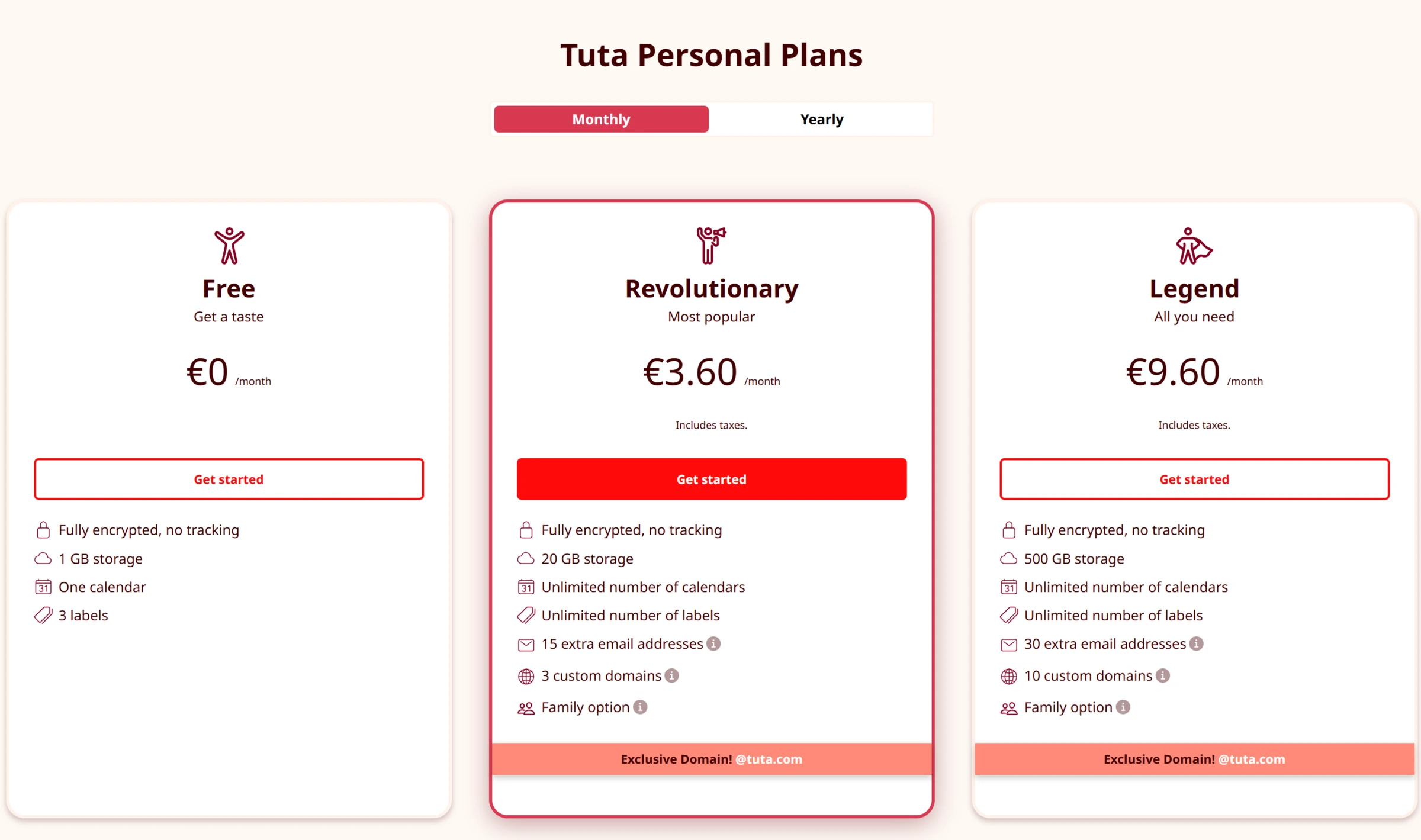
- Tuta Revolutionary: €3/mo (€36/yr). 20 GB storage, 15 email aliases, custom domains, encrypted calendar, full search.
Tuta publishes a EUR3/month rate, while Proton localizes Mail Plus pricing. Compare the current checkout totals. Proton's paid plan also includes IMAP Bridge access, which Tuta does not offer at any price.
Ecosystem bundles:
- Proton Unlimited: bundles Mail, VPN, Drive, Pass, and Calendar; pricing and included limits vary by term, region, and current promotion.
- Tuta Legend: €8/mo. Adds more storage (500 GB), more aliases (30), and whitelabel domains. No VPN, no drive, no password manager bundled.
If all you need is email, Tuta's published entry rate is easier to compare. If you want a privacy ecosystem, price the current Proton bundle against the separate services it would replace.
| Feature | Proton Mail | Tuta |
|---|---|---|
| Encryption Protocol | OpenPGP (battle-tested, widely compatible) | TutaCrypt (proprietary, hybrid quantum-safe) |
| Subject Line Encrypted | ✗ PGP protocol limitation | ✓ Full metadata encryption |
| Quantum-Safe Encryption | ✗ Not yet (VPN has it since 2023) | ✓ ML-KEM-1024, default since March 2024 |
| IMAP / Desktop Clients | ✓ Via Proton Mail Bridge (paid plans) | ✗ Deliberately unsupported |
| Open-Source Clients | ✓ All apps on GitHub | ✓ All apps on GitHub |
| Security Audits | SOC 2 Type II + ISO 27001 + Securitum | SySS GmbH penetration test (2023) |
| Jurisdiction | Switzerland (Proton Foundation, non-profit) | Germany (GDPR, but Fourteen Eyes member) |
| Free Plan Storage | 1 GB (+ 5 GB shared with Drive) | 1 GB |
| Paid Plan Price | Localized by region and billing cycle | €3/mo (Revolutionary) |
| Ecosystem Apps | VPN, Drive, Pass, Calendar | Calendar only |
| Action | Get Proton Mail → | Get Tuta → |
Proton Mail — Full Review
SOC 2 Type II and ISO 27001 certifications combined with IMAP Bridge and a full privacy ecosystem no competitor can match.
Users whose threat model demands subject line encryption or quantum-safe email — Proton's PGP foundation can't deliver either.
- SOC 2 Type II + ISO 27001 — the audit certifications that actually matter to businesses
- IMAP Bridge lets you use Thunderbird, Outlook, or Apple Mail with full encryption
- Proton ecosystem bundles VPN, Drive, Pass, Calendar — one account, one bill
- Swiss jurisdiction with non-profit Proton Foundation backing
- PGP compatibility means encrypted email with anyone using GPG/PGP
- Generous free tier includes Drive storage and limited VPN access
- Subject lines are NOT encrypted — fundamental PGP limitation, not fixable
- No quantum-safe encryption for email yet (VPN has it, mail doesn't)
- IMAP Bridge requires desktop app running — no native IMAP without it
- Localized pricing makes a universal Tuta percentage comparison unreliable
- Mail Plus checkout must be compared against Tuta's published EUR3/month entry rate
Proton Mail's strength is that it doesn't exist in isolation. Once you're inside the Proton ecosystem, everything connects. Your browser auto-fills Proton Pass credentials. Your VPN is one click away. Your files are in Proton Drive. Calendar events link to email threads. It's the closest thing to a privacy-first Google Workspace, and that's exactly what a lot of users are looking for.
SOC 2 is worth explaining for non-business readers: it's not a one-time pentest. It's a continuous audit that evaluates security controls over months. If you're a consultant, lawyer, or freelancer handling client data, SOC 2 is what your clients' compliance teams will ask about. Tuta can't check that box.
Where Proton frustrated me: the subject line issue. I know it's a PGP limitation, not a product choice. But in 2026, when Tuta has solved this with their own protocol, it feels like Proton is carrying legacy debt. If you're emailing your accountant about "Tax Returns 2026" and that subject line is visible in plaintext to anyone with server access, your encryption story has a gap. A real one.
Tuta — Full Review
First major email provider to ship quantum-safe encryption to all users by default, plus full subject line encryption PGP can't offer.
Anyone who needs IMAP support, third-party email clients, or PGP interoperability with the broader encryption ecosystem.
- TutaCrypt: quantum-safe encryption (ML-KEM-1024) default since March 2024
- Encrypts subject lines, sender names, and recipients — not just body and attachments
- Cheapest premium encrypted email — €3/mo with 20 GB storage
- Clean, fast apps on all platforms — minimal attack surface
- Encrypted calendar with event data fully protected
- No Google reCAPTCHA — uses their own verification to avoid Google tracking
- No IMAP support, deliberately locked into Tuta's own apps only
- No PGP compatibility — can't exchange encrypted email with PGP users
- Proprietary encryption protocol has less adversarial scrutiny than PGP
- No ecosystem — just email and calendar, no VPN/drive/password manager
- Only one published security audit (SySS GmbH 2023) — no SOC 2 or ISO 27001
- Germany is a Fourteen Eyes member — weaker jurisdiction than Switzerland
Tuta's decision to build their own encryption protocol from scratch was bold. Most security professionals would say "don't roll your own crypto." But Tuta's implementation has held up. The ML-KEM-1024 component uses a NIST-standardized algorithm, and the hybrid approach means that if the post-quantum part fails, x25519 still protects you. They're the first major email provider to make quantum-safe encryption the default, not an opt-in experiment.
The no-IMAP stance is where Tuta loses users. I understand their security argument — third-party email clients don't enforce Tuta's encryption, so decrypted mail sitting in Thunderbird's local cache defeats the purpose. But plenty of sophisticated users manage their own endpoint security. Refusing to offer IMAP at all, even as an opt-in for power users who accept the trade-off, is paternalistic. It's also a practical dealbreaker for anyone who manages multiple email accounts in a single client.
At €3/month with 20 GB of storage, Tuta is the cheapest serious encrypted email you can get. If you just want encrypted email and calendar without paying for an ecosystem you won't use, the math is simple.
Final Verdict: Which Encrypted Email Should You Choose?
Use Proton Mail if:
- You want encrypted email plus VPN, Drive, password manager, and calendar in one ecosystem
- You need IMAP Bridge to use Thunderbird, Outlook, or Apple Mail
- SOC 2 and ISO 27001 compliance matter for your business or clients
- You exchange encrypted emails with PGP users outside your provider
- You're already in the Proton ecosystem (Proton VPN, Drive, Pass)
- Swiss jurisdiction and non-profit structure give you extra peace of mind
Use Tuta if:
- Subject line encryption is critical to your threat model
- You want quantum-safe encryption now, not "eventually"
- You want the cheapest path to serious encrypted email (€3/mo)
- You don't need IMAP or third-party client support
- You prefer a minimal, focused email service over a bundled ecosystem
- You object to Google reCAPTCHA tracking during account creation
For most users reading this site, Proton Mail is the better choice. You get IMAP Bridge, SOC 2 audits, and an ecosystem that replaces Gmail, Google Drive, and Chrome password manager in one move. That's a practical privacy upgrade Tuta can't match.
That said, Tuta has done something Proton hasn't: quantum-safe encryption, default for every user, shipping right now. Not on a roadmap. Not behind a flag. Live. If the encryption protocol itself is what you care about most, Tuta is ahead. And at €3/month, it's hard to argue with the price.
Frequently Asked Questions
Ready to check Proton Mail?
Use the verified route if the trade-offs still fit. If not, jump back to the summary and compare the alternatives.
Security and privacy editor focused on evidence-led buying guides. Reads official documentation, audit notes, privacy policies, recovery limits, and support pages before turning security claims into practical recommendations.
Sarah starts by locating the evidence boundary, then ranks security and privacy tools by audit and policy scope, recovery design, trust boundaries, residual risk, and what a cautious buyer can verify.
Related Articles
Venice AI vs Proton Lumo vs Duck.ai: Which Private AI Chat Fits?
Private AI chat decision guide
Venice AI, Proton Lumo, and Duck.ai compared by privacy architecture, saved-history protection, provider exposure, plan limits, model access, and price.
Malwarebytes vs Bitdefender vs Norton
Paid antivirus decision guide
Malwarebytes, Bitdefender, Norton, and Microsoft Defender compared by paid antivirus value, real-time protection, renewal risk, bundle scope, and lab evidence.