
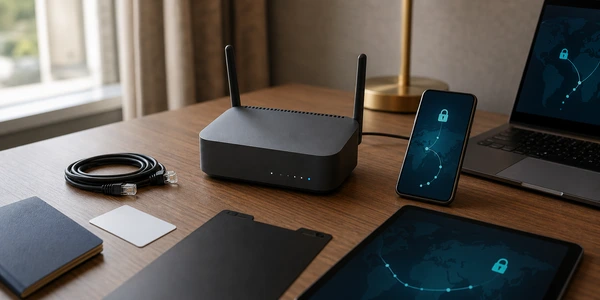
NordVPN is my first mainstream shortlist pick, but not because it is magically private or a discount timer says to hurry.
The honest NordVPN review verdict: it is a polished, feature-heavy VPN for people who want the category to feel simple, with one serious caveat - you need to manage the renewal price before you buy a long plan. If your threat model is strict anonymity, corporate diversification, or flat pricing, this should not be your only tab.
This is an evidence-led review. I checked official pricing, renewal language, device limits, stored-information policy, NordVPN's current scam and phishing protection scope, and no-logs assurance material. I did not create an account, install an app, connect to a VPN server, run speed tests, unblock streaming services, run DNS/WebRTC leak tests, contact support, or test refund and cancellation flows.
If you are still choosing the category, start with our best VPNs roundup. If you want NordVPN against privacy-first Proton, use the Proton VPN vs NordVPN comparison. If the decision is really household value, read NordVPN vs Surfshark before you accept a long intro offer.
How to read this NordVPN review
VPN reviews get slippery fast. One page calls a service the fastest, another calls it the most private, a third says the same company is perfect for streaming, and none of that helps if the claim is detached from method. For this page, I am using a narrower standard: what can a buyer verify before handing over card details?
Official pages are useful because they show what the company is willing to publish in public. They are also limited because they are written by the company. That is why the strongest parts of this review are the dull parts: support articles, device rules, stored-information language, and the difference between NordVPN's full malware-protection layer and its lighter cross-platform scam and phishing protection.
I am not using Reddit sentiment as evidence here. r/VPN and r/nordvpn can be useful places to look for fresh complaints after a product update, but quick community threads tend to mix coupons, support questions, angry one-off cases, and referral noise. Without a concrete thread worth citing, I would rather leave Reddit out than pretend it proves how most buyers feel.
So treat this page as a purchase filter, not a lab report. It can tell you whether NordVPN belongs on your shortlist, where the weak spots are, and which alternative to compare next. It cannot tell you your local speed, whether a specific streaming catalog works today, how a support agent will handle your ticket, or whether a future app update will behave well on your exact device mix.
-
#1 NordVPNBest mainstream VPN pick when you want a strong bundle, ten-device coverage, and current public no-logs assurance
-
#2 Proton VPNBetter privacy-first shortlist pick when Swiss jurisdiction, open-source posture, and ecosystem trust matter more
-
#3 MullvadBetter flat-price anonymity pick when account minimalism matters more than a mainstream bundle
For most mainstream buyers, I would start with NordVPN , write the renewal date in the calendar, and avoid buying the bigger bundle unless the extras are actually used. For stricter privacy setups, I would compare Proton VPN and Mullvad before paying.
NordVPN review verdict: strong default, real renewal risk
NordVPN wins the default slot because it is easy to explain. You get a large consumer VPN brand, mature apps, ten simultaneous devices, router coverage as a workaround for bigger households, scam and phishing protection features, Meshnet-style utility, and a public no-logs assurance trail that is more current than many mainstream competitors.
The catch is that the buying experience still depends on promotional pricing. The official U.S. page checked July 11 showed the 2-year Basic plan at $3.49 per month ($94.23 for the first 27 months), Complete at $4.49 per month ($121.23), and Prime at $7.49 per month ($202.23), before sales tax. Those are observed official-page prices, not a universal promise for every region or checkout.
That makes NordVPN a good buy only if the bundle is worth it to you. If you just want a simple, audited VPN and do not care about Nord extras, a lower-friction alternative may age better after the first term.
The useful part is not one magic VPN feature. It is the bundle: ten devices, router coverage, scam and phishing protection options, current no-logs assurance material, and enough polish that non-technical buyers are less likely to abandon setup.
Skip it if you want flat pricing, anonymous account creation, cash payment, a non-mainstream corporate footprint, or hands-on lab results from this article.
NordVPN scores well for mainstream usability, app coverage, security extras, and public assurance evidence. It loses points for promotional pricing complexity and because this review did not verify live speed, streaming, leak behavior, support, or refund workflows.
- Strong mainstream app ecosystem and simple buyer story.
- Official support page says ten devices can connect at the same time.
- Current public no-logs assurance announcement from February 2026.
- NordVPN includes separate scam/phishing and malware-protection layers for supported platforms.
- Good internal fit with a broader password manager, privacy browser, and security-key stack.
- Intro prices and renewal references require active management.
- This article did not verify speed, streaming, leaks, support, refund, or cancellation behavior.
- The full malware-protection layer is limited to Windows and the sideloaded macOS app.
- Privacy-hardline buyers should still compare Proton VPN and Mullvad.
- Bundled plans can push buyers toward extras they may not need.
NordVPN pricing: the intro price is not the whole price
The price that matters is bigger than the monthly number. NordVPN's official U.S. page showed Basic at $94.23 for the first 27 months and a $139.08/year renewal reference. Complete showed $121.23 for the first term and $219.48/year at renewal. Prime showed $202.23 for the first term and $296.28/year at renewal, before sales tax.
That does not mean your checkout will match those exact values. VPN pricing changes by country, tax, term, promotion, add-on, and account path. The right move is boring: screenshot your checkout total, note the renewal date, and decide whether Basic is enough before a bundle upsell turns a VPN subscription into a security-suite subscription.
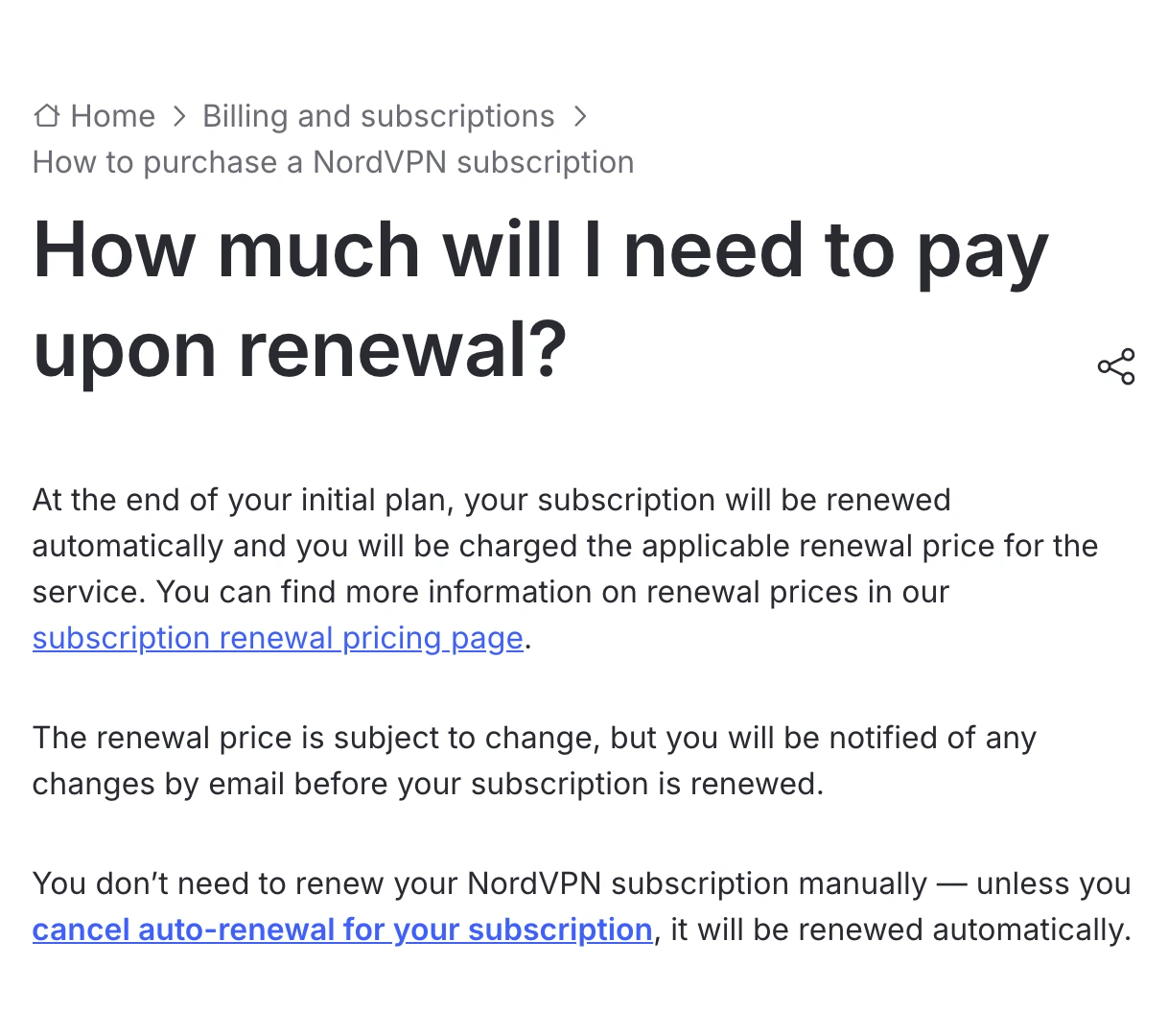
The support-page language is the reason I keep calling this a renewal-risk product rather than a cheap VPN. NordVPN says the subscription renews automatically at the applicable renewal price unless you cancel auto-renewal, and that renewal pricing can change with email notice. That is normal in the VPN market, but it is still the buyer risk most comparison pages treat too softly.
Privacy and no-logs: good evidence, still not a guarantee
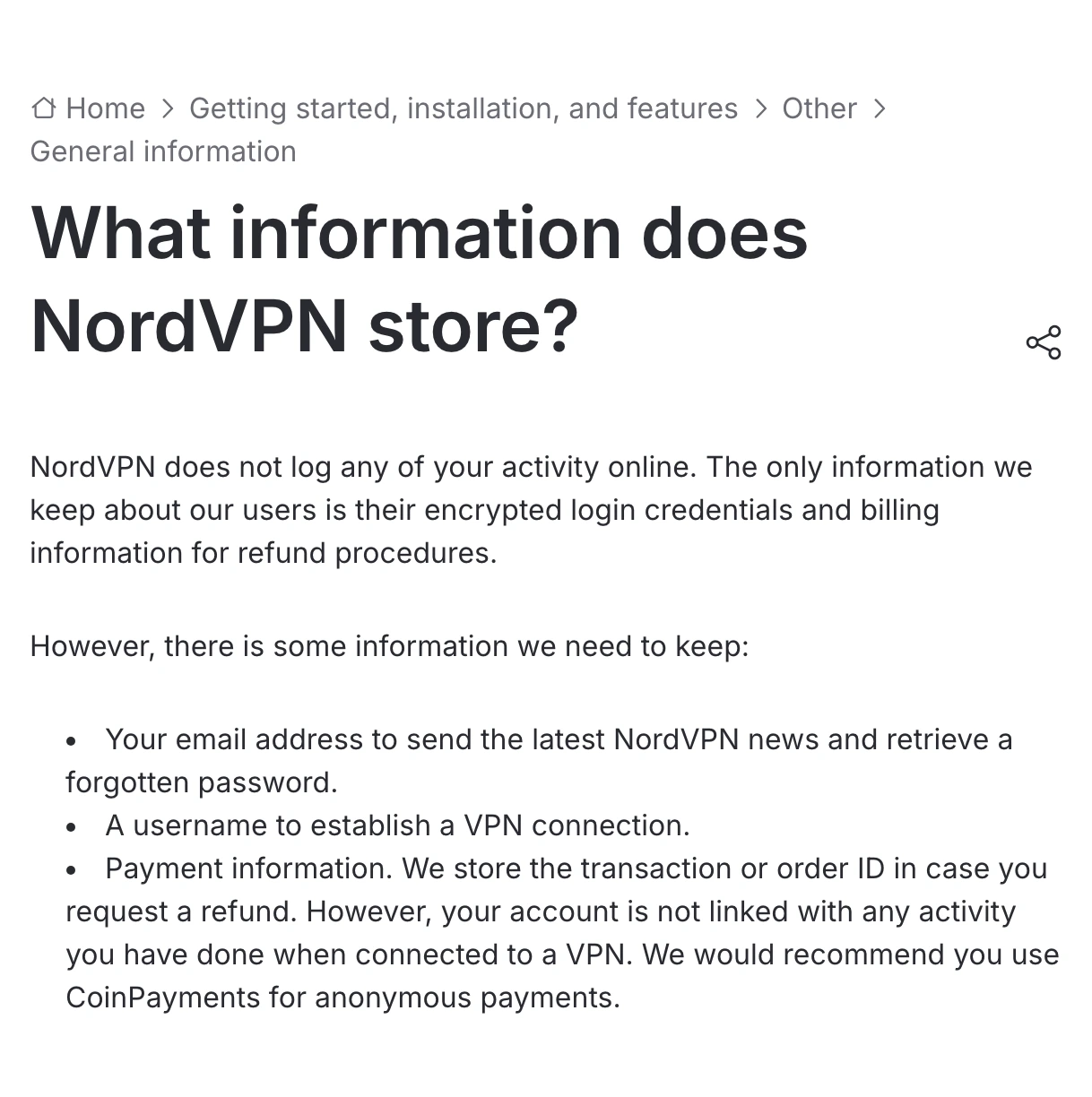
NordVPN's strongest trust argument is not a vague privacy slogan. Its support page says it does not log online activity and lists the account and billing data it keeps, including encrypted login credentials, email/account identifiers, and payment or order information for refund procedures.
The audit trail also matters. NordVPN announced in February 2026 that it completed a sixth independent no-logs assurance engagement, with Deloitte Lithuania reviewing the late-2025 period under ISAE 3000. The important limitation is that this is still a point-in-time assurance engagement. It improves confidence; it does not turn a commercial VPN into a privacy guarantee.
If your threat model is casual ISP shielding, public Wi-Fi, travel, streaming friction, or basic privacy hygiene, that evidence is enough to put NordVPN on the shortlist. If your threat model is activism, sensitive journalism, high-risk crypto operations, or anonymity from account metadata, compare a stricter privacy provider and do not let a mainstream VPN brand do all the thinking for you.
The NordVPN features that change the decision
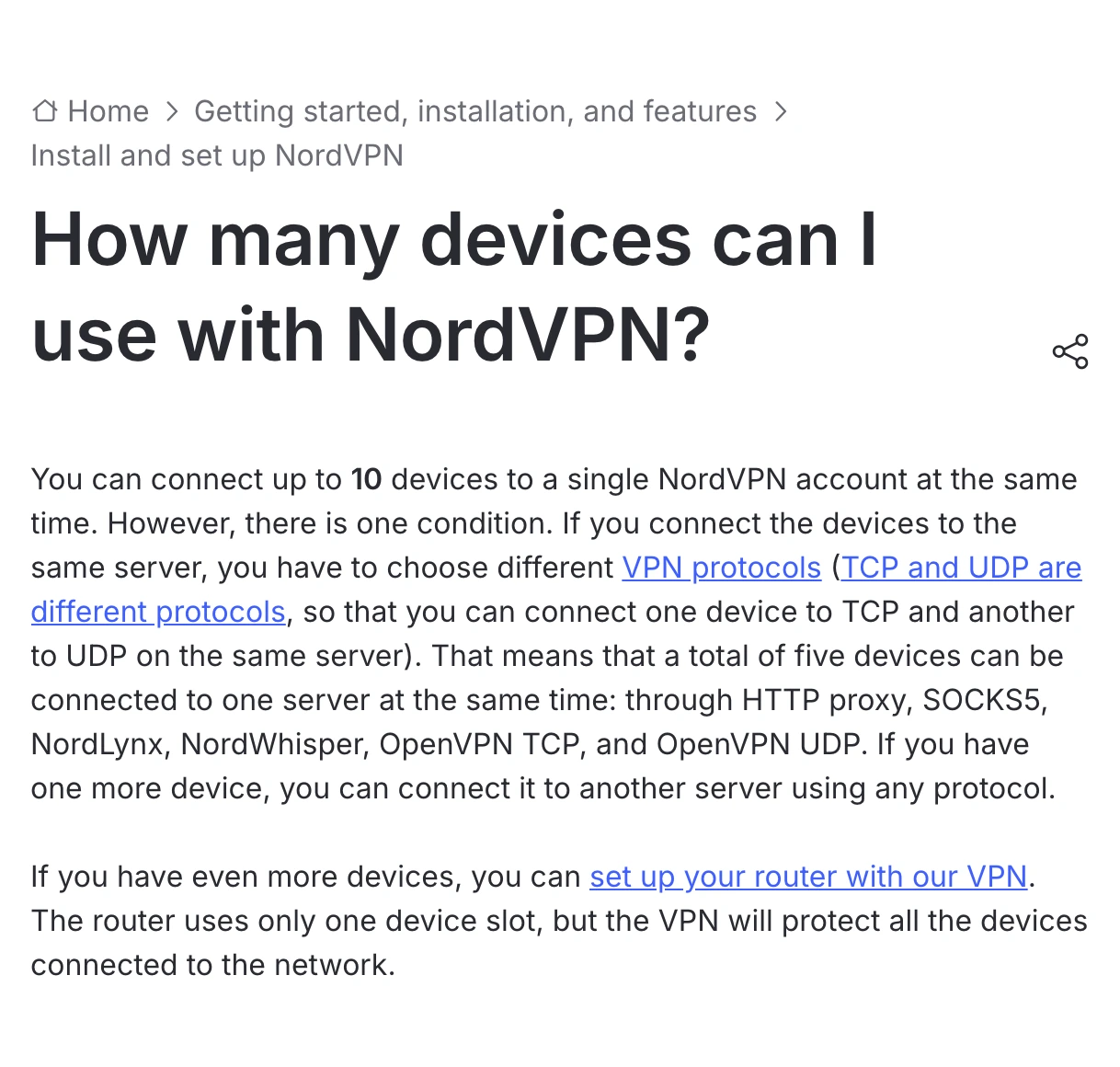
NordVPN's feature set is strongest when you think beyond one laptop. Its support page says ten devices can connect at the same time on one account, with a same-server protocol caveat, and that router setup can protect more devices while using one device slot. That is not the same as Surfshark's unlimited-device promise, but it is enough for many solo buyers, couples, and small families.
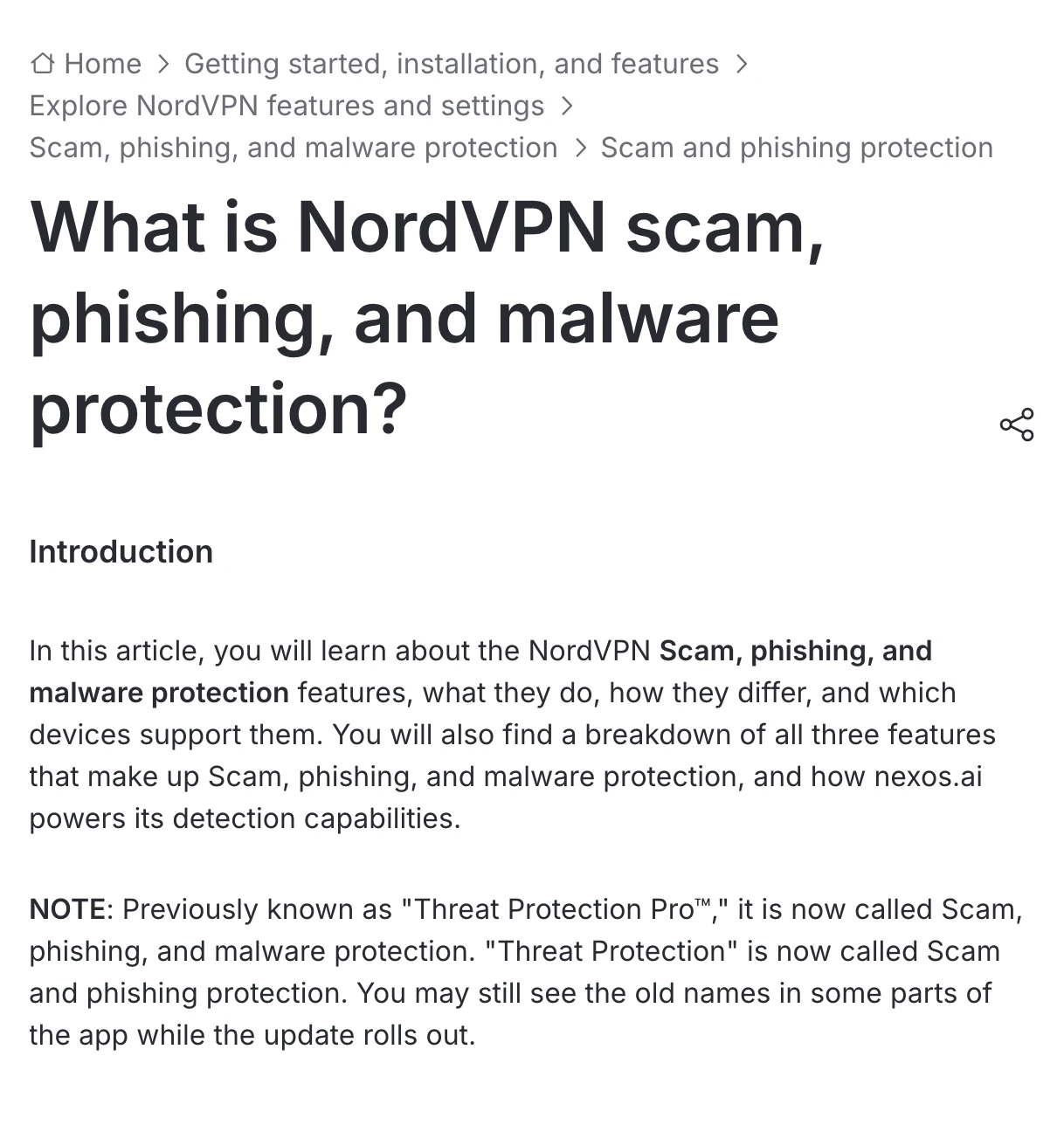
NordVPN has renamed its security extras. The feature previously called Threat Protection Pro is now Scam, phishing, and malware protection, while Threat Protection is now Scam and phishing protection. NordVPN says the old names may still appear in parts of the apps while the rollout continues.
NordVPN lists the full scam, phishing, and malware protection layer for Windows 10/11 and the sideloaded macOS 12-or-newer app. Its lighter scam and phishing protection is available on macOS, Windows, Android, iOS, Linux, Android TV or Fire Stick, and NordVPN's Chrome, Firefox, and Edge extensions.
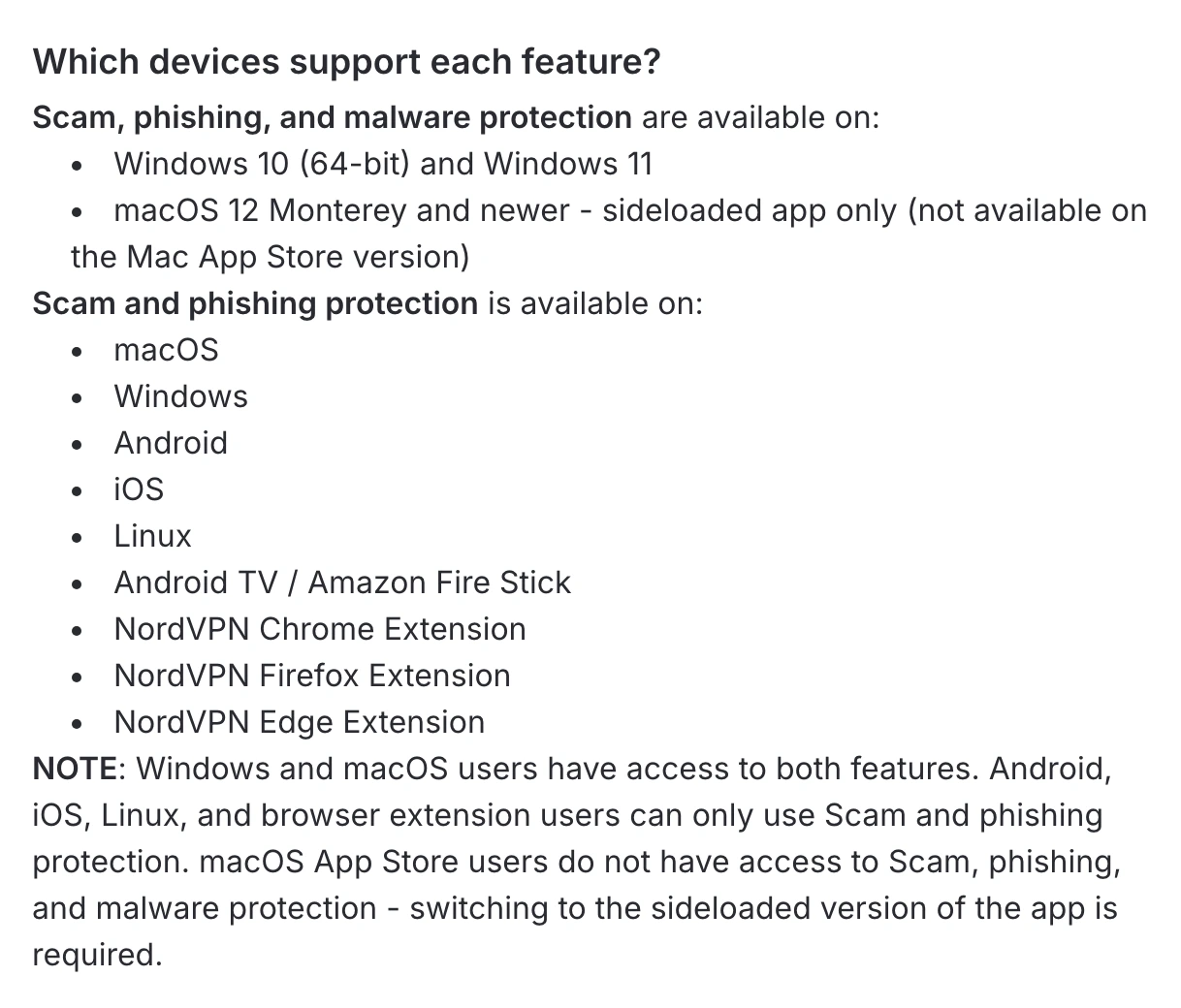
If you use Windows or the sideloaded macOS app, both layers are part of the bundle story. If your life is mostly iPhone, Android, Linux, or browser extensions, do not treat the lighter feature as a full malware-security replacement.
The checklist I would use before signing up
Before buying NordVPN, I would write down three things: the devices that need coverage, the networks that actually worry you, and the extras you will use in the first week. If the answer is one laptop and one phone on hotel Wi-Fi, Basic may be enough. If the answer is every family device plus browser filtering plus a travel router, NordVPN starts to make more sense as a bundle.
The device list is the boring sanity check. Count phones, laptops, tablets, streaming boxes, and shared machines. Then decide whether those devices need the VPN app directly or whether a router setup is the cleaner approach. NordVPN's support page makes the router option important because it can protect more devices while using one device slot, but router setup also means more configuration work and less portability.
Next, look at the operating systems. The full scam, phishing, and malware protection layer is most persuasive on Windows and sideloaded macOS. If your security habits live on iOS, Android, Linux, or browser extensions, value the lighter scam and phishing protection differently. It may still help, but it is not the same product surface.
Finally, decide what you are trying to hide. A VPN can stop a coffee-shop network or hotel Wi-Fi operator from seeing raw browsing traffic. It can reduce casual ISP visibility. It can make travel browsing less annoying. It does not fix weak passwords, reused credentials, malicious browser extensions, account recovery weaknesses, or data brokers that already have your home address.
If NordVPN is one layer in a wider stack, it is easy to recommend. Pair it with a password manager, passkeys or a security key, a trusted browser, and the right paid antivirus decision for devices that need real-time malware protection. If NordVPN is supposed to be the whole privacy strategy, slow down. A VPN is a tunnel. It is not a personality transplant for your digital life.
NordVPN vs Proton VPN, Surfshark, and Mullvad
NordVPN is not the universal best VPN. It is the strongest mainstream default in this review because it balances polish, current no-logs assurance, device coverage, and useful extras. But the alternative changes when the buyer fear changes.
1. NordVPN: best mainstream default if you will manage the subscription
Start with NordVPN if the real buyer job is simple coverage across travel, home Wi-Fi, and everyday devices. It wins this review because the bundle is coherent: mature apps, ten-device support, router coverage as a fallback, protection scope that is spelled out in support docs, and a current public no-logs assurance announcement. The tradeoff is discipline. If you know you will ignore subscription reminders, NordVPN becomes easier to regret.
2. Proton VPN: better if privacy culture matters more than bundle depth
Pick Proton VPN instead if the buyer fear is not hotel Wi-Fi but trust model. Proton is the cleaner fit for readers who care about Swiss jurisdiction, open-source posture, and keeping VPN, email, drive, and password workflows under one privacy-first brand. The reason it does not replace NordVPN as the default here is practical: many mainstream buyers want the smoother consumer bundle first. Proton wins when the privacy story is the product, not the extra.
3. Surfshark: better if the household has too many devices
Pick Surfshark if the wrong-buyer risk is paying for a VPN that cannot comfortably cover the household. Surfshark's unlimited-device angle is the reason it keeps showing up in this cluster. A family with phones, laptops, tablets, TVs, and browser extensions can make NordVPN's ten-device limit feel tighter than it looked on the product page. The tradeoff is that Surfshark is still a mainstream promo-heavy VPN, so the same checkout and subscription discipline applies.
4. Mullvad: better if anonymity and flat math beat convenience
Pick Mullvad if the buyer does not want the mainstream bundle at all. Mullvad is the better fit for people who value account minimalism, simple math, and a privacy posture that feels less like a consumer security suite. The reason it loses the default recommendation here is that it asks the reader to care about a different set of things. If you want NordVPN's polish, Mullvad can feel sparse. If you want less marketing gravity, that sparseness is the point.
| Feature | NordVPN | Proton VPN | Surfshark | Mullvad |
|---|---|---|---|---|
| Best fit | Mainstream buyer who wants a polished VPN bundle | Privacy-first buyer already drawn to Proton ecosystem | Families and device-heavy homes | Anonymity and flat-price buyers |
| Pricing style | Intro pricing with renewal references | Free tier plus paid plans | Aggressive promo pricing with renewal caveats | Flat-price model |
| Privacy posture | Current no-logs assurance announcement plus account/billing data caveats | Swiss privacy brand with open-source/security positioning | Mainstream VPN brand under the same broader Nord Security orbit | Minimal-account posture is the reason to compare it |
| Device angle | Ten simultaneous devices; router can cover more | Better for Proton ecosystem consolidation | Unlimited devices is the value argument | Better for privacy minimalists than bundle seekers |
| Main caveat | Renewal and bundle upsell discipline required | Not always the easiest mainstream streaming/value pick | Bundle value can be more persuasive than privacy differentiation | Less mainstream bundle depth than NordVPN |
| Action | See pricing | Try free | See pricing | See pricing |
For a typical family, Surfshark deserves a serious look because unlimited devices changes the math. For a privacy maximalist, Mullvad and Proton VPN deserve a serious look because account model, jurisdiction, and privacy culture matter more than bundle breadth. For someone who wants the most straightforward mainstream VPN with enough extra security features to justify the subscription, NordVPN is still the sensible first click.
Who should buy NordVPN
Buy NordVPN if you want a polished VPN that can cover ordinary travel, hotel Wi-Fi, public networks, streaming friction, and household devices without turning into a research project. It is also a good fit if you already planned to pay for a VPN and would actually use its scam and phishing protection, Meshnet-style private networking, router coverage, or the broader Nord security bundle.
Do not buy NordVPN because a review says it is the fastest VPN unless that review shows fresh methodology, regions, servers, baseline ISP speed, protocols, test runs, and date. This page does not provide that. It is better at answering a different question: whether the official evidence and buyer trade-offs are strong enough to justify putting NordVPN on your paid shortlist.
If you do buy, the operating checklist is simple: choose the smallest plan that solves the real problem, save the checkout price, mark the renewal date, turn off auto-renewal if you do not want renewal surprise, and pair the VPN with basics from our password manager guide, security key comparison, and privacy browser guide. A VPN is one layer, not the whole privacy stack.
Who should skip NordVPN
Skip NordVPN if you hate promotional pricing and renewal management. Skip it if anonymous account creation is more important than mainstream convenience. Skip it if you need a provider whose pricing model does not nudge you toward bundles. Skip it if your employer, regulator, or client requires documented lab testing for speed, leaks, or platform behavior.
I would also skip the higher NordVPN bundles unless you can name the exact features you will use. A VPN plus password manager plus dark-web monitor plus insurance-style extras can be useful, but it can also become a subscription bundle that feels cheaper on day one and less rational at renewal.
Final verdict: should you buy NordVPN in 2026?
NordVPN remains one of the easier VPNs to recommend to a normal buyer because the bundle is coherent and the public trust evidence is current. The support-page evidence is also plain enough: ten simultaneous devices, automatic renewal at the applicable renewal price, specific stored-information caveats, and platform limits around the full scam, phishing, and malware protection layer.
That is enough for an 8.4/10 evidence-led score, not a perfect score. The renewal caveat is real, and this review does not replace hands-on VPN testing. If you want a polished mainstream VPN, start with NordVPN . If you want stricter privacy posture or cleaner pricing, compare Proton VPN, Mullvad, and Surfshark before committing.
NordVPN review FAQ
Ready to check NordVPN?
Use the verified route if the trade-offs still fit. If not, jump back to the summary and compare the alternatives.
Security and privacy editor focused on evidence-led buying guides. Reads official documentation, audit notes, privacy policies, recovery limits, and support pages before turning security claims into practical recommendations.
Sarah starts by locating the evidence boundary, then ranks security and privacy tools by audit and policy scope, recovery design, trust boundaries, residual risk, and what a cautious buyer can verify.
Related Articles

Venice AI vs Proton Lumo vs Duck.ai: Which Private AI Chat Fits?
Private AI chat decision guide
Venice AI, Proton Lumo, and Duck.ai compared by privacy architecture, saved-history protection, provider exposure, plan limits, model access, and price.
Malwarebytes vs Bitdefender vs Norton
Paid antivirus decision guide
Malwarebytes, Bitdefender, Norton, and Microsoft Defender compared by paid antivirus value, real-time protection, renewal risk, bundle scope, and lab evidence.