

Mailchimp owns 64% of the email marketing tool market. And they just gutted their free plan to 250 contacts and 500 emails per month. That's not even enough to send one newsletter to a small mailing list.
Meanwhile, they still charge you for unsubscribed contacts. Let that sink in. People who explicitly told you they don't want your emails are inflating your Mailchimp bill every month. Reddit is full of users reporting surprise invoices for contacts they can't even reach.
Worth separating one thing early: newsletter software is not the same as cold outbound. If you are still deciding who deserves outreach before any email leaves the domain, our AI sales prospecting tools guide covers the research layer. If you are evaluating sales-engagement tools instead of broadcasts, our Instantly vs Lemlist comparison covers the sending side of the stack. And if the problem is your own inbox, not campaigns, the AI email assistant comparison is the cleaner starting point.
Same warning for support inboxes: don't buy an email platform and expect it to become a help desk. If the work is ticket routing, deflection, and live customer replies, our AI customer support tools comparison covers that market separately. If the shortlist is Help Scout, Intercom, and Zendesk, use the direct support desk comparison before you move customer replies out of email.
I spent the last two weeks pulling apart the pricing pages, Reddit threads, and Trustpilot reviews for 7 email marketing platforms. Not 15. I'm not going to pretend I meaningfully evaluated tools I glanced at for 30 seconds. Seven tools, real pricing math, honest opinions.
The short version: two platforms are overcharging for what they deliver, one had a controversial 35% price hike, and a couple of budget options are genuinely impressive for the price. Here's the breakdown.
-
#1 MailerLiteBest overall — clean interface, generous free tier, only charges for active contacts
-
#2 BrevoBest for large lists — charges by emails sent, not contacts. 100k contacts for free
-
#3 MoosendBudget pick — full features for $9/mo, unlimited emails, 30-day free trial
MailerLite — The One That Does Everything Right (Almost)
MailerLite doesn't try to be everything. No built-in CRM. No webinar hosting. No SMS marketing. It just does email, and it does email really well.
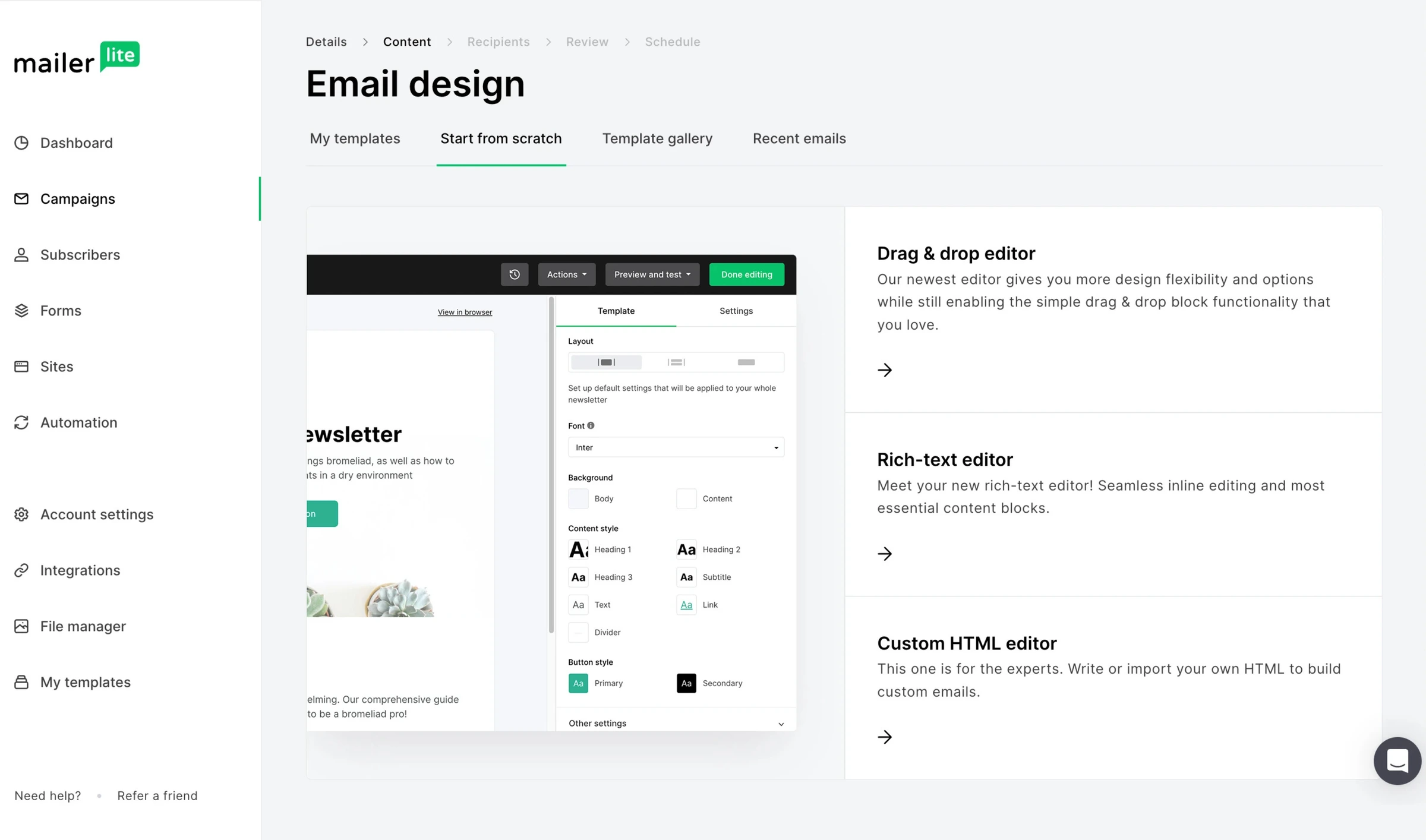
The drag-and-drop editor is clean. Not "clean for an email tool," actually clean. Templates look modern, the builder doesn't fight you, and you can go from blank canvas to finished newsletter in maybe 15 minutes. Compare that to Mailchimp's editor, which has gotten bloated with features nobody asked for while the core building experience got worse.
Free plan: 1,000 subscribers, 12,000 emails/month. That's 12 newsletters to your entire list every month before you pay a cent. Mailchimp gives you 250 contacts and 500 emails. MailerLite's free tier alone would have cost $13/month on Mailchimp's Essentials plan.
And here's the detail I keep coming back to: MailerLite only counts active subscribers. Unsubscribed? Gone. Bounced? Gone. You're not paying for dead weight. This sounds like it should be the default, but Mailchimp and Kit both count inactive contacts toward your bill.
The automation is solid for the price. Visual workflow builder, triggered sequences, A/B testing on subject lines and content. It's not ActiveCampaign-level deep, but 90% of small businesses don't need that depth. If your automation needs go beyond "welcome sequence → nurture series → promotion," you've outgrown MailerLite. For everything else, it's more than enough.
One thing that bugs me: no phone support on any plan. Email and live chat only. If you're the kind of person who needs to call someone when things break, that's worth knowing. But honestly? Their documentation is good enough that I've never needed to.
Only charges for active subscribers, so unsubscribed and bounced contacts never inflate your bill.
Teams needing deep automation with conditional splits, lead scoring, or multi-channel SMS marketing.
- Free plan covers 1,000 subscribers with 12,000 emails/month — more generous than Mailchimp, Kit, or Beehiiv combined
- Only charges for active contacts. Unsubscribed and bounced addresses are automatically excluded from billing
- Growing Business plan starts at just $10/month for 500 contacts with unlimited emails — hard to beat
- Clean, modern email builder that doesn't require a design degree to produce professional-looking newsletters
- Automation is functional but not deep. No conditional splits based on purchase history, no lead scoring, no CRM integration
- No phone support on any plan — email and live chat only. Enterprise is the exception but requires 100k+ subscribers
- Free plan limits you to a single user. If your team has 2+ people managing email, you need the $10/month plan minimum
- No built-in SMS or WhatsApp marketing. If you need multi-channel, look at Brevo or GetResponse instead
Use it or skip it? Use it. For solo creators, small businesses, and anyone under 50,000 subscribers, MailerLite is the best balance of features, simplicity, and price. Skip it only if you need deep automation or multi-channel marketing. Then look at Brevo or GetResponse.
Brevo — Charges by Emails, Not Contacts (That Changes Everything)
Every other tool on this list charges based on how many contacts you have. Brevo flips that entirely. You pay based on how many emails you send.
Why does that matter? Because a 50,000-contact list on Mailchimp costs $350+/month just to exist. On Brevo, those 50,000 contacts cost exactly $0. You only pay when you actually email them. If you send 20,000 emails to your 50,000-person list, that's $18/month on the Standard plan. Do the math on that difference.
For businesses with large but infrequently-emailed lists (event companies, seasonal retailers, real estate agents with big databases), Brevo's model saves hundreds per month. It's the single biggest differentiator in the email marketing space and most comparison articles barely mention it.
The free tier is surprisingly capable: 300 emails/day (roughly 9,000/month) with unlimited contacts. The catch? Brevo branding on every email. Removing the logo costs an extra $10.80/month on top of your plan, which feels a bit nickel-and-dimey.
Beyond email, Brevo bundles SMS marketing, WhatsApp campaigns, and a basic CRM, all in one platform. If your automation stack currently involves stitching together 3 separate tools, Brevo might consolidate that. The automation builder isn't as visual as Make or Zapier, but for email-specific workflows, it gets the job done.
Charges by email volume instead of contacts, so a 50,000-contact list costs $0 in base fees.
Small lists under 1,000 contacts where MailerLite's free plan is simpler and more generous.
- Pricing by email volume instead of contacts — a 50,000-contact list costs $0 in base fees. Only Brevo does this
- Free plan includes unlimited contacts with 300 emails/day. No other free tier matches this contact allowance
- Built-in SMS, WhatsApp, and push notification marketing. No separate tools or integrations needed
- 99%+ deliverability rate backed by dedicated IP options on higher plans
- Removing the Brevo logo from emails costs an extra $10.80/month — feels like a tax on professionalism
- Starter plan caps automation at 2,000 contacts. Automated workflows for larger lists require the $18/month Standard plan
- The email editor is functional but dated compared to MailerLite's or Mailchimp's — fewer modern templates out of the box
- Professional plan jumps to $499/month, which is steep. There's a big pricing gap between Standard and Pro
Use it or skip it? Use it if you have a large contact list but don't email them daily. The per-email pricing model will save you real money. Skip it if your list is under 1,000 contacts — MailerLite's free plan is simpler and more generous at that scale. Users on r/emailmarketing consistently recommend MailerLite as the best starting point.
Moosend — $9/Month and You Get Everything
No tiers. No feature gating. No "upgrade to unlock automation." Moosend has one paid plan, Pro, and it includes everything.
$9/month for 500 subscribers with unlimited emails. $16/month for 1,000. $48/month for 5,000. All with the same features: drag-and-drop editor, automation workflows, landing pages, reporting, A/B testing. That's it. No gotchas in the pricing page, no asterisks leading to a footnote about overage charges.
I keep waiting for the catch and it hasn't appeared. The automation builder handles multi-step sequences, conditional triggers, and cart abandonment flows. The templates are decent, not MailerLite-level polished, but perfectly usable. Deliverability sits in the 98%+ range according to independent tests.
The biggest downside? No permanent free plan. Moosend offers a 30-day free trial and that's it. If you're bootstrapping on zero budget, MailerLite or Brevo's free tiers are better starting points. But the moment you're ready to spend $9/month, Moosend arguably gives you more for that $9 than anyone else.
Also worth mentioning: the affiliate program pays 30-40% lifetime recurring commission with a tiered structure. Bronze starts at 30%, and if you refer 36+ paid accounts you hit Diamond at 40%. That's among the best commission structures in the email marketing space.
One paid plan includes everything from automation to A/B testing with zero feature gating or tier confusion.
Anyone who needs a free plan to get started, since Moosend only offers a 30-day trial.
- One plan, all features included. No tier confusion — $9/month gets you everything from automation to A/B testing
- Unlimited emails on every paid plan. No send caps, no overage charges, no surprises
- Annual billing drops to $7/month for 500 contacts — the cheapest paid option in this roundup by a significant margin
- Nonprofits get an additional 25% discount on top of annual pricing
- No free plan — only a 30-day trial. If budget is literally zero, you need MailerLite or Brevo instead
- Template library is smaller and less modern than MailerLite's or Mailchimp's. You'll probably customize heavily
- Fewer third-party integrations than the big players. Check their integrations page before committing if you rely on niche tools
- No SMS or multi-channel marketing. Email only — if you need SMS, look at Brevo or GetResponse
Use it or skip it? Use it if you want the simplest possible pricing with zero feature restrictions. At $9/month for everything, there's no cheaper option that doesn't compromise on features. Skip it if you need a free tier to start.
GetResponse — When You Need More Than Just Email
GetResponse is the Swiss Army knife entry. Email marketing, landing pages, webinar hosting, conversion funnels, AI-powered send-time optimization, all bundled together. Whether that's a pro or con depends on how many of those features you'll actually use.
The standout feature nobody else offers: native webinar hosting. If your business runs webinars for lead generation, GetResponse eliminates the need for a separate Zoom or WebinarJam subscription. The Creator plan includes webinars for up to 100 attendees. That alone could save you $40-50/month on a standalone webinar tool.
Pricing starts at $13.30/month for the Starter plan with 1,000 contacts. The Marketer plan ($49/month) unlocks full automation, and the Creator plan ($59/month) adds webinars, courses, and paid newsletters. It's not cheap, but the per-feature value is competitive if you actually use the extras.
The affiliate program is solid: 33% recurring commission or a flat $100 per referral, your choice. The 120-day cookie is one of the longest in the industry.
Where it falls short: the email builder is functional but feels like it was designed in 2019 and hasn't been fundamentally updated since. Templates exist but they're not winning any design awards. If visual polish matters to your brand, you might find yourself fighting the editor more than necessary.
Native webinar hosting eliminates a separate $40-50/month Zoom or WebinarJam subscription.
Anyone who just sends newsletters, since you would be paying for webinar, funnel, and course features you will never touch.
- Native webinar hosting included — eliminates a separate $40-50/month webinar subscription for many businesses
- AI-powered send-time optimization learns when your subscribers actually open emails and adjusts delivery automatically
- Conversion funnels built in — landing page → email sequence → webinar → sale, all in one platform. No Zapier glue needed
- Free plan available for up to 500 contacts with basic email marketing features
- Starter plan limits AI tools to 3 uses and automation to 1 workflow. Meaningful automation requires the $49/month Marketer plan
- Email builder feels dated compared to MailerLite or Mailchimp. Template designs need more modernization
- Pricing jumps are significant — $13.30 to $49 to $59. The gap between Starter and Marketer is a 3.7x increase
- The sheer number of features creates a learning curve. If you just need simple newsletters, this is overkill and overpriced
Use it or skip it? Use it if you run webinars or need an all-in-one marketing platform that goes beyond email. The bundled features genuinely save money if you'd otherwise pay for 3 separate tools. Skip it if you just send newsletters. You're paying for features you won't touch.
Mailchimp — The Name Everyone Knows (and Increasingly Regrets)
I'll say something controversial: Mailchimp is coasting on brand recognition. The product isn't bad. The pricing is.
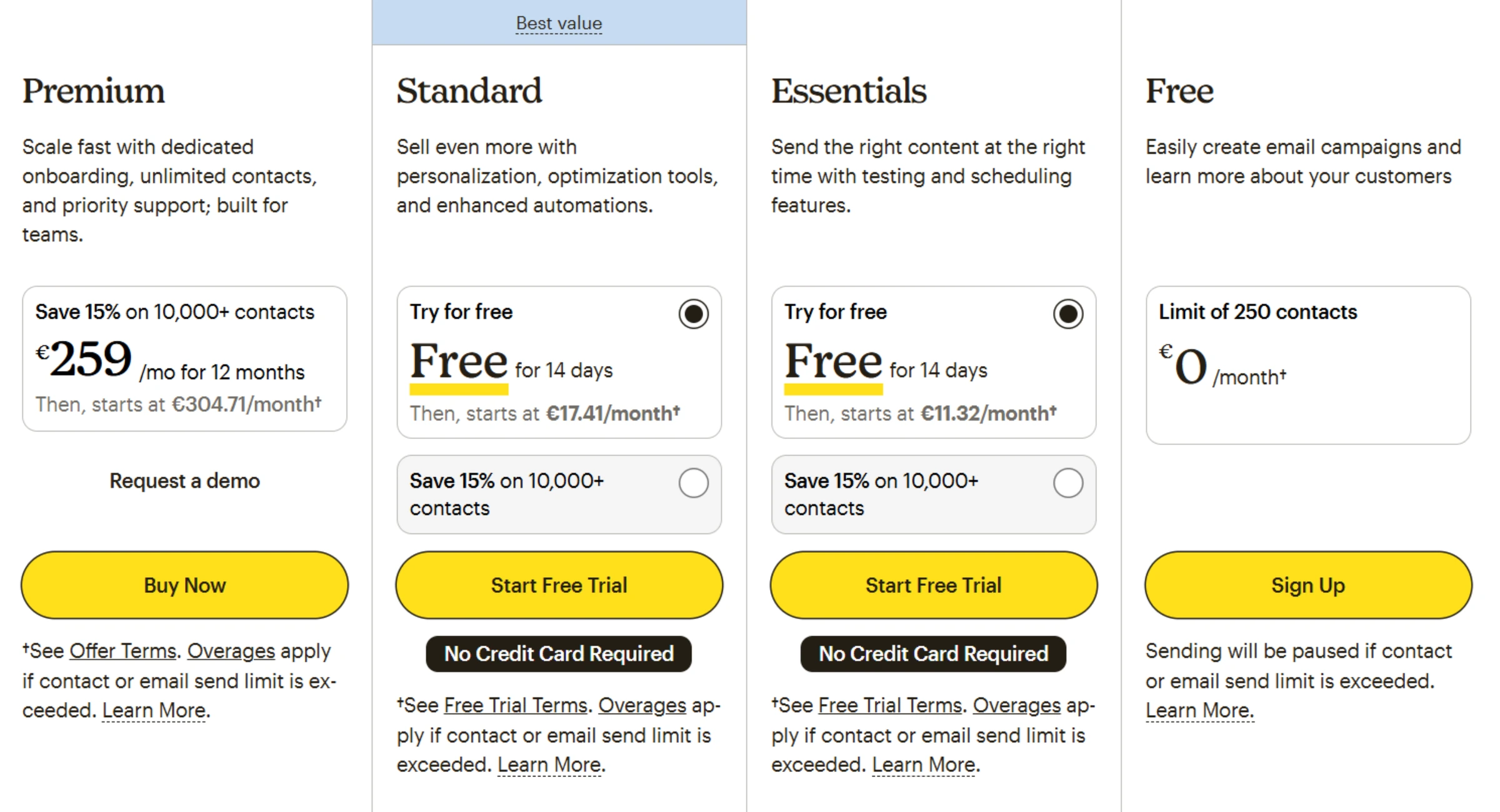
Start with the free plan massacre. It used to be 2,000 contacts with 10,000 emails/month, one of the best free tiers in the industry. Now it's 250 contacts, 500 emails/month, and zero automation. That's barely enough to test the platform, let alone run a real business on it.
Essentials starts at $13/month for 500 contacts. Standard is $20/month. Premium is $350/month for 10,000 contacts. These prices aren't outrageous in isolation, but compare them to MailerLite ($10/month for 500 contacts with unlimited emails) or Moosend ($9/month with all features) and the premium evaporates.
Then there's the contact billing issue. Mailchimp counts unsubscribed and bounced contacts toward your total. If someone on your list unsubscribes, you're still paying for them unless you manually archive or delete them. One Trustpilot reviewer reported being charged for 3,000 unsubscribed contacts they couldn't even email. Threads on r/Entrepreneur and r/SaaS about this go back years. It's not a bug, it's a business model.
Is the product any good? Yes, actually. The template library is extensive. The analytics are detailed. The integration ecosystem is massive. If a SaaS tool exists, it probably connects to Mailchimp. And the brand recognition means your emails are less likely to hit spam filters (deliverability benefits from being the biggest sender in the room).
But paying 30-50% more for brand recognition doesn't make financial sense when cheaper tools deliver the same results. I've seen too many small businesses on Mailchimp who switched to MailerLite and saved $50-100/month with no drop in open rates.
The largest integration ecosystem connects to virtually every SaaS tool, CRM, and e-commerce platform.
New users setting up from scratch, since MailerLite and Brevo deliver the same results for 30-50% less.
- Largest integration ecosystem — connects to virtually every SaaS tool, CRM, and e-commerce platform out there
- Strong deliverability backed by being the biggest email sender in the market. Inbox placement rates are consistently high
- Extensive template library with modern designs. The drag-and-drop builder is polished and intuitive despite its bloat
- Advanced analytics including click maps, purchase tracking, and comparative reports across campaigns
- Charges for unsubscribed and bounced contacts unless you manually remove them. This has been a billing complaint for years
- Free plan gutted to 250 contacts and 500 emails/month — essentially a trial, not a usable tier. Was 2,000 contacts two years ago
- 30-50% more expensive than MailerLite and Moosend for comparable features. You're paying for the brand name
- Contact-based pricing with automatic overage billing. Reddit users report surprise charges when lists grow past plan limits
Use it or skip it? Skip it unless you're already deeply integrated and migration would cost more than the price difference. For new setups, MailerLite or Brevo deliver the same results for less money. Mailchimp's best days are behind it.
Kit (ConvertKit) — Built for Creators, Priced Like It
Kit rebranded from ConvertKit in 2024 and immediately raised prices by up to 35% in September 2025. The Creator plan jumped from roughly $29/month to $39/month for 1,000 subscribers. Reddit was not happy. "Cash grab" was the nicest thing people said.
Setting the price hike aside, Kit does one thing exceptionally well: serving solo creators. Bloggers, YouTubers, podcasters, course creators. The platform is designed around subscriber tagging, visual automations, and selling digital products (courses, ebooks, paid newsletters) directly to your audience. If that's your business model, Kit's workflow is smoother than anything else here.
The free plan is unusually generous: 10,000 subscribers with unlimited emails. But it only includes one automation sequence. If you need more than a basic welcome email, you're on the Creator plan. And at $39/month for 1,000 subscribers, you're paying 4x what MailerLite charges for comparable features.
Kit's landing pages and forms are excellent. The subscriber tagging system makes segmentation intuitive. And the Creator Network (cross-promotion with other Kit users) can drive organic growth if you're in a complementary niche.
But if you're running an e-commerce store, a SaaS company, or anything that isn't a content-first business, Kit is the wrong tool. It lacks the marketing automation depth of GetResponse, the multi-channel capabilities of Brevo, and the raw affordability of MailerLite or Moosend.
Built-in digital product sales and the Creator Network for cross-promotion give creators a unique growth channel.
E-commerce stores, SaaS companies, or anyone whose business is not content-first, since the price-to-feature ratio falls apart.
- Free plan supports up to 10,000 subscribers with unlimited emails — the most generous subscriber cap of any free tier here
- Built-in digital product sales: courses, ebooks, paid newsletters, and tips. No need for Gumroad or Teachable
- Creator Network enables cross-promotion with other Kit users in related niches — genuine organic growth channel
- Subscriber tagging and visual automation are intuitive. Segmentation feels natural, not like wrestling a database
- 35% price hike in September 2025. Creator plan went from ~$29 to $39/month for 1,000 subscribers — significant for solo creators
- Free plan caps you at 1 automation sequence. Anything beyond a welcome email requires the paid plan
- No SMS, no built-in CRM, no e-commerce integrations beyond basic. It's a creator tool, not a marketing platform
- At $39/month for 1,000 contacts, it's 4x the cost of MailerLite's Growing Business plan with similar core features
Use it or skip it? Use it if you're a content creator selling digital products and the Creator Network matters to your growth. The ecosystem is tailor-made for that workflow. Skip it for everything else. The price-to-feature ratio doesn't justify it against MailerLite or Moosend.
Beehiiv — Not Email Marketing, But Worth Knowing About
I'm including Beehiiv because it keeps showing up in "best email marketing" lists, and I think that's misleading. Beehiiv is a newsletter platform. It's not email marketing software.
The difference matters. Beehiiv doesn't do drip campaigns. It doesn't do marketing automation. It doesn't integrate with your CRM or trigger emails based on purchase behavior. What it does: help you build, grow, and monetize a newsletter as a standalone media product.
And at that specific job, it's excellent. The free Launch plan covers 2,500 subscribers with unlimited sends. The Scale plan ($49/month) adds monetization: ads via the Beehiiv Ad Network, paid subscriptions with 0% platform fees, and Boosts (get paid when other newsletters recommend you). Morning Brew, The Hustle, and Milk Road were all built on platforms like this.
If you're building a content-driven business where the newsletter IS the product, Beehiiv is purpose-built for that. But if you're a SaaS company needing onboarding sequences, an e-commerce store wanting abandoned cart emails, or any business where email is a marketing channel rather than the product itself, Beehiiv is the wrong tool entirely.
Built-in monetization with ads, paid subscriptions, and Boosts at 0% platform fees is unique in this space.
Anyone using email as a marketing channel rather than the product itself, since there is no automation or CRM.
- Built-in monetization: ad network, paid subscriptions, and Boosts — all with 0% platform fees on Scale plan and above
- Free plan covers 2,500 subscribers with unlimited emails. No credit card required to start
- Website builder included — your newsletter doubles as a blog/website without a separate CMS
- Referral program tools built in — incentivize subscribers to share your newsletter with reward tiers
- Not email marketing software. No automation workflows, no drip sequences, no CRM integration, no transactional emails
- Scale plan at $49/month is expensive just for newsletter features. MailerLite does newsletters AND marketing for $10/month
- Removing Beehiiv branding requires the Max plan at $109/month — one of the priciest branding-removal fees in the space
- Limited integrations compared to traditional email platforms. If you need to connect to Shopify, HubSpot, or Salesforce, look elsewhere
Use it or skip it? Use it if you're building a newsletter as a media business. Monetization is baked into the platform in ways no traditional email tool matches. Skip it for literally any other use case. It's a newsletter platform, not an email marketing tool, regardless of what listicles tell you.
Side-by-Side Comparison
| Feature | MailerLite | Brevo | Moosend | GetResponse | Mailchimp | Kit | Beehiiv |
|---|---|---|---|---|---|---|---|
| Free plan | 1,000 subs / 12k emails | Unlimited / 300/day | 30-day trial only | 500 subs | 250 subs / 500 emails | 10k subs / 1 automation | 2,500 subs |
| Paid from | $10/mo | $9/mo | $9/mo | $13.30/mo | $13/mo | $39/mo | $49/mo |
| Pricing model | Per contact | Per email sent | Per contact | Per contact | Per contact | Per contact | Per subscriber |
| Counts dead contacts? | ✗ Active only | ✗ Unlimited contacts | ✗ Active only | ✗ Active only | ✓ Yes | ✓ Yes | ✗ Active only |
| Automation | Basic visual | Advanced | Full included | Advanced (paid) | Advanced (paid) | Visual sequences | ✗ None |
| SMS marketing | ✗ | ✓ | ✗ | ✓ (Enterprise) | ✓ (add-on) | ✗ | ✗ |
| Webinars | ✗ | ✗ | ✗ | ✓ Built-in | ✗ | ✗ | ✗ |
| Best for | Small biz, creators | Large lists | Budget-conscious | All-in-one needs | Legacy users | Content creators | Newsletter biz |
| Action | Try MailerLite | Try Brevo | Try Moosend | Try GetResponse | Try Mailchimp | Try Kit | Try Beehiiv |
The Bottom Line
The email marketing space has a clear divide right now. On one side, you've got the incumbents: Mailchimp riding brand recognition while quietly making the product worse for small businesses, and Kit charging creator tax on features that MailerLite includes for a quarter of the price.
On the other side, platforms like MailerLite, Brevo, and Moosend are delivering genuine value. MailerLite nails the balance between simplicity and capability. Brevo's per-email pricing model is legitimately innovative for anyone with a large contact database. Moosend's all-features-for-$9 approach eliminates the upgrade anxiety that plagues every other platform.
My recommendation matrix is simple:
- Starting out, under 1,000 contacts? MailerLite free plan. Don't overthink it.
- Large list, don't email daily? Brevo. The per-email pricing will save you hundreds compared to contact-based billing.
- Want the cheapest paid plan with zero feature gating? Moosend at $9/month.
- Need webinars + email + funnels in one place? GetResponse.
- Building a newsletter as a business? Beehiiv, but understand it's not email marketing software.
- Already on Mailchimp? Check your last 3 invoices, then check MailerLite's pricing page. Most people switch and wonder why they waited.
And if you're evaluating project management tools and meeting assistants alongside your email stack, those reviews follow the same methodology: verified pricing, Reddit complaints, honest verdicts.
For anyone handling sensitive subscriber data, our Proton Mail vs Tuta comparison covers the encrypted email side of things. A different use case, but worth reading if GDPR compliance keeps you up at night.
Frequently Asked Questions
Ready to check MailerLite?
Use the verified route if the trade-offs still fit. If not, jump back to the summary and compare the alternatives.
Crypto and productivity editor focused on cost, custody risk, setup friction, exports, fees, and workflow drag. Prioritizes verifiable numbers and clear skip criteria over hype.
Lucas starts with total operating cost, then ranks tools by setup and recurring friction, custody or export, reversibility, and whether the decision still makes sense when the exit path is included.
Related Articles

Hey Noah vs Lindy vs Fyxer: Best AI Executive Assistant
AI executive assistants compared by action authority, reversibility, workflow fit, cost predictability, context reach, and trust readiness
Compare Hey Noah, Lindy, and Fyxer by approvals, email sending, scheduling, calls, integrations, security, and current entry prices.

Paste vs Maccy vs Raycast: Which Mac Clipboard Manager Fits?
Mac clipboard managers compared by local history, Apple-device sync, privacy posture, launcher fit, setup burden, and subscription value
Paste, Maccy, and Raycast compared by clipboard history, Apple-device sync, local storage, privacy posture, pricing, and workflow fit.