

Too many Help Scout vs Intercom vs Zendesk comparisons flatten the decision into a feature grid. That is how a five-person support team ends up buying a support operations machine, or a product-led SaaS team buys a polite inbox and then wonders why in-app support still feels bolted on.
The real question is support shape. Does support still come through email, where humans need a cleaner shared inbox? Does it happen inside the product, where chat, tickets, onboarding, and AI have to live together? Or has support become an operations problem with routing, SLAs, reporting, permissions, AI add-ons, and teams that need process more than charm?
That split is the whole review. Help Scout is my default pick for small and calm human-first support. Intercom is the stronger product-led support platform. Zendesk is the right answer when support has become a department, not a shared responsibility.
This is an evidence-led comparison. I checked official pricing and product pages on May 5, 2026, captured rendered evidence screenshots, reviewed current competitor pages and public Reddit/community buyer-friction threads, and verified the commercial routes. I did not create accounts, configure a workspace, process tickets, trigger AI answers, migrate data, or test support response times.
If you are comparing broader support automation, our AI customer support tools guide covers Gorgias, Freshdesk, Tidio, and other adjacent picks. If support needs to trigger work in other apps after a ticket, read Zapier vs Make vs n8n. If the real bottleneck is customer follow-up before support ever sees a ticket, our email marketing tools guide is the upstream stack.
-
#1 Help ScoutBest default for small support teams: email-first shared inbox, readable pricing, Docs, Beacon, and humans staying close to replies
-
#2 IntercomBest for product-led SaaS: Messenger, Fin AI Agent, shared inbox, tickets, product context, and outcome billing in one platform
-
#3 ZendeskBest for mature support ops: Suite tiers, routing, reporting, AI agents, Copilot options, and heavier admin control
If your team still says "the inbox" when talking about support, start with Help Scout . If customers expect help inside the product, compare Intercom first. If support has queues, escalation paths, QA, SLAs, and managers asking for dashboards, Zendesk belongs on the shortlist.
The support shape matters more than the feature grid
Help Scout, Intercom, and Zendesk all answer customer questions. That does not make them the same purchase.
The trap is buying the tool that makes the team look mature before the support job is mature.
Help Scout is best when email is still the center of gravity. The product feels like a calmer team mailbox: shared inboxes, saved replies, Docs, Beacon, reports, and enough AI to handle repetitive questions without making the whole support system feel like a black box.
Intercom is best when support is part of the product experience. Messenger, inbox, tickets, Help Center, Fin, product context, and proactive messaging sit close together. That is useful for SaaS teams where support, onboarding, activation, and education keep overlapping.
Zendesk is best when support is already operationally heavy. It is the least charming product in this comparison, and that is not always a flaw. Bigger teams need routing, reporting, admin control, multiple channels, help centers, QA, workforce tools, AI agents, and permission discipline.
The wrong purchase usually happens when a buyer mistakes "more support features" for "better support fit." A tiny team can drown inside Zendesk. A product-led team can outgrow Help Scout's center of gravity. A mature support department can find Intercom too centered on conversation and product-led workflow.
The real risk is not paying a few dollars more per seat. It is making every customer reply run through a workflow the team quietly works around.
Here's the thing: the buyer is not choosing customer support software in the abstract. The hard part is naming the support habit that is already broken. The real comparison starts there.
Help Scout vs Intercom vs Zendesk comparison
| Feature | Help Scout | Intercom | Zendesk |
|---|---|---|---|
| Best job | Human-first shared inbox | Product-led customer service | Support operations backbone |
| Starting price verified | $25 Standard; $45 Plus; $75 Pro per user/mo annual | $29 Essential; $85 Advanced; $132 Expert per seat/mo annual | $19 Support Team; $55 Suite Team; $115 Suite Professional; $169 Suite Enterprise |
| AI billing | $0.75 per AI resolution | $0.99 per Fin outcome | AI included in Suite; add-ons can stack |
| Core workflow | Email, Docs, Beacon, saved replies, basic workflows | Messenger, inbox, tickets, Help Center, Fin | Ticketing, channels, routing, AI, reporting, admin |
| Ops depth | Light to medium | Medium to high | Highest |
| Best buyer | Small support team leaving email | SaaS team with in-app support | Support department with process |
| Skip if | You need heavy routing and enterprise admin | You mostly need an email inbox | You are trying to keep support simple |
| Action | Try Help Scout | Try Intercom | Try Zendesk |
How I ranked the three desks
The comparison uses the same rubric for all three tools: Inbox Fit, Product Fit, Ops Depth, AI Billing, and Value Clarity. Inbox Fit asks whether a team can answer customers without fighting the workspace. Product Fit asks whether support can live inside the customer journey. Ops Depth asks how well the product handles scale, routing, reporting, and admin control. AI Billing asks whether the buyer can model the AI meter before the first invoice. Value Clarity asks whether the pricing page lets a real operator build a budget.
That is the point.
That scoring favors Help Scout for the default small-team buyer, even though Intercom is stronger for product-led SaaS and Zendesk is stronger for mature departments. The default buyer for this keyword is usually trying to choose a support desk, not run a 200-agent contact center. That is why "best overall" here does not mean "most features."
Pricing reality: each tool uses a different meter
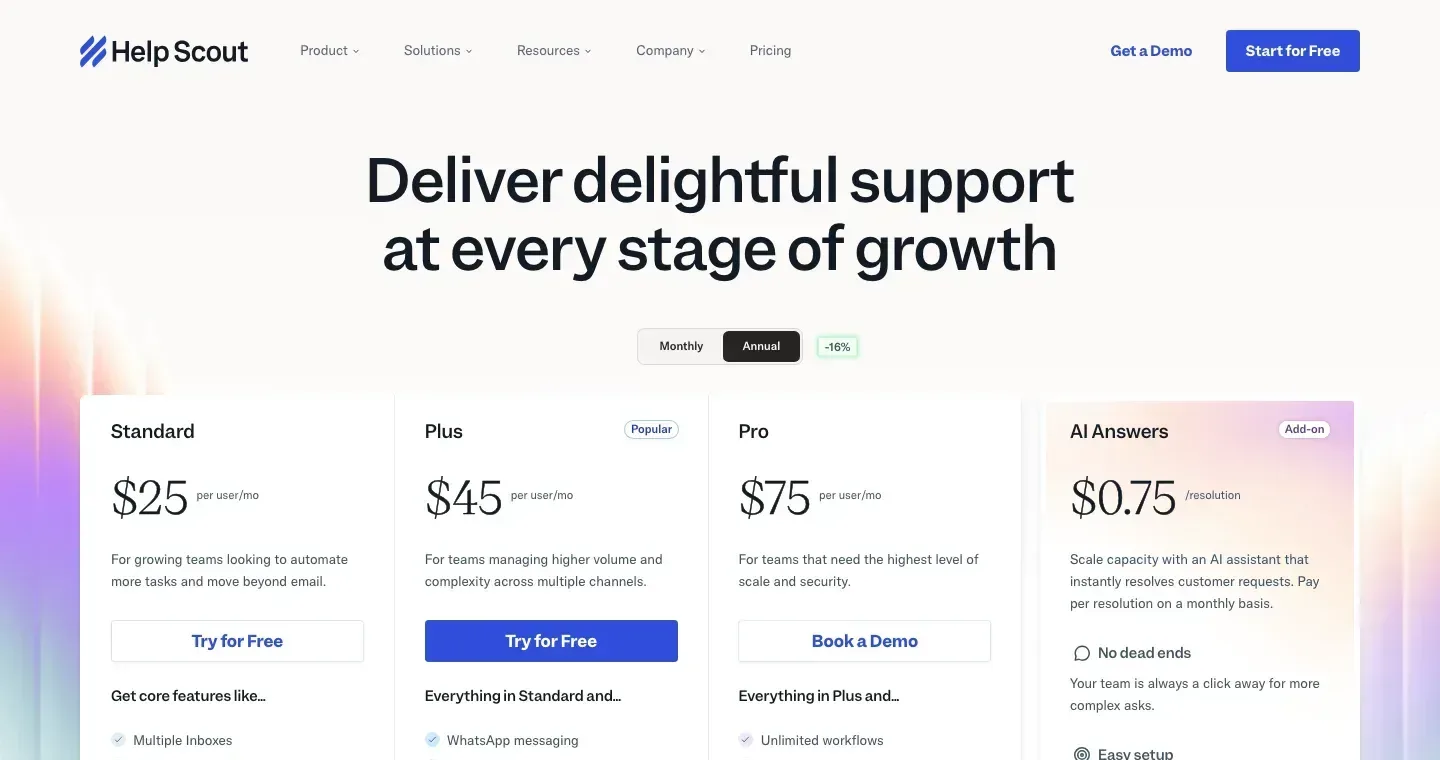
Help Scout is the easiest to explain. The May 5 render showed Standard at $25 per user per month on annual billing, Plus at $45, and Pro at $75. AI Answers appears as an add-on at $0.75 per resolution. The important part is not only the sticker price. It is that a small team can read the page and see the shape of the bill.
Intercom needs more modeling. The pricing page showed Essential at $29 per seat per month, Advanced at $85, and Expert at $132 on annual billing. Fin AI Agent adds $0.99 per Fin outcome. That can be a smart meter if Fin resolves real work, but it is still a second meter. A product-led SaaS team should estimate both seats and outcomes before anyone celebrates the base plan.
Zendesk starts lower on paper, but the operational purchase gets more complicated. The rendered pricing page showed Support Team at $19 per agent per month, Suite Team at $55, Suite Professional at $115, and Suite Enterprise at $169 on annual billing. It also displayed add-ons such as Copilot at $50 per agent per month. That does not make Zendesk overpriced by default. It means the buyer has to separate "ticketing starts at $19" from "our real support suite will cost more."
This is where the cheap-looking plan can become the expensive migration.
1. Help Scout: best default for email-first support
Help Scout wins the default recommendation because most small support teams are not trying to invent a new customer service system. They are trying to stop Gmail from becoming a liability.
The product thesis is clear: bring shared email aliases, teammates, social messages, Docs, Beacon, saved replies, customer history, workflows, and reports into a support workspace that still feels human. That is not as dramatic as an AI agent demo. It is also what many teams actually need first.
Use Help Scout if support still revolves around email and customers expect thoughtful replies from real people. It is especially good for SaaS, services, education, lightweight ecommerce, and small B2B teams where tone matters and the support team does not want every question turned into a ticket factory.
Skip it if your support process already needs complicated routing, many brands, advanced SLAs, deep admin permissions, workforce planning, call center layers, or heavy reporting. At that point you are not buying "a nicer inbox." You are buying support operations, and Zendesk starts to make more sense.
Help Scout keeps the buying decision readable: inbox, Docs, Beacon, saved replies, workflows, reports, and AI Answers without asking a tiny team to become Zendesk admins.
Teams that need heavy routing, advanced SLAs, multiple operations layers, call-center workflow, or enterprise admin control.
Help Scout leads for the default buyer because its inbox fit and value clarity are stronger than its operations ceiling. It is not the deepest platform; it is the easiest right-sized first desk.
- Best match for teams leaving Gmail or Outlook and wanting a shared inbox that still feels human
- Official pricing render showed Standard at $25, Plus at $45, and Pro at $75 per user per month on annual billing
- AI Answers pricing is visible at $0.75 per resolution, with a 3-month trial shown on the pricing page
- Docs, Beacon, saved replies, customer history, workflows, reports, and multiple inboxes cover the core small-team job
- Less admin weight than Zendesk and less product-led complexity than Intercom
- Not the deepest support operations platform for routing, complex SLAs, QA, workforce planning, or large teams
- AI value still depends on clean Docs and enough repetitive questions to justify resolution billing
- Product-led SaaS teams may outgrow the email-first center of gravity and want Intercom instead
- Evidence-led review only; no Help Scout workspace, Beacon configuration, AI answer, or ticket workflow was tested
2. Intercom: best for product-led SaaS support
Intercom is the tool I would test first when support happens inside the product. It is not just a prettier inbox. The purchase is Messenger, shared inbox, ticketing, Help Center, Fin, product context, and proactive support living near the customer journey.
That is why Intercom can be the right answer even when Help Scout is cheaper and calmer. If customers ask onboarding questions inside the app, if support and activation overlap, if product tours and help articles matter, and if Fin can answer repetitive product questions without breaking handoff, Intercom has a cleaner center of gravity.
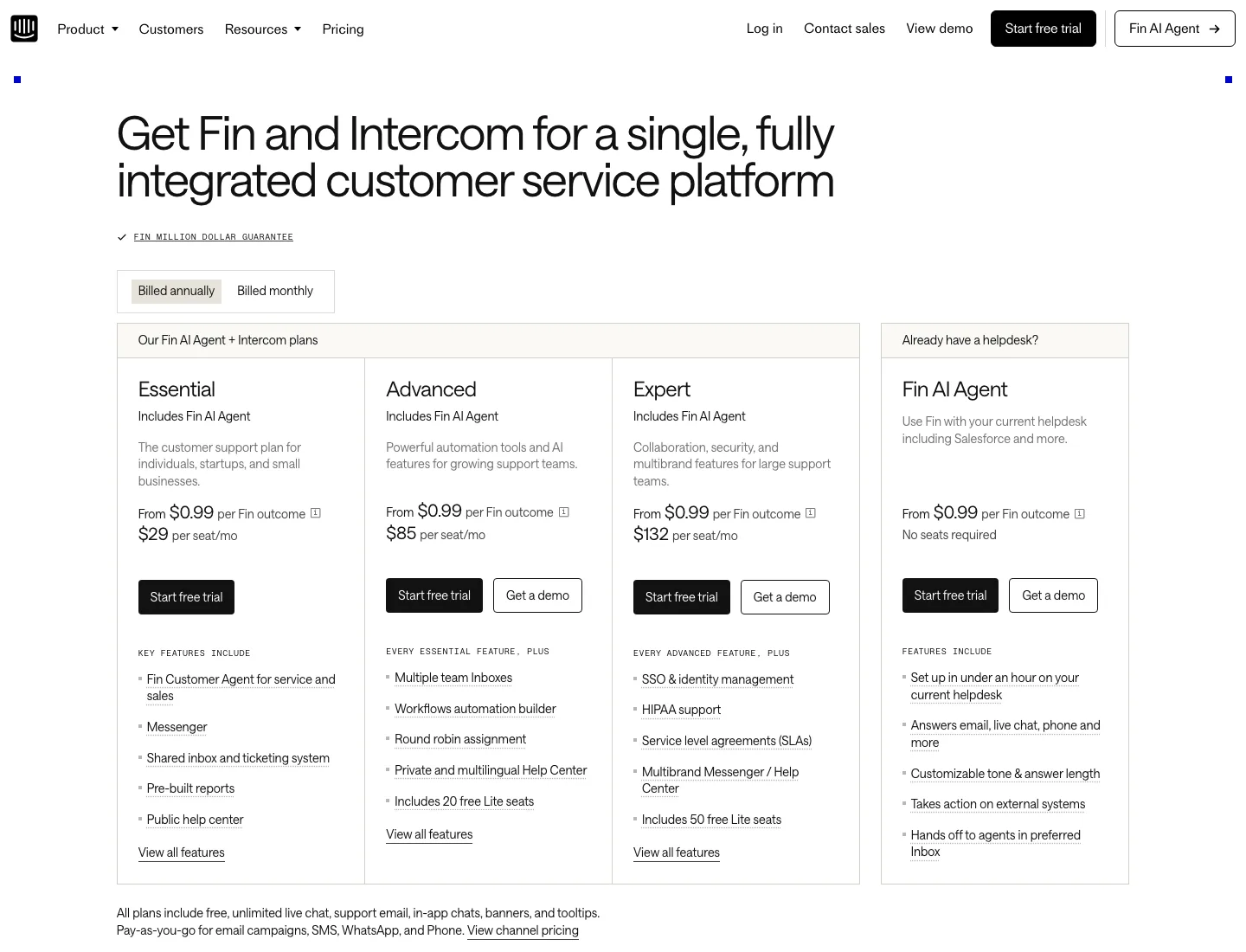
The catch is cost shape. Intercom's page showed $29, $85, and $132 seat tiers, plus $0.99 per Fin outcome. That can be worth it if Fin actually resolves product-led support questions and keeps the customer moving. It can also get expensive when the help center is messy and outcomes stack without enough true deflection.
Use Intercom if support, onboarding, product education, and in-app messaging are connected. Skip it if support is mostly email and your team mainly needs a calmer queue. Paying for product-led magic when customers still write ordinary support emails is how software budgets get weird.
Intercom is strongest when support is part of the product journey: Messenger, inbox, tickets, Help Center, Fin, and customer context all point at the same workflow.
Teams that mostly need email support, have low support volume, or cannot model Fin outcome billing from real ticket history.
Intercom scores highest on product fit, but it ranks second overall because seat pricing and Fin outcome billing make value harder to model for a general support-desk buyer.
- Best fit here for product-led SaaS teams where support, onboarding, and in-app customer education overlap
- Official pricing render showed Essential at $29, Advanced at $85, and Expert at $132 per seat per month on annual billing
- Fin AI Agent pricing is exposed at $0.99 per Fin outcome, including standalone Fin over an existing helpdesk
- Messenger, shared inbox, ticketing, public Help Center, reports, and automation sit in one product-led support platform
- Stronger customer-context and product workflow fit than Help Scout for in-app support
- Seats and Fin outcomes stack, so a low base plan is not the whole budget
- Bad help-center content can turn outcome billing into a tax on unresolved setup work
- Can be overkill for small teams that only need email, saved replies, Docs, and a basic widget
- Evidence-led review only; no Intercom workspace, Messenger setup, Fin outcome, ticket flow, or paid plan was tested
3. Zendesk: best when support has become operations
Zendesk ranks third for the default buyer, but it is not a weak product. It is just the easiest tool here to buy too early.
Zendesk starts making sense when support has managers, queues, agent roles, channel strategy, dashboards, SLAs, reporting expectations, AI governance questions, and integrations that cannot live in a lightweight shared inbox. If that sounds like your team, Help Scout can feel too small and Intercom can feel too conversation-centered.
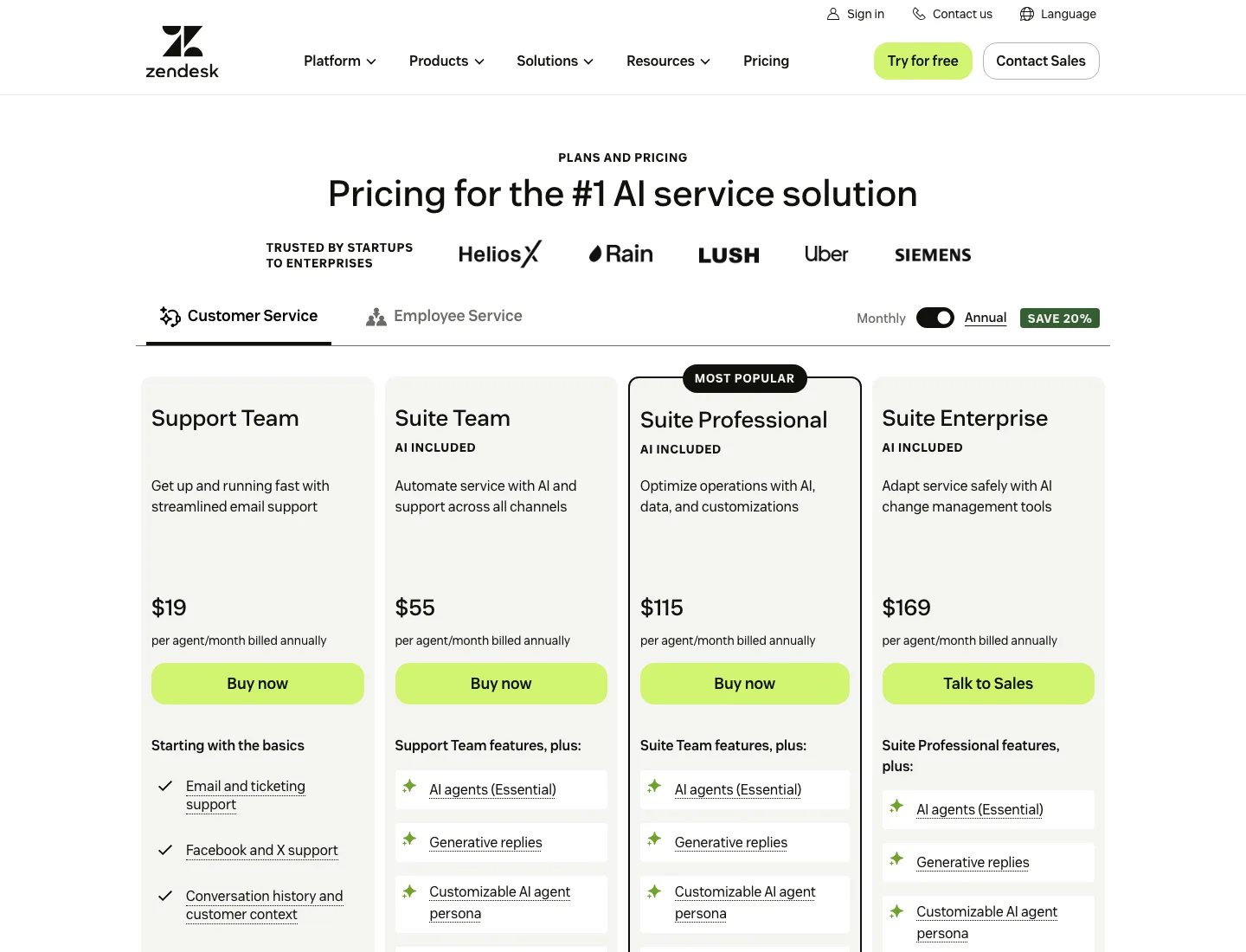
The price story needs care. The pricing render showed Support Team at $19 per agent per month, Suite Team at $55, Suite Professional at $115, and Suite Enterprise at $169 on annual billing. That page also showed AI included in Suite tiers and add-ons such as Copilot at $50 per agent per month. A buyer comparing only the $19 entry plan to Help Scout or Intercom is not comparing the same job.
Use Zendesk when support complexity is already real. Skip it if the team is hoping software will create process discipline for them. Zendesk can preserve a messy workflow at a higher price if the buyer has not fixed ownership, macros, help content, escalation rules, and reporting definitions first.
Zendesk has the deepest operations ceiling here: ticketing, channels, AI agents, reporting, help centers, routing, admin control, and add-on paths for bigger teams.
Small teams trying to keep support simple, or teams that have not defined support ownership before buying software.
Zendesk ranks third for this buyer because its operations depth is excellent, but the admin weight and add-on pricing can be wrong for teams that only need a clean first support desk.
- Deepest support operations ceiling in this comparison for routing, reporting, channels, admin control, and team process
- Official pricing render showed Support Team at $19, Suite Team at $55, Suite Professional at $115, and Suite Enterprise at $169 per agent per month on annual billing
- Suite tiers showed AI included, including AI agents and generative replies in the rendered pricing table
- Add-on paths such as Copilot, QA, workforce management, and advanced privacy fit larger support departments
- Better long-term fit than Help Scout when support has become a managed operations function
- Easy to buy too early if the team only needs a shared inbox and basic workflows
- The useful support suite can cost much more than the $19 entry ticketing plan once Suite tiers and add-ons are modeled
- Admin weight can slow teams that have not already defined ownership, routing, macros, and reporting rules
- Evidence-led review only; no Zendesk account, ticket workflow, AI agent, add-on, or migration was tested
How I would choose
Start with the support failure, not the feature list.
If the failure is shared inbox chaos, pick Help Scout. The symptoms are missed replies, duplicate answers, no customer history, copy-pasted macros, and founders still watching a support alias at midnight. Help Scout fixes the boring workflow without making the team carry enterprise admin weight.
If the failure is product-led support friction, pick Intercom. The symptoms are customers asking for help inside the app, onboarding questions repeating, product tours and help articles living apart from support, and a team that wants Fin to handle repetitive product questions before a human steps in.
If the failure is support operations debt, pick Zendesk. The symptoms are queues, SLAs, multiple support teams, managers needing live reporting, several channels, compliance concerns, and escalation rules that cannot live in a simple inbox. Zendesk is heavy because the job is heavy.
My practical rule: do not buy one stage ahead. A small team should not buy Zendesk to feel more mature. A product-led team should not buy Help Scout just because it is calmer. A support department should not force Intercom to become an operations backbone if the real need is routing, governance, and reporting.
One migration note matters here. The first week after a help desk switch is rarely about fancy AI. It is about aliases, saved replies, help articles, tags, assignment rules, and who owns the queue when a customer is angry. Help Scout has the least painful first week for that job. Intercom has the best first week when the messenger and product context are already central. Zendesk has the best first week only when someone has mapped the process before the trial starts.
Process beats platform theater.
What competing comparisons miss
The common competitor mistake is ranking these products as if they are three versions of the same help desk. They are not.
Many comparisons skip the buyer stage.
Help Scout is an opinion about staying close to customers. Intercom is an opinion about support as part of the product. Zendesk is an opinion about support as a managed operation. A feature grid can hide those opinions because every product can claim inboxes, automation, docs, AI, reporting, and integrations.
Public community threads were useful here, but only as friction signals. The recurring questions were not "which tool has more features?" They were cost creep, setup weight, whether Intercom is too much for email support, whether Zendesk is too heavy for small SaaS, and whether Help Scout stays useful after the team grows. I did not treat those threads as representative sentiment or product ratings.
The best purchase is boringly specific. What channel creates most support work? Who owns the queue? How many questions are repetitive enough for AI? Which reports matter? What happens when a customer asks for a human? If the buyer cannot answer those, a bigger support platform will mostly make the uncertainty more expensive.
The boring question wins: what support habit are you trying to stop?
Final verdict
My take: Help Scout is the default because most teams comparing these three are trying to get out of inbox chaos, not build a support department. It is readable, right-sized, and less likely to make a small team pay for process it does not yet need.
Intercom is the pick when support lives inside the product. I would happily choose it over Help Scout for a product-led SaaS company where onboarding, Messenger, Help Center, tickets, and Fin all matter together.
Zendesk is the pick when support is already operationally heavy. I would not buy it early just to look mature. I would buy it when the team has real routing, reporting, SLA, admin, AI governance, and channel problems that a calm inbox cannot solve.
Help Scout is the best default for small teams choosing a first serious support desk. Intercom is better for product-led support. Zendesk is better once support has become operations.
Try Help ScoutHelp Scout vs Intercom vs Zendesk FAQ
Ready to check Help Scout?
Use the verified route if the trade-offs still fit. If not, jump back to the summary and compare the alternatives.
Crypto and productivity editor focused on cost, custody risk, setup friction, exports, fees, and workflow drag. Prioritizes verifiable numbers and clear skip criteria over hype.
Lucas starts with total operating cost, then ranks tools by setup and recurring friction, custody or export, reversibility, and whether the decision still makes sense when the exit path is included.
Related Articles

Hey Noah vs Lindy vs Fyxer: Best AI Executive Assistant
AI executive assistants compared by action authority, reversibility, workflow fit, cost predictability, context reach, and trust readiness
Compare Hey Noah, Lindy, and Fyxer by approvals, email sending, scheduling, calls, integrations, security, and current entry prices.

Paste vs Maccy vs Raycast: Which Mac Clipboard Manager Fits?
Mac clipboard managers compared by local history, Apple-device sync, privacy posture, launcher fit, setup burden, and subscription value
Paste, Maccy, and Raycast compared by clipboard history, Apple-device sync, local storage, privacy posture, pricing, and workflow fit.