

The AI SDR pitch is too clean.
Give the software a market, let it find prospects, write personalized emails, book meetings while you sleep, and call it pipeline. That sounds good until the first list is full of bad-fit companies, the AI-generated first lines feel creepy, and the sender domains start collecting bounces faster than replies.
So I would not buy an AI sales prospecting tool by asking which one automates the most steps. I would ask a more useful question: does this tool make it easier to decide who deserves outreach, or does it only help you send more messages to a list you should not trust?
That split decides the whole stack. Clay and Apollo are the research and data decision. Instantly , Smartlead , and Lemlist are mostly execution decisions: sending, warmup, inbox routing, multichannel cadence, and agency workflow.
I checked current official pricing, product positioning, workflow evidence, and commercial CTA routes. I did not send campaigns, measure enrichment accuracy, or benchmark reply rates. This is a buyer guide for choosing the right layer of the stack before the bill and deliverability risk get real.
If you already know you are choosing only between two email senders, read our Instantly vs Lemlist comparison. If the outreach will feed newsletters or nurture flows, our email marketing tools guide is the better next read. If this turns into workflow plumbing, compare Zapier, Make, and n8n before buying another add-on.
-
#1 ClayBest overall — strongest AI research and enrichment layer for serious prospecting
-
#2 ApolloBest database-first pick — easier lead search plus AI assistance and sequencing
-
#3 InstantlyBest email execution layer — use it after the lead data is already trusted
The stack split most buyers miss
AI sales prospecting is not one category. It is two purchases wearing the same jacket.
The first purchase is the research layer. Who fits the account profile? What changed recently? Which companies hired a VP, raised money, opened a new office, installed a tool, changed headcount, or started showing buying intent? This is where Clay is strongest and where Apollo is easiest for a smaller team to start.
When that research begins on live webpages and needs to become a structured dataset, a browser agent may be the narrower fit. Our Bardeen vs Zapier Agents vs Lindy comparison explains when browser extraction beats a broad app agent or personal operations assistant; this guide still owns the full prospecting-stack decision.
The second purchase is the sending layer. Which inbox sends the email? How many mailboxes are connected? Where do replies land? How do you pause bad campaigns? How do you keep sender reputation from getting punished by lazy data? This is where Instantly, Smartlead, and Lemlist belong.
Mix those two layers together and the wrong tool looks better than it is. Instantly can look like a prospecting platform because it helps you send. Clay can look expensive because it is not just a lead list. Apollo can look like the obvious middle ground because it includes database, AI, and sequence features in one place. Lemlist can look more complete because it adds LinkedIn and calls.
But the harder truth is simpler: more automation does not fix weak account selection.
The best prospecting stack starts with fewer better accounts, not more generated touches. I would rather see a team build a narrow Clay workflow for 200 accounts than spray 10,000 generic contacts through a sequencer and call the reply rate a market signal.
How I ranked the prospecting tools
I ranked every tool on the same five axes: research depth, workflow control, sending safety, cost clarity, and buyer fit. Each axis carries 20% of the score. Research-layer products can still win on account selection, while sending-layer products must earn their place through safer execution and a clearly defined buyer.
The shared rubric prevents a sender from receiving a generous score merely because it sends well, or a research platform from winning merely because it enriches more fields. A high score requires a coherent place in the full outbound workflow, not the largest feature list.
That is why Clay can win even though it is more complex, and why Smartlead or Lemlist can be good tools without being the best first purchase. If the team still cannot define a qualified account, the sending tool is not the bottleneck yet.
Where AI prospecting fails
The failure pattern is predictable. A buyer starts with a broad market, enriches too many records, trusts every "verified" contact, lets AI write a soft personalization line, and pushes the list into a sender before anyone asks whether the account should be contacted at all. The workflow does not break loudly. It breaks as wasted credits, messy CRM records, weak replies, higher bounce risk, and a quiet sender-reputation cost that shows up later.
The wrong-buyer trap is also real. Clay is overkill when the team has no ICP discipline. Apollo is risky when database access becomes a substitute for account judgment. Instantly and Smartlead are risky when scale hides list failure. Lemlist is expensive when multichannel work is mostly aspirational. The tradeoff is not "AI or no AI." It is whether the tool creates a safer decision before outreach or just makes the wrong decision easier to execute.
| Feature | Clay | Apollo | Instantly | Smartlead | Lemlist |
|---|---|---|---|---|---|
| Decision job | Custom account research | Lead database start | Email execution | Email ops control | Rep multichannel workflow |
| Evidence anchor | Actions and data-credit meters | 240M+ contacts and 65+ filters | $47, $97, $358 tiers | $32-$315 visible pricing | Email and Multichannel annual tiers |
| Cost trap | Credits/actions before ICP is proven | Credits feel like strategy | Scale arrives before list quality | Sender infrastructure add-ons | Seats, senders, calls, credits |
| Failure mode | Overbuilt enrichment workflow | Contact access hides weak targeting | Sender reputation damage | Mailbox complexity without owner | Multichannel theater |
| Use when | You know your ICP | You need a simpler start | Lead source is already trusted | You manage sender operations | LinkedIn is real, not decorative |
| Skip when | You need a simple lead database | You need custom enrichment logic | You still need account research | Nobody owns email ops | Email is the only real channel |
| Action | Try Clay | Try Apollo | Try Instantly | Try Smartlead | Try Lemlist |
The 5 best AI sales prospecting tools
1. Clay — Best overall AI prospecting layer
Clay is the best overall pick when sales prospecting means research before outreach. Not because it is the easiest tool here. It is not. Clay wins because it gives a serious GTM team the most control over how accounts are found, enriched, scored, routed, and handed to the rest of the outbound stack.
Clay's checked pricing page did not present one perfectly consistent headline. The visible cards showed Launch at $167 per month and Growth at $446, while the FAQ described those plans as starting at $185 and $495. Treat that difference as a checkout warning, not a number to average away. The stable part is the billing model: separate Actions and Data Credits sit on top of the plan.
But if the team knows its ICP, Clay is where the category gets interesting. You can build a table that says: find companies matching this market, enrich from multiple providers, check signals, summarize the account, find likely buyers, reject weak matches, and only then push the result into a sequencer. That is the right order. The send button should be late in the workflow.
My worry with Clay is not quality. My worry is undisciplined ambition. A team can build broad workflows, connect too many enrichment paths, and burn credits before the buying thesis is proven. Clay rewards specificity. Vague markets punish your wallet.
Use Clay if the problem is "we do not know enough about the right accounts." Skip it if the problem is "we need a cheap contact database by Friday."

Clay treats AI prospecting as an account-research workflow, not just a message generator.
Teams that only need a quick lead database or do not yet have a sharp ICP.
Clay leads on research, workflow control, and fit for a disciplined GTM team. Cost clarity stays lower because the visible cards, FAQ starts, Actions, and Data Credits all affect the real bill.
- Best fit for custom enrichment, waterfall logic, buying signals, and account research
- The Free plan supports a small proof of concept before a paid rollout
- Separate Actions and Data Credits make usage visible instead of hiding it in one vague allowance
- Pairs well with a separate sequencer once the account-selection logic is proven
- The checked plan cards and FAQ showed different starting prices
- Too complex if the team only wants a standard contact database
- Can create expensive busywork if the ICP is vague
- Still needs human review before outreach because enrichment is not the same as buyer intent
2. Apollo — Best database-first starting point
Apollo is the tool I would hand to a small sales team that needs a working database before it needs a custom GTM lab.
Apollo's official search page currently positions the database around more than 240 million verified leads and 65-plus filters. The public pricing FAQ confirms a free entry point and a trial allowance, but the paid plan cards did not render reliably in this verification pass. I would not carry the old $49/$79/$119 matrix forward as if it were freshly verified; check the signed-out pricing page and final checkout for the current seat and credit terms.
That matters because Apollo is easier to explain than Clay. Search for accounts and contacts, use filters, add credits, use AI assistance, score leads, sequence, and sync into the sales workflow. A founder or first SDR can understand the shape of the tool in an afternoon. They may not build the world's smartest enrichment logic, but they can get moving.
The tradeoff is that database convenience can feel like evidence. It is not. A contact appearing in Apollo does not mean the company has a timely reason to hear from you. This is where many teams confuse access with strategy. They find names, export names, send to names, and then blame the sequencer when nobody replies.
Use Apollo when the team needs a broad lead database, credits, AI assistance, and a lighter path into outbound. Move toward Clay when the winning edge is account-specific research that Apollo filters cannot express cleanly.
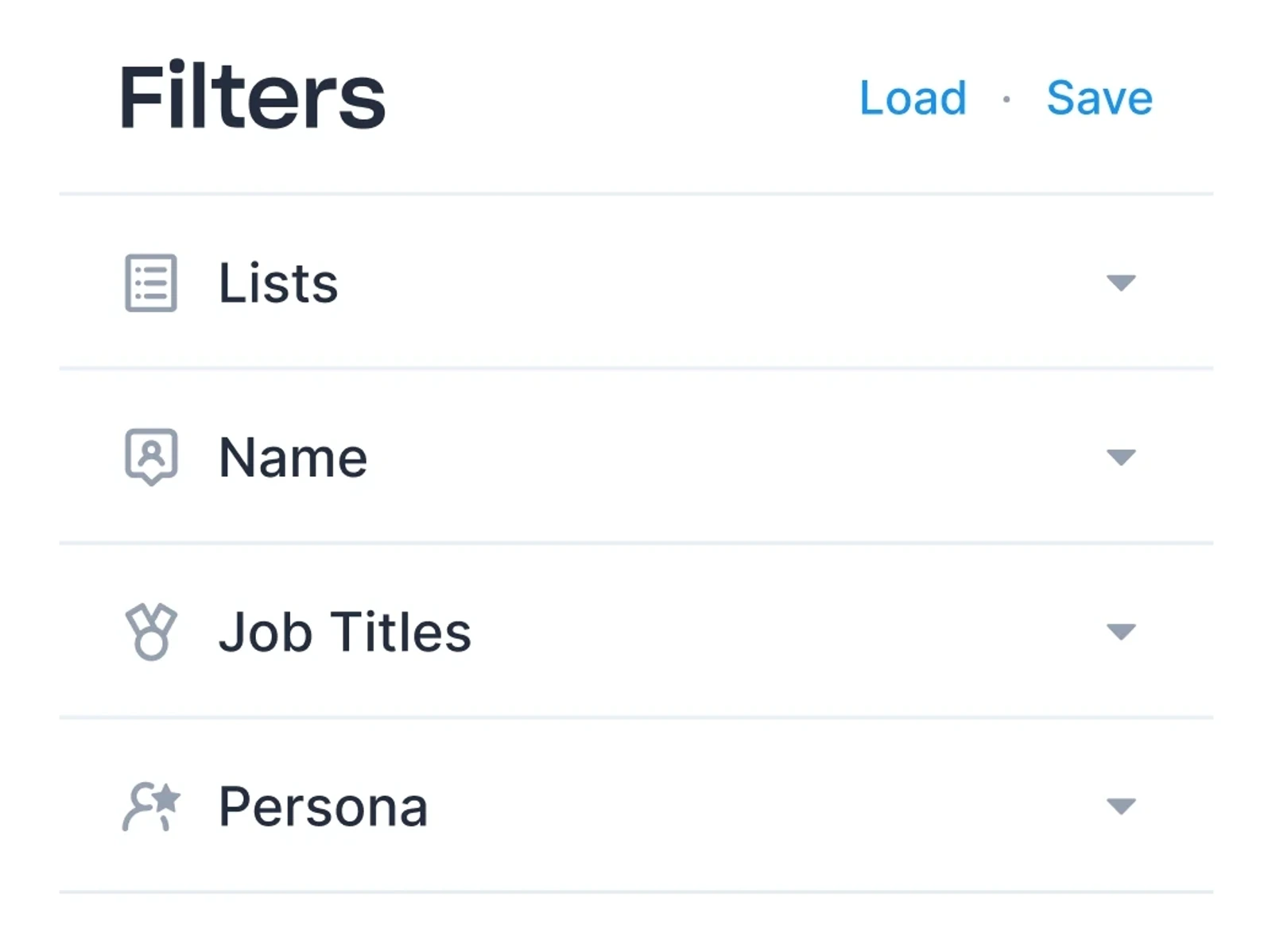
Apollo gives small teams one easier place for lead search, credits, AI assistance, scoring, and sequencing.
Teams that need custom enrichment waterfalls and account-specific research logic.
Apollo's database, filters, and integrated workflow make it the safest first purchase for a small team. It trails Clay on custom research depth, and paid cost clarity remains conditional on the current checkout.
- Clearer first step for teams that do not want to design a Clay workflow from scratch
- A free entry point lets a small team test the search workflow before committing
- Combines lead search, credits, AI assistant, AI research, lead scoring, and sequencing features
- Good fit for founders and SDR teams that need a practical database before specialized tooling
- Easier access to contacts can hide weak targeting
- Not as flexible as Clay for custom account intelligence workflows
- Paid seat and credit terms require a current checkout check
- Still requires list discipline and human judgment before outreach
3. Instantly — Best email execution layer
Instantly should not be judged as the smartest prospecting brain. It is an email sending machine.
The pricing page shows Growth at $47 per month, Hypergrowth at $97, and Light Speed at $358. The checked Hypergrowth card listed 125,000 monthly emails while the comparison table on the same page listed 100,000. That is exactly the kind of plan-page mismatch worth confirming before checkout. The broader reason agencies keep looking at Instantly is simpler: unlimited email accounts, warmup, and high-volume sending math.
But this is exactly why Instantly is dangerous in the wrong hands. It makes scale feel available before strategy is proven. Bad lists do not become good because the sender rotation is clean. Generic AI copy does not become thoughtful because it was sent from more mailboxes.
I like Instantly after the research layer is settled. Get the Clay or Apollo workflow right first. Define who deserves outreach. Verify contacts. Keep volume sane. Then Instantly can do what it is good at: execute email-first outbound without forcing a per-seat multichannel product onto an agency workflow.
For a deeper sender-only comparison, the Instantly vs Lemlist guide breaks down deliverability, sender math, and the Smartlead alternative in more detail.
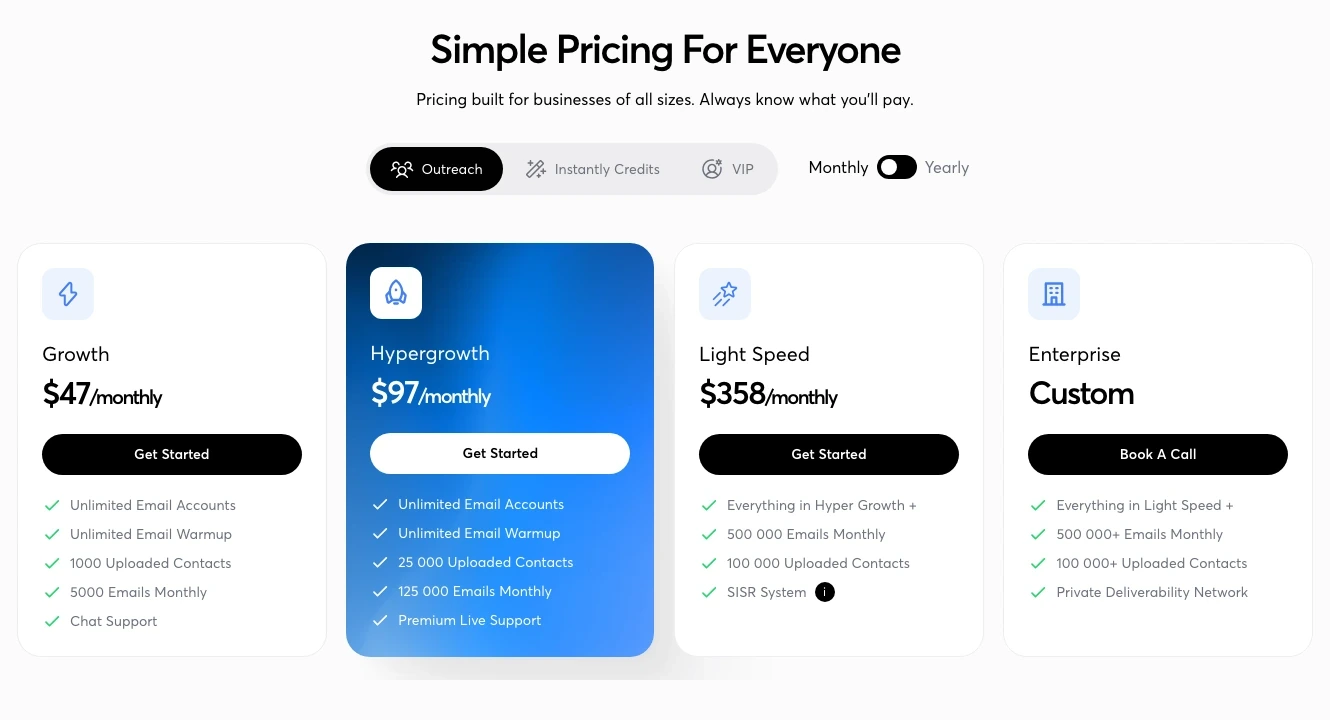
Instantly is strongest after the list is trusted, when the buyer needs sender accounts, warmup, volume, and reply routing.
Teams still figuring out who to target should solve research before scaling email volume.
Instantly earns its place through controlled email execution and agency fit, not upstream account research. Cost clarity is good at the plan level but loses ground because the checked Hypergrowth limits disagreed across the same page.
- Unlimited email accounts are valuable for email-first agencies and outbound operators
- Growth and Hypergrowth tiers keep the core sending story simple
- Best used as the execution layer after data quality is handled elsewhere
- Cleaner fit for pure email than a multichannel rep workflow
- Not the best tool for deciding which accounts deserve outreach
- Scale can amplify bad data and weak offers
- AI copy and lead features should not distract from deliverability basics
- The checked Hypergrowth card and comparison table showed different monthly email limits
- Teams still need suppression logic, DNS discipline, and careful volume control
4. Smartlead — Best for outbound operators
Smartlead is the most operator-coded tool here.
The checked page opened on annual billing and showed effective monthly prices of $32, $78, $144, and $315. Smartlead's own FAQ lists the corresponding monthly plans at $39, $94, $174, and $379 and says annual billing saves 17%. Sender infrastructure and verification remain separate costs. The practical clue is that Smartlead prices the outbound operation, not just a sequence builder.
That makes it a strong alternative when the team has someone who actually owns sender infrastructure, mailbox rotation, reply management, and outbound process. It is less attractive when a founder just wants an easy lead database. In that case, Apollo is simpler and Clay is more strategic.
Smartlead's risk is the same as Instantly's risk: scale feels like progress. It is not. If the underlying account selection is lazy, the better operations layer only moves bad outreach faster.
The buyer test is simple: if someone on the team can explain domain rotation, bounce thresholds, reply ownership, and suppression rules without opening a support doc, Smartlead belongs in the conversation. If nobody owns those details, the tool will feel powerful right before it becomes messy.
I would put Smartlead on the shortlist for agencies and technical outbound teams that want more control over the sending machine. I would not use it as the first answer to the question "who should we contact?"

Smartlead is better framed as outbound infrastructure and sending operations than as a general AI prospecting database.
Teams that want one simple lead database or do not have someone owning sender operations.
Smartlead is strong on operational control and sender safety for a prepared team. Research depth stays low, and the split between annual equivalents, monthly rates, and infrastructure add-ons lowers cost clarity.
- Strong fit for agencies and operators who care about sender infrastructure and reply workflow
- Public page now surfaces sends, verified prospect emails, and infrastructure add-ons in the buying flow
- A practical alternative when Instantly's workflow does not give enough operational control
- Best used after a research layer has already produced a qualified list
- Not the simplest starting point for a first sales database
- Infrastructure add-ons can change the true monthly cost
- Still depends on list quality and sending discipline
- Can become operational complexity if the team is not ready to manage mailboxes seriously
5. Lemlist — Best when multichannel is real
Lemlist is the tool in this group that most clearly asks: are you actually doing multichannel sales, or do you just like saying that you are?
The official U.S. page showed Email at $63 and Multichannel at $87 with annual billing when checked on July 11. The localized Croatian page rendered Email at €55 per user per month annually, against €69 monthly, and Multichannel at €87 annually, against €109 monthly, when rechecked on July 29. Enterprise remains custom. Lemlist also prices credits separately: its official page states one credit costs $0.01, an email lookup uses five credits, and a phone lookup uses 20. That is a lot of moving parts if the team mainly sends email.
But Lemlist makes sense when reps really work across email, LinkedIn, and calls. Not "we might add LinkedIn later." I mean actual weekly behavior: profile visits, connection steps, calls, manual tasks, and a rep who needs context in one place. In that world, Lemlist's workflow can be easier to defend than stitching together a sender, a LinkedIn tool, a call task system, and a CRM reminder chain.
The mistake is buying Lemlist for multichannel theater. If the team will ignore LinkedIn steps after week two, the per-user model and sender add-ons become a tax on ambition. Instantly or Smartlead will usually fit the email-first case better.
The best Lemlist buyer is not chasing maximum volume. It is a rep-led team where the sequence has real human touches and the manager wants those touches visible. If the campaign owner only cares about inbox count and reply routing, the multichannel layer is decoration.
The tradeoff is clear because the billing follows the workflow. Lemlist costs more when you add users, senders, calls, and credits, so the buyer needs the multichannel behavior to be real. If LinkedIn and calls are only there because the sales deck looks better with them, avoid the extra cost and pick a sender-focused tool instead.
Choose Lemlist when the rep workflow is the product. Skip it when the only real channel is email.
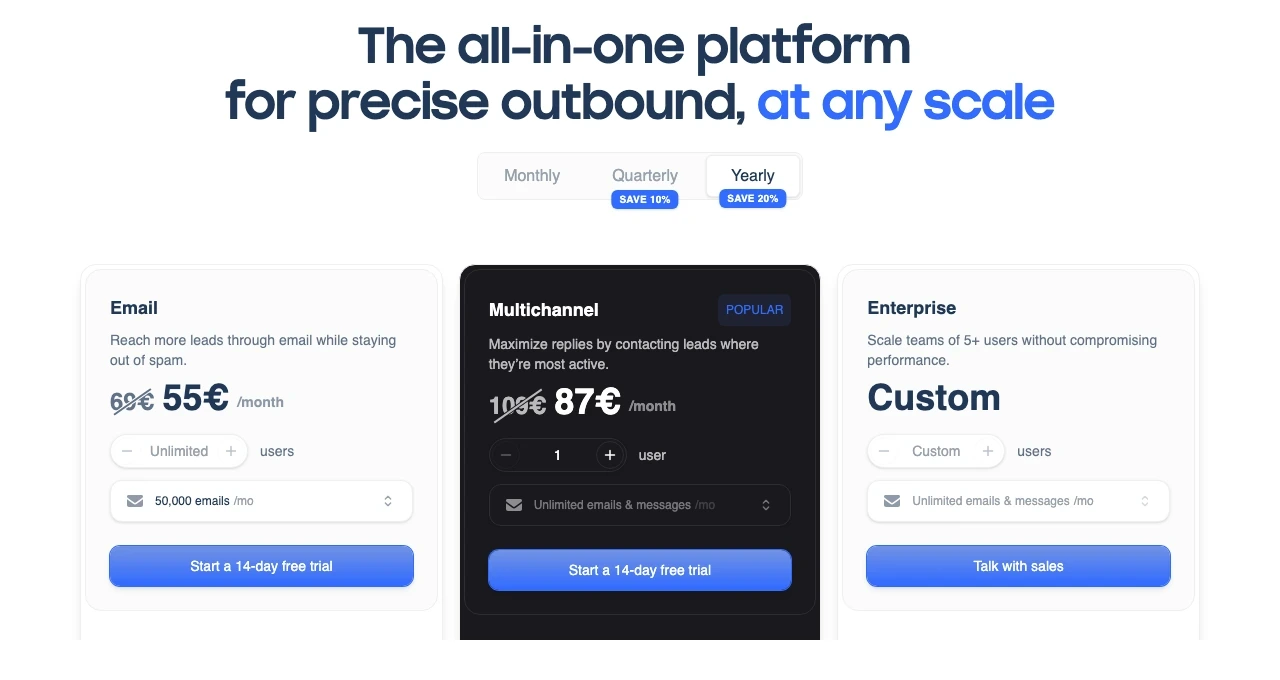
Lemlist is strongest when LinkedIn and calls are real rep behaviors, not roadmap decoration.
Email-first agencies and lean teams that do not need paid multichannel workflow per user.
Lemlist earns workflow and buyer-fit points when reps truly use email, LinkedIn, calls, and tasks. Research depth is modest, while per-user plans, credits, and add-ons lower cost clarity.
- Email and Multichannel plans map clearly to different rep workflows
- Better fit than pure senders when LinkedIn and calls are genuinely part of the cadence
- Lead credits, email finder, verifier, and rep workflow features can reduce tool sprawl
- Useful for sales teams where humans still own relationship context
- Per-user pricing gets expensive for teams that mostly need mailbox scale
- Extra senders and calling add-ons can stack quickly
- Multichannel value disappears if reps do not use LinkedIn and calls consistently
- Not the strongest AI research layer compared with Clay
How I would choose
Start with the bottleneck, not the vendor category. If the team cannot explain why an account is worth contacting, solve research first. If the list is already trusted and the pain is replies, mailboxes, or handoffs, solve sending operations first.
If you need smarter account research: start with Clay . It is the strongest tool here for custom enrichment, signal logic, and AI-assisted account investigation.
If you need a simpler first database: choose Apollo . It is less intimidating than Clay and gives a small team lead search, credits, AI help, and sequencing in one place.
If your list is already good and email is the channel: use Instantly . It is the cleanest email-first execution layer for many agencies.
If outbound operations are owned by a serious operator: compare Smartlead . It belongs with teams that care about sender infrastructure, reply workflow, and campaign operations.
If sales reps truly work across email, LinkedIn, and calls: pick Lemlist . If they do not, do not pay for the fantasy version of the workflow.
Also considered
Reply.io and Jason AI remain credible options for teams evaluating a more agent-led outbound layer. The public pricing path did not provide sufficiently stable, inspectable evidence for this refresh, so I would not rank the product above five tools with clearer current plan and workflow proof.
Outreach and Salesloft belong on an enterprise sales-engagement shortlist when governance, CRM administration, enablement, and procurement matter more than a self-serve entry price. Their custom enterprise buying motion is a different decision from the founder and small-team stack ranked here.
The AI SDR reality check
The phrase "AI SDR" makes the category sound more autonomous than it is.
AI can summarize account pages, classify companies, enrich contacts, draft first lines, route prospects, score leads, and help a rep avoid staring at a blank sequence. That is useful. It can also confidently turn weak data into polished outreach, which is worse than doing nothing because it damages the domain and the brand at the same time.
I would not let any tool in this guide decide the market alone. The human job is still to define the account thesis, reject false positives, check whether a trigger actually matters, set suppression rules, and decide when volume should stay low. The machine can help with research. It should not be the adult in the room.
Here is the practical workflow I would trust:
1. Define a narrow account thesis. Industry, size, trigger, pain, and why the timing matters.
2. Build or pull the account list. Use Clay if the list needs enrichment logic. Use Apollo if the team needs a simpler database-first path.
3. Reject aggressively. Bad-fit accounts should die before they reach a sequencer.
4. Send cautiously. Put the qualified list into Instantly, Smartlead, or Lemlist only after contacts and suppression logic are sane.
5. Read replies manually. AI can help triage, but early campaigns need human eyes. The market will tell you what your spreadsheet missed.
That is less glamorous than "AI SDR books meetings automatically." It is also much closer to how a production outbound system survives.
Frequently Asked Questions
Final verdict
For most readers searching for AI sales prospecting tools, Clay is the best overall pick. It solves the highest-value problem: better account research and enrichment before outreach. That is where AI can improve the workflow instead of just making bad messages easier to send.
Apollo is the better default for teams that need a simpler database-first start. Instantly is the better email execution layer after the list is trusted. Smartlead is the operator pick when sender infrastructure and outbound control matter. Lemlist is the multichannel pick when LinkedIn and calls are real rep behavior.
The wrong-buyer warning is blunt: do not buy a sending tool to fix a research problem, and do not buy a research tool if the team only wants a contact list. That mismatch is where most prospecting stacks get expensive before they get useful.
The best AI prospecting stack should slow you down at the right moment. It should make you prove the account deserves outreach before the first email leaves the domain.
Best for teams that need AI-assisted account research, enrichment waterfalls, and custom GTM workflow before sending.
Try freeReady to check Clay?
Use the verified route if the trade-offs still fit. If not, jump back to the summary and compare the alternatives.
Crypto and productivity editor focused on cost, custody risk, setup friction, exports, fees, and workflow drag. Prioritizes verifiable numbers and clear skip criteria over hype.
Lucas starts with total operating cost, then ranks tools by setup and recurring friction, custody or export, reversibility, and whether the decision still makes sense when the exit path is included.
Related Articles

Hey Noah vs Lindy vs Fyxer: Best AI Executive Assistant
AI executive assistants compared by action authority, reversibility, workflow fit, cost predictability, context reach, and trust readiness
Compare Hey Noah, Lindy, and Fyxer by approvals, email sending, scheduling, calls, integrations, security, and current entry prices.

Paste vs Maccy vs Raycast: Which Mac Clipboard Manager Fits?
Mac clipboard managers compared by local history, Apple-device sync, privacy posture, launcher fit, setup burden, and subscription value
Paste, Maccy, and Raycast compared by clipboard history, Apple-device sync, local storage, privacy posture, pricing, and workflow fit.