

AI customer support tools are having a very predictable moment: every vendor says the bot will deflect tickets, cut costs, and keep customers happy. Then a real customer asks about a weird refund edge case and the bot confidently makes up a policy your finance team has never approved.
That is why I split this category by failure surface: SaaS onboarding, ecommerce order data, full helpdesk operations, and human fallback. A bot that is useful in one of those jobs can be dangerous in another.
I looked at the current pricing pages, Reddit threads in r/SaaS and r/AI_CustomerService, official billing docs, and the top ranking comparisons for "AI customer support tools 2026." The trend is real. Founders are actively replacing messy inboxes with AI support agents, especially in SaaS and ecommerce. But the affiliate-friendly tools are not all equal, and the cheapest-looking plan is rarely the cheapest production setup.
Does it actually save time or just look cool? That's the filter here. If a tool only gives you a nicer chat bubble, skip it. If it can answer repetitive questions, hand off cleanly, use your help center without inventing facts, and keep the bill understandable, it belongs on the shortlist.
If you are comparing broader autonomous systems, read our AI agents roundup first. If the support bot needs to trigger workflows after a ticket, our Zapier vs Make vs n8n comparison covers that automation layer. And if your support bottleneck is actually customer calls, the AI voice agents guide is the better page.
If your shortlist is only the big support desks, use the direct Help Scout vs Intercom vs Zendesk comparison instead. This roundup is about AI support agents; that page is about choosing the actual help desk shape. If the inbox is personal or executive email rather than customer support, the AI email assistant comparison is the more relevant buyer decision.
-
#1 Intercom FinBest overall — product-led SaaS support where chat, docs, tickets, and onboarding overlap
-
#2 Tidio LyroBest small-store start — fast chat widget without making someone become a support admin
-
#3 GorgiasBest for Shopify — order-aware automation where product questions and returns create real cost
A support bot has to know when to stop
The real test for AI customer support tools is not whether the bot can answer "where is my order?" in a demo. It is whether it knows when to stop talking.
Ask about a refund window that expired yesterday. Ask a product-fit question with missing catalog data. Ask for a human twice. Delete one help article and see whether the bot still answers from memory. That tells you more than a feature grid.
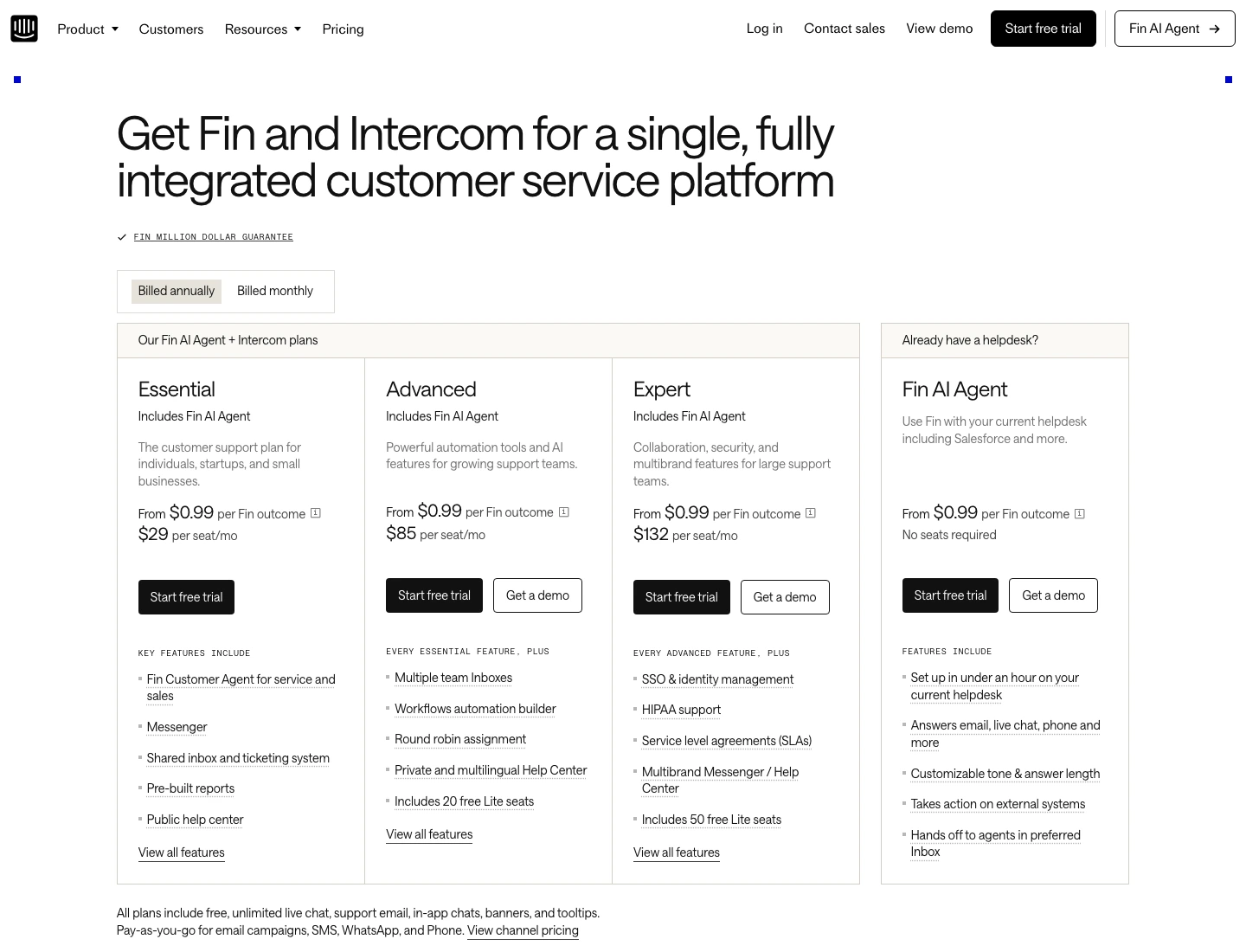
Pricing still matters, obviously. Support software now mixes seats, tickets, AI outcomes, resolutions, automated interactions, and session packs. Intercom charges per resolved Fin outcome. Gorgias adds AI interactions on top of tickets. Freshdesk keeps the useful AI higher in the plan table. Help Scout charges per AI resolution after the trial.
But the bigger question is operational: does the tool reduce bad tickets, or does it just make bad answers arrive faster?
That's the line for this review.
How I ranked the support tools
I ranked these tools by the support job they should own, not by chatbot polish. A SaaS team needs clean help-center grounding, in-app handoff, and onboarding context. A Shopify brand needs order, return, subscription, and product data. A mature support department needs routing, reporting, permissions, and admin control.
That is why Intercom can beat cheaper tools for product-led support, while Gorgias can be the better answer for ecommerce even though it is not the universal #1. Zendesk and Freshdesk are judged more like operations systems. Help Scout is judged as a human-first inbox where AI should reduce repetitive docs-based work without turning support into a black box.
The score is not a claim that one bot "answered more tickets" in a private benchmark. It is a buyer-fit score based on public evidence, pricing shape, handoff risk, and how much damage a wrong AI answer can create in that workflow.
AI customer support tools compared
| Feature | Intercom Fin | Tidio Lyro | Gorgias | Zendesk | Freshdesk | Help Scout |
|---|---|---|---|---|---|---|
| Support job | In-app SaaS support | Fast chat plus FAQ automation | Shopify order support | Omnichannel ticket operations | Budget ticketing foundation | Human-first shared inbox |
| Grounding risk | Help center quality controls outcomes | Thin docs cap Lyro value | Catalog/order mistakes create refunds | Admin complexity and add-ons | AI value starts higher than entry | Docs quality decides AI Answers |
| Billing trigger | $0.99 resolved Fin outcome | Plans, quotas, add-ons | Tickets plus AI interactions | Seats, suite tiers, AI add-ons | Seats plus Freddy sessions | $0.75 AI resolution |
| Handoff fit | Strong inside Intercom or standalone | Good for small teams | Strong for ecommerce teams | Strong for mature teams | Good for basic helpdesk teams | Best when humans stay central |
| Best buyer | Product-led support team | Small ecommerce/store owner | Shopify-heavy brand | Established support department | Cost-sensitive support team | Calm small support team |
| Skip when | You only need a cheap inbox | You need deep support ops | You are not ecommerce | You need a light chat widget | Advanced AI is the main reason | You need enterprise routing |
| Action | Try Intercom | Try Tidio | Try Gorgias | Try Zendesk | Try Freshdesk | Try Help Scout |
The 6 best AI customer support tools in 2026
1. Intercom Fin — Best overall for SaaS support
Intercom Fin is the one I would test first if support happens inside your product. Not because it is cheap. It is not. It wins because it treats AI support like part of the product experience: messenger, inbox, help center, tickets, reporting, outbound touches, and Fin sitting in the middle.
That last part matters. A lot of support bots feel like a chat bubble bolted onto the side of the business. Fin feels more like a layer across the help center, inbox, product messaging, and ticket flow. If your support team spends half the day answering onboarding questions inside the app, that is a better fit than a generic FAQ bot.
The tradeoff is cost discipline. Intercom seats start at $29/seat/month on the full suite, and Fin is priced separately at $0.99 per outcome. Standalone Fin can sit over another helpdesk, but there is still a 50-outcome monthly minimum. r/SaaS threads keep circling back to that same tension: Fin can save real support hours, but only if the knowledge base is clean enough that resolved outcomes are actually resolved.
My verdict: use Intercom when support is tied to onboarding, product activation, and in-app customer moments. Skip it if all you need is a cheap shared inbox with a chatbot bolted on.
Fin can run inside Intercom or as a standalone AI agent over an existing helpdesk.
Teams with low ticket volume or no clean help center will pay for outcomes before seeing real payoff.
Intercom scores highest on deflection and product fit because Fin sits close to help-center, inbox, and in-app support workflows; value is lower because outcomes and seats can stack quickly.
- Fin outcome billing is transparent at $0.99, and standalone Fin does not require paid seats
- Full Intercom suite covers messenger, shared inbox, tickets, public help center, reports, and in-app support
- Works well for product-led SaaS where support, onboarding, and customer education overlap
- 14-day free trial with no credit card required gives teams enough room to test real help content
- Outcome billing gets serious at scale: 5,000 Fin outcomes is $4,950 before any seat costs
- Full suite pricing jumps from $29 to $85 to $132 per seat as workflows and collaboration needs grow
- Bad help center content produces bad AI answers, and Intercom will not fix messy docs for you
- Smaller teams may be paying for a product-growth platform when they only need basic ticket handling
2. Tidio Lyro — Best for small stores that need chat fast
If Intercom feels like buying an operations platform, Tidio feels like getting a working support widget by Friday. That is the appeal.
The useful part is speed. Tidio combines live chat, help desk conversations, flows, Lyro, visitor tracking, and Shopify-style conversion features without making you become a Zendesk admin. The 7-day trial gives access to Customer Service, Lyro AI Agent, and Flows without a credit card, which is exactly what a small store needs before committing.
That is the real positioning. In r/SaaS threads, Tidio keeps showing up as the "just make it work" option for bootstrapped teams leaving Intercom or avoiding Zendesk. Lyro's FAQ claims it can solve up to 67% of customer questions automatically, but I would treat that as an upside case, not a plan. Start with the repetitive questions customers already ask ten times a day.
The catch is the ceiling. My research session localized Starter at €24.17/month and Growth at €49.17/month, while bigger support needs can push you into Plus or Premium territory. API access, branding removal, managed Lyro, and higher-volume support are the places where "small-store simple" can stop feeling cheap.
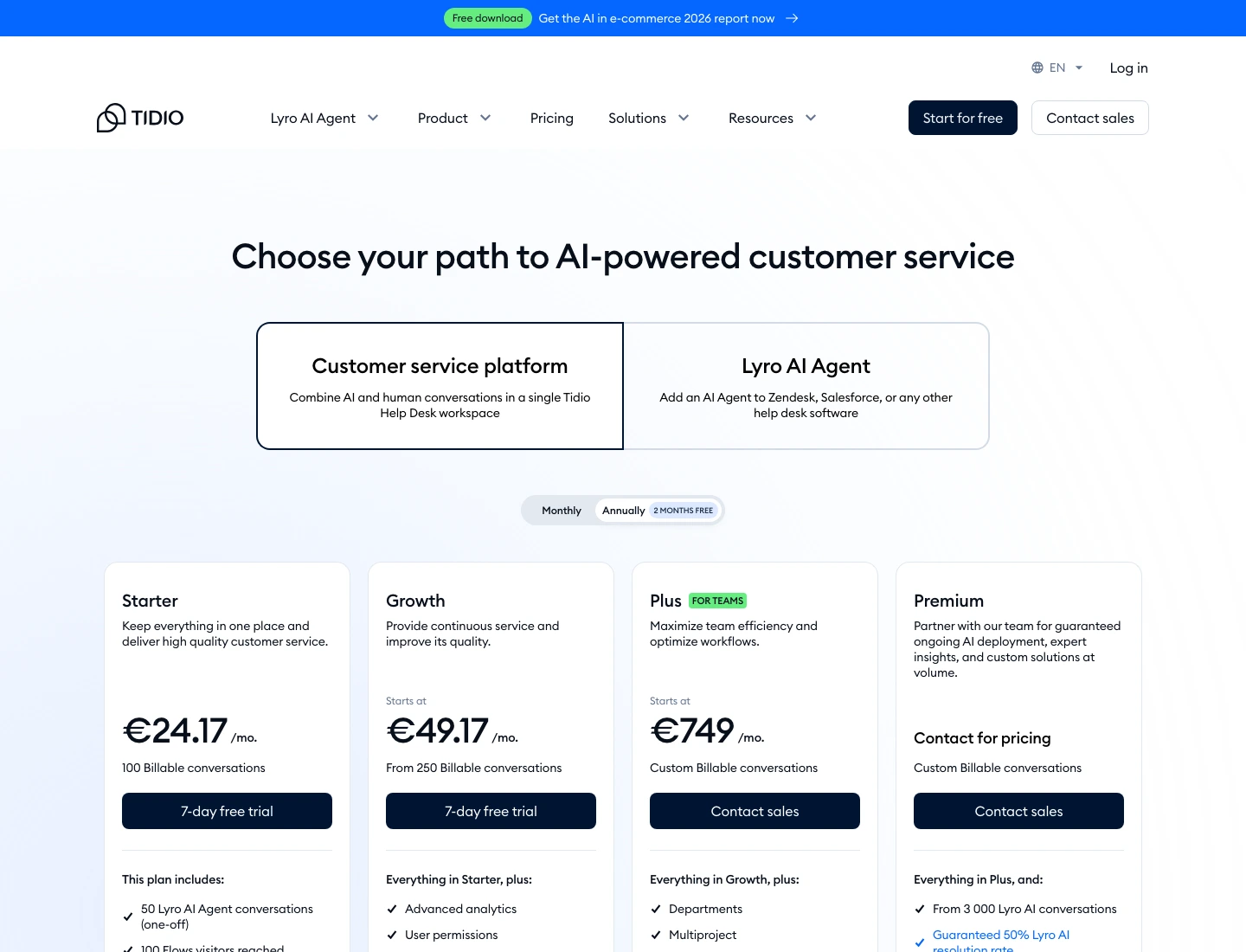
Tidio gives small teams live chat, flows, and Lyro AI without the Zendesk-style admin burden.
Technical teams that need API-friendly deep integrations should compare Intercom, Freshdesk, or a custom stack first.
Tidio scores high on setup speed and small-team value because it gets chat and Lyro live quickly; scalability is lower once API needs, branding, quotas, and support complexity grow.
- 7-day trial gives access to Customer Service, Lyro AI Agent, and Flows without a credit card
- Lyro can be purchased as a standalone AI product or combined with Customer Service and Flows
- Good fit for Shopify and small ecommerce teams that need chat, FAQ automation, and human fallback quickly
- Billing rules explain that unanswered spam or untouched visitor messages do not count as billable conversations
- Advanced needs like branding removal, managed Lyro, bigger quotas, and API-heavy workflows raise the real cost
- The official page localized pricing during research, which makes regional price comparisons less clean
- Not the best fit for complex B2B support queues with SLAs, routing, and multiple specialist teams
- Community complaints focus on API pricing and integration friction once teams outgrow basic chat
3. Gorgias — Best for Shopify and ecommerce support
Gorgias is not trying to be the universal helpdesk for every team. Good. The support market has enough tools pretending to fit everyone.
Gorgias is built for ecommerce, especially Shopify-heavy brands. That sounds obvious until you compare it with generic helpdesks. Order status, returns, refunds, shipping questions, product fit, discounts, subscriptions, cart issues — those are not side cases for a store. They are the work.
The pricing model is where Gorgias gets strong and annoying at the same time. Starter begins at $10/month for 50 tickets, and AI Agent is separate, starting at $30 for 30 automated interactions. That can be perfectly reasonable for a store with repetitive order questions. It can also get messy during seasonal spikes because you are modeling both billable tickets and automated interactions.
r/EntrepreneurRideAlong had a very specific Gorgias AI complaint in March: product-question hallucinations creating downstream refund problems. That is exactly the failure mode I worry about with ecommerce AI. A bot that guesses a product detail is not "slightly wrong." It just created a return.
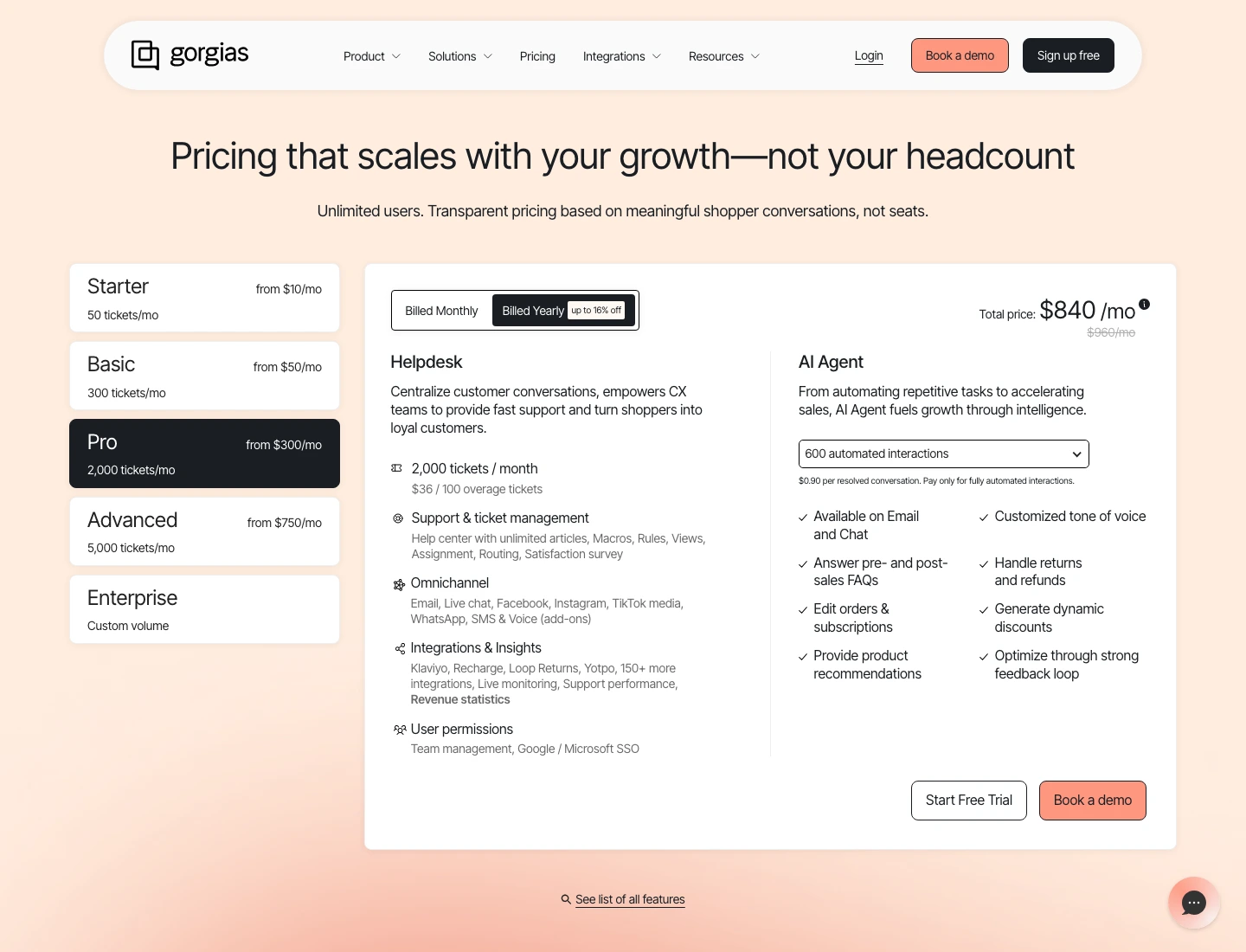
Gorgias is the most ecommerce-native platform here, with AI automation tied to order and shopper support.
B2B SaaS teams and service businesses should avoid paying for ecommerce depth they will not use.
Gorgias scores highest for ecommerce because order, return, and catalog context are central; general-support and pricing clarity are lower because non-store teams still inherit ticket plus AI-interaction math.
- Starter plan begins at $10/month for 50 tickets, which is approachable for small stores testing a helpdesk
- AI Agent automation pricing is published in tiers, starting at $30 for 30 automated interactions
- Strong ecommerce context for returns, order tracking, discounts, subscriptions, product questions, and Shopify workflows
- Annual billing materially lowers core helpdesk pricing on Basic, Pro, and Advanced plans
- You need to model both ticket volume and automated interactions before the monthly bill is obvious
- AI Agent overages are $1.50 per automated interaction, which can hurt during seasonal spikes
- Product-detail hallucinations are a real ecommerce risk if your catalog data is messy
- Not a natural fit for SaaS onboarding, IT helpdesk, or internal support teams
4. Zendesk AI — Best for established support operations
Zendesk is the boring answer. Sometimes boring is correct.
Zendesk makes sense when support has already become a process: SLAs, routing, voice, chat, email, social, help center, reporting, QA, permissions, and lots of agents. If you are at that stage, "simple" tools become expensive in a different way because someone spends hours duct-taping missing workflows together.
The current official pricing page lists Suite Team at $55 per agent per month billed annually and Suite Professional at $115. Suite Enterprise + Copilot is sales-led, while the Copilot add-on is $50 per agent per month billed annually. That is a serious operations product, not a weekend chat widget.
The hard part is the economic tension. Recent community threads keep complaining about seat expansion and AI add-ons. One r/GrowthHacking discussion from April framed it bluntly: per-agent pricing feels brutal once AI is supposed to reduce human workload. I agree. Paying more seats while telling finance that AI will reduce human work is a strange pitch.
Zendesk earns its place when the support operation is already large enough to need rules, permissions, reporting, and channel control. If the team is still arguing about macros and ownership, Zendesk can become the place where unclear process gets preserved at enterprise prices.
Zendesk is the strongest full operations suite here, with AI layered into a mature ticketing and omnichannel system.
Small SaaS teams that mainly need live chat and a few FAQ answers should start with Tidio or Intercom Fin.
Zendesk scores high on operations depth because mature routing, reporting, channels, and admin controls are the product; ease and value are lower for teams that do not need that machinery.
- Suite plans cover ticketing, messaging, voice, SMS, live chat, help center, reporting, and app integrations
- Current pricing separates Suite Team, Suite Professional, Enterprise + Copilot, and the Copilot add-on
- Best fit for teams that already need routing, analytics, permissions, multilingual support, and change management
- Zendesk Marketplace and API ecosystem make it easier to connect mature support operations to existing systems
- Per-agent pricing works against the AI cost-saving story once the team starts automating more volume
- Useful AI, QA, workforce, privacy, and copilot features can move buyers into add-on or higher-tier territory
- Setup and admin overhead are too heavy for small teams that only need basic chat plus FAQ automation
- Community complaints around pricing complexity are persistent enough that finance should model total cost before rollout
5. Freshdesk — Best budget helpdesk with AI on higher tiers
Freshdesk is the option I would use when the support team needs real ticketing but Zendesk feels like walking into an enterprise procurement meeting.
That makes Freshdesk a good middle option. You get helpdesk fundamentals without Zendesk's heavier starting point: tickets, knowledge base, reports, customer portal, and automation basics. The free program is unusually concrete too — $0 for 1-2 agents for 6 months.
But if the reason you are shopping is AI automation, do not stop at the Growth plan. Growth starts at $19/agent/month billed annually, while Freddy AI Agent sessions show up higher in the plan table: Pro at $55 and Enterprise at $89. Both include the first 500 sessions, then extra sessions cost $49 per 100. Translation: the cheap helpdesk and the useful AI story are not the same thing.
Reddit complaints about Freshdesk are not subtle: clunky search, update friction, and AI features that do not always reduce day-to-day work. That does not make Freshdesk bad. It means the product is better as a budget helpdesk foundation than as the most exciting AI support agent in 2026.
The right Freshdesk buyer wants the helpdesk floor first and the AI layer second. If the buyer only wants a bot to answer repetitive questions, Tidio or Help Scout may feel cleaner. If the buyer needs tickets, portal, reports, and a lower Zendesk-style entry point, Freshdesk makes more sense.
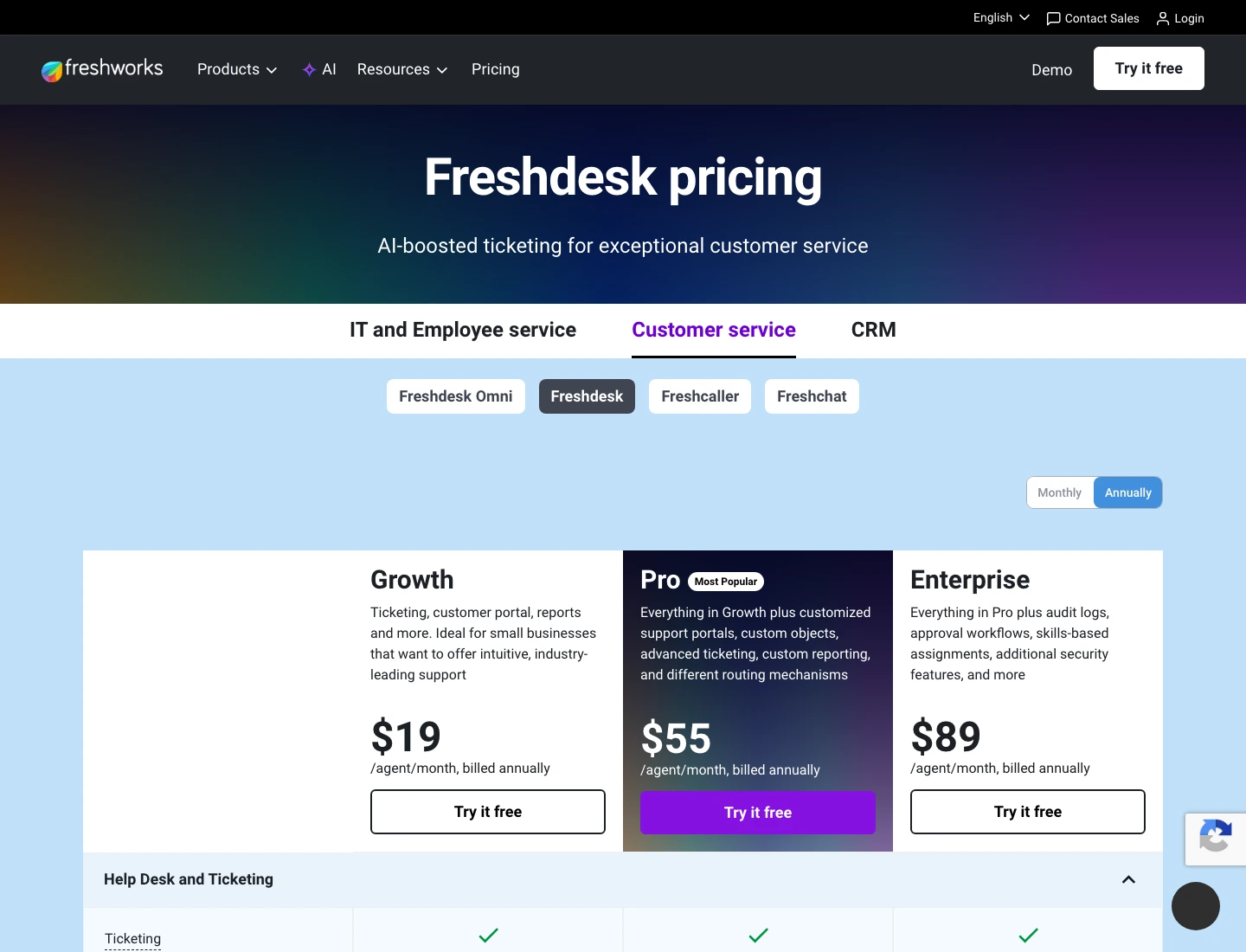
Freshdesk has a practical free ramp and lower seat pricing than Zendesk, but serious AI starts higher.
Teams buying specifically for advanced AI automation should check whether Pro or Enterprise pricing still beats Intercom or Zendesk.
Freshdesk scores well as a budget helpdesk because the ticketing foundation is accessible; AI depth is lower because Freddy Agent sessions become more relevant on higher tiers.
- $0 for 1-2 agents for 6 months gives tiny teams a real helpdesk runway before paying
- Growth starts at $19/agent/month billed annually, materially below Zendesk Suite Team
- Pro and Enterprise include the first 500 Freddy AI Agent sessions before paid session packs
- Good fit for teams that need tickets, knowledge base, reports, customer portal, and automation basics
- Freddy AI Agent sessions are not the main reason to buy the entry Growth plan
- Additional Freddy AI Agent sessions cost $49 per 100 sessions after included usage
- Community threads complain about clunky search, update breakage, and AI features that feel less useful in daily work
- Less product-led and in-app-support focused than Intercom for SaaS onboarding workflows
6. Help Scout AI Answers — Best human-first shared inbox
Help Scout is the anti-Zendesk pick. That is a compliment.
The product is built around shared inboxes, docs, Beacon, and a calmer support workflow. AI Answers is available on paid Help Scout plans with a free 3-month trial, then costs $0.75 per AI resolution. A resolution is a single AI chat session solved without human help, and Help Scout says it only charges once per session even if AI Answers replies to multiple questions.
That is the cleanest AI pricing in this roundup. It is also the easiest to cap because administrators can set a monthly AI Answers spending limit. When the spending limit is reached, AI Answers is disabled in Beacon until the next cycle or until the limit is raised.
The tradeoff is scope. Help Scout is not trying to be a giant omnichannel operations suite. It is better for small teams that still care about human support and want AI to answer repetitive docs-based questions, not replace the entire support department. If that sounds less futuristic, good. It is usually safer.
That focus is also the reason Help Scout ranks lower. It is not trying to win enterprise routing or ecommerce order automation. It is trying to make a support inbox calmer without hiding the human team, and that is exactly the right job for some buyers.
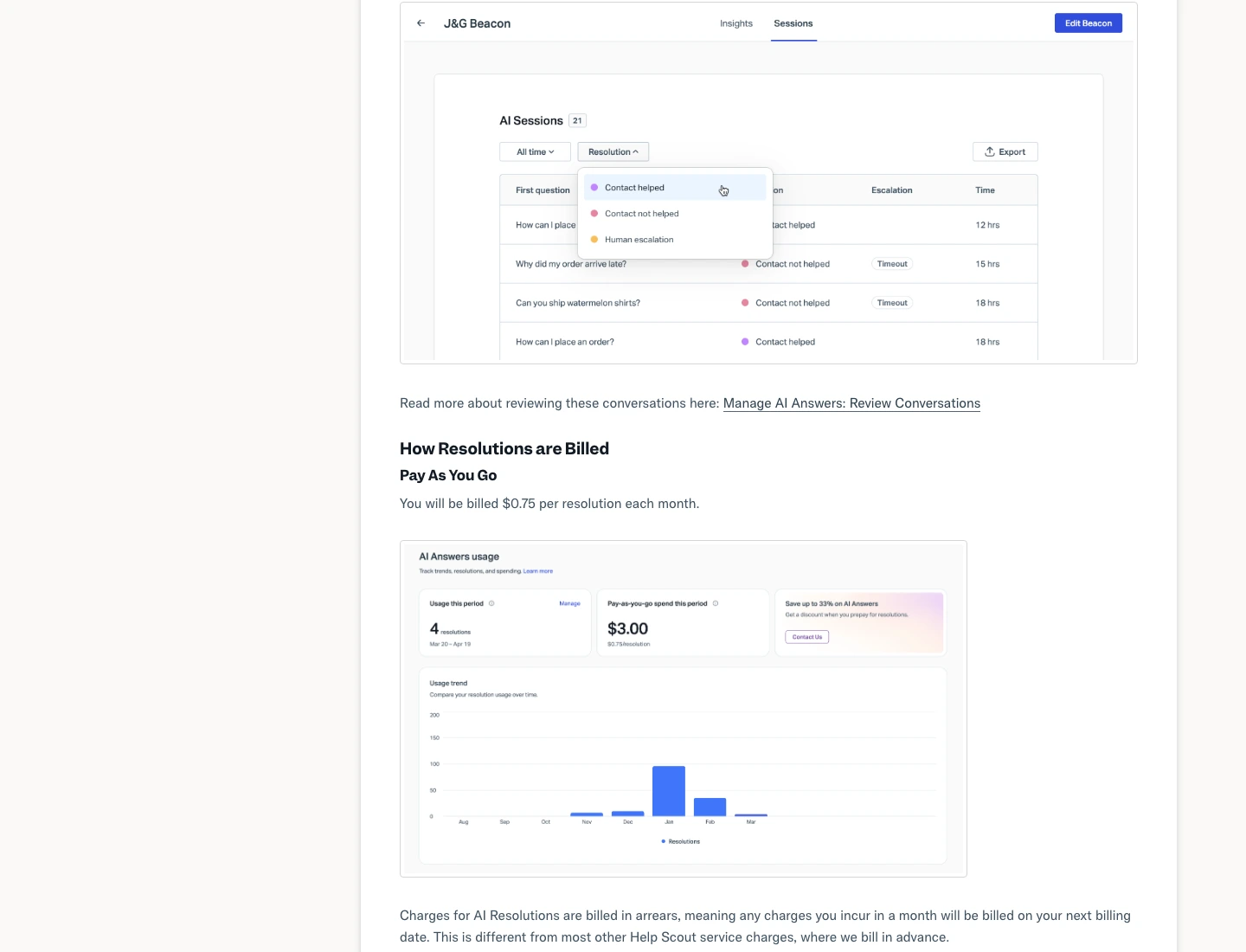
Help Scout's AI Answers pricing is unusually readable: 3-month trial, then $0.75 per resolution with spending limits.
Large teams needing deep routing, workforce management, QA, and enterprise omnichannel operations should use Zendesk.
Help Scout scores high on simplicity and AI cost clarity because resolution billing and spending limits are easy to explain; automation depth and enterprise fit stay lower by design.
- AI Answers has a free 3-month trial on paid plans before $0.75 per AI resolution billing starts
- Only charges when AI Answers provides an answer and the customer does not ask for more help
- Monthly AI spending limits can disable AI Answers before costs run away
- Strong choice for teams that want a shared inbox, docs, Beacon, and AI assistance without Zendesk complexity
- Not as deep as Zendesk for complex routing, QA, workforce management, or enterprise support operations
- Seat-based pricing still scales linearly as the team grows
- AI Answers depends heavily on clean help content and Beacon configuration
- Not the strongest ecommerce-specific option compared with Gorgias or Tidio
How I would choose
Start with the support failure you cannot tolerate. If the scary failure is a hallucinated policy, prioritize grounding and handoff. If the scary failure is queue chaos, prioritize routing and reporting. If the scary failure is cost sprawl, model AI resolutions before the demo.
If you run SaaS or product-led support: start with Intercom Fin . It is expensive, but it understands in-app support better than the rest of this list. Model the 50-outcome minimum and $0.99 outcome billing before you get excited.
If you run a small ecommerce store: test Tidio Lyro . It is the fastest path to live chat plus AI help without hiring a support ops person. Watch the API and branding costs as you grow.
If Shopify support is already painful: use Gorgias . The AI and order context are more relevant than generic ticketing features. Just treat product-detail hallucinations as a refund risk, not a cute AI mistake.
If you have a real support department: evaluate Zendesk . It is not the most exciting pick. It is the one with the deepest operations muscle.
If you want a cheaper Zendesk-style foundation: look at Freshdesk . The entry price is better, but advanced AI is not truly entry-level.
If your team still wants humans in control: pick Help Scout . AI Answers is there to handle repetitive docs-based questions, not turn your support team into a black box.
The support bot checklist before you launch
Do this before any AI support agent touches real customers. It takes one afternoon. It can save weeks of cleanup.
1. Ask ten policy edge cases. Refund window expired by one day. Subscription canceled mid-cycle. Missing package with no tracking update. If the bot invents policy, turn it off.
2. Test handoff in under two clicks. A customer should not need to beg the bot five times for a human. Two clicks or two messages. Max.
3. Delete one help article and ask about it. If the bot still answers from stale memory, you have a knowledge-sync problem.
4. Model 500, 2,000, and 5,000 tickets. Cost curves behave differently. Intercom outcome billing, Gorgias automated interactions, and Help Scout resolutions look harmless until volume shows up.
5. Watch the first 100 conversations. Not the dashboard summary. The transcripts. Count wrong answers, unnecessary handoffs, and customers who rephrase the same question because the first answer missed the point.
Hot take: most teams should automate fewer questions than the vendor demo suggests. A bot that handles 35% of tickets accurately is better than one that "deflects" 70% by annoying customers into giving up.
Frequently Asked Questions
Final verdict
For most SaaS teams, Intercom Fin is the best AI customer support tool to test first in 2026. It has the best balance of AI agent, product support, help center, inbox, and deployment flexibility. The $0.99 outcome model is not cheap, but at least it maps cost to resolved work instead of pretending seats are the whole story.
For ecommerce, I would not force Intercom. Gorgias wins Shopify-heavy support, while Tidio is the faster starter option for small stores. Freshdesk is the budget helpdesk. Zendesk is the operations machine. Help Scout is the calm human-first inbox with the cleanest AI resolution pricing.
The uncomfortable truth is that AI support does not fix bad support. It exposes it faster. Messy docs, unclear refund rules, weak handoffs, and outdated product data become customer-facing mistakes at machine speed.
Pick the tool after you fix the process.
Best overall balance of AI support, product messaging, help center, inbox workflow, and deployment flexibility for SaaS teams.
See pricingThe fastest path to chat plus AI support for small stores that need something working quickly.
See pricingThe ecommerce-native pick when order data, returns, product questions, and Shopify workflows matter more than generic ticketing.
See pricingReady to check Intercom Fin?
Use the verified route if the trade-offs still fit. If not, jump back to the summary and compare the alternatives.
Crypto and productivity editor focused on cost, custody risk, setup friction, exports, fees, and workflow drag. Prioritizes verifiable numbers and clear skip criteria over hype.
Lucas starts with total operating cost, then ranks tools by setup and recurring friction, custody or export, reversibility, and whether the decision still makes sense when the exit path is included.
Related Articles

Hey Noah vs Lindy vs Fyxer: Best AI Executive Assistant
AI executive assistants compared by action authority, reversibility, workflow fit, cost predictability, context reach, and trust readiness
Compare Hey Noah, Lindy, and Fyxer by approvals, email sending, scheduling, calls, integrations, security, and current entry prices.

Paste vs Maccy vs Raycast: Which Mac Clipboard Manager Fits?
Mac clipboard managers compared by local history, Apple-device sync, privacy posture, launcher fit, setup burden, and subscription value
Paste, Maccy, and Raycast compared by clipboard history, Apple-device sync, local storage, privacy posture, pricing, and workflow fit.