

A voice agent can sound calm while doing the wrong thing.
The demo is persuasive for the wrong reason. It shows the agent inside a clean script, where the caller speaks clearly, the calendar has room, and every tool call succeeds. Real calls are uglier: a caller mumbles their email, changes the appointment time twice, asks a policy question the bot should not answer, and the CRM write fails in the background. If the agent keeps speaking with confidence, the business has a problem that sounds polite.
So I do not rank AI voice agents by who has the prettiest synthetic voice. That matters, but it is no longer the hard part. The hard part is workflow control: interruptions, retries, transcripts, handoffs, provider costs, phone routing, and the moment an agent has to admit it cannot finish the job.
I rechecked the official pricing and product material for Retell, Vapi, Bland AI, Synthflow, and ElevenLabs on July 29. Retell is still the safest default. Vapi is the developer pick. Bland is the clearest high-volume outbound story, but its telephony bill now needs to be modeled separately. Synthflow is the enterprise no-code option. ElevenLabs is the voice-quality layer that many buyers will overvalue if they actually need phone operations.
If the calls have to connect into the rest of your stack, read our Zapier vs Make vs n8n comparison before you buy anything. If you are still deciding whether this should be a voice agent or a broader workflow agent, start with our AI agents roundup. If the support bottleneck is tickets, chat deflection, or help-desk routing rather than phone calls, use the AI customer support tools comparison first. And if the real output is meeting notes instead of phone calls, our AI meeting assistants guide is the cleaner category.
If voice is only one surface in a broader coworker purchase, the Bardeen vs Zapier Agents vs Lindy comparison separates browser research, cross-app orchestration, and personal operations. This page remains the narrower phone-agent decision.
-
#1 Retell AIBest overall — the most balanced path from demo to monitored phone workflow
-
#2 VapiBest for developers — build the voice stack instead of renting a packaged workflow
-
#3 Bland AIBest for outbound scale — published limits and bundled model costs, with telephony separate
The wrong voice agent fails quietly
The bad version of this purchase is not dramatic. It is a bunch of tiny failures that look acceptable in isolation.
The agent talks over a caller for two seconds too long. It captures "Meyer" as "Mayer." It books a slot but forgets to write the note back to the CRM. It keeps the call alive while a customer sits in silence, which is still billable on most voice stacks. Finance sees the invoice later and asks why the demo was cheap but the rollout is not.
That is why the pricing model matters, but only after the workflow model. Vapi's $0.05/min hosting fee is not the full stack because speech-to-text, model, voice, and telephony costs are passed through at cost unless you bring your own keys. Bland bundles the LLM, speech-to-text, and text-to-speech inside its minute rate, but its current FAQ explicitly bills telephony separately through your carrier or at Bland's pass-through cost. Retell sits in the middle with a published $0.07-$0.31/min range and a component table that shows where the money goes.
Here's the thing: the cheapest agent is not automatically the cheapest deployment.
For a real rollout, I would rather pay a bit more for simulation testing, transcripts, analytics, and predictable handoff controls than save a few cents while discovering mistakes through angry callers.
How I ranked the tools
The same five-part rubric applies to every platform: rollout control, deployment effort, cost explainability, monitoring depth, and buyer fit. The category scores are decision judgments from public evidence, not latency or call-quality measurements.
The useful questions are not "which voice sounds real?" but "what happens when the bot books wrong, bills during dead air, or needs a human handoff?" Those belong in the checklist before any demo voice sample.
There is a reason "who should skip it" matters. Most voice-agent pages sell the same fantasy: replace repetitive calls, reduce support work, qualify leads, book more appointments. Fine. But a dentist office, a developer building a voice product, and an agency selling AI receptionists to local businesses are not buying the same thing.
The winning tool has to match the buyer's operating model.
That is also why I kept ElevenLabs in the list even though I would not recommend it as the default phone-agent platform for most small businesses. Voice quality is a legitimate differentiator when the voice itself is the product. It is a distraction when the buyer really needs routing, validation, and fallback logic.
The five AI voice agents worth comparing
1. Retell AI — Best overall
Retell is the tool I would start with for a business that wants a phone agent live soon without turning the rollout into a custom infrastructure project. It is not the cheapest option. It is not the most developer-controlled option either. It wins because it gives mainstream buyers the cleanest path from "this demo sounds good" to "we can monitor what happens after launch."
The official pricing page still gives the right shape of the product: $10 in free credits, pay-as-you-go access, $0.07-$0.31/min for AI voice agents, call analytics and transcripts, simulation testing, webhooks, API access, and 20 included concurrent calls. Those last four matter more than the voice sample. A team needs to see what the agent said, what it heard, what it tried to do, and where the call flow broke.
Retell's component pricing is also more useful than a single headline rate. The table breaks out voice infrastructure, voice provider cost, LLM cost, telephony, and add-ons such as knowledge base, denoising, guardrails, PII removal, and AI quality assurance. That does not make the bill cheap. It makes the bill explainable.
The buyer fit is clear: appointment booking, inbound qualification, basic support triage, local-service reception, and SaaS support routing. The wrong buyer is equally clear: a developer team that wants to own every provider choice should look harder at Vapi, and a pure outbound-volume operation should price Bland before committing.
My take: Retell is the least embarrassing default recommendation. You can still ship a bad agent with it. You just have fewer excuses if you skip the guardrails.
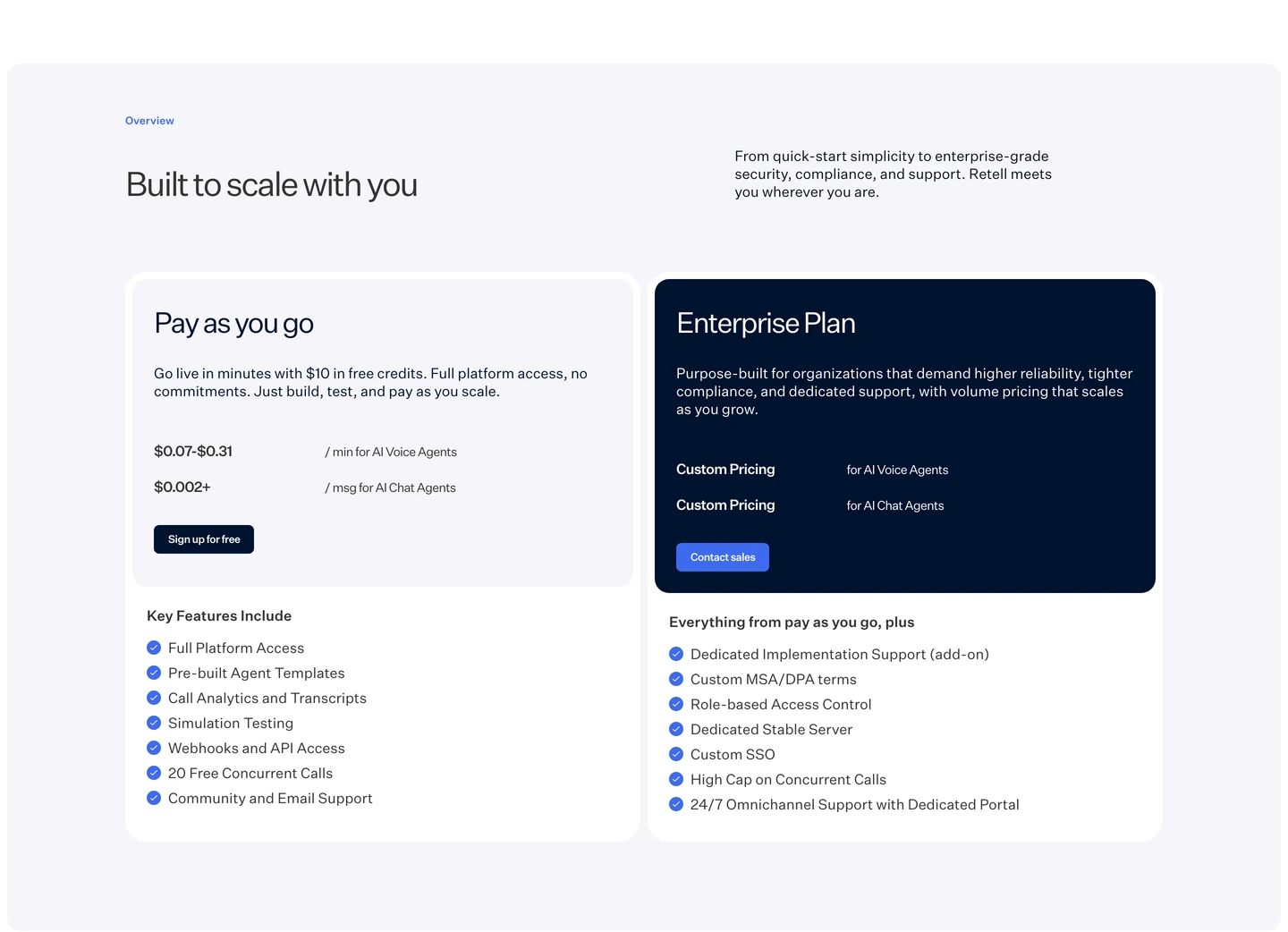
Retell combines a guided builder with simulation testing, transcripts, analytics, webhooks, and API access.
Teams optimizing only for the lowest possible per-minute cost should compare Vapi, Bland, or a custom stack first.
Retell averages 8.7 because simulation, transcripts, analytics, webhooks, and API access sit in one rollout path; cost explainability stays lower because voice, model, telephony, and add-ons still change the production bill.
- $10 free credits and pay-as-you-go access let teams test before committing to a contract
- 20 included concurrent calls are useful for pilots before paid concurrency becomes a scaling question
- Simulation testing, transcripts, analytics, webhooks, and API access support real monitoring after launch
- Component pricing exposes voice infrastructure, TTS, LLM, telephony, and add-on costs instead of hiding them
- The $0.07/min low end is not the whole production cost once model, voice, telephony, and add-ons are selected
- Billing still follows call behavior, so silence, long prompts, and messy retries affect economics
- High-control engineering teams may prefer Vapi's provider-level flexibility
- A weak prompt, bad transfer rule, or unvalidated CRM write can still ruin the caller experience
2. Vapi — Best for developers
Vapi is not a friendly receptionist-in-a-box. It is a voice infrastructure layer for teams that are comfortable choosing the pieces underneath the agent.
That is a compliment if you have engineers. Vapi's current comparison table frames the product around orchestration: calls, messages, provider keys, model choice, text-to-speech, speech-to-text, tools, and phone lines. Build includes 10 concurrent calls, additional lines are listed at $10/month, Vapi hosting is $0.05/min for calls, and model-provider costs are charged at cost unless you bring your own keys.
The upside is obvious: a developer-led team can control the stack. Use your own API keys. Pick the model. Change the voice provider. Route calls through the telephony setup that fits the product. Build the tool calls and server-side logic the way you want.
The downside is the same sentence written from a buyer's point of view. You now own the stack. That means forecasting cost, debugging providers, monitoring latency, and explaining to finance why the $0.05/min number was never the full call cost. I like Vapi a lot for actual voice products. I would not hand it to a non-technical owner who just needs the phones answered next week.
Use it if API depth is the point. Skip it if predictability is the point.
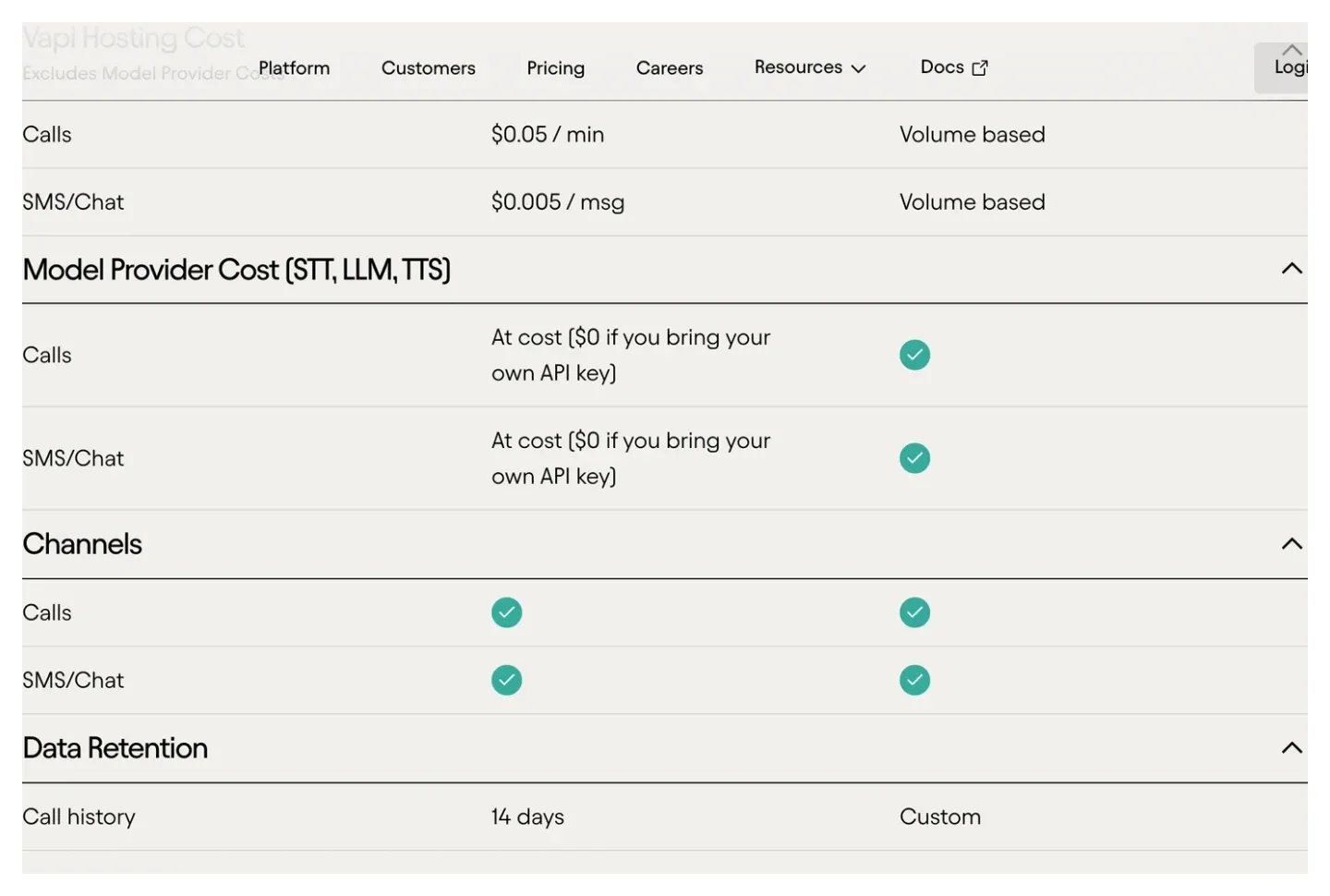
Vapi separates platform orchestration from provider costs, which gives technical teams more control.
Non-technical teams that want one predictable invoice and a guided deployment should avoid starting here.
Vapi averages 8.2 for a developer-led buyer because engineers can own providers, keys, and tool logic; deployment effort and cost explainability drop because that same team must forecast and operate every provider layer.
- $0.05/min platform fee is clear, usage-based, and prorated to the second
- At-cost provider model lets teams bring their own keys and control STT, LLM, TTS, and telephony choices
- Strong fit for voice products that need custom tools, web calls, phone calls, and server-side logic
- Build includes 10 concurrent calls and publishes the $10-per-line monthly expansion cost
- The platform fee excludes transcriber, model, voice, and telephony costs
- Provider choice creates real forecasting work once call volume, silence, and premium voices enter the mix
- Setup gets technical quickly for teams that do not already understand voice pipeline pieces
- Production quality still depends on your own retries, validation, evals, and fallback design
3. Bland AI — Best for high-volume outbound
Bland makes more sense when the buyer thinks in volume.
That is the easiest way to understand it. Start has no platform fee and lists $0.14/min, 10 concurrent calls, and 100 calls/day. Build moves to a $299/month platform fee with $0.12/min, 50 concurrent calls, and 2,000 calls/day. Scale is $499/month with $0.11/min, 100 concurrent calls, and 5,000 calls/day. Enterprise goes custom with concurrency sized to volume, on-prem or VPC availability, a forward-deployed engineer, BAA, SSO, and data-residency options.
That is not subtle positioning. Bland is aiming at operations where call volume, concurrency, and a cleaner finance conversation matter more than the most elegant builder.
The key difference is narrower than the old sales pitch implied. Bland says its rate covers LLM, speech-to-text, and text-to-speech without model-provider pass-throughs. Telephony is separate. That is still easier to model than a fully unbundled provider stack, but it is not one all-in minute. For outbound sales, collections, appointment reminders, logistics updates, and callbacks, the carrier line belongs in the budget from day one.
The tradeoff is focus. Bland's reason to exist is volume: if you need a careful first rollout with heavy monitoring, Retell gives you a softer landing; if you need thousands of outbound calls with published limits and a partly bundled model stack, Bland becomes much easier to defend.
I would not choose Bland first for a careful first answering-agent rollout at a small office. I would choose it when the business case is measured in thousands of calls, not one polished demo.
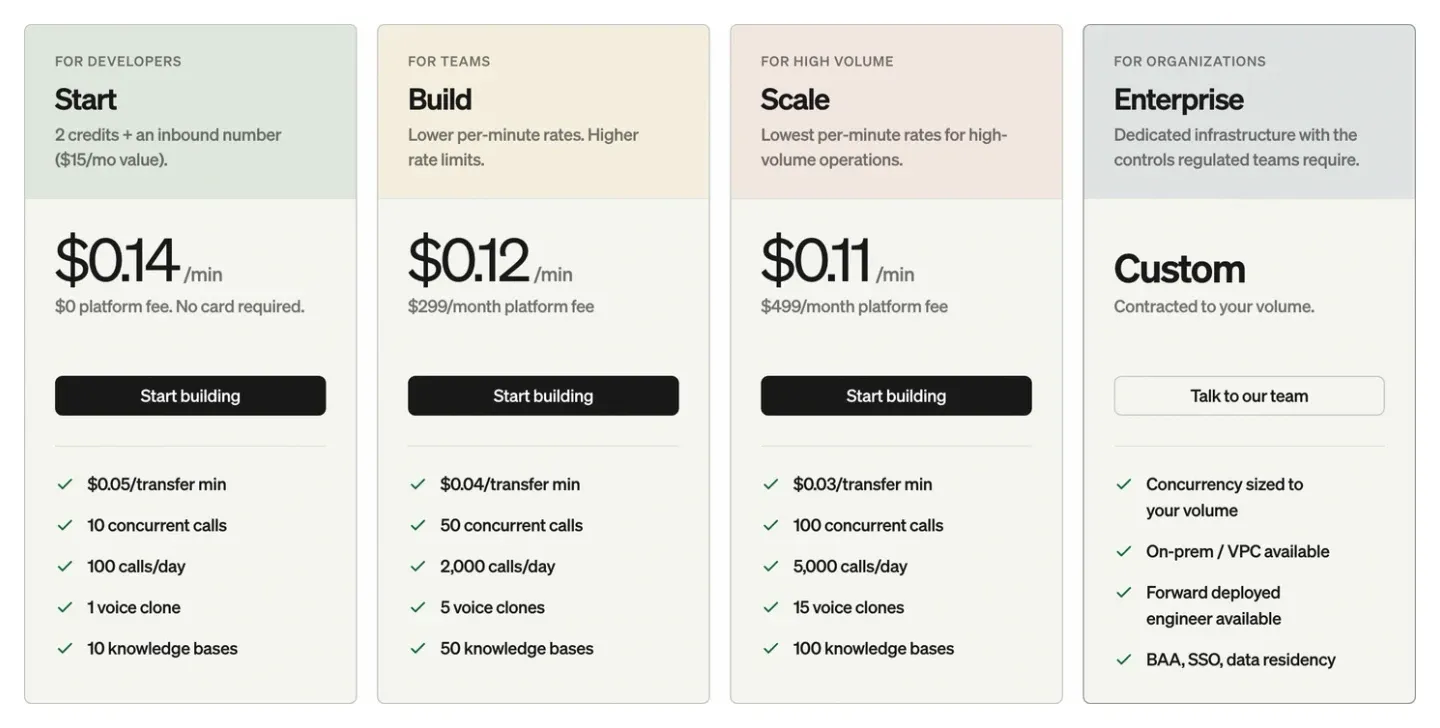
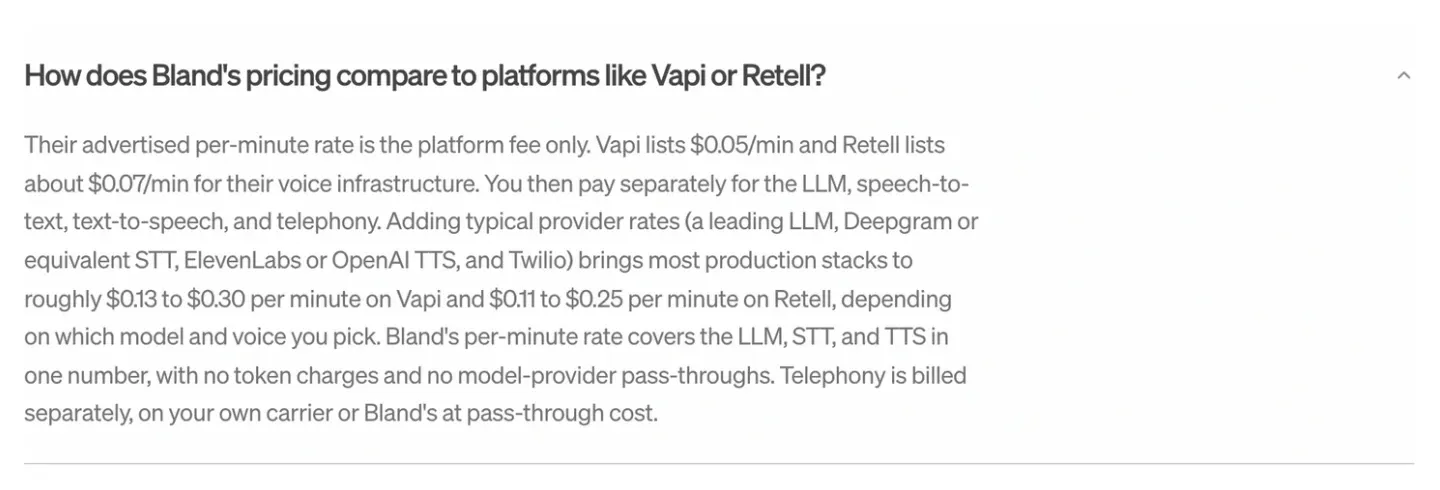
Bland bundles LLM, STT, and TTS into the minute rate and publishes serious volume limits, while telephony remains separate.
Small teams that need a careful guided builder before they need 50 to 100 concurrent calls.
Bland averages 7.8 for outbound operations because the plans expose scale limits and bundle the model stack; cost explainability stays below Retell because telephony is a separate carrier or pass-through charge.
- Start plan includes 10 concurrent calls and 100 calls/day without a platform fee
- Build and Scale publish serious concurrency limits: 50 and 100 concurrent calls
- Per-minute rate includes LLM, speech-to-text, and text-to-speech without model-provider pass-throughs
- Enterprise lists volume-sized concurrency, on-prem or VPC availability, BAA, SSO, and data residency
- The lower $0.12/min and $0.11/min rates require $299/month and $499/month platform fees
- Telephony is billed separately through the buyer's carrier or at Bland's pass-through cost
- The product fit is stronger for outbound operations than for one-off receptionist workflows
- Developer teams that want provider-level tuning may feel boxed in compared with Vapi
4. Synthflow — Best no-code agency option
Synthflow is the agency answer in this list.
Synthflow's current pricing is sales-led. Enterprise contracts start at $30,000 per year, and the final quote depends on call volume, concurrency, telephony, integrations, security, and launch support. That is a different purchase from the old PAYG offer.
That makes Synthflow less attractive if your only question is "what is the cheapest minute?" But that is not the agency question. The agency question is: can I package this for clients without rebuilding every call flow from scratch?
Synthflow's pitch is no-code workflows, client-friendly delivery, knowledge bases, integrations, and launch support that can help an agency or enterprise deploy an AI receptionist or lead-qualification service. The risk is entering a sales process before proving that the expected call volume and client margin can support a five-figure annual contract.
The buyer test is repeatability. If an agency can reuse the same intake, appointment, qualification, and fallback patterns across clients, Synthflow's packaging makes sense. If every client needs custom provider routing and deep engineering logic, a developer-first stack will age better.
Use Synthflow if you sell voice agents as a service at enterprise contract size. Skip it if you are a developer who wants provider control or a small buyer who only needs a single answering workflow.
Synthflow is built for packaged voice-agent delivery, with no-code workflows and agency-friendly operations.
Price-sensitive SMBs and small agencies should compare Vapi, Retell, and Bland before entering a $30,000-plus annual sales process.
Synthflow averages 7.3 because enterprise no-code packaging lowers deployment effort, while cost explainability and general buyer fit fall behind self-serve products at a $30,000 starting contract.
- Sales-led rollout can account for call volume, concurrency, telephony, integrations, security, and launch support
- No-code packaging remains useful for repeatable enterprise and agency workflows
- Enterprise scope can include more implementation support than self-serve developer platforms
- Agency fit is stronger than most developer-first platforms because the workflow is easier to package for clients
- Enterprise contracts start at $30,000/year, excluding small experimental buyers
- Final pricing depends on call volume, concurrency, telephony, integrations, security, and launch support
- Public self-serve price comparison is weaker than Retell, Vapi, or Bland
- Teams that want to tune every provider in the stack should use Vapi instead
5. ElevenLabs Conversational AI — Best voice quality layer
ElevenLabs is the easiest tool here to overrate for the wrong reason.
The voice quality is the draw. If you are building a language tutor, creator tool, roleplay app, premium sales assistant, branded voice experience, or multilingual audio product, ElevenLabs belongs on the shortlist. The main pricing page lists Free at 10k credits/month, Starter at $6/month with 30k credits, Creator at $22/month with the first month discounted to $11, Pro at $99/month, Scale at $299/month, and Business at $990/month with 6M credits and low-latency TTS listed as low as 5c/minute.
That is a strong voice platform. It is not automatically the best phone-operations platform.
The buying sequence matters. Choose the call workflow first, then decide whether ElevenLabs should power the voice layer inside that workflow. If the team starts with voice quality, it can end up optimizing the one part of the call that customers notice only when the rest of the experience already works.
The credit model takes more translation work than Retell, Vapi, Bland, or Synthflow when your buyer question is "what will 3,000 calls cost?" The product also overlaps with voice layers that other agent platforms already wrap. If Retell or Vapi can use high-quality voices inside a more complete phone workflow, buying ElevenLabs directly may duplicate part of the stack.
The affiliate angle is unusually clear: ElevenLabs publicly lists 22% for the first 12 months on eligible Starter, Creator, Pro, and Scale referrals, 11% on Business, no Enterprise commission, and a 90-day cookie duration. That is useful commercially. It still should not decide the ranking. The ranking is about buyer fit, and most small businesses need workflow reliability before premium voice quality.
ElevenLabs is the strongest voice-quality option here, but many phone-agent buyers need operations tooling first.
Teams that mainly need routing, booking, fallback, and call monitoring should start with Retell, Bland, or Synthflow.
ElevenLabs averages 7.1 for this phone-operations decision: premium voice is a real strength, but routing, monitoring, and credit-to-call economics require more assembly than the higher-ranked agent platforms.
- Free tier includes 10k credits/month and Starter is listed at $6/month with 30k credits
- Creator, Pro, Scale, and Business tiers provide a clear path for higher-volume voice and audio work
- Business tier lists low-latency TTS as low as 5c/minute and 6M monthly credits
- Public affiliate program is clear: 22% for 12 months on eligible paid plans and 11% on Business
- Credit-based pricing takes more work to translate into phone-agent economics
- Not the simplest starting point for a local-business answering agent or appointment setter
- HIPAA BAA, SSO, elevated concurrency, and custom assurance sit behind Enterprise terms
- If another platform already wraps ElevenLabs voices, direct ElevenLabs usage may duplicate the voice layer
AI voice agent comparison table
The table is a handoff map rather than a feature tally. Read across the failure, billing, and control rows together: a platform can look inexpensive until the team adds provider charges, monitoring work, and the human process required when an automated call cannot finish safely.
| Feature | Retell AI | Vapi | Bland AI | Synthflow | ElevenLabs |
|---|---|---|---|---|---|
| Rollout job | Monitored phone workflow | Developer-owned voice stack | High-volume outbound calls | Packaged client workflows | Premium voice layer |
| Failure to inspect | Bad handoff or failed writeback | Provider cost and latency drift | Volume before call quality | Client margin after usage | Voice quality hiding ops gaps |
| Billing watch | $0.07-$0.31/min plus components | $0.05/min plus providers | $0.14/min start; telephony separate | Enterprise from $30,000/yr; quote varies | Credits and subscriptions |
| Control model | Builder plus API/webhooks | Bring providers and keys | Bundled LLM/STT/TTS | No-code delivery | Voice API and conversational AI |
| Use when | You need a safer default | The agent is a product | Concurrency drives the case | You sell voice agents | The voice is the product |
| Skip when | Lowest infra cost is the goal | You need one simple invoice | You need careful first rollout | You want provider control | Phone ops are the bottleneck |
| Action | Try Retell | Try Vapi | Try Bland | Try Synthflow | Try ElevenLabs |
How I would choose
Start with launch shape. A local business answering phone calls, a developer building a voice product, an outbound operation, and an agency packaging AI receptionists do not need the same stack. The wrong first question is "which voice sounds best?" The right first question is "who owns the failure when the call breaks?"
If you need a real answering agent quickly: start with Retell AI . The builder, simulation testing, transcripts, analytics, webhooks, and API access give you the cleanest path from prototype to monitored workflow.
If you are building a voice product: use Vapi . You will care about provider keys, model routing, tool calls, latency, web calls, and evals. That is exactly where Vapi is strongest.
If call volume is the business case: pilot Bland AI . Its published concurrency and daily-call caps make scale easier to model, but add the carrier or Bland pass-through telephony cost before comparing totals.
If you are an agency with enterprise-size client volume: look at Synthflow . The no-code workflow and packaging angle are the product, but the contract starts at $30,000 per year and requires a real margin model before a sales call.
If the voice itself sells the experience: use ElevenLabs . For premium speech, branded voice, and multilingual audio products, it is the strongest voice layer here. For basic phone work, it is probably the wrong starting point.
The production checklist nobody puts in the demo
Before you put any AI phone agent in front of customers, test the boring parts. The boring parts decide whether the rollout survives Monday morning.
1. Interruption handling. Can the caller interrupt the agent mid-sentence without being talked over?
2. Name and email correction. Spell a weird last name. Correct it. Change the email halfway through. If the correction disappears, the agent is not ready.
3. Calendar conflicts. Ask for an unavailable time, then ask for the same time next week. Watch whether it checks again or invents confidence.
4. Failed tool calls. If a CRM write, calendar lookup, or payment-status check fails, the agent needs to retry, transfer, or admit it. Pretending success is the worst option.
5. Billing during silence. Silent time is still call time in most voice stacks. Long pauses and retries are not just awkward; they change the cost model.
6. Consent language. Recording, AI disclosure, and state or regional consent rules are not UX details. Treat them like launch blockers.
7. Human fallback. The agent needs a graceful exit for angry callers, refund exceptions, medical or legal issues, billing disputes, and anything outside scope.
8. Post-call review. If you cannot read transcripts, inspect failure points, and improve prompts after calls, you are flying blind.
This is where many AI voice agent reviews are too optimistic. They compare voices and rates, then skip the part where the agent has to operate inside a messy business.
Frequently Asked Questions
Final verdict
For most teams, Retell AI is the best AI voice agent to start with. It gives the strongest balance of builder speed, monitoring, transcripts, simulation testing, API access, and pricing visibility. That balance matters more than having the cheapest headline minute.
Vapi is the better choice when the voice agent is a product and your team wants to own the provider stack. Bland is the better choice when published concurrency, daily-call limits, and a partly bundled model stack drive the business case. Synthflow is the enterprise no-code option. ElevenLabs is the premium voice layer, not the default phone-ops recommendation.
The wrong-buyer risk is simple: if your team will not review transcripts, validate tool calls, price silence and retries, and define human fallback rules, any of these tools can become an expensive way to sound confident while failing.
The counter-intuitive answer is that voice quality should probably be the third or fourth thing you evaluate. The first question is uglier: what happens when the agent is wrong, stuck, interrupted, or unable to write data back to the system?
That is the real benchmark.
Best balance of builder speed, API depth, pricing visibility, and production controls for real phone-agent deployments.
See pricingReady to check Retell AI?
Use the verified route if the trade-offs still fit. If not, jump back to the summary and compare the alternatives.
AI tools editor focused on public docs, changelogs, API limits, free-tier constraints, and developer community feedback. Turns fast-moving AI claims into buyer-focused recommendations without implying undocumented hands-on testing.
Anthony starts with the workload behind the demo, then ranks AI tools by documented model access, limits, implementation clarity, failure behavior, and the cost of an acceptable result.
Related Articles

Bardeen vs Zapier Agents vs Lindy: Best AI Coworker
AI coworkers compared by starting context, agent authority, usage economics, approval boundaries, and offboarding clarity
Compare Bardeen, Zapier Agents, and Lindy by workflow fit, approvals, credits, integrations, browser permissions, and cancellation terms.

GPT-5.6 vs Claude Sonnet 5 API: Which Tier Fits?
Production API model routing guide
GPT-5.6 Sol, Terra, and Luna compared with Claude Sonnet 5 on API price, long context, tokenization, migration risk, tools, and workload fit.