
AI subscriptions crossed an awkward line. At $20, ChatGPT Plus, Claude Pro, and Google AI Pro feel like software expenses. At $100 or $200 per month, they start competing with your project management app, code editor stack, cloud storage, and a serious SaaS seat.
The trap is paying premium pricing for a limit you rarely hit.
That changes the question.
The question is not "which model is smartest?" for a generic prompt. The better question is: which plan will stop interrupting real work often enough to justify the jump?
My default pick is ChatGPT Pro for most power users because OpenAI now has a cleaner $100 and $200 Pro ladder, and the current Help Center positions Pro around Codex, Deep Research, image creation, memory, and file uploads. Google AI Ultra is the best bundle if you live in Google's ecosystem and can actually use the storage, NotebookLM, Flow, Antigravity, and YouTube pieces. Claude Max is still the cleaner Claude-first upgrade, especially if Claude Code or long writing/analysis sessions are the reason you keep hitting limits.
Here's the thing: the wrong $100 AI plan does not feel expensive on day one. It feels expensive on day 23, when you realize you bought headroom for a workflow you only run twice a month.
This is an evidence-led comparison. I checked official OpenAI, Google, Gemini, and Anthropic pages, rendered screenshots, current SERP competitors, and concrete Reddit buyer-friction examples. I did not upgrade paid accounts, run private coding tasks, benchmark output quality, test latency, test cancellation, or measure exact usage limits inside any account.
If your real decision is model quality rather than subscription headroom, start with our ChatGPT vs Claude comparison. If search and citations matter more than coding or file work, the Perplexity vs SearchGPT guide is the better frame. If this started with notes and research workflows, read the AI note-taking apps roundup before spending $100 on a broader AI bundle.
-
#1 ChatGPT ProBest default: broader workbench for Codex, Deep Research, image creation, memory, files, and general power-user work
-
#2 Google AI UltraBest bundle: Gemini usage, Antigravity, NotebookLM, Flow credits, storage, and YouTube value in one Google plan
-
#3 Claude MaxBest Claude-first pick: higher Claude limits, Claude Code, Cowork, and cleaner $100/$200 Max tiers
If you already spend most of the day inside ChatGPT, compare ChatGPT Pro first. If your work is glued to Gmail, Docs, Drive, NotebookLM, and YouTube, look at Google AI Ultra . If Claude is the tool you trust for coding, long-form reasoning, or writing, check Claude Max .
Ranking method for premium AI plans
The ranking uses five criteria: Usage Clarity, Work Surface, Coding and Agent Depth, Bundle Value, and Price Clarity. Usage Clarity asks whether the plan explains what the buyer gets when they pay 5x or 10x a normal $20 subscription. Work Surface asks whether the subscription replaces multiple daily tools or only adds more chatbot capacity. Coding and Agent Depth matters because much of the $100-plan pressure is coming from Codex, Claude Code, Google Antigravity, and agent-style workflows. Bundle Value asks whether the extras are real value or just padding. Price Clarity asks whether the buyer can understand the bill before upgrading.
That rubric punishes vague "unlimited" language. It also punishes bundles that look generous but only help if the buyer already lives in that ecosystem.
Bad upgrade math is simple: paying $100 for a plan because you might use it.
The better threshold is stricter. Upgrade when the current plan interrupts paid work, long research, coding sessions, client analysis, or repeated production tasks. If you are not hitting limits, waiting is rational.
AI subscription plans compared: ChatGPT Pro vs Google AI Ultra vs Claude Max
| Feature | ChatGPT Pro | Google AI Ultra | Claude Max |
|---|---|---|---|
| Best job | Broad AI workbench for power users | Google ecosystem bundle with AI headroom | Claude-first writing, analysis, coding, and long sessions |
| Verified premium range | OpenAI Help showed Pro $100 and Pro $200 | Gemini page showed Ultra from $99.99/mo; Google blog says $100 and $200 tiers | Anthropic Help showed Max 5x at $100/mo and Max 20x at $200/mo |
| Usage boundary | $100 is 5x Plus; $200 is 20x Plus | 5x or 20x higher usage versus Google AI Pro depending tier | 5x or 20x more usage than Claude Pro depending selected tier |
| Coding or agent angle | Codex plus Deep Research, files, image creation, memory, and Pro models | Google Antigravity, Jules, Gemini Spark, Flow, NotebookLM, and agent features | Claude Code and Cowork access inside the Max subscription |
| Bundle value | Mostly AI workbench value, not storage or media bundle value | Strongest bundle: storage, YouTube Premium, Google Home, Flow credits, NotebookLM | Focused AI capacity, not a media/storage bundle |
| Skip if | You mainly want Claude Code or Google Workspace bundle perks | You do not value Google storage, YouTube, or Workspace-adjacent AI | You need the broadest multi-tool AI workspace rather than more Claude |
| Action | Compare ChatGPT Pro | Compare Gemini | Compare Claude Max |
How to choose the right AI subscription plan
Before comparing plan cards, write down the thing that actually broke last week. Not the thing that felt annoying. The thing that stopped useful work.
If the interruption was coding, the next question is where the code lives. If you already work inside ChatGPT and want Codex tied to research, files, and general analysis, ChatGPT Pro is the cleaner default. If your hands are already in a terminal and you trust Claude for multi-file reasoning, Claude Max is more direct. If the work is specifically around Google's agent stack, Gemini, Jules, or Antigravity, Google AI Ultra is the one to investigate first.
If the interruption was research, do not jump straight to the highest plan because it sounds more capable. Ask whether the research job needs citations, file handling, source-grounded notebooks, or long synthesis. ChatGPT Pro looks strongest when Deep Research, files, and general follow-up work live together. Google AI Ultra looks stronger when NotebookLM, Gemini, Docs, Drive, and storage are part of the same workflow. Claude Max looks stronger when the research turns into long writing, structured reasoning, or code.
If the interruption was creative production, count the tools you would replace. Google AI Ultra can make sense if Flow credits, storage, and Google media perks replace things you would otherwise pay for. ChatGPT Pro can make sense if image creation and broader ChatGPT workflows are central. Claude Max is not the default creative-media subscription because its value is focused more on Claude capacity, code, and written reasoning.
If the interruption was just "I want the best AI," wait. That is not a buying reason. It is a mood.
The cleanest test is a one-week friction log. Every time your $20 plan blocks a useful task, write down the date, tool, task, and what you did instead. If the log has two or three real work interruptions by Friday, a $100 plan is at least a rational experiment. If the log is mostly curiosity, stay where you are.
The concrete community questions point the same way. I saw r/codex users debating whether a coding-heavy buyer should pick ChatGPT Pro $100, ChatGPT Pro $200, or split the budget with Claude. I also saw r/google_antigravity users asking whether Google AI Ultra makes sense compared with cheaper Claude or ChatGPT plans. Those are useful examples of buyer friction, not a survey of what communities believe.
I would also avoid buying all three premium plans at once. That sounds obvious until you spend a week in AI Twitter and convince yourself every workflow needs every model. Start with the plan that matches the bottleneck. Keep the others on free or $20 tiers. Revisit after one billing cycle.
Where premium AI plans fail
The most common failure is overbuying for a hypothetical week. A $100 plan can feel sensible when the demo is fresh, but the billing regret shows up when the real week is still Slack, email, docs, and one or two serious AI sessions.
The second failure is bundle math. Google AI Ultra can be strong value, but only if storage, YouTube, NotebookLM, Flow, and Google app benefits replace a real cost or real workflow. If those perks are not already useful, the bundle becomes confusing padding.
The third failure is buying the wrong work surface. Claude Max can be the right answer for Claude Code and long reasoning. It is the wrong buyer fit if the buyer needs image creation, broad file workflows, Google app perks, or one general assistant for everything. ChatGPT Pro has the opposite risk: broad enough to be convenient, but broad enough that a buyer can avoid deciding what problem they are solving.
The last failure is assuming premium means fewer hallucination or quality risks. These plans mainly sell capacity, access, and workflow headroom. They do not remove the need to check sources, read generated code, review private uploads, or control where sensitive client material goes.
1. ChatGPT Pro: best default premium AI subscription
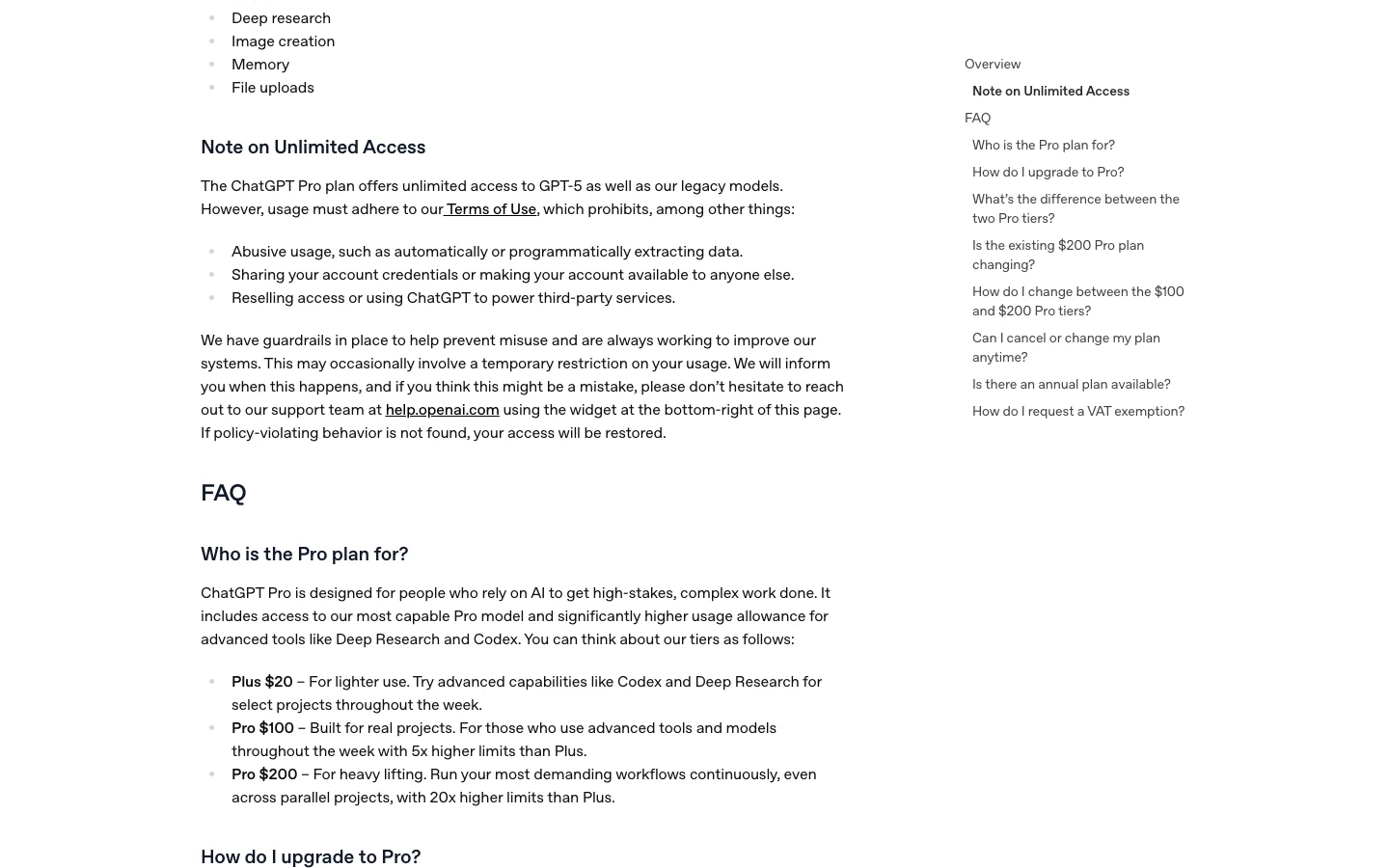
ChatGPT Pro wins because it is the broadest $100-$200 workbench. The current OpenAI Help page frames Pro for people doing high-stakes, complex work and lists advanced features including Pro models, Codex, Deep Research, image creation, memory, and file uploads. The same page shows Plus at $20, Pro $100 for real projects with 5x higher limits than Plus, and Pro $200 for heavy lifting with 20x higher limits than Plus.
That does not mean every ChatGPT user should upgrade. It means OpenAI's premium ladder is now easier to map to buyer behavior. If Plus is enough, stay at Plus. If Codex or Deep Research is interrupting real work throughout the week, Pro $100 is the practical jump. If you are running parallel, demanding workflows often enough that $100 still feels tight, Pro $200 is the ceiling.
The strongest reason to pick ChatGPT Pro is consolidation. A single subscription can cover general chat, code help, Deep Research, files, memory, image creation, and Codex-heavy work. That is not the same as saying it is best at every task. It means the average power user is less likely to need three separate premium AI subscriptions.
The caveat is usage opacity. OpenAI says Pro includes unlimited access subject to abuse guardrails, and the $100/$200 split uses 5x and 20x language. That is useful directionally, but it is still not a public count of exactly how many high-compute tasks your account will get next Thursday.
The buyer I would steer toward ChatGPT Pro is the person who keeps switching contexts: research in one tab, code in another, an image brief in another, a document upload in another, and a follow-up explanation for a client after that. The value is not that ChatGPT is magically better at every job. The value is that enough jobs happen in the same workbench that the subscription replaces friction.
OpenAI now gives power users a $100 Pro step before the $200 tier, while keeping Codex, Deep Research, file, memory, image, and Pro-model work under one umbrella.
Skip it if you mainly want Claude Code, Google Workspace bundle value, or you are not actually hitting limits on a $20 plan.
ChatGPT Pro ranks first because the $100/$200 split now matches real power-user usage better than the old $20-to-$200 jump, and the work surface is broader than the alternatives.
- Official Help page showed Pro $100 and Pro $200 tiers checked June 3, 2026
- $100 tier is positioned for real projects with 5x higher limits than Plus
- $200 tier is positioned for demanding parallel workflows with 20x higher limits than Plus
- Strongest single workbench across Codex, Deep Research, files, image creation, memory, and general ChatGPT use
- Still not a public exact task-count schedule for every model and feature
- Bundle value is AI-workbench value, not storage, media, or Workspace value
- Claude-first coders may still prefer Claude Max because Claude Code is the core workflow
- This review did not upgrade an account or test Codex, Deep Research, latency, or output quality hands-on
2. Google AI Ultra: best if the bundle is real value
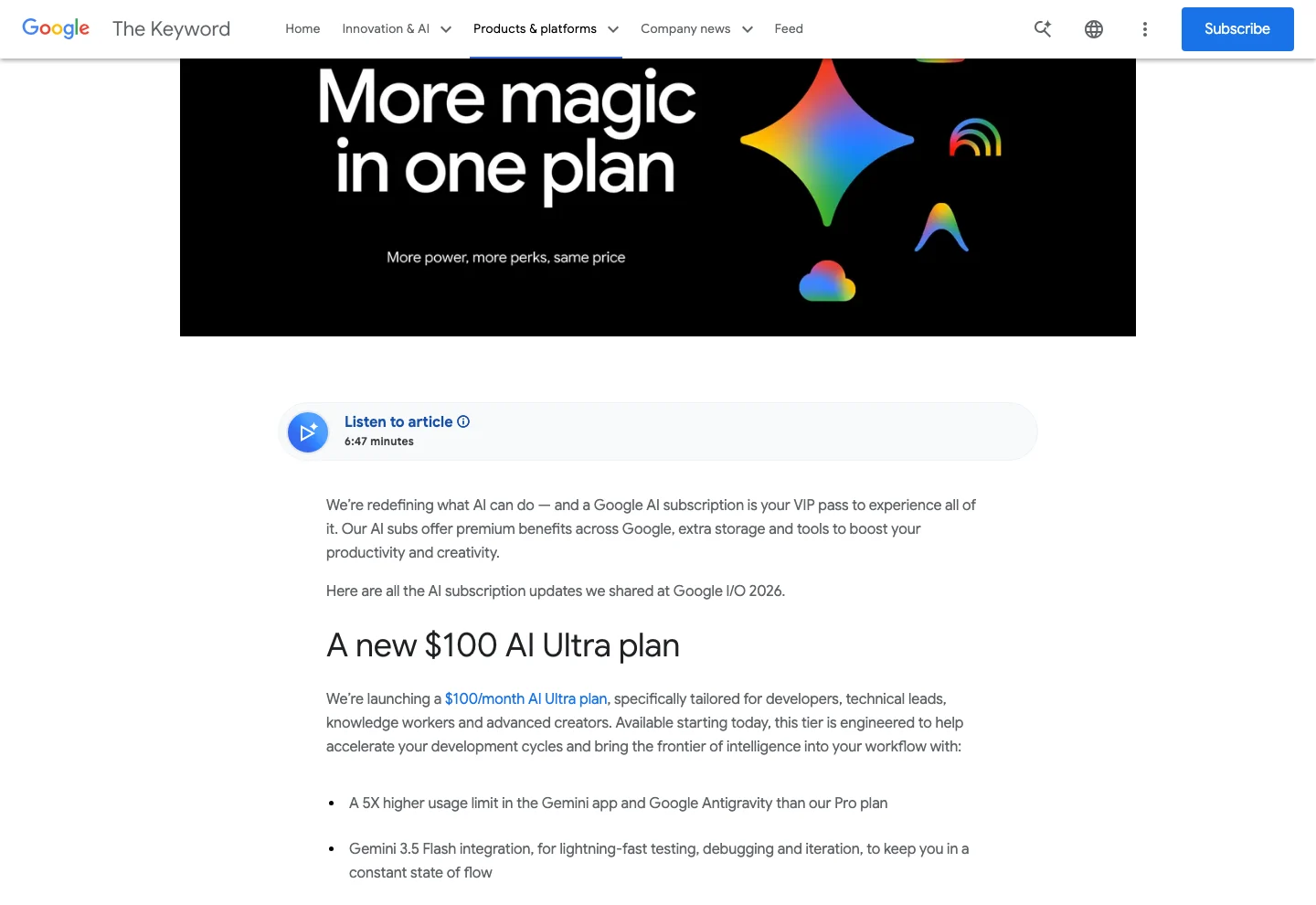
Google AI Ultra is the freshest change in this comparison. Google announced a new $100 AI Ultra plan at I/O 2026 and said the top Ultra plan dropped from $250 to $200. The Gemini subscription page showed Google AI Ultra starting at $99.99/month in the United States during this pass.
The buyer logic is different from ChatGPT Pro. Google is not only selling more Gemini. It is selling a bundle: Gemini app usage, Google Antigravity priority, Gemini Spark access, Jules, Flow credits, NotebookLM limits, Gmail/Docs/Vids AI, storage, Google Home Premium, Project Genie, and YouTube Premium depending tier and availability.
That is why Google AI Ultra can be either the best value or the easiest plan to overbuy. If you already pay for Google storage, YouTube Premium, and use NotebookLM or Gemini across Gmail and Docs, the bundle matters. If you only want better answers in a chat window, the bundle may be a distraction.
I would not count every bundled perk at face value. A YouTube Premium line item only matters if you would pay for it separately. Storage only matters if you need it. Flow credits only matter if video/image generation is part of your week. Antigravity only matters if you build with Google's agent surface. This is where Google AI Ultra gets powerful, but also where the buyer can lie to themselves.
The fairest way to price Google AI Ultra is to subtract only the services you already pay for or were about to buy. If YouTube Premium, storage, and NotebookLM capacity are already real line items, the AI portion gets cheaper in practice. If none of those matter, the plan is just an expensive Gemini upgrade with a long receipt.
That is why this plan is second, not first. It can beat ChatGPT Pro for the right Google-heavy buyer. The tradeoff is cost risk: because the bundle is long, the wrong buyer can justify a $99.99 or $199.99 plan with perks they will never use. It is not my default for someone who just wants one premium AI assistant and has no commitment to Google's stack.
Google AI Ultra bundles Gemini headroom with Antigravity, NotebookLM, Flow, storage, YouTube, and Google service perks, which can make it worth more than pure chatbot capacity.
Skip it if you do not use Google services deeply or if storage, YouTube, Flow, and Workspace-adjacent AI would not replace separate spend.
Google AI Ultra ranks second because its bundle can be excellent, but the buyer has to value the Google ecosystem extras instead of pretending every perk is cash-equivalent.
- Google announced a new $100 AI Ultra plan and reduced the top Ultra plan to $200 at I/O 2026
- Gemini subscription page showed Ultra starting at $99.99/month in the United States
- Strongest non-model bundle with storage, YouTube Premium, Flow credits, NotebookLM, Google Home, and Google app integrations
- Good fit for buyers already using Google Workspace-adjacent AI and Google Antigravity
- Bundle math can be misleading if the buyer would not pay for the extras separately
- Some features are region, language, age, beta, or availability constrained
- Compute-used limits are harder to reason about than fixed message counts
- This review did not upgrade Google AI Ultra or test Gemini Spark, Antigravity, Flow, NotebookLM, or Workspace behavior hands-on
3. Claude Max: best when Claude is already the daily tool
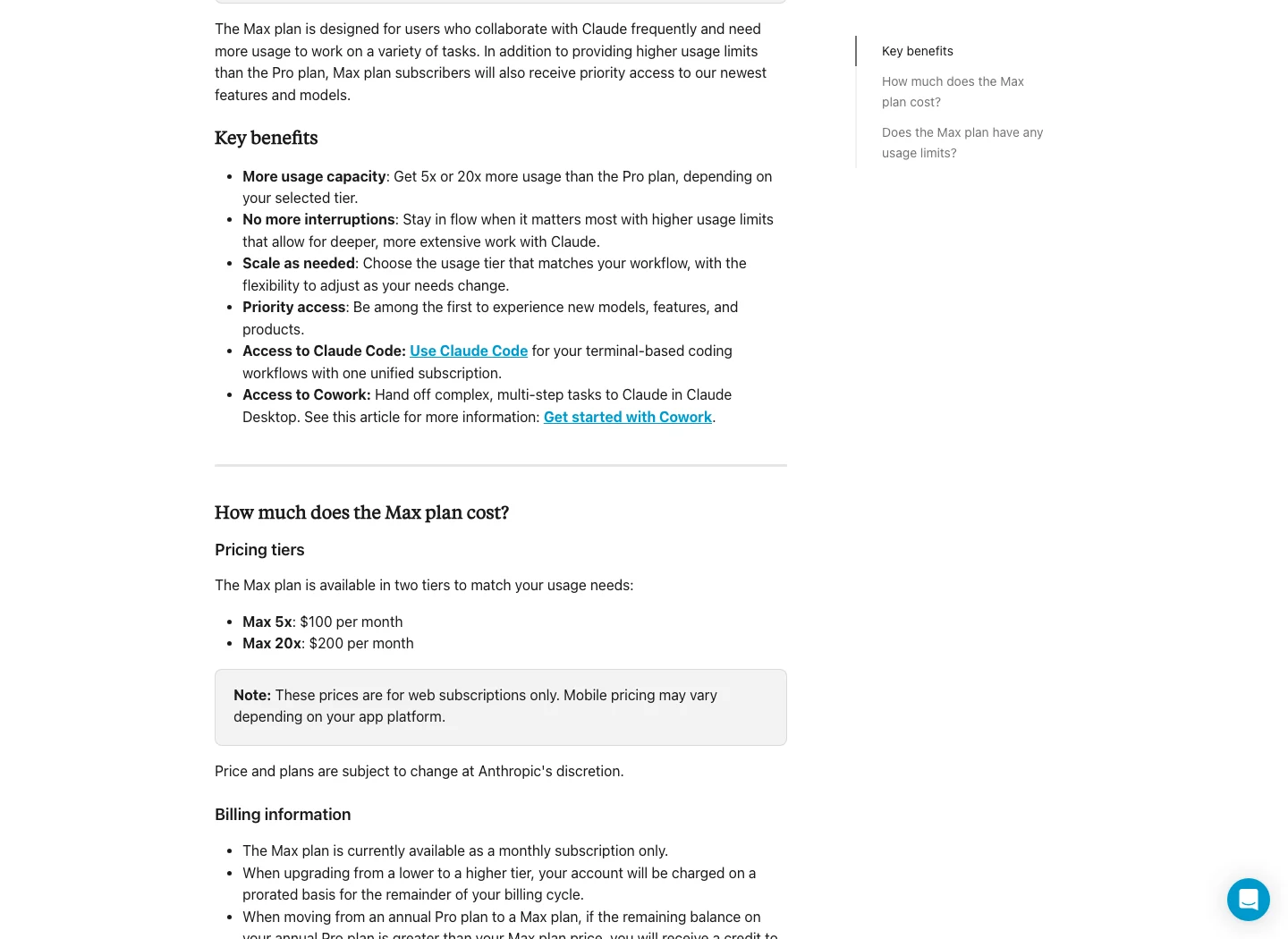
Claude Max is the most focused plan here. Anthropic's Help Center showed Max 5x at $100 per month and Max 20x at $200 per month for web subscriptions, with mobile pricing possibly varying by platform. The same page says Max gives 5x or 20x more usage than Claude Pro depending tier, priority access, Claude Code, and Cowork.
That is not a weak offer. It is just narrower than ChatGPT Pro and less bundle-heavy than Google AI Ultra.
Claude Max makes the most sense when you already know the answer to one question: "Do I want more Claude?" If yes, the plan is clean. If the real problem is that you need AI search, image generation, Google integrations, or a broader multi-surface assistant, Claude Max is probably too focused.
The concrete Reddit friction around Claude Max is useful, but not as sentiment. A recent r/ClaudeAI thread about the missing middle between Pro and Max shows the exact buyer anxiety: $20 feels too tight for heavy users, but $100 feels abrupt unless the work is paid, frequent, or critical. That is a real buyer problem. It does not prove what most Claude users think.
I like Claude Max most for people who can name the specific Claude workflow before they open the pricing page: Claude Code in the terminal, long written analysis, deep editing, architecture review, or a repeated reasoning task where Claude is already the trusted tool. If the answer is "I might use Claude more if I had Max," that is not enough.
The tradeoff is focus. Claude Max wins when the problem is more Claude, but it loses when the buyer is really trying to consolidate research, image creation, file workflows, and ecosystem perks into one subscription. That wrong-buyer risk is why it sits behind ChatGPT Pro and Google AI Ultra in the default ranking.
Claude Max is the cleanest upgrade when the buyer already wants more Claude capacity, Claude Code, and Cowork rather than a broad bundle.
Skip it if you want one subscription to cover general AI, image creation, file workflows, Google app perks, storage, and coding in one place.
Claude Max ranks third only because it is focused. It can be the right first-place pick for Claude-first coders and writers, but it is not the broadest premium subscription.
- Official Anthropic Help page showed Max 5x at $100/month and Max 20x at $200/month
- Includes more Claude usage than Pro, plus Claude Code and Cowork access
- Cleaner price explanation than many AI subscriptions
- Strong fit when Claude is already the tool that blocks or accelerates paid work
- Narrower than ChatGPT Pro if the buyer wants one general AI workbench
- Less bundle value than Google AI Ultra
- Monthly web-subscription pricing was clear, but mobile pricing may vary by app platform
- This review did not upgrade Claude Max or test Claude Code, Cowork, output quality, or real usage resets hands-on
The actual buying rule
Do not buy a $100 AI plan because the model demo looked better. Buy it because the $20 plan is interrupting a workflow that has a measurable cost.
For ChatGPT Pro, that means Codex, Deep Research, file, image, memory, or repeated high-compute work is central to the week. For Google AI Ultra, it means the Google bundle replaces separate value, not just a vague hope that Gemini will be better. For Claude Max, it means Claude is already the tool you reach for when the work is serious and the current limit is the bottleneck.
Look, I would rather see a buyer keep two $20 plans for another month than jump to a $100 plan and invent reasons to use it. The $100 tier is not a badge. It is a capacity purchase.
The practical upgrade path is boring and useful:
- Stay on $20 if limits are rare or annoying but not work-blocking.
- Move to $100 if limits interrupt paid work, coding sessions, research, or repeated client deliverables every week.
- Move to $200 only if the $100 tier still blocks parallel or continuous workflows.
- Cancel or downgrade after one billing cycle if the extra headroom is not used.
That last line matters. Premium AI plans are easy to rationalize because they feel like buying intelligence. Most of the time, you are buying throughput.
Final verdict
Choose ChatGPT Pro if you want the broadest premium AI workbench and you actually use Codex, Deep Research, files, image creation, memory, and general ChatGPT workflows enough to need the headroom.
Choose Google AI Ultra if the Google ecosystem bundle has real value for you: storage, YouTube, NotebookLM, Gmail/Docs/Vids AI, Flow credits, Antigravity, and Gemini usage. Do not buy it just because the bundle is long.
Choose Claude Max if Claude is already your main work tool and the limit is the problem. It is the simplest upgrade when the answer is "more Claude," not "more everything."
My default recommendation is ChatGPT Pro. My second recommendation is discipline: wait until the limit costs more than the plan.