

Mixo vs Durable looks simple until you ask the useful question: do you need a quick public page, or do you need a small-business operating layer wearing a website-builder costume?
My default pick is Mixo if the job is fast validation, a basic business site, or a lead page you can publish without turning the project into a software rollout. Durable is the better pick when the website is only one piece of the workflow and you also want CRM, bookings, payments, invoices, AI chat, and AI visibility checks in the same account.
This is evidence-led. I checked official pricing, feature pages, rendered screenshots, SERP competitors, Reddit question patterns, GDT Search Console data, and affiliate click data on May 21, 2026. I did not create accounts, generate sites, connect domains, submit leads, test support, or measure SEO performance.
If you are still deciding the broader category, start with our AI website builders guide. If you only need the narrower Mixo decision, read the Mixo review. And if the project is actually an app rather than a website, the vibe coding tools roundup is the better fork.
-
#1 MixoBest fast default: cheaper paid site path, simple lead capture, custom domain, SSL, and no mini-CRM tax
-
#2 DurableBest business stack: website, CRM, bookings, payments, invoices, AI chat, and AI visibility tools together
-
#3 FramerBest upgrade path when design control, CMS depth, animations, and a more intentional product site matter
If a founder asked me where to start today, I would send them to Mixo first and make them prove people care before buying a bigger site stack. If a local service business already needs customer records, bookings, invoices, and payments, I would compare Durable instead. That is the real split.
The buyer trap: a 30-second website is not the whole decision
Both tools sell speed. Mixo says it can build your site in 30 seconds. Durable says you can get online in 30 seconds too. Fine.
The expensive mistake is treating that first draft like the purchase decision.
A website builder can fail after the site is technically live. The lead form might be too basic. The CRM might be a second spreadsheet. The domain offer might hide renewal work later. The AI SEO/GEO pitch might sound better than the control you actually get. Or the opposite happens: you buy a full business stack when all you needed was a one-page proof that someone would send an enquiry.
Look, I like fast builders. But speed is only useful when it removes work you were definitely going to do. If the tool creates a new maintenance surface, another dashboard, another billing model, another place where contacts live, then the 30-second demo just moved the work downstream.
Mixo vs Durable comparison table
| Feature | Mixo | Durable |
|---|---|---|
| Best buyer | Founder, solo operator, or local business that needs a simple site and enquiry path quickly | Local service business that wants website, CRM, bookings, payments, invoices, and AI visibility in one place |
| Official price signal | Free; Business Site $20/mo monthly or $16/mo annual; Premium $40/mo monthly or $32/mo annual | Free; Launch $25/mo monthly or $22/mo annual; Grow $99/mo monthly or $85/mo annual |
| Free plan shape | Mixo web address, live website, contact form, Mixo badge | durable.site subdomain, 5 AI images/month, 10 AI chat messages/month, CRM up to 10 customers |
| Lead/customer workflow | Forms, enquiries, lead capture, exports, and integrations | CRM, unlimited customers on paid plans, bookings, payments, invoices |
| SEO/GEO angle | SEO-ready pages and AI-ready/llms.txt language on official pages | SEO plus Advanced GEO, prompt rankings, competitive analysis, directory scans on paid plans |
| Main caveat | Less complete if the buyer needs bookings, invoices, payments, or CRM as the core workflow | More expensive once the buyer only needed a public page and simple lead capture |
| Action | Check Mixo | Check Durable |
How I ranked Mixo and Durable
The scoring rubric uses five criteria: Launch Speed, Lead Capture, Business Stack, Design Control, and Value Clarity. Launch Speed asks whether the buyer can get from idea to public page without dead setup time. Lead Capture asks whether the site can collect a real enquiry without Zapier glue. Business Stack asks whether the tool handles the work around the website. Design Control asks how quickly a buyer will outgrow the editor. Value Clarity asks whether the paid plan matches the buyer's actual stage.
That last one decides the winner. Mixo is not the bigger product. Durable is. But the bigger product is not automatically the better purchase. If your bottleneck is "I need a credible page and a form by Friday," Durable's extra stack can become overhead. If your bottleneck is "I need the site to feed customer management, bookings, payments, and invoices," Mixo is too narrow.
Not the same job.
1. Mixo: the better default when speed and simple lead capture matter
Mixo wins because it stays closer to the job most early buyers actually have: get a believable website live, attach a lead path, and stop tinkering. The rendered pricing page showed Free, Business Site at $20/month monthly or $16/month billed annually, and Premium Site at $40/month monthly or $32/month billed annually. Business and Premium also showed a 30-day money-back guarantee, and the free-domain FAQ said Business and Premium include a first-year standard domain valued at $30.
The annual math matters because it changes the commitment. Business Site at $16/month is billed as $192/year, and Premium Site at $32/month is billed as $384/year. That is still reasonable compared with hiring a designer for a tiny launch page, but it is not the same psychological decision as keeping a free validation URL live for a week. I would only pay annually after the page has a job: a live campaign, a local service offer, a waitlist, or a referral path that needs a real domain.
The free tier is useful because it creates a real public proof surface: a Mixo-branded URL, a live site, and a contact form. That is enough to answer the question a lot of founders avoid: will anyone actually click, call, or submit an enquiry?
The boring features are the point. Custom domain, SSL, mobile-responsive layout, form capture, simple integrations, and the ability to export form submissions matter more than another shiny AI claim. If the page exists to turn cold traffic, a Product Hunt launch, a local referral, or a LinkedIn post into a lead, you do not need a giant CMS. You need the page to work and the form to not disappear into a black hole.
That is also why I would avoid treating Mixo like a mini product team. The public evidence supports a focused recommendation: publish quickly, collect enquiries, and learn whether the offer deserves more infrastructure. It does not support a claim that Mixo is the right place for a knowledge base, programmatic landing pages, a serious blog, checkout logic, member areas, or a long-term editorial engine. When the site itself becomes the business system, the tool choice should be boringly deliberate, not driven by the first generated draft that looks presentable.
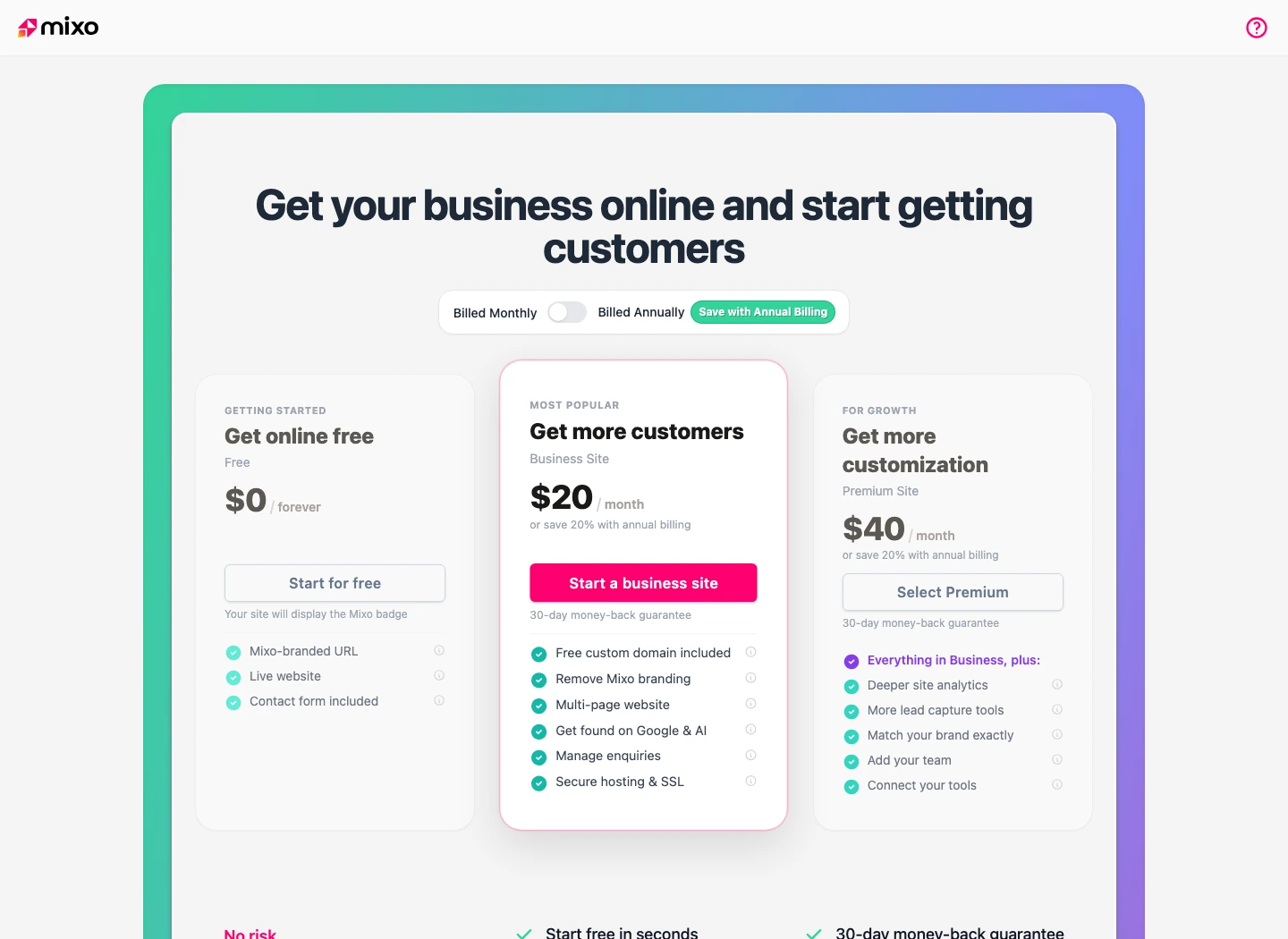
The tradeoff is ceiling. Mixo's official feature page talks about forms, custom domains, SEO-ready sites, GDPR compliance, hosting, responsive design, and integrations. Good. But if your real requirement is invoices, bookings, payments, a CRM, AI visibility rankings, and ongoing local-business operations, you will either bolt tools together or move platforms.
I would not use Mixo as the long-term home for a content-heavy site, marketplace, SaaS docs hub, ecommerce store, or anything where custom code and CMS structure become the product. The custom-code language on the pricing page is helpful, but it does not turn Mixo into Webflow, Framer, or WordPress. Treat it like a fast business-site launcher, not a forever architecture.
Verdict: choose Mixo first unless you already know the website has to run customer operations.
Mixo keeps the buying decision focused: a public site, custom domain path, SSL, form capture, and lower paid-plan entry before the buyer overbuilds.
Skip it if bookings, invoices, payments, CRM workflows, or deeper CMS/design control are the reason you are shopping.
Mixo ranks first because most early buyers need credible launch speed and lead capture before they need a heavier business stack.
- Free plan can publish a live Mixo-branded site with a contact form
- Business Site rendered at $20/mo monthly or $16/mo annual in the May 21 check
- Feature page calls out custom domains, forms, SEO-ready sites, GDPR compliance, hosting, mobile responsiveness, and integrations
- Cleaner fit when the buyer only needs a credible page and enquiries, not a full customer-management workflow
- Not the strongest fit for bookings, invoices, payments, or CRM-heavy local-service operations
- Design and CMS ceiling arrives faster than in Framer, Webflow, or WordPress
- Annual domain offer still needs renewal awareness after the first year
- Evidence-led review only; no Mixo account, generated site, lead submission, domain connection, support flow, or cancellation flow was tested
2. Durable: better when the website is part of the business system
Durable is the more ambitious product. Its official pricing page says all plans include SEO, secure hosting, unlimited website traffic, and CRM. The Free plan lists a durable.site subdomain, 5 AI images per month, 10 AI chat messages per month, and customer management for up to 10 customers. Paid Launch adds a custom domain, removes Durable branding, raises AI images to 50 per month, raises AI chat to 1,000 messages per month, unlocks unlimited customers, and includes bookings and payments. Grow pushes image generation to 500 per month, AI chat to unlimited, and adds deeper AI visibility work.
That is a lot more than "make me a landing page."
The May 21 pricing check showed Durable Launch at $25/month on the monthly toggle and $22/month on annual billing. Grow showed $99/month monthly and $85/month annually. Payment fees on the pricing table showed 2.9% + 30c for Launch and Grow. So the real question is not whether Durable costs more. It does. The question is whether you are replacing enough other tools to justify it.
This is the clean Durable argument: if one subscription replaces a basic CRM spreadsheet, an appointment tool, manual invoice work, a simple payment setup, and a lightweight site editor, the sticker price is easier to defend. If it replaces only a landing page and a form, the same plan starts to look like feature drag. Durable should earn its keep through the operations it removes, not through the comfort of a bigger menu.
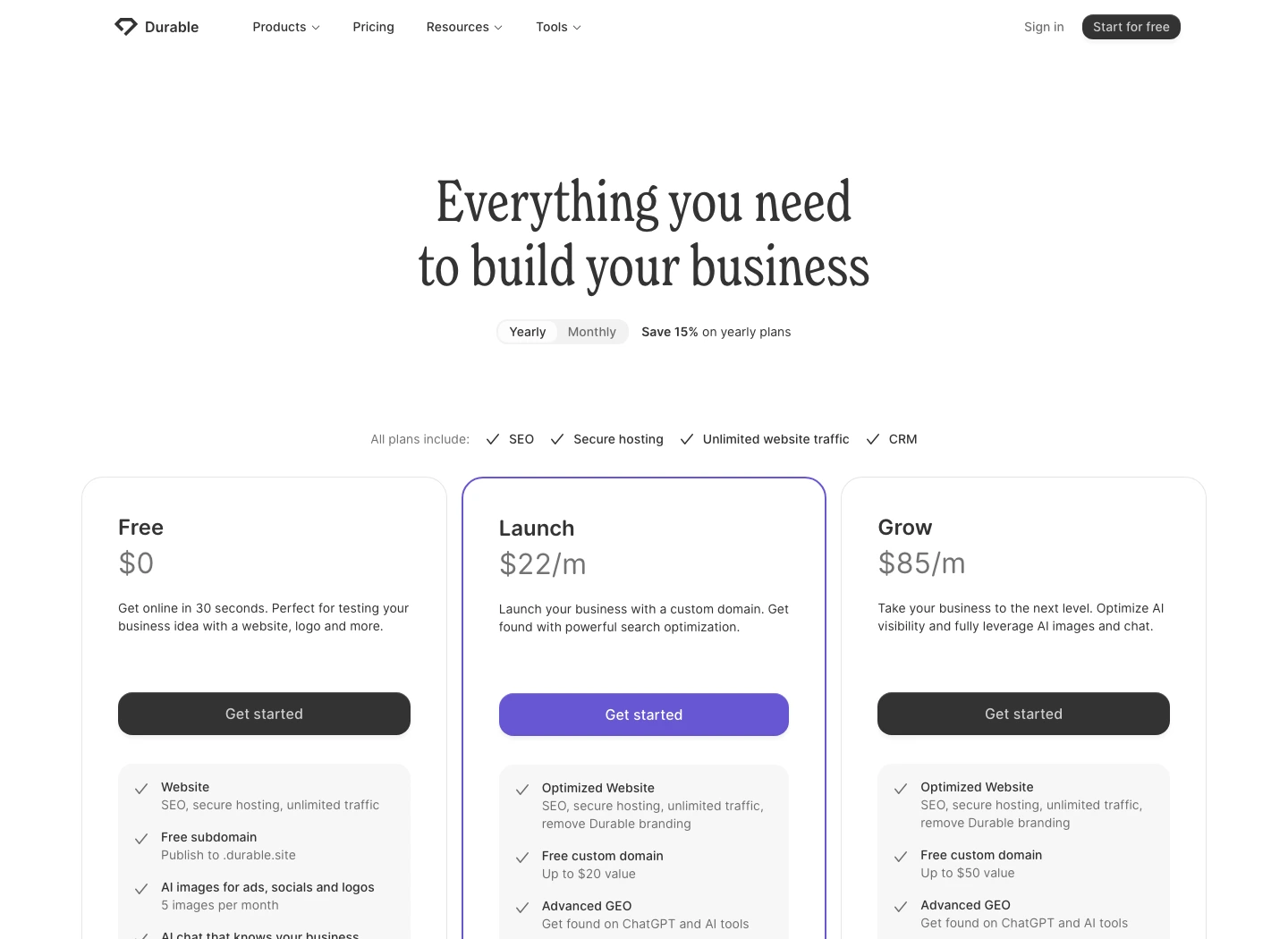
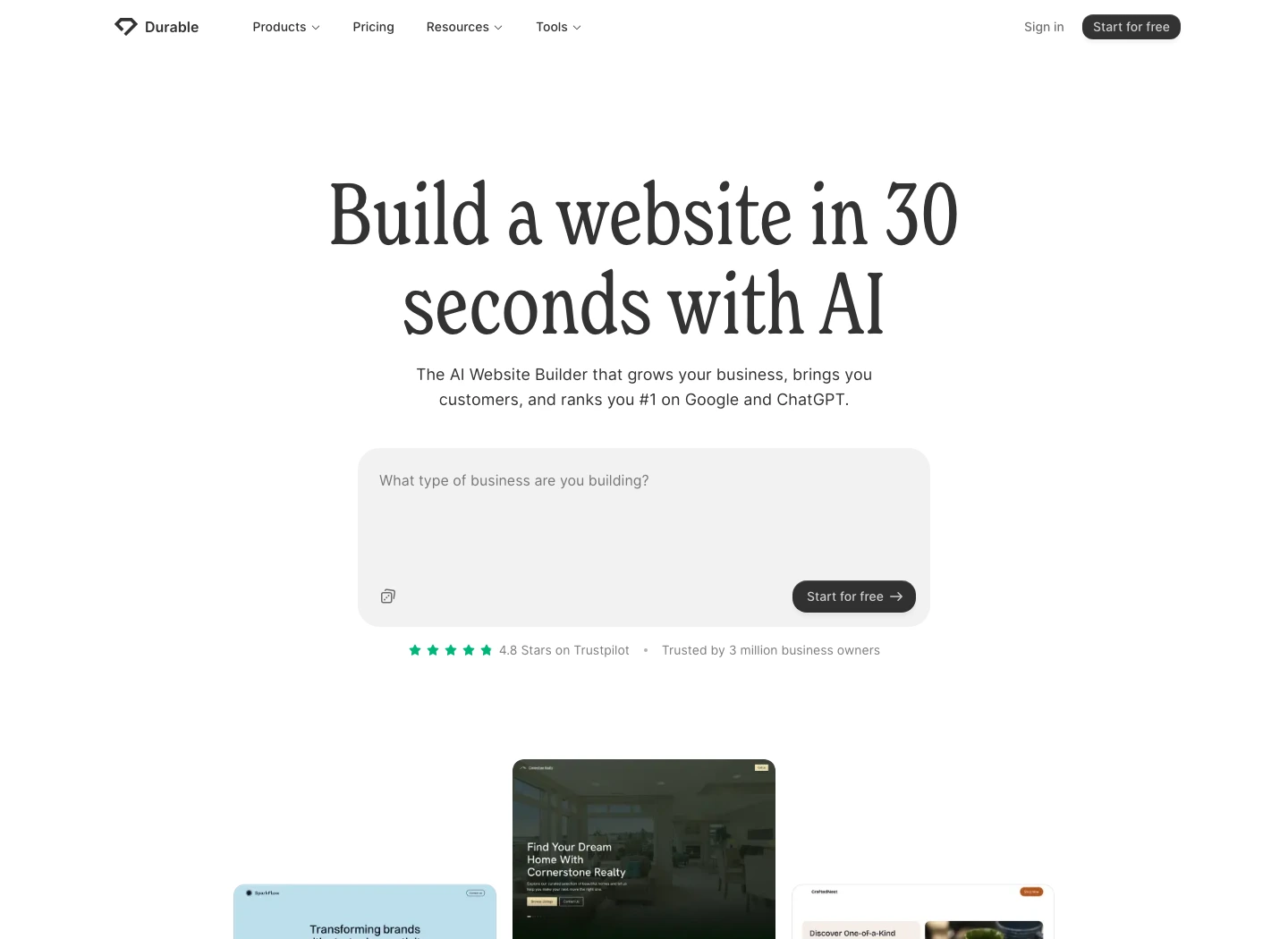
Durable's official AI website builder page also frames the workflow around answering three questions, getting an AI-built site, then editing layout, images, headings, and fonts. The same page says Durable is trusted by 3 million business owners. I would treat that as a scale signal, not a quality benchmark. Big user-count copy does not tell you whether your plumbing company, consultant site, or local studio will convert.
The strong Durable buyer is specific: local services, appointment-driven businesses, solo operators with customer records, and people who want the website to feed a lightweight back office. For that buyer, CRM and bookings are not bloat. They're the reason to pay.
The wrong Durable buyer is also specific: someone validating a newsletter, waitlist, one-page startup idea, or simple local landing page who buys the bigger stack because the demo looked more complete. That category mistake is common across software: the product feels safer because it has more boxes, then the buyer ends up maintaining boxes the project never needed.
Verdict: choose Durable when customer operations are the point, not a future maybe.
Durable folds website, CRM, bookings, payments, invoices, AI chat, and AI visibility tools into one paid stack.
Skip it if your actual job is one fast public page and a simple enquiry form.
Durable ranks second because it is stronger for operations-heavy buyers, but its extra system weight is the wrong default for simple validation pages.
- Free plan includes durable.site publishing, AI image allowance, AI chat allowance, and CRM for up to 10 customers
- Paid Launch includes unlimited customers, bookings, payments, and priority live chat on the official pricing table
- Grow adds larger AI image/chat limits and deeper AI visibility tracking
- Better fit than Mixo when a local service business wants customer operations attached to the site
- Launch and Grow cost more than Mixo paid tiers in the May 21 pricing check
- Payment fee row showed 2.9% + 30c on paid plans
- No-code FAQ says Durable does not offer extensive HTML customization options
- Evidence-led review only; no Durable account, generated site, booking, payment, invoice, support, or cancellation flow was tested
3. Framer, Webflow, or WordPress: better when the website itself is the product
The third option is not another 30-second builder. It is admitting that Mixo and Durable are the wrong comparison when the website needs to become a durable growth asset. If the buyer needs a real CMS, reusable templates, schema control, custom code, redirects, editorial workflows, content ownership, animation control, or a serious SEO architecture, the risk is not paying too much for Mixo or Durable. The risk is starting in a tool that feels fast today and becomes a rebuild cost later.
Framer is the cleaner upgrade path for design-led marketing pages. Webflow fits teams that want structured CMS control without moving straight to WordPress. WordPress still wins when content operations, plugin depth, ownership, and migration flexibility matter more than a polished first draft. None of those are better because they are simpler. They are better because they reduce a different failure: locking a long-term site into a speed-first builder before the buyer understands the growth model.
Skip this path if the site is still a test. Paying the setup cost of Framer, Webflow, or WordPress before you have an offer is its own overkill trap. Use it when the failure would be migration pain, missing CMS depth, weak template control, or a content engine that cannot survive beyond the launch week.
Evidence screenshots: what the public pages actually prove
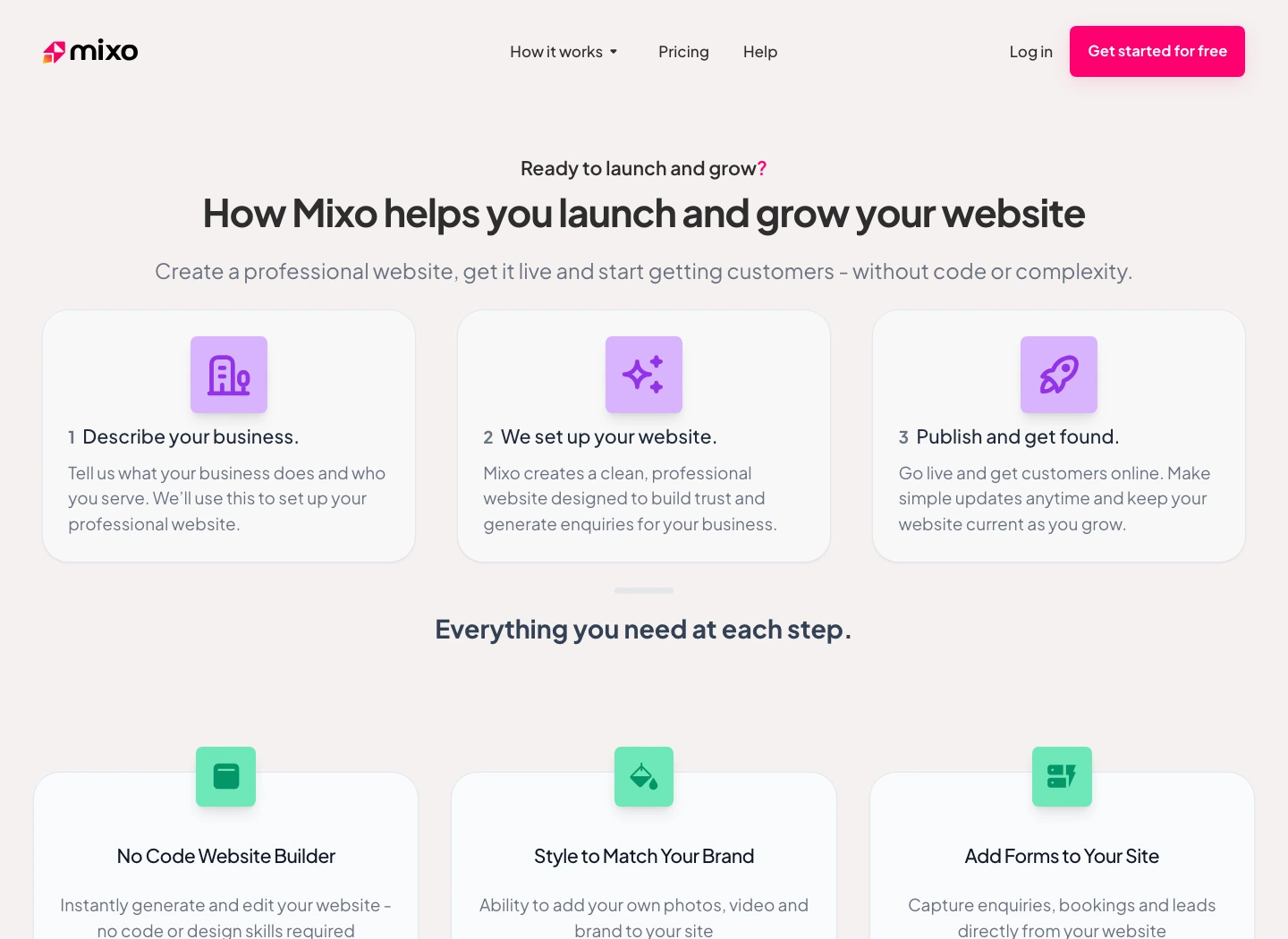
The Mixo feature page is clear about its lane: no-code generation, custom domains, forms, SEO-ready sites, GDPR compliance, managed hosting, responsive design, and integrations. That proves enough for the simple-site recommendation. It does not prove complex CMS depth, export freedom, or long-term SEO performance.
The Durable builder page proves a different thing. Durable is not just trying to be a prettier landing-page generator. It positions itself as an AI website builder that grows the business, with a three-question setup flow and business-owner positioning. Pair that with the pricing table, and the product shape is obvious: site plus operations.
I also checked community threads, but I am not using Reddit as a fake sentiment score. A recent r/nocode thread framed Durable as creeping beyond "website builder" into CRM, invoicing, and AI marketing tools. A current r/framer discussion pushed back on the idea that AI builders replace intentional Framer/Webflow-style sites. Both are useful question signals. Neither proves that Mixo or Durable will perform for your business.
How to choose between Mixo and Durable
Choose Mixo if the decision is still early. You need a clean site, a contact form, a custom-domain path, and a quick way to see whether the idea gets enquiries. The failure to avoid is spending two weeks building a small-business command center before one customer has raised a hand.
Choose Durable if the buyer is already running a business workflow. CRM, bookings, payments, invoices, AI chat, and AI visibility checks can justify the higher paid tiers when those replace other tools or manual admin.
Choose Framer, Webflow, or WordPress when design control, CMS depth, custom code, content ownership, or long-term SEO architecture matters more than speed. This is where the broader website builder shortlist becomes more useful than this head-to-head.
Use one practical test before paying: write down the next three actions after the site goes live. If they are "share the link, collect leads, follow up manually," Mixo is probably enough. If they are "book appointments, take payment, track customers, send invoices, and monitor local visibility," Durable is solving the actual next step. If they are "publish 40 pages, own the CMS, run content SEO, and control templates," neither should be your default platform.
My uncomfortable take: most "AI website builder" buyers are overbuying before they know the job. A prettier generated homepage is not product-market fit. A bigger dashboard is not a business. Start with the smallest tool that proves the next decision.
Verdict: Mixo for validation, Durable for operations
Mixo wins the default recommendation because most buyers comparing these two are still trying to get online, collect leads, and look credible without building a whole operating system. It is cheaper at the first paid tier, cleaner for simple sites, and less likely to turn a validation page into another admin project.
Durable is the better product for the buyer who has already crossed that line. If the website needs to feed CRM records, bookings, payments, invoices, and AI visibility work, Durable's higher price can make sense. Just do not buy that stack because the demo feels safer.
Both tools are still wrong for a serious content business. If search traffic, CMS structure, export control, and long-term content ownership are the actual strategy, stop comparing 30-second builders and look at Framer, Webflow, or WordPress. Speed is useful. Locking your whole growth model into the fastest first draft is not.
For the normal buyer: start with Mixo. Move to Durable only when customer operations, not site creation, are the bottleneck.
Mixo is the better default for fast validation and simple lead capture. Durable is the better choice when the buyer needs CRM, bookings, payments, invoices, AI chat, and AI visibility tools attached to the website.
Try freeFrequently Asked Questions
Ready to check Mixo?
Use the verified route if the trade-offs still fit. If not, jump back to the summary and compare the alternatives.
AI tools editor focused on public docs, changelogs, API limits, free-tier constraints, and developer community feedback. Turns fast-moving AI claims into buyer-focused recommendations without implying undocumented hands-on testing.
Anthony starts with the workload behind the demo, then ranks AI tools by documented model access, limits, implementation clarity, failure behavior, and the cost of an acceptable result.
Related Articles

Bardeen vs Zapier Agents vs Lindy: Best AI Coworker
AI coworkers compared by starting context, agent authority, usage economics, approval boundaries, and offboarding clarity
Compare Bardeen, Zapier Agents, and Lindy by workflow fit, approvals, credits, integrations, browser permissions, and cancellation terms.

GPT-5.6 vs Claude Sonnet 5 API: Which Tier Fits?
Production API model routing guide
GPT-5.6 Sol, Terra, and Luna compared with Claude Sonnet 5 on API price, long context, tokenization, migration risk, tools, and workload fit.