
Adobe Firefly vs Midjourney vs Ideogram is not a normal image-quality fight. If you are choosing for commercial work, the prettiest output is only one part of the risk.
My default pick is Adobe Firefly for commercial teams that need a safer review story. Ideogram is the sharper pick for text-heavy social and layout work. Midjourney is still the art-first tool I would keep for concept direction, mood boards, and visual exploration.
The trap is buying the generator that makes the most impressive single image, then discovering the real blocker is legal review, private workflow, unreadable text, credit math, or getting the asset into a production design tool.
This is an evidence-led comparison. I rechecked official pricing, plan limits, commercial-use language, content-rights documents, SERP competitors, GDT Search Console data, affiliate route status, and rendered evidence screenshots on August 1, 2026. I did not create accounts, buy plans, generate prompts, benchmark output quality, test private modes, or run a legal review of any generated image.
If you are still building the wider shortlist, start with our best AI image generators guide. If the image will become a video asset, compare the AI video generator shortlist too. And if the final destination is a deck, the Gamma vs Canva vs Beautiful.ai comparison is the better workflow decision.
-
#1 Adobe FireflyBest commercial default: stronger licensing posture, Adobe workflow, and public training-data commitments
-
#2 IdeogramBest for text inside images: posters, labels, thumbnails, signs, and layout-heavy creative
-
#3 MidjourneyBest art-first generator: strongest visual drama, but private workflow and company-size rules need attention
If a marketing team asked where to start today, I would send them to Adobe Firefly first because it makes the commercial-review conversation easier. If the actual deliverable has words inside the image, I would price Ideogram before anything else. If the team needs bolder visual exploration, I would keep Midjourney in the stack and set rules around privacy, reuse, and plan level.
Start with the publishing failure, not the gallery image
Most AI image comparisons reward the output that looks best in a gallery. That is useful for artists and hobbyists. It is thin for teams publishing paid ads, landing pages, client assets, thumbnails, presentation visuals, and brand campaigns.
The real buyer question is slower: can the team explain where the model comes from, what the plan costs at the needed volume, whether output can stay private, whether text is readable, whether the workflow lands in a design tool, and whether a reviewer will approve the asset without a week of back-and-forth?
That is where Firefly wins this comparison. Adobe's current Firefly approach page says Adobe does not train Firefly on customer content, only trains on content where it has permission, developed the model family to be commercially safe, and does not claim ownership of user content. Those claims do not remove every legal question. They do give brand teams a cleaner starting point than "the image looks amazing."
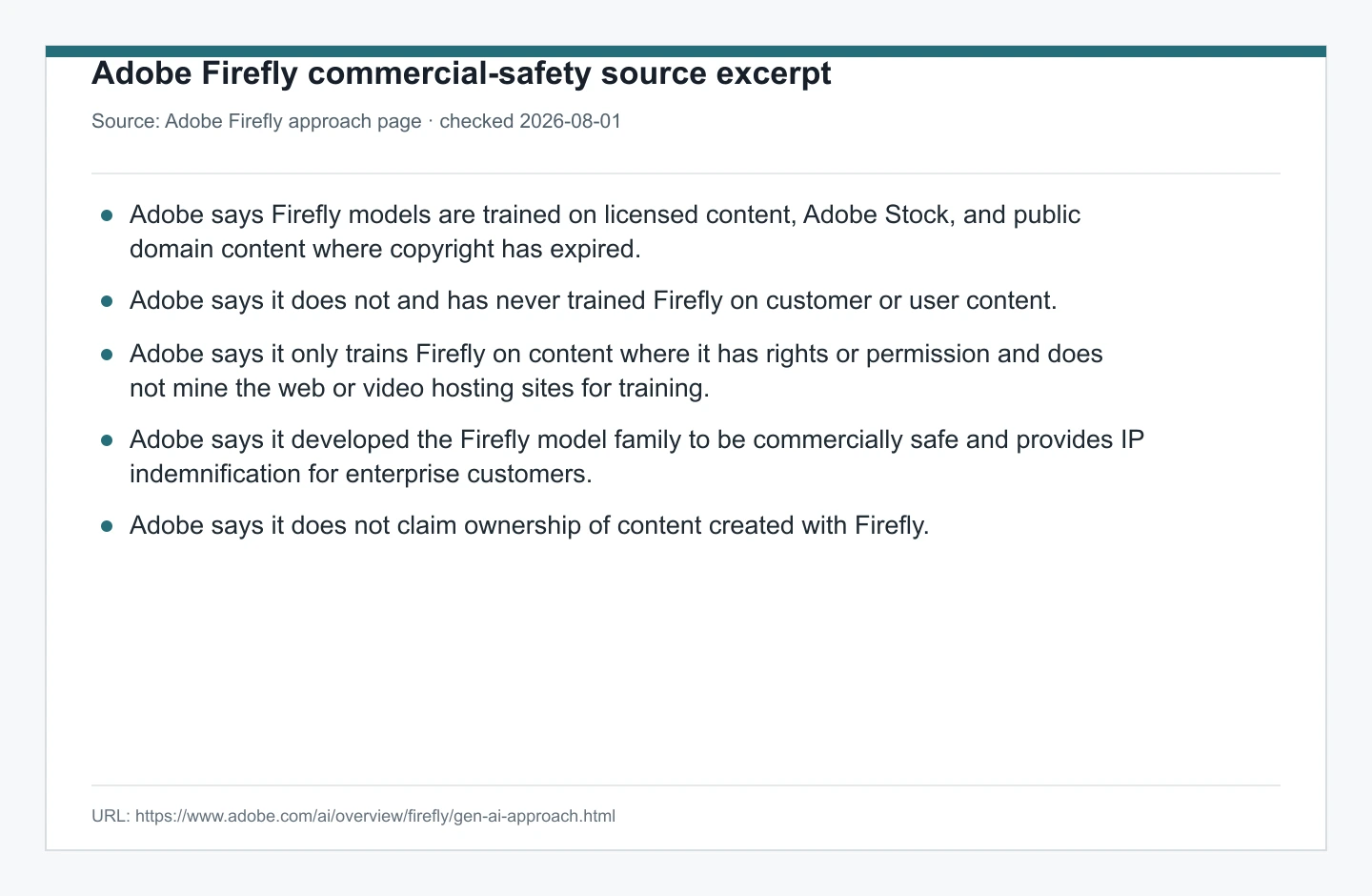
Small warning. "Commercially safe" is not a magic shield. It is a vendor posture, not a guarantee that every image is approved for every brand, country, placement, trademark, likeness, regulated industry, or client contract. The buyer still needs review discipline.
Adobe Firefly vs Midjourney vs Ideogram comparison
| Feature | Adobe Firefly | Ideogram | Midjourney |
|---|---|---|---|
| Best job | Commercial brand assets and Adobe workflow handoff | Posters, labels, thumbnails, signs, and images with readable text | Art direction, mood boards, concept art, and visual exploration |
| Public price signal | Standard $9.99/mo; Pro $19.99/mo; Pro Plus $49.99/mo regular; Premium $199.99/mo regular | Free plan exists; live pricing page showed Plus $15/mo billed annually, Pro $42/mo billed annually, and Team $20/user/mo billed annually | Basic $10/mo, Standard $30/mo, Pro $60/mo, Mega $120/mo |
| Commercial-use posture | Strongest public training-data and commercial-safety story in this shortlist | Docs say Ideogram does not restrict rights in output, subject to terms | Broad subscriber rights, but companies over $1M revenue need Pro or Mega to own assets |
| Text in images | Usable for design workflows, but not the text-first specialist | Best in this comparison; official page claims 95% text accuracy | Not the cleanest text-heavy workflow versus Ideogram |
| Private workflow | Best fit for Creative Cloud and business review workflows | Private generation starts on paid Plus and above | Public/remixable by default; Stealth is only on Pro and Mega |
| Main catch | Less exciting than Midjourney for art-first exploration and higher tiers get expensive | Narrower default than Firefly for commercial review and narrower than Midjourney for art-first work | Best-looking output can still be the wrong operational choice for commercial teams |
| Action | Check Firefly | Check Ideogram | Check Midjourney |
How I ranked the three tools
The rubric uses five criteria: Commercial Safety, Visual Range, Text Layout, Private Workflow, and Cost Clarity. Commercial Safety asks how easy it is to defend the tool in a brand or client review. Visual Range asks how strong the tool is for image direction. Text Layout asks whether words inside the image are part of the job. Private Workflow asks whether drafts can avoid unwanted exposure. Cost Clarity asks whether the buyer can model the plan before a team adopts it.
This is why Firefly wins even though Midjourney is the obvious art-first favorite. For a commercial buyer, the best output is not always the best purchase. The best purchase is the tool that removes the failure most likely to block the asset from shipping.
1. Adobe Firefly: the safest default for commercial creative teams
Firefly is the least flashy recommendation here, which is exactly why it wins. The buyer who cares about brand review, client comfort, Creative Cloud handoff, and training-data posture should not start with a gallery beauty contest.
Adobe's current plan page lists limited free access, Firefly Standard at $9.99/month, Pro at $19.99, Pro Plus at the regular $49.99 price, and Premium at the regular $199.99 price. Model the regular monthly amount before comparing Firefly with Midjourney or Ideogram.
The tradeoff is output taste. Firefly can feel more controlled and production-safe than adventurous. That is good when a brand team needs campaign variants inside Adobe tools. It is less good when the creative director wants a strange, cinematic, high-drama concept wall.
Firefly has the strongest public commercial-safety posture in this shortlist, plus the cleanest handoff for teams already living in Adobe tools.
Skip it if your main job is art-first exploration, cinematic concept work, or a style range that feels less brand-governed.
Firefly ranks first because commercial review, Creative Cloud workflow, and training-data commitments matter more for this buyer than raw visual drama.
- Strongest public commercial-safety and training-data posture in this comparison
- Natural fit for Adobe Express, Photoshop, and Creative Cloud production workflows
- Plan page makes credits and regular monthly prices visible before signup
- Good default when brand, legal, or client review can block publication
- Not the most exciting art-first generator in this shortlist
- Heavy creative AI, video, and audio use can push buyers into expensive higher tiers
- Commercial-safety language still does not replace a legal or brand review
- Evidence-led review only; no Firefly account, paid plan, prompt generation, output benchmark, or support flow was tested
2. Ideogram: the best specialist when the image needs readable text
Ideogram wins a narrower but very real job. If the asset needs a poster headline, product label, sign, packaging mockup, YouTube thumbnail phrase, event graphic, or ad concept with words inside the image, it belongs high on the shortlist.
The official Ideogram text-rendering page claims 95% text accuracy and frames the product around legible, publication-ready typography. Ideogram's docs now point buyers to the live pricing page for current plan names, prices, credits, and billing cadence instead of preserving a static plan table. That is the kind of source boundary I want visible before recommending it for layout-heavy creative.
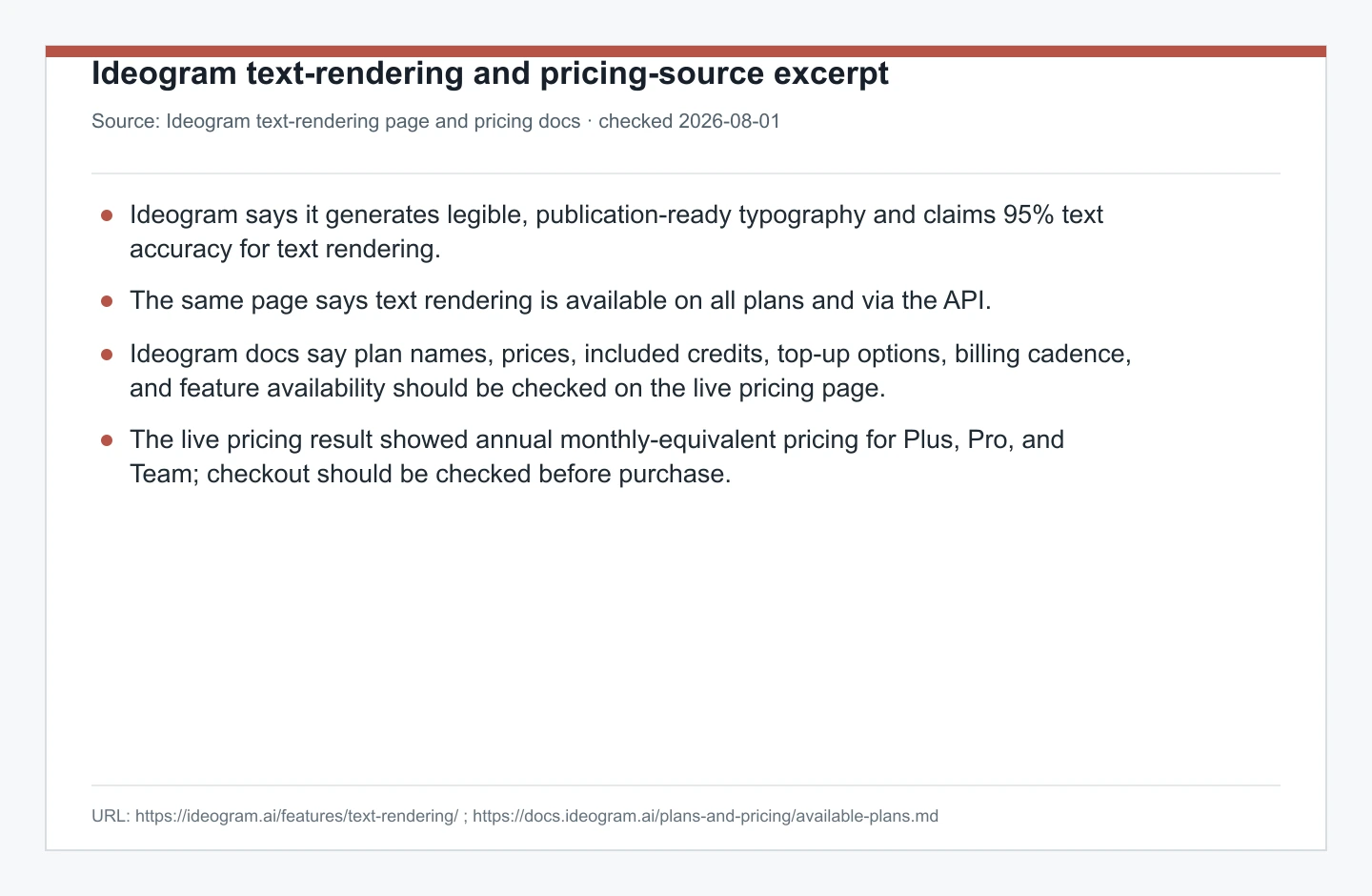
Ideogram's live pricing result showed annual monthly-equivalent pricing of Plus at $15/month, Pro at $42/month, and Team at $20/user/month, all billed annually. The practical point is not the discount. It is that Ideogram now treats pricing as live checkout evidence, so buyers should verify the monthly toggle, credit counts, private-generation rules, and team minimum before standardizing it.
The wrong Ideogram buyer is the team trying to replace its whole creative stack with a text specialist. Ideogram can be excellent, but I would pair it with Firefly for commercial review or Midjourney for visual direction when the campaign needs more than readable type.
Ideogram is the clearest answer when readable words are part of the image, not a caption added later in a design tool.
Skip it if commercial review, Adobe handoff, or high-drama concept art matters more than text-in-image reliability.
Ideogram ranks second because text layout is a high-value failure case. It loses the default slot because Firefly has stronger commercial-workflow posture.
- Best first stop here for posters, labels, thumbnails, signage, and text-heavy social assets
- Free plan exists, and the live pricing page exposes current paid-plan pricing before checkout
- Official docs say paid Plus and above include private generation
- Docs say Ideogram does not restrict rights in output, subject to terms
- Less convincing as the one default generator for all commercial creative work
- Static docs no longer carry the full plan table, so old comparison pricing can mislead buyers
- Private generation requires a paid plan
- Evidence-led review only; no Ideogram account, prompt generation, text-accuracy benchmark, private mode, or support flow was tested
3. Midjourney: the best creative spark, but not the cleanest commercial default
Midjourney is the tool I would still want in the room for visual exploration. It is strong for mood, lighting, cinematic concept art, stylized campaign directions, and images that need to feel less like a templated marketing asset.
The reason it ranks third here is not weak output. It ranks third because the buyer in this article is a commercial operator, not only an art director. Midjourney's plan page lists Basic at $10/mo, Standard at $30/mo, Pro at $60/mo, and Mega at $120/mo; annual upfront prices are $96, $288, $576, and $1,152. It also says Stealth Mode is only available on Pro and Mega, and its terms say content is publicly viewable and remixable by default when posted in a public setting.
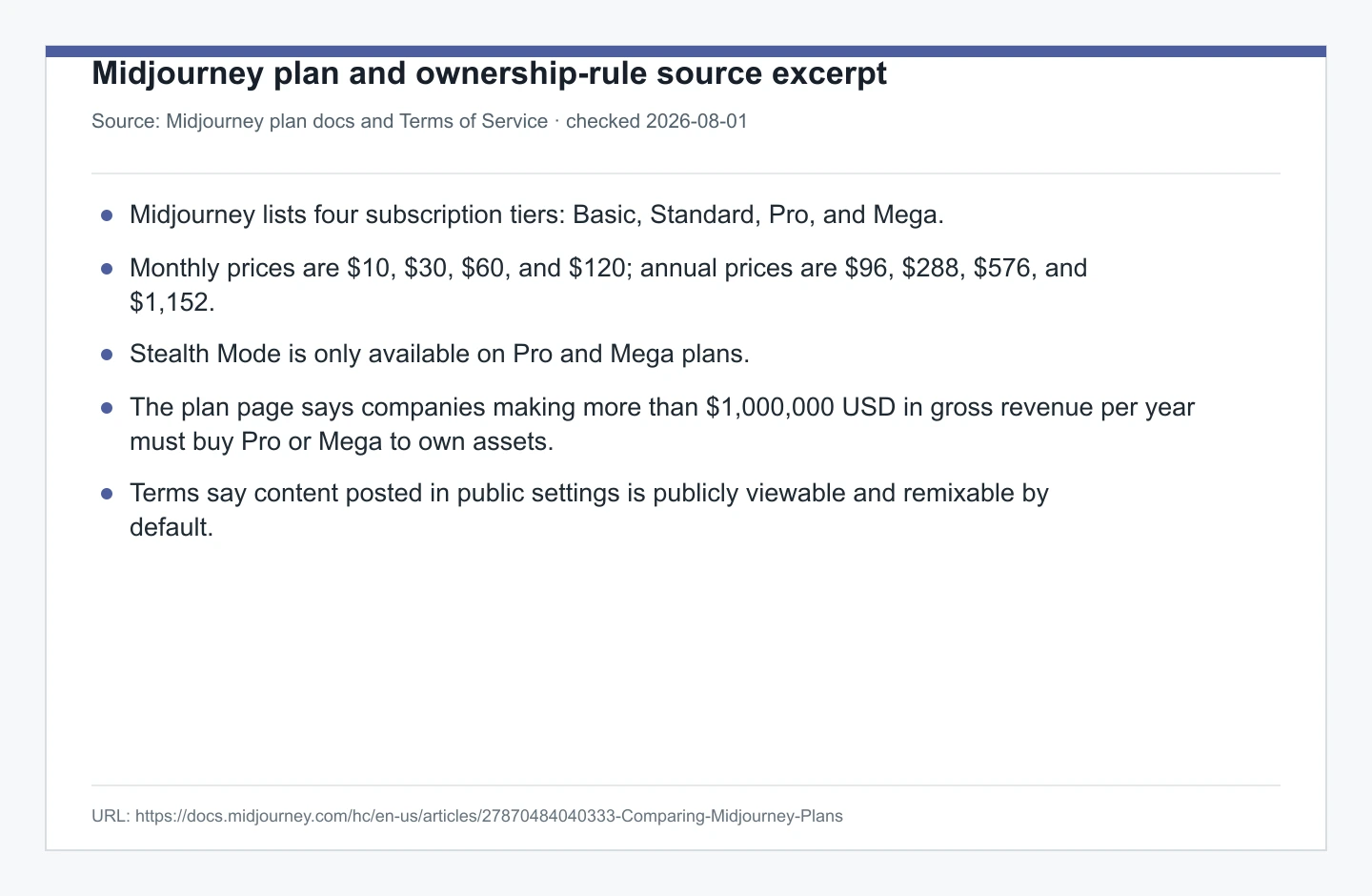
There is also a company-size rule that deserves more attention. Midjourney's terms say a company or employee of a company with more than $1,000,000 in yearly revenue must be on Pro or Mega to own assets. That does not matter to a hobbyist. It matters immediately to agencies, ecommerce brands, funded startups, and enterprise teams.
The wrong Midjourney buyer is the team that treats the $10 plan as the commercial answer before checking privacy and ownership requirements. The right Midjourney buyer knows the tool is for exploration and allocates the plan level, approval process, and reuse rules around that.
Midjourney still has the strongest creative spark for art direction, but the public/private workflow and company-size ownership rules make it a more careful commercial choice.
Skip it as the default if legal review, private drafts, readable text, or Adobe production handoff matter more than visual drama.
Midjourney ranks third because this comparison values commercial workflow more than pure image beauty. It can still be the best second tool for creative exploration.
- Best visual-direction tool here for concept art, mood boards, and art-first exploration
- Clear public plan table with monthly and annual pricing
- Standard, Pro, and Mega include unlimited image generations in Relax Mode
- Pro and Mega include Stealth Mode for more private work
- No free tier in the official plan table
- Stealth Mode is locked to Pro and Mega
- Terms say public-setting content is publicly viewable and remixable by default
- Evidence-led review only; no Midjourney account, prompt generation, output benchmark, private mode, or support flow was tested
What current comparison pages miss
The SERP around AI image generators is crowded, but much of it collapses the decision into "best output" or "best overall." Tom's Guide and several 2026 roundups are useful for category mapping. The gap is that a commercial buyer needs a narrower decision: what failure blocks publishing?
One competitor pattern ranks Midjourney first because the images are better. That can be true and still be the wrong conclusion for a brand team. Another pattern praises Firefly as commercially safe without forcing the reader to model the credit tiers. A third pattern calls Ideogram the text winner but repeats static pricing even though Ideogram's docs now direct buyers to the live pricing page for current plan names, prices, credits, and billing cadence.
I also checked public Reddit surfaces as friction checks only, not as representative sentiment. A current r/midjourney thread centered on prompt adherence and text integration when comparing Ideogram and Midjourney, while an r/AiForSmallBusiness discussion framed the choice around content format: Midjourney for quality, Firefly for Adobe/commercial workflow, and Ideogram for text-heavy visuals. Those threads support the question pattern. They do not prove product quality.
That is the useful opening for this page. I am not trying to prove that Firefly makes prettier images than Midjourney. I am saying that commercial teams should first pick the failure they cannot afford: legal review friction, unreadable text, weak visual direction, public drafts, or runaway credit costs.
How to choose the right one
Choose Adobe Firefly when the asset will be used in client work, brand campaigns, paid ads, ecommerce pages, or Creative Cloud production. The tradeoff is that some teams will still prefer Midjourney for concept direction and Ideogram for text-heavy layouts.
Choose Ideogram when the image needs readable words inside it. The failure to avoid is spending hours fixing garbled poster text in another editor. Keep Firefly or a normal design tool nearby for final brand review.
Choose Midjourney when the job is mood, style, atmosphere, creative exploration, or visual range. The failure to avoid is treating the cheapest plan as production-ready for a company that needs privacy, ownership clarity, or repeatable brand governance.
Use two tools if the team publishes often. Firefly plus Ideogram is the cleanest commercial-and-text pair. Firefly plus Midjourney is the better brand-and-concept pair. Midjourney plus Ideogram is strong for creators who care less about Adobe workflow and more about visual punch plus readable type.
The team recipes I would use
Small ecommerce team: start with Firefly, then add Ideogram only if packaging, labels, sale banners, or product-ad mockups keep breaking because the text is wrong. The failure to avoid is publishing an image that looks fine in a thumbnail but collapses when the product name, offer, or disclaimer is unreadable.
Agency concept team: keep Midjourney in the ideation layer and Firefly in the production-review layer. Midjourney can move a mood board faster than most safer tools. Firefly is easier to defend when the asset moves from internal exploration to a client-facing campaign draft.
Solo creator: start with Ideogram if thumbnails, posters, or visual hooks need words. Start with Midjourney if the whole value is style. Start with Firefly only if commercial safety or Adobe editing is the reason you are paying. A solo creator does not need the most enterprise-friendly tool by default.
Enterprise marketing team: do not let the art team choose alone. Put legal, brand, creative ops, and the people who own the publishing workflow in the same decision. If the company is above Midjourney's $1,000,000 revenue threshold, model the Pro or Mega tier before anyone treats Basic or Standard as the production plan.
That is the practical split. Firefly is the safer organizational default, Ideogram is the text-layout repair tool, and Midjourney is the art-direction accelerator. The right stack depends on which failure the team sees every week, not which demo image gets the loudest reaction.
What I would not use as the default here
I would not make Leonardo AI, ChatGPT image generation, Canva, Flux, or Stable Diffusion the default answer for this exact keyword, even though each can be the right tool elsewhere.
Leonardo and Canva matter when the buyer wants a broader design or creator workflow. ChatGPT image generation matters when conversational editing is the job. Flux and Stable Diffusion matter when developers or advanced teams want model control, local/private workflows, API pipelines, or custom generation systems. Those are real needs. They are just different from the Firefly vs Midjourney vs Ideogram decision.
The strongest buying path is boring: start with the asset risk, not the model hype. A product label with text points to Ideogram. A brand-safe social campaign points to Firefly. A fantasy concept wall points to Midjourney. A regulated client campaign may require Firefly plus human review plus legal approval. No single generator removes that last step.
This is where most comparisons get the buyer wrong. They ask which model wins the screenshot, not which tool survives the approval chain.
Verdict: Firefly wins the commercial default, not the beauty contest
Pick Adobe Firefly if you need the safest default for commercial creative work. It has the best public story around training-data commitments, commercial safety, ownership posture, and Adobe production workflow. That is the buyer job behind my ranking.
Pick Ideogram if your recurring failure is text inside images. It is the specialist I would reach for before asking an art-first model to spell a headline correctly.
Pick Midjourney if you need the strongest creative spark. It can absolutely be the most valuable tool in the stack, but for commercial teams it should come with rules around plan level, public visibility, reuse, and review.
The mistake is pretending one tool wins every image job. Firefly is the best commercial default. Ideogram is the best text specialist. Midjourney is the best art-first spark. Choose the failure you need to remove first.
Frequently Asked Questions
Ready to check Adobe Firefly?
Use the verified route if the trade-offs still fit. If not, jump back to the summary and compare the alternatives.
AI tools editor focused on public docs, changelogs, API limits, free-tier constraints, and developer community feedback. Turns fast-moving AI claims into buyer-focused recommendations without implying undocumented hands-on testing.
Anthony starts with the workload behind the demo, then ranks AI tools by documented model access, limits, implementation clarity, failure behavior, and the cost of an acceptable result.
Related Articles

Bardeen vs Zapier Agents vs Lindy: Best AI Coworker
AI coworkers compared by starting context, agent authority, usage economics, approval boundaries, and offboarding clarity
Compare Bardeen, Zapier Agents, and Lindy by workflow fit, approvals, credits, integrations, browser permissions, and cancellation terms.

GPT-5.6 vs Claude Sonnet 5 API: Which Tier Fits?
Production API model routing guide
GPT-5.6 Sol, Terra, and Luna compared with Claude Sonnet 5 on API price, long context, tokenization, migration risk, tools, and workload fit.