

A new email alias cannot remove an old listing that already shows your home address. A removal request cannot stop you from giving your real phone number to the next shop. Cloaked and Incogni both sell data removal, but only Cloaked bundles a way to mask the contact details you hand out next.
I would pay for one service first, not both. Choose Incogni Standard when the immediate job is recurring removal from data brokers. Choose Cloaked when you will actually use its email and phone aliases as part of everyday sign-ups. Add the second subscription only after identifying a gap the first one does not solve. Two removal dashboards can still leave the same old listing online.
This is an evidence-led buying comparison of public product pages, pricing, a limited-assurance report, and focused screenshots checked October 4, 2026. I did not create either account, submit personal details, run removal requests, measure take-down rates, or test support. The scores below describe fit for a removal-first individual buyer, not measured effectiveness.
-
#1 Incogni StandardExisting broker listings are the main problem
-
#2 Cloaked IndividualYou also need reusable email and phone aliases
One, both, or neither?
Think of the purchase as two jobs. The first is cleanup: identifying existing exposure and sending repeated opt-out requests. The second is containment: using a different contact identity with each new account, so your primary email or number is shared less often. Incogni concentrates on the first job. Cloaked sells both in one subscription. That does not mean Cloaked's removal is identical to Incogni's, or that a second removal subscription automatically doubles coverage.
Make a short inventory before comparing site counts: one published listing you can still open, the broker holding it if identifiable, and the next account where you would otherwise give out your real contact details. If there is no public listing and spam comes through a single merchant account, an alias for that account may address the problem without a removal subscription. If old addresses recur across people-search sites but you seldom create new accounts, recurring removal is the more relevant starting purchase. The list gives you something specific to check against each plan instead of letting a large coverage number decide for you.
| Feature | Incogni Standard | Cloaked Individual |
|---|---|---|
| Best starting problem | Existing broker records | Mask new contacts while addressing exposure |
| Future sign-up aliases | Not a bundled email or phone alias product | Unlimited email and phone aliases in the plan |
| Documented removal scope | 420+ public and private broker sites; recurring requests | 1,000+ mixed sites advertised, including brokers and other websites |
| Annual individual bill | $95.88 billed annually, before possible tax | $119.99 billed annually |
| Reason to add the other service | Add Cloaked if masking new sign-ups becomes a real second job | Add Incogni only for a documented broker-removal gap |
| Poor fit if | You mainly need phone and email aliases | You will not use the alias system |
| Action | See pricing | See pricing |
There is also a legitimate neither answer. Skip both if a single exposed listing is the whole problem and that site's own opt-out route resolves it. If you live outside the United States or Canada, Cloaked's public site says it is not currently available to you. Do not pay on the assumption that its checkout, phone numbers, or insurance will work in your region.
The 1,000-versus-420 comparison is the wrong calculation
Cloaked's data-removal page advertises 1,000+ sites, but its own list separates Data Brokers from Other websites. Incogni's Standard plan advertises 420+ data broker sites. The two numbers count differently defined groups. Subtracting 420 from 1,000 cannot tell you how many additional relevant brokers Cloaked covers, or how many of your records either service will find.
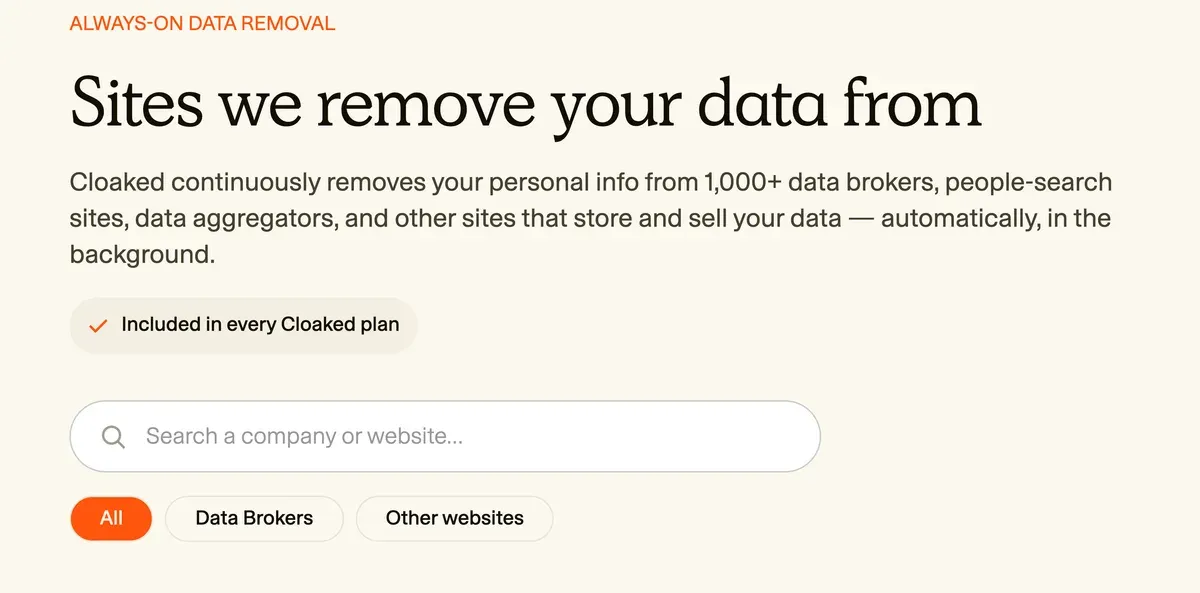
Incogni has a narrower, better-defined public proof point. A Deloitte limited-assurance report dated August 2025 assessed specified Incogni practices as of July 18, 2025: requests and confirmations from more than 420 brokers and recurring requests at stated intervals, with exceptions for suppression lists. That is useful independent process evidence. It is not a 2026 head-to-head effectiveness test, and it does not certify that your own listing disappeared from every site.
Nor is the entire internet in either subscription's control. A broker request, a search-result removal, and a record held by the original publisher are different tasks. If your problem is one stubborn page, check whether the product supports that exact site and the type of removal you need before assuming a headline site count settles it. Our data-broker removal guide compares broader specialist options; this article asks whether a second service is worth paying for beside Cloaked.
Take a concrete case: your old address appears on two named people-search pages after a move. A comparison of 420 and 1,000 still cannot tell you which subscription will deal with those two pages. Check the named sites against the providers' published scope and note whether removal is automated, a custom request, or outside the plan. If both sites are in Incogni Standard's scope and you do not need aliases, its lower annual bill makes more sense than purchasing two products. If neither provider supports one of those pages, a second subscription is not a solution merely because its marketing number is larger.
How I scored the starting choice
The default reader already has exposed contact details and wants to reduce recurring broker listings. Documented Removal Process is 35% of the score, Prevention Tools 25%, Cost and Plan Clarity 25%, and Scope Clarity 15%. Incogni gains ground on a clearly defined, independently assessed removal process and a lower entry bill. Cloaked earns prevention credit for aliases and a bundled workflow. Changing the reader's primary job to masking future sign-ups would change the order.
Incogni: start here for a removal-only purchase
A defined 420+ broker scope, recurring requests, and independent limited assurance on specified 2025 processes.
Skip Standard if your real need is fresh email or phone aliases, or if you need custom removals beyond its covered broker list.
Best starting purchase for existing exposure; the score rewards documented process and price, not measured personal take-down success.
- 420+ broker sites on Standard, including public and private brokers
- Recurring requests are included
- Annual Standard bill is clearly displayed
- Higher tiers add custom-removal requests
- No bundled replacement for Cloaked email and phone aliases
- Custom removals require a higher-priced plan
- Broker processing can take hours or weeks
- Limited assurance covers specified historical processes, not a guarantee for each customer
Incogni's pricing FAQ explains an important limitation behind its process. It can scan public people-search listings for matches. Private broker databases cannot be searched the same way, so Incogni says it sends periodic opt-out requests based on information such as your region. A dashboard status is not a universal measurement of every hidden database; the service describes different routes for different kinds of brokers.
The annual Standard card lists $7.99 per month as a monthly equivalent, $95.88 actually billed for the year, 420+ broker sites, and recurring removals. The page says VAT or sales tax may apply. Month-to-month Standard is a separate $15.98 per month in the official FAQ. Do not compare an annual equivalent on one side with a month-to-month price on the other.
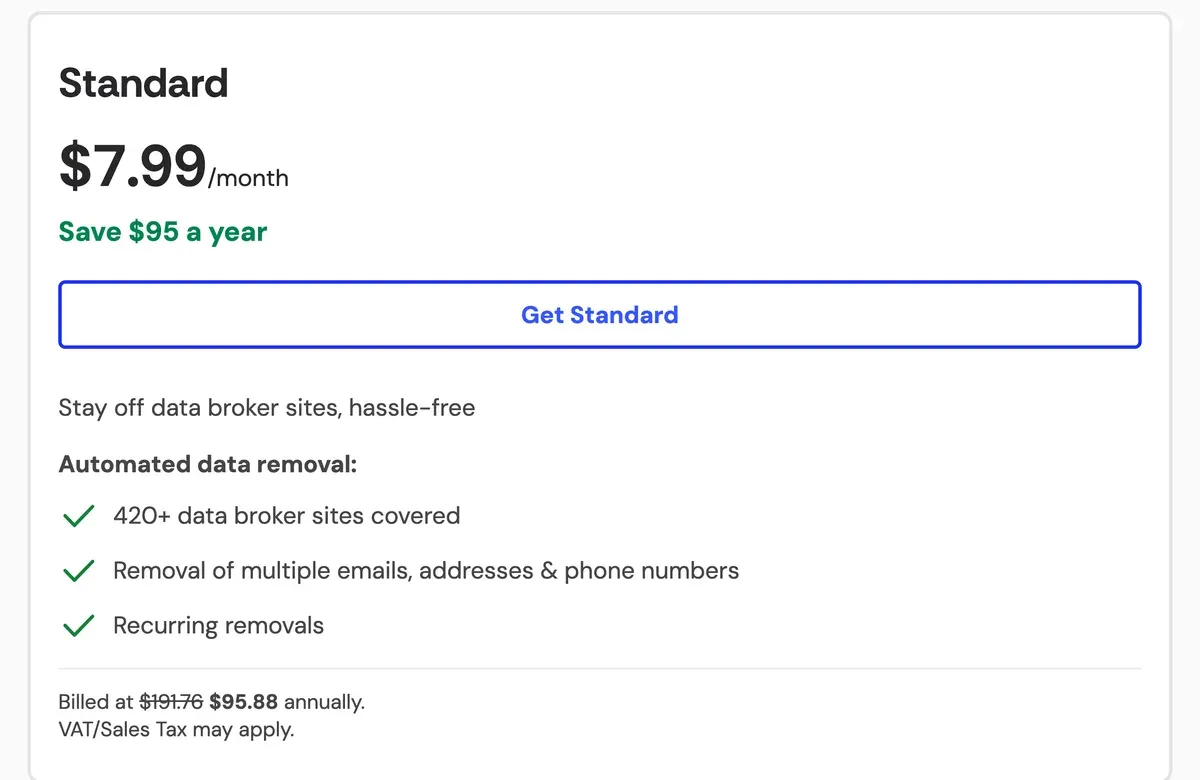
If your exposed page falls outside Incogni Standard's broker set, Unlimited advertises custom removal requests at a higher annual bill. That is a different comparison from buying Cloaked as a second automated removal service. First identify the actual unaddressed page; then compare the specialist upgrade against Cloaked's broader bundle. For a removal-only decision among other vendors, see DeleteMe vs Incogni vs Optery.
Cloaked: pay for the aliases, not the larger number
Email and phone aliases can address the next disclosure while bundled removal addresses some existing exposure.
Skip it if you will keep giving out your real contact details or are buying only for a broker count.
An effective fit for the alias-first buyer, but its mixed site total is less useful than a broker-only count for the removal-first default.
- Unlimited email and phone aliases in the published plan
- An alias can be muted or disabled if it attracts spam
- Data removal is included rather than a separate add-on
- One account also bundles a VPN, password manager, and monitoring
- Higher annual entry bill than Incogni Standard
- 1,000+ mixed-site total is not a like-for-like broker count
- Only publicly available in the United States and Canada
- Virtual cards are invite-only and Family Sharing is marked coming soon
Cloaked's identity page says a fresh identity can combine an email, phone number, and password; incoming messages and calls can be organized per identity, and a noisy identity can be muted or disabled. That is a meaningful workflow for someone who routinely signs up for services and wants to stop reusing the same contact details. It does not erase a previously published home address. Our separate Cloaked review examines the rest of its bundle and trust trade-offs in depth.
Cloaked's Individual annual card shows a $9.99 monthly equivalent but $119.99 billed per year. Its monthly tab shows $14.99 per month. The annual amount is the relevant comparison with Incogni's $95.88 annual Standard plan; they are different products with partly overlapping removal work.
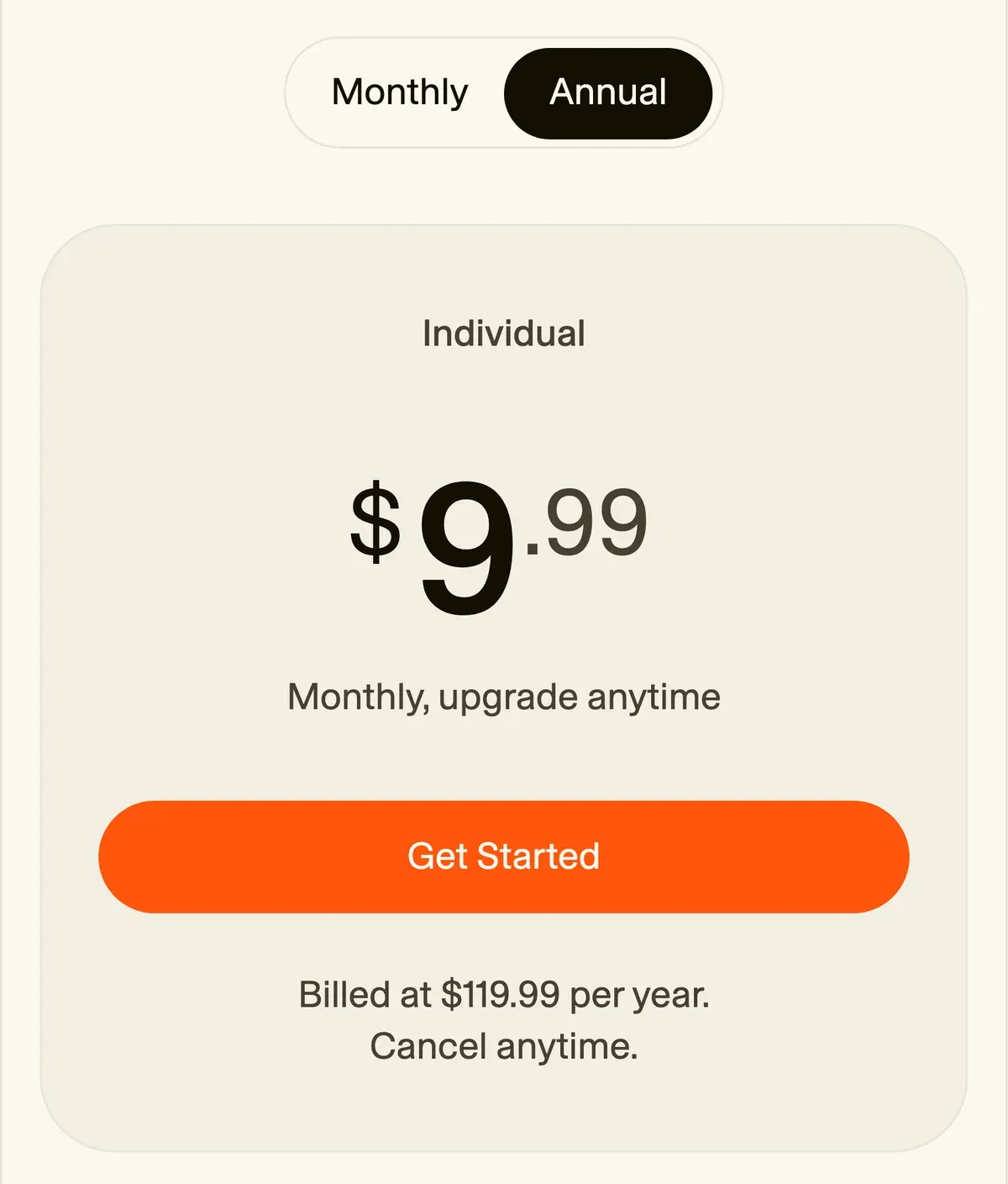
I would not buy Cloaked solely because it also lists insurance, a VPN, a password manager, or virtual cards. The payment-card feature is marked invite-only, and Family Sharing is marked coming soon on the features page despite family pricing being advertised. Buy the released alias-and-removal workflow you can use now; verify account-specific availability before treating another feature as the deciding benefit.
When a second subscription earns its cost
At today's public individual annual prices, both cost $215.87 a year before applicable tax ($119.99 plus $95.88). Adding Incogni to a Cloaked subscription costs another $95.88; adding Cloaked to Incogni costs another $119.99. Those amounts are a budget comparison, not evidence that either product removes more of your personal records.
Here is the case in which I would consider both: you actively use Cloaked aliases for new accounts, yet you have identified broker listings whose removal or repeat-request status you cannot establish through Cloaked, and those sites are within Incogni's documented scope. Then Incogni serves a specific cleanup gap rather than duplicating an attractive dashboard. The reverse is possible too: begin with Incogni, discover that your real email and number keep getting shared at new sign-ups, and add Cloaked for aliasing.
The second service has a data cost as well as a subscription cost. A removal provider needs enough real identifiers to match your records; Cloaked's exposure and identity workflows also ask you to entrust it with information about yourself. Buying both means maintaining information and requests in two accounts. That can be reasonable when the extra process covers a genuine gap, but it deserves a deliberate decision. Do not enter additional old addresses, phone numbers, or other sensitive identifiers into a second service just to see whether its dashboard looks busier. Read each provider's data-handling terms for your region and supply only what the specific removal task requires.
Before paying twice, make a short list of your actual exposures and compare named site coverage, not the marketing totals. Keep a dated record of listings you can lawfully view and the status each service reports. Recheck after the provider's documented processing window; Incogni warns that broker response times range from hours to weeks. I have not run this experiment for this article, so I cannot promise that a second plan will improve your individual result.
Do not mistake request volume for completed cleanup. Incogni's limited-assurance scope concerns sending requests and receiving confirmations at a defined set of brokers at a historical point in time. A confirmation about one broker does not prove a record was removed from a different site, and an alias generated for a new shop does not alter an older public record. For the purchase, write down what a useful outcome would look like: a specific listing no longer visible after the relevant processing time, or a new account operating without your primary contact details. Those are different checks, which is precisely why the subscriptions should not be bought as interchangeable insurance.
One more practical cost is dependency. If you adopt aliases for important accounts, keep an inventory of which identity is tied to each account and plan how you would update those contacts before canceling the alias service. A cancellation can otherwise become a migration project even if the annual price looks manageable. Treat that as a planning precaution, not a claim that Cloaked immediately disables every alias after cancellation; I did not test that policy.
Do not infer family coverage from the individual comparison
Incogni's current pricing page explicitly lists a Family plan for up to five members at $191.88 per year, plus a higher Family Unlimited plan. Cloaked advertises Couple and Family annual plans too, but its general features page still labels Family Sharing as coming soon. If several people need coverage, verify the exact enrollment and available features with each provider before buying. A competing article's claim that Incogni has no family option is contradicted by Incogni's current public pricing.
Cloaked vs Incogni FAQ
Verdict: start with the missing job
For someone trying to remove existing broker records, I would start with Incogni Standard . Its lower annual bill and clearer broker-only scope match that narrow job. For someone who will use unique phone and email identities whenever they sign up for something new, I would buy Cloaked instead; the aliases, not a bigger site count, make the bundle distinct.
Buying both is defensible only when you can name the additional task and accept the $215.87 annual combined bill. The risk is paying for duplicate requests while your specific uncovered listing sits outside both plans. Check that site before adding the second bill. Neither public feature list nor an older assurance report substitutes for your own observed outcome.
The clearer first purchase for a removal-first individual; Cloaked is the better single subscription when new email and phone aliases are the real need.
See pricingReady to check Incogni Standard?
Use the verified route if the trade-offs still fit. If not, jump back to the summary and compare the alternatives.
Security and privacy editor focused on evidence-led buying guides. Reads official documentation, audit notes, privacy policies, recovery limits, and support pages before turning security claims into practical recommendations.
Sarah starts by locating the evidence boundary, then ranks security and privacy tools by audit and policy scope, recovery design, trust boundaries, residual risk, and what a cautious buyer can verify.
Related Articles
Backblaze vs IDrive: Choose by What You Need to Recover
For one active Mac or Windows PC with a growing file collection; choose IDrive for several personal computers or retained locally deleted files
Backblaze vs IDrive compared by deleted-file retention, device limits, private keys and current annual prices. Choose backup for the recovery you need.

Venice AI vs Proton Lumo vs Duck.ai: Which Private AI Chat Fits?
Private AI chat decision guide
Venice AI, Proton Lumo, and Duck.ai compared by privacy architecture, saved-history protection, provider exposure, plan limits, model access, and price.