
Every "Todoist vs TickTick" article I've read this year follows the same script: list features side by side, say "it depends on your needs," collect the affiliate check. Really helpful.
Here's what actually happened when I dug into both apps for this review: Todoist quietly restructured its entire pricing in December 2025 and launched an AI voice feature that nobody's covering yet. TickTick didn't change much, because it didn't need to. It already had a built-in calendar, habit tracker, Pomodoro timer, and Eisenhower Matrix that Todoist still doesn't offer at any price tier.
So the real question isn't "which is better." It's whether you want the app that does more things or the app that does fewer things more reliably. And that's a genuinely tough call in 2026.
-
#1 TickTickBest for solo productivity — more built-in features, cheaper
-
#2 TodoistBest for teams and AI task capture — polished, stable, smarter NLP
-
#3 Super ProductivityFree & open-source dark horse — no subscription, dev-friendly
What Actually Changed in 2026
Two things happened since the last time most comparison articles bothered to update.
Todoist restructured pricing (December 10, 2025). The free plan got renamed to "Beginner." Pro landed at $4/month billed annually ($5 monthly). Business at $6/month annual ($8 monthly). If you subscribed before June 2022, you're on a "Pro Legacy" plan at your old price, but you don't get the new AI features. Most articles are still quoting outdated numbers. The ones I found ranged from $3/month to $7/month for the same plan depending on when the page was last touched.
Todoist launched Ramble (January 2026). This is the big one. Ramble lets you talk to your phone like a normal person. "I need to email Sarah about the quarterly review next Tuesday and pick up groceries after work," and it creates two separate tasks with correct dates, priorities, and project assignments. It runs on Gemini 2.5 Flash, handles 40+ languages, and it actually works. Beginner plan users get limited sessions. Pro and Business get unlimited.
TickTick? Mostly cosmetic updates. Custom tab bars, background images, a yearly heatmap view. Nothing that changes the fundamental value proposition. That's partly because TickTick already shipped most of the features people want from a task manager. Todoist is playing catch-up on functionality while leading on intelligence.
TickTick — The Swiss Army Knife That Costs Less
On paper, TickTick should win this comparison. It shouldn't even be close.
For $36/year ($3/month billed annually), you get a task manager with a full calendar view, habit tracking with 60+ presets, a built-in Pomodoro timer with white noise, an Eisenhower Matrix for prioritization, and Kanban boards. That's four separate apps collapsed into one subscription. If you're currently paying for Todoist Pro plus a habit tracker plus a focus timer, TickTick eliminates two subscriptions overnight.
The calendar is the killer feature. Not a "task list with dates attached" but an actual visual calendar where you see tasks and Google Calendar events side by side, drag them around to reschedule, and time-block your day. Users on r/productivity and r/ticktick consistently call it the best calendar implementation in any task manager. If you're using something like Motion or Reclaim AI for scheduling but want your tasks in the same view, TickTick gets you 80% of the way there for a fraction of the cost; the newer time blocking apps roundup shows where that budget pick still loses to dedicated blockers. If the workflow problem is actually opening, searching, and automating Mac tools faster, compare Raycast, Alfred, and BetterTouchTool before changing task managers again. If you mostly need copied project notes and URLs to stop disappearing, the Paste vs Maccy vs Raycast clipboard-manager guide is a cleaner fix than another task app.
Habit tracking is surprisingly solid. You're not getting Habitica-level gamification, but for "did I drink water / exercise / read today?" tracking with streaks and stats it replaces a standalone app. Same with the Pomodoro timer, which has configurable work/break intervals, focus session history, optional white noise. These aren't afterthoughts. They're well-built features that happen to live inside a task manager.
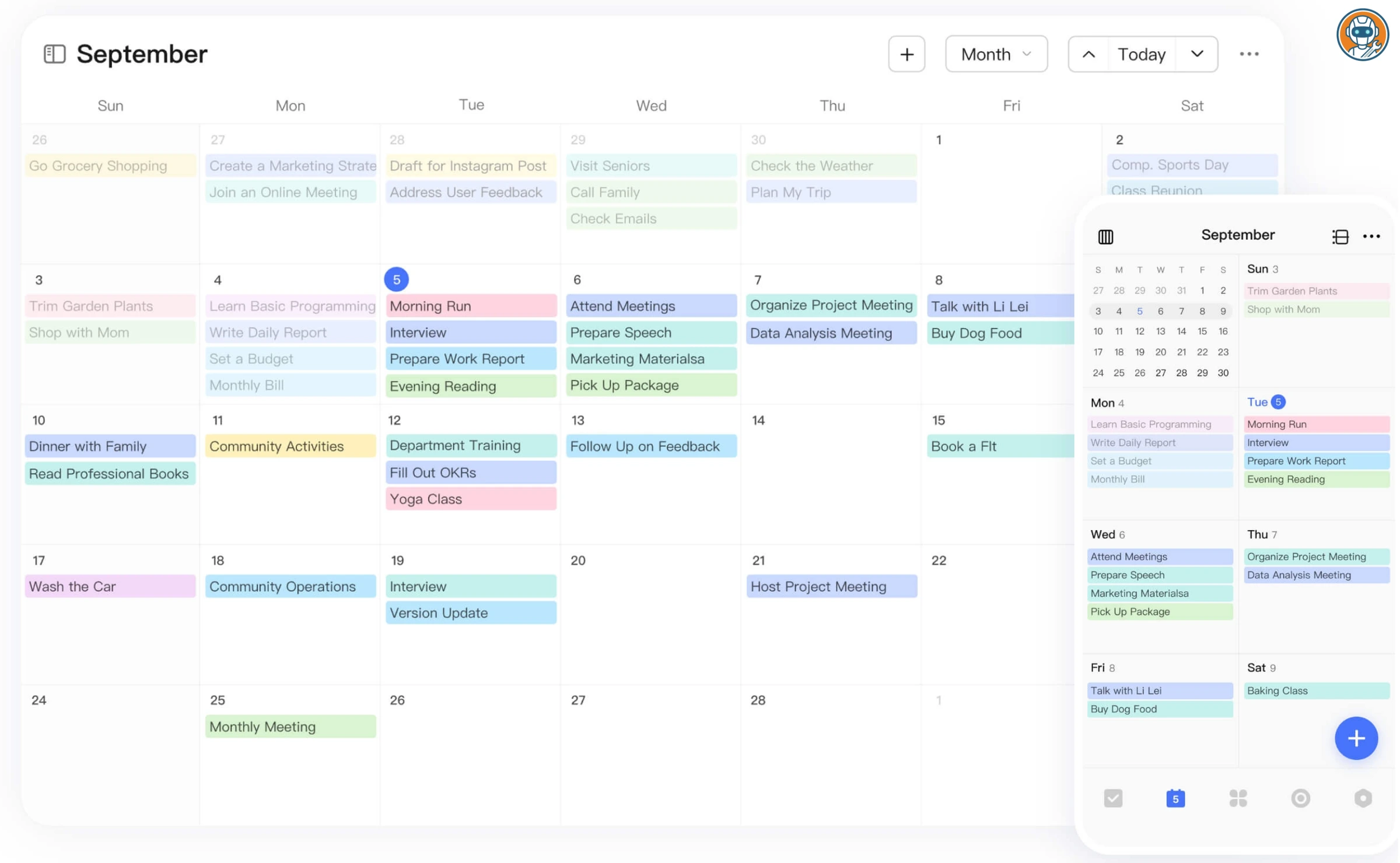
Calendar, habit tracker, Pomodoro timer, and Eisenhower Matrix bundled into one $36/year subscription replaces four separate apps.
Teams needing real collaboration, since the free plan caps shared lists at 2 members and there are no admin controls.
- Built-in calendar, habit tracker, Pomodoro timer, and Eisenhower Matrix. Four apps in one subscription
- Premium at $36/year ($3/mo) is cheaper than Todoist Pro's $48/year
- Free plan includes habits, Pomodoro, and Eisenhower — features Todoist doesn't offer at any tier
- Frequent feature updates — yearly heatmap, custom tab bar, and flexible month view all shipped in early 2026
- Natural language input is noticeably weaker than Todoist's. Complex recurrence patterns require manual setup
- Calendar sync with Google Calendar can lag up to 15 minutes. Reddit threads confirm this is a persistent issue
- No AI features whatsoever. No smart task parsing, no voice capture, nothing
- Collaboration is basic. Free plan caps shared lists at 2 members including yourself, no team workspace or admin controls
Here's the thing though. All those features come with a tradeoff that the feature comparison tables won't show you.
TickTick is buggier than Todoist. Not catastrophically, it's not crashing every day. But r/todoist and r/ticktick threads surface a consistent pattern: reminders that don't fire on certain Android devices, task ordering that occasionally scrambles after a sync, and calendar updates that lag behind Google Calendar by 5-15 minutes. The more frequently TickTick ships new features, the more edge cases slip through.
The Reddit consensus sums it up perfectly: "If you want stability, go with Todoist. If you want a lot of updates and the potential for neat features, go with TickTick." That's not a knock. It's a real engineering tradeoff between speed of development and reliability. Pick which one bothers you more.
Use it or skip it? Use it if you're a solo user who wants the most functionality per dollar. Skip it if you need team features or hate troubleshooting sync issues.
Todoist — The One That Just Works (But Costs More For Less)
Todoist's pitch is the opposite of TickTick's. Where TickTick throws everything at the wall, Todoist picks three things and polishes them until they shine.
The natural language processing is the best in any task manager. Full stop. Type "submit report every last Friday at 4pm #Work p1" and Todoist creates a recurring task assigned to the Work project with Priority 1, due on the correct date. TickTick's NLP handles basic dates but gets lost on anything more complex than "tomorrow at 3pm." If you capture 20+ tasks a day, the time saved on input adds up fast.
Then there's Ramble. I was skeptical. "Voice to task" sounds like the kind of feature that works in a demo and fails in practice. But Ramble genuinely parses unstructured speech into organized tasks. You can ramble (hence the name) about your entire morning (meetings, errands, follow-ups) and it separates everything into individual tasks with dates and priorities. It's built on Gemini 2.5 Flash and handles 40+ languages. Is it perfect? No. It sometimes misassigns priorities and occasionally misses context. But it saves enough time that I stopped typing tasks into my phone while walking.
Collaboration is where Todoist demolishes TickTick. If you've been using Notion for team collaboration, Todoist offers something lighter but still functional: 25 collaborators per project on Pro, 250 on Business, team workspaces that separate personal and work tasks, detailed activity logs, and comments with file attachments. TickTick's "collaboration" is sharing a list with one other person. Not the same conversation.
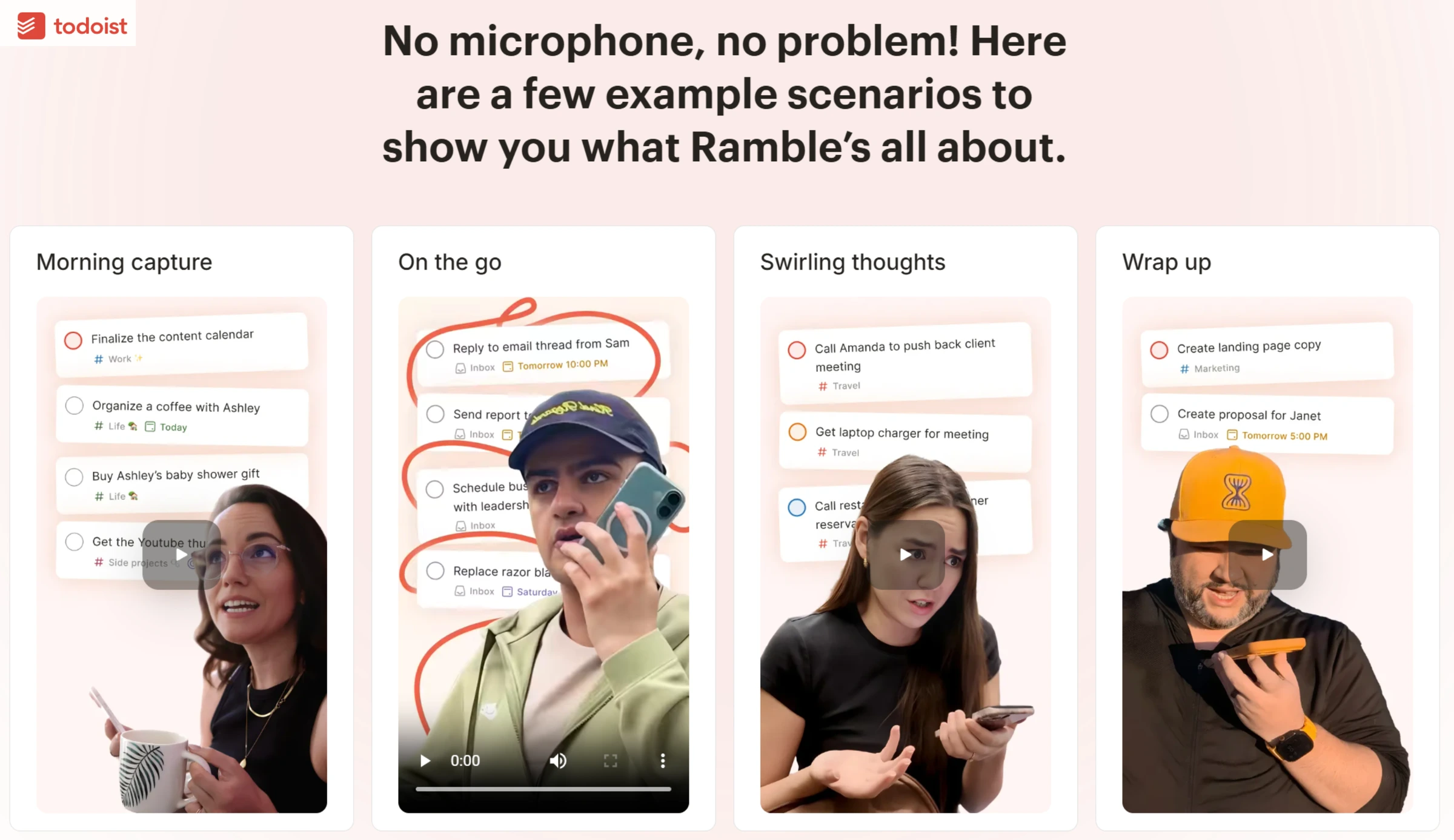
Ramble AI converts unstructured voice into organized tasks with dates and priorities across 40+ languages.
Solo users who want an all-in-one productivity suite, since you will need 2-3 more apps to fill the gaps Todoist leaves.
- Natural language processing is the best in any task manager, period. Complex recurring tasks parsed from one line of text
- Ramble AI (Jan 2026) converts unstructured voice into organized tasks with dates and priorities across 40+ languages
- Rock-solid stability. No sync lag, no phantom notifications, no task reordering bugs
- Team features that actually work: up to 250 collaborators, team workspaces, activity logs, comments with files
- No built-in calendar on the free plan. The feature most users want is locked behind $48/year
- No habit tracking, no Pomodoro timer, no Eisenhower Matrix. Core productivity features that TickTick includes for free
- Pro at $48/year is 33% more expensive than TickTick Premium at $36/year for fewer built-in features
- Free plan limited to 5 projects and 300 tasks, which gets restrictive fast for anything beyond a simple personal workflow
But here's the frustrating part. Todoist charges $48/year and doesn't include a calendar view on the free tier, has zero habit tracking, no focus timer, and no prioritization matrix. TickTick includes all of those, some even on its free plan. You're paying a 33% premium for better NLP, AI features, and stability. Whether that's worth it depends entirely on how you use a task manager.
If you're a "capture 30 tasks a day from meetings and messages" person, Todoist's NLP and Ramble are worth the premium. If you're a "plan my day visually, track habits, and focus with a timer" person, you're paying Todoist $48/year to not have those features.
Use it or skip it? Use it if you need team collaboration, fast task capture, or AI-powered input. Skip it if you want an all-in-one productivity suite. You'll end up buying 2-3 more apps to fill the gaps Todoist leaves.
The AI Gap Nobody's Talking About
As of March 2026, Todoist has four AI features: Ramble (voice parsing), Task Assist (subtask suggestions), Filter Assist (natural language filter creation), and Email Assist (forwarded emails → tasks). TickTick has zero.
This matters more than it sounds like. Todoist Assist can take "Plan the product launch" and break it into 8 subtasks with suggested deadlines. Filter Assist lets you type "show me all overdue work tasks assigned to me with high priority" and it builds the filter query. Not gimmicks. If you manage 50+ active tasks, these features trim real minutes off your day.
TickTick hasn't announced any AI features. Their development focus in 2025-2026 has been UI customization (themes, tab bars, background images) and calendar improvements. Different priorities. But if AI-powered task management matters to you (and it will matter to everyone eventually), Todoist is 18+ months ahead and building on that lead.
The counterargument: you don't need AI in a task manager. TickTick's built-in features handle the same problems through direct tools instead of AI parsing. Eisenhower Matrix replaces "ask AI to prioritize." Habit tracker replaces "ask AI about recurring patterns." It's the manual tool vs the smart tool debate, and both approaches work. Worth noting: Todoist's AI features run server-side, so they require an internet connection. If you regularly capture tasks offline (commuting underground, flights), TickTick's manual tools work everywhere without a data connection.
Free Plan Face-Off: This Is Where It Gets Ugly
Both apps have restrictive free tiers, but they're restrictive in completely different ways.
Todoist Beginner (Free): 5 projects, 300 tasks per project, 3 custom filters, 1 week of activity history, no calendar view, no custom reminders. You get labels, Kanban boards, and basic AI access (limited Ramble sessions). Collaboration: 5 people per project.
TickTick Free: 9 lists, 99 tasks per list, 2 reminders per task, no calendar views. But you get habit tracking, Pomodoro timer, and Eisenhower Matrix, all free. Collaboration: 2 members per shared list (including you).
TickTick gives you more functionality for free. Todoist gives you more room to grow for free (more tasks, more collaborators). If you're a student or someone who just needs a solid personal task system without paying, TickTick's free plan is the better deal. If you need to share tasks with a small team, Todoist's 5-person collaboration limit on the free tier makes more sense. One thing r/todoist users frequently point out: Todoist's 5-project cap on Beginner feels artificial when TickTick allows 9 lists at no cost. For anyone juggling work, personal, and side projects simultaneously, that ceiling hits fast.
Side-by-Side Comparison
| Feature | Todoist | TickTick |
|---|---|---|
| Monthly price (annual) | $4/mo ($48/yr) | $3/mo ($36/yr) |
| Free plan task limit | 300/project (5 projects) | 99/list (9 lists) |
| Natural language input | ✓ Industry-leading | ✓ Basic |
| AI features | ✓ Ramble, Assist, Filter AI | ✗ |
| Built-in calendar | Pro+ only | ✓ Premium |
| Habit tracking | ✗ | ✓ 60+ presets |
| Pomodoro timer | ✗ | ✓ With white noise |
| Eisenhower Matrix | ✗ | ✓ Native view |
| Kanban boards | ✓ | ✓ |
| Collaboration (free) | 5 per project | 2 per list |
| Collaboration (paid) | 25–250 per project | 29 per list |
| Integrations | 120+ native | ~61 native |
| API & SDKs | REST API v2 + Python/JS SDKs | Open API v1, no SDKs |
| Trustpilot | 3.6/5 | 4.4/5 |
| Offline support | ✓ All platforms | ✓ All platforms |
| Action | Try Todoist → | Try TickTick → |
Who Should Pick What
Pick TickTick if you're:
- A solo productivity person who wants calendar + habits + focus timer + tasks in one app
- Budget-conscious. $36/year gets you more features than Todoist's $48/year
- A visual planner who needs to see tasks on a real calendar and drag them around
- Fine with occasional sync hiccups in exchange for a feature-packed experience
Pick Todoist if you're:
- Managing tasks with a team. TickTick's collaboration is basically nonexistent
- A power user who captures 20+ tasks daily and needs fast NLP parsing
- Interested in AI-powered productivity (Ramble voice capture, smart subtask suggestions)
- A developer who wants to build automations on top of a well-documented API
Pick neither if you're: a developer who wants time tracking baked in. Check out Super Productivity . It's free, open-source, integrates with Jira and GitHub, and r/productivity keeps recommending it as the dark horse in this space. If your next question is whether Claude, ChatGPT, Cursor, or VS Code should read and update your task list, compare Superlist MCP, Todoist MCP, and Linear Agent before switching task managers again.
Frequently Asked Questions
Final Verdict
I've wasted more hours switching between task managers than any productivity tool has ever saved me. Tried Things 3, tried Notion databases, tried a plain text file (lasted two days). This comparison comes down to one question: do you want more features or a more polished experience?
TickTick packs a habit tracker, Pomodoro timer, Eisenhower Matrix, and a proper calendar into a $36/year package. For individual productivity, that's hard to beat. You're getting four tools for the price of one. The tradeoffs (weaker NLP, no AI, occasional bugs) are real, but they don't negate the raw value.
Todoist is the more refined app. The natural language parsing saves minutes per day, Ramble AI is genuinely useful for capturing tasks on the go, and the collaboration features make it viable for teams. But at $48/year, you're paying 33% more for an app that makes you install separate tools for habits, focus, and visual planning.
My pick for most of our readers: TickTick Premium. The feature density at that price point is unmatched, and if you're reading a comparison article about task managers, you're probably a solo user optimizing your personal workflow, exactly who TickTick is built for. But if you work on a team or live inside your inbox, Todoist is the only serious option.
Neither app is perfect. Both are a 6.5 for different reasons. That's the honest truth about task managers in 2026 — you'll always wish you had one feature from the other app. Pick your tradeoffs and commit. Switching costs are low, both export cleanly, and you can trial everything for free before spending a dollar. But as someone who reviewed both AI presentation tools and AI meeting assistants recently, the productivity category is heating up fast. These apps will look different in six months.
Ready to check Todoist?
Use the verified route if the trade-offs still fit. If not, jump back to the summary and compare the alternatives.
Crypto and productivity editor focused on cost, custody risk, setup friction, exports, fees, and workflow drag. Prioritizes verifiable numbers and clear skip criteria over hype.
Lucas starts with total operating cost, then ranks tools by setup and recurring friction, custody or export, reversibility, and whether the decision still makes sense when the exit path is included.
Related Articles

Hey Noah vs Lindy vs Fyxer: Best AI Executive Assistant
AI executive assistants compared by action authority, reversibility, workflow fit, cost predictability, context reach, and trust readiness
Compare Hey Noah, Lindy, and Fyxer by approvals, email sending, scheduling, calls, integrations, security, and current entry prices.

Paste vs Maccy vs Raycast: Which Mac Clipboard Manager Fits?
Mac clipboard managers compared by local history, Apple-device sync, privacy posture, launcher fit, setup burden, and subscription value
Paste, Maccy, and Raycast compared by clipboard history, Apple-device sync, local storage, privacy posture, pricing, and workflow fit.