
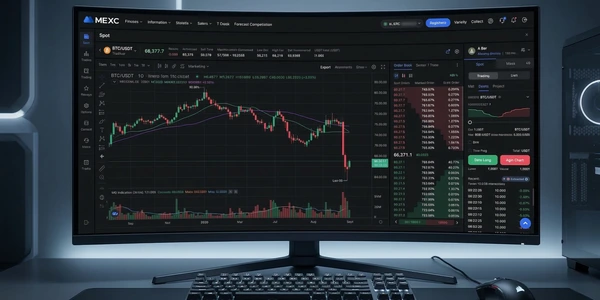
Half the "best no-KYC exchange" articles ranking on Google right now are lying to you. KuCoin made KYC mandatory in mid-2023. Bybit followed in 2024. OKX has restricted or blocked users in 90+ countries. The big media sites just haven't updated their rankings, because the affiliate commissions didn't change when the KYC policies did.
Here's what actually works as of March 2026: a handful of exchanges that still allow meaningful trading without passport verification, plus perpetual DEXs that make KYC enforcement structurally impossible. Five platforms, every withdrawal limit and fee structure verified against official documentation. And the one thing most of these articles skip entirely: what happens to your funds if your VPN fails.
-
#1 MEXCBest overall — 0% spot maker fees, 30 BTC daily withdrawal without KYC
-
#2 Apex ProBest DEX — feels like a CEX, can't freeze your account
-
#3 BingXBest for copy trading — mirror professionals, no identity check
The Fake No-KYC Problem Nobody's Fixing
Let's name names. KuCoin, Bybit, and OKX all rank on first-page results for "no KYC crypto exchange." All three now require mandatory KYC for full account functionality. KuCoin introduced it in July 2023 after a $291 million hack triggered regulatory investigations across multiple jurisdictions. Bybit required full verification by October 2024 under pressure from UAE regulators. OKX has been progressively tightening requirements for years.
The sites still listing these as no-KYC options are either outdated or deliberately misleading. Probably both.
What's left is smaller, more regionally-focused platforms operating in gray zones, plus a DEX category that changes the conversation entirely. None of these are risk-free — but at least the risk is described accurately.
Fees, Limits, and What You Actually Need to Know
| Feature | MEXC | BingX | Apex Pro | ChangeNOW | Phemex |
|---|---|---|---|---|---|
| Best For | Altcoin trading | Copy trading | Perp traders, max privacy | One-off swaps, no account | Derivatives (backup option) |
| 24h No-KYC Withdrawal | 30 BTC equivalent | ~2 BTC equivalent | Unlimited (your wallet) | No limit (swap-based) | 2 BTC equivalent |
| Headline Fees (Maker/Taker) | Spot: 0% / 0.05% | Spot: 0.1% / 0.1%; perps: 0.02% / 0.05% | Perps: 0.02% / 0.05% | ~0.4% all-in | Contracts: 0.01% / 0.06% |
| US/UK IP Blocked? | Yes — use VPN | Yes — use VPN | IP-blocked, wallet isn't | No | Strictly enforced |
| Custody Type | Custodial (CEX) | Custodial (CEX) | Non-custodial (DEX) | Swap service | Custodial (CEX) |
| Action | Visit MEXC → | Visit BingX → | Visit Apex Pro → | Visit ChangeNOW → | Visit Phemex → |
MEXC — The Default Pick, for Good Reason
30 BTC per day. That's MEXC's no-KYC withdrawal limit, confirmed in their official help documentation as of March 2026. At current prices, that's north of $2.5 million. Unless you're running institutional-scale positions, you'll never hit it.
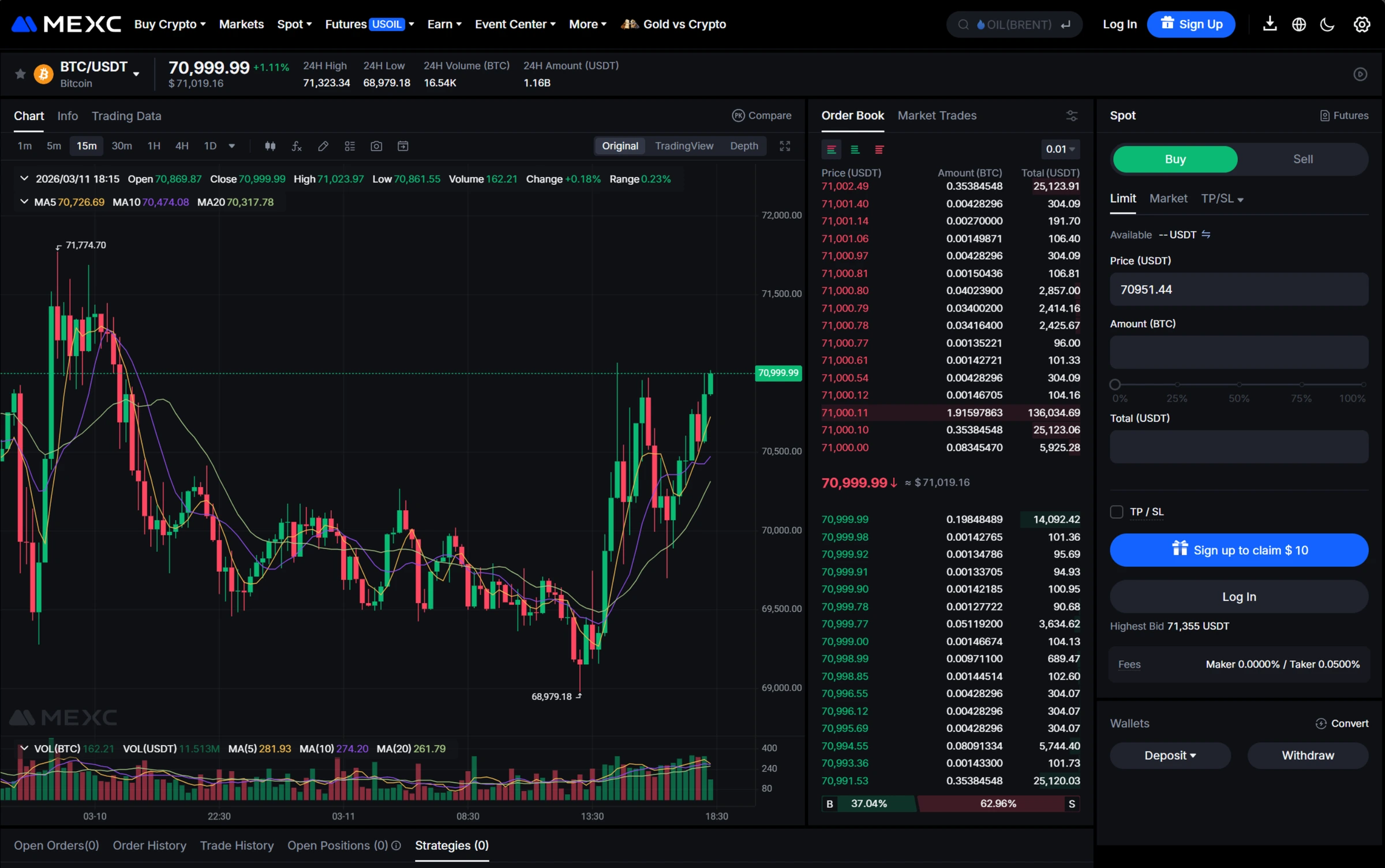
0% spot maker fees and a 30 BTC daily withdrawal limit without any identity documents — unmatched fee-to-limit ratio.
US and UK users — you are explicitly banned in the Terms of Service and there is no legal workaround.
- 0% maker fee on spot — no other major exchange matches this
- 30 BTC daily withdrawal limit without submitting any ID documents
- 1,500+ trading pairs including small-cap tokens that aren't listed anywhere else
- Futures and spot in one account, same no-KYC rules apply to both
- Email or phone verification only — no passport, no selfie, no proof of address
- US and UK users are explicitly banned in the Terms of Service
- Customer support response times average 48-72 hours based on consistent Reddit reports
- Some altcoin withdrawal networks have minimum withdrawal amounts that aren't obvious upfront
- Regulatory risk is real — Seychelles-registered, no major financial licensing
- No kill-switch equivalent at the platform level — VPN discipline is entirely on you
The 0% maker fee is the headline that doesn't get enough attention. On a $10,000 trade, Binance charges you $10. Coinbase charges $25-40 depending on your tier. MEXC charges $0. If you're trading actively rather than just buying and holding, that difference compounds fast. r/CryptoCurrency users consistently cite the fee structure as MEXC's main competitive edge, noting the savings alone justify the operational complexity of using a less mainstream exchange.
The altcoin selection is legitimately exceptional. MEXC lists tokens within days of launch (sometimes hours). For anyone wanting exposure to early-stage projects before they hit Binance or Coinbase, MEXC is often the only option with real liquidity. The tradeoff is obvious: some of those tokens are pure speculation. MEXC won't protect you from bad investments, and their listing standards are not Coinbase-level.
The regulatory risk deserves honest discussion. MEXC is registered in Seychelles. They've had regional bans and periodic service disruptions. The probability of a sudden account freeze isn't high, but it's not zero either. Treat MEXC as a trading platform, not a savings account. Fund it, execute your trade, withdraw. Don't leave significant balances sitting for weeks.
BingX — For Copy Traders Who Don't Want the KYC Friction
Most no-KYC exchange roundups treat BingX as an afterthought. They're missing the point. BingX's copy trading feature is one of the better implementations in this space right now. You can browse verified traders by historical returns, risk score, maximum drawdown percentage, and total AUM under copy, then mirror their positions automatically with a configurable allocation.
Copy trading with verified trader stats — win rate, drawdown, AUM — plus the cleanest mobile app in the no-KYC space.
High-volume traders — the 2 BTC daily withdrawal limit is a real constraint for moving large positions.
- Copy trading with full verified trader statistics — win rate, drawdown, AUM all displayed
- Derivatives and spot in one unified account
- Mobile app is cleaner and faster to navigate than MEXC's
- Decent liquidity on major BTC, ETH, and SOL pairs
- Up to 125x leverage on perps if that's your setup
- 2 BTC daily withdrawal limit without KYC — far below MEXC's 30 BTC ceiling
- Spot fees (0.1% / 0.1%) are higher than MEXC across the board
- US users explicitly banned
- Copy trading past returns aren't predictive — some of those 'verified' traders had one good quarter and nothing since
- Altcoin selection is significantly thinner than MEXC
The 2 BTC daily withdrawal limit is the real constraint here. That sounds like a lot until you're moving a meaningful portfolio position during a volatile session. If you regularly need to move more than $150,000 at once, MEXC or Apex Pro are better fits.
Where BingX quietly outperforms is the mobile experience. The app loads faster, navigation between spot and derivatives is less cluttered, and the copy trading dashboard surfaces trader stats (PnL history, max drawdown, follower count, average hold time) without burying them behind four menu taps. r/CryptoCurrency threads comparing mobile interfaces generally put BingX ahead of MEXC for usability, even if MEXC wins on fees. If you're managing positions from your phone more than a desktop, that matters.
The copy trading feature itself has a realistic ceiling that BingX doesn't advertise. You're limited to following a set number of traders simultaneously, allocations are capped per leader, and slippage on copied entries can differ from the leader's fill price during fast moves. It's a useful tool for passive exposure, not a guaranteed return engine.
Use BingX if copy trading is your primary workflow and you're comfortable with the lower withdrawal ceiling. Skip it if you need deep altcoin markets or the lowest possible fee structure.
Apex Pro — The DEX That Eliminates the Account-Freeze Risk
Here's what nobody in the no-KYC CEX conversation wants to admit: centralized exchanges can still freeze your account. They don't know who you are, but they know your IP address and your deposit wallet history. If regulators put enough pressure on MEXC or BingX, they'll comply. They've done it before in other contexts.
Apex Pro is a non-custodial perpetual DEX. You connect your Ethereum wallet (MetaMask, Ledger, Rabby, whatever you're using) and trade directly against the protocol's liquidity pools. There's no company holding your funds. There's no account to freeze. If Apex Pro's front-end website disappeared tomorrow, your positions would still exist on-chain and could be accessed through the smart contract directly.
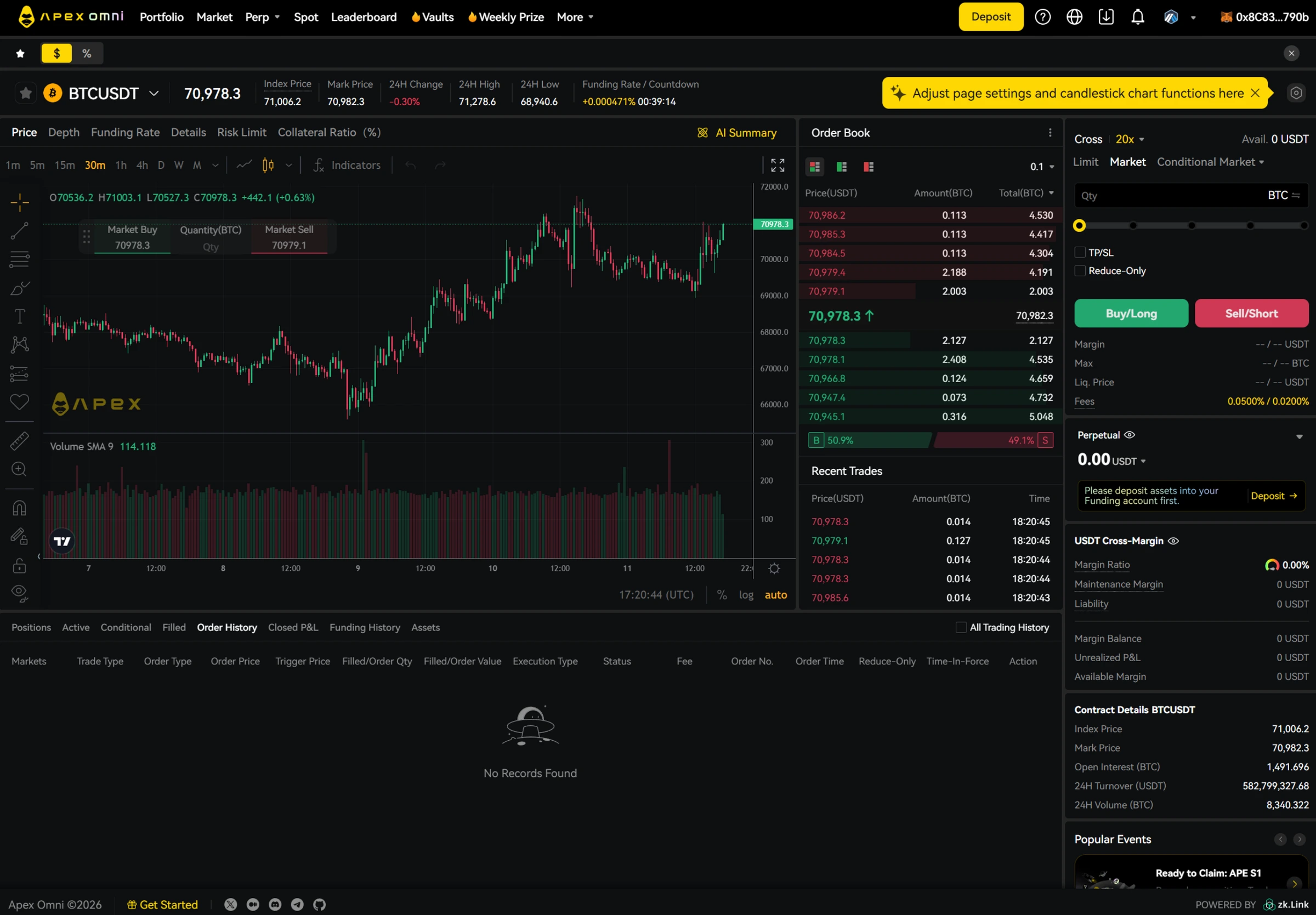
Non-custodial perpetual DEX that structurally cannot freeze your account — no company, no compliance order, just smart contracts.
Spot buyers who want actual token ownership — Apex Pro is perpetuals-only with no spot trading.
- True non-custodial — your funds never leave your wallet at any point
- No account creation required, just a wallet connection
- 0.02% maker fee — cheapest perp trading on this entire list
- Structurally cannot be shut down at the account level by government order
- Interface is surprisingly functional — TradingView charts, clean order book, feels like a CEX
- Perpetuals only — no actual spot token ownership
- Front-end is IP-blocked for US and UK users (your wallet isn't, but using a VPN on a DEX is its own question)
- No built-in fiat on-ramp — you need a funded wallet to get started
- Liquidity on altcoin perps is thinner than MEXC spot markets
- Learning curve is real if you've never used a non-custodial platform before
The UI deserves real credit here. Most DEXs feel like someone tried to build Bloomberg Terminal on a broken website. Apex Pro's interface would pass for a decent CEX. r/ethfinance users who've tried it note that onboarding takes about 10 minutes if you already have a funded Ethereum wallet: connect, deposit to the protocol's margin, start trading. No registration, no email verification, nothing.
One honest limitation: Apex Pro is for perpetual traders, not spot buyers. You can't use it to accumulate a bag of tokens. For that, MEXC is the answer. Apex Pro is for people who trade derivatives and want the account-freeze risk reduced to zero through structural design rather than trust.
ChangeNOW — When You Just Need a Swap With No Account
ChangeNOW isn't an exchange in the traditional sense. There's no account. No login. No order book. You go to the site, pick the two coins you want to swap, enter your destination wallet address, send the source coin to ChangeNOW's address, receive the target coin in your wallet. Transaction done. The whole interaction takes 2-10 minutes and they never hold your funds for longer than the swap execution time.
Zero account, zero login, zero registration — send crypto in, receive a different crypto out in 2-10 minutes.
Active traders — the 0.4% fee adds up fast on frequent swaps and there is no order book or trading functionality.
- Zero account required — genuinely accountless, not just low-KYC
- 850+ coins supported across 40+ blockchains
- Fixed-rate option available — lock in the exchange rate before you send
- No published transaction limits for standard-sized swaps
- Straightforward fee structure at roughly 0.4% all-in
- The 0.4% fee adds up on large swaps — it's not competitive for frequent trading
- Floating-rate swaps can shift during processing if the market moves
- No trading functionality — this is strictly a swap service, not an exchange
- No recourse mechanism if a swap gets stuck or the rate deviates significantly
- Not suitable for anything resembling active trading
ChangeNOW supports hundreds of tokens across dozens of blockchain networks, which means you can swap between chains that most CEXs don't bridge natively. Need to move from Avalanche C-Chain to Cosmos? From Polygon to Algorand? ChangeNOW handles cross-chain routing without requiring you to find a bridge protocol yourself. The fixed-rate option locks your exchange rate for 20 minutes after you create the transaction, which protects you during volatile windows but comes at a slightly wider spread than the floating-rate option.
ChangeNOW's use case is specific: you have BTC, you want ETH, you want zero friction and no account trail. It's not for building a position. It's not for trading. It's a clean, accountless conversion layer. r/Monero users in particular recommend it for XMR conversions, since Monero has been delisted from most regulated exchanges and ChangeNOW still supports it without any identity requirements. We covered ChangeNOW in more depth alongside other swap services in our non-custodial exchanges roundup, worth reading if accountless swapping is your primary requirement.
Use ChangeNOW for one-off conversions where privacy and speed matter more than getting the absolute tightest spread. Skip it for anything that resembles active trading.
Phemex — Solid Platform, Aggressive IP Enforcement
Phemex has good fundamentals. Competitive fees, clean charting, a derivatives product with solid liquidity on major pairs. The problem is a specific failure mode that's well-documented in Reddit threads and that you need to understand before funding an account there.
Competitive perp fees with better charting tools than BingX and reliable liquidity on major pairs.
Anyone without a tested kill-switch VPN — Phemex has the strictest IP enforcement and will freeze funds on detection.
- 0.01% maker fee on contracts — competitive for perp trading
- Charting tools are better than BingX's default implementation
- Derivatives product has reliable liquidity on BTC and ETH pairs
- 2 BTC daily withdrawal without KYC
- Operating since 2019 with a reasonably clean track record
- IP enforcement is the strictest on this list — account restriction triggers quickly on restricted IP detection
- Multiple documented Reddit cases of funds being frozen after VPN disconnection mid-session
- Altcoin selection is significantly narrower than MEXC
- Customer support has persistent slow-response complaints specifically around withdrawal holds
- US users are comprehensively banned, not just restricted
Here's the specific scenario documented across r/phemex and r/CryptoMoonShots: VPN kill-switch disengages (app update, Wi-Fi handoff, whatever). Real IP from a restricted country gets logged for 30 seconds. Account gets flagged. Funds frozen pending KYC review. The user now has to either submit full identity documents or spend weeks arguing with support — at an exchange they specifically chose to avoid KYC. That's not a hypothetical risk. It's happened enough times that there are dedicated threads about it.
Use Phemex only if MEXC and BingX aren't available in your region, and only with a kill-switch VPN you've actively tested. More on that in the section below.
How to Use These Without Losing Your Funds
This is the section that makes the difference.
The Kill-Switch Rule
If you're in a jurisdiction restricted by these exchanges (US, UK, most of the EU for some platforms), a VPN isn't optional. It's the foundational security layer. But not all VPNs are equal for this specific use case.
You need two things: a kill-switch that cuts all internet traffic the moment the VPN connection drops, and a no-logs policy that's been independently audited. Without the kill-switch, a VPN disconnection exposes your real IP for a few seconds, enough for exchange fraud detection to log it. Without the audit, you're trusting a company's word about what happens to your usage data.
Proton VPN and Mullvad are the two that crypto-focused communities consistently trust for this use case. Both have published audit reports verifying no-logs claims. Both have kill-switch implementations that have been tested under real network conditions. Our VPN roundup covers the full comparison with verified 2026 pricing and audit details. That's the right place to start before choosing one for exchange use.
The Fiat On-Ramp Is Always KYC
These are crypto-to-crypto platforms. You cannot buy Bitcoin with a credit card on MEXC, BingX, or Phemex without going through KYC. The fiat on-ramp (card payments, bank transfers) always requires identity verification because payment processors are legally required to collect it. No exceptions. If you are comparing those card or bank-transfer routes, the MoonPay, Transak, and Ramp on-ramp comparison covers the fee and partner-markup traps.
If you want to enter the market with fiat anonymously, the options are P2P (Bisq is decentralized but slow and illiquid), crypto ATMs in some cities (high fees, usually capped amounts), or finding a counterparty directly. There's no clean, cheap, anonymous fiat-to-crypto path. These no-KYC exchanges don't solve that problem.
Withdraw Immediately. Every Time.
The single biggest mistake people make with no-KYC exchanges: they leave meaningful balances sitting on the platform for weeks or months. Don't.
These exchanges don't carry the regulatory protections of licensed financial institutions. If MEXC has a security incident, there's no deposit insurance equivalent. If Phemex freezes accounts following regulatory action, the resolution process is slow and uncertain. The correct operating procedure is simple: fund the account, execute your trade, withdraw to a wallet you control. Long-term holdings belong in a hardware wallet, not on an exchange you're using specifically because it doesn't know who you are.
And on the tax side: every swap, every trade, every withdrawal is a taxable event in most jurisdictions. If you're active on these platforms, a tool like CoinLedger or Koinly makes tax season significantly less painful. Both support MEXC import and most major exchange transaction histories.
Frequently Asked Questions
The Bottom Line
For most people: MEXC . The 0% maker fee is real, the 30 BTC daily limit is irrelevant for 99% of traders, and the altcoin selection beats everything else on this list by a wide margin. The regulatory risk is manageable if you treat it as a trading platform with a strict withdrawal discipline.
If the account-freeze risk is genuinely your main concern, Apex Pro solves it structurally. There's no account. There's no company that can comply with a freeze order. The learning curve exists but the security model is fundamentally different from anything in the CEX category.
Copy trading your focus? BingX . Just know the 2 BTC withdrawal limit is a real constraint if you're moving large positions.
One-off swap, no account needed? ChangeNOW . Zero friction, done in minutes.
Phemex only if everything else is unavailable, and only with a kill-switch VPN you've actually tested before you need it.
Whatever you pick: fund it, trade it, withdraw it. These aren't banks. They don't want to be, and you shouldn't want them to be either.
Ready to check MEXC?
Use the verified route if the trade-offs still fit. If not, jump back to the summary and compare the alternatives.
Crypto and productivity editor focused on cost, custody risk, setup friction, exports, fees, and workflow drag. Prioritizes verifiable numbers and clear skip criteria over hype.
Lucas starts with total operating cost, then ranks tools by setup and recurring friction, custody or export, reversibility, and whether the decision still makes sense when the exit path is included.
Related Articles

Best Tokenized Stock Platforms for EU Users
EU stock-token platforms compared by legal wrapper, total cost clarity, shareholder rights, trading hours, and self-custody exit
Kraken xStocks, Robinhood Classic Stock Tokens, and Crypto.com compared for EU users by ownership, fees, rights, market hours, and wallet withdrawal.

MiCA Deadline: Kraken vs Coinbase vs Crypto.com in EU
Post-deadline EEA exchange verification guide
Kraken, Coinbase, and Crypto.com compared for EEA users after the July 1 MiCA deadline: entities, restrictions, fees, and safe transfer checks.