

Pionex vs Bitsgap is not really a feature-count fight. The real decision is whether you should pay a monthly SaaS bill for bot control, or accept an exchange-native bot model and avoid the third-party API layer.
My default pick is Pionex for most smaller bot users. Not because it is magic. Not because bots make money on command. Because a paid bot can be mathematically wrong before it places a trade.
At $29 per month, Bitsgap costs $348 per year on its monthly Basic plan. On a $5,000 bot budget, that is 6.96% of capital before exchange fees, spread, slippage, taxes, and bad strategy choices. The bot has to beat that drag just to reach zero.
Wrong question.
The question is not "which crypto trading bot has more knobs?" The question is: which setup gives a retail trader a cleaner workflow with fewer expensive failure points? I checked official pricing, Pionex.US Webot migration context, Bitsgap security claims, current SERPs, public r/Pionex and r/CryptoCurrency friction threads, affiliate routes, and GDT operator data. I did not create accounts, connect exchanges, generate API keys, launch bots, place trades, or measure performance.
If you are still choosing the broader category, start with our best crypto trading bots guide. If you still need the exchange layer, use the best crypto exchanges guide first. If your bot output will create taxable transactions, pair this decision with our CoinLedger vs Koinly comparison before tax season turns into archaeology.
-
#1 PionexBest default for smaller bot budgets: no monthly SaaS plan and no third-party API connection
-
#2 BitsgapBest if you need multi-exchange bot control and can justify a paid subscription
-
#3 3CommasControl benchmark to check only if SmartTrade-style routing matters more than subscription drag
If a friend with a modest crypto allocation asked me today, I would start them at Pionex and make them prove they need more. If that friend already had exchange accounts, understood API permissions, and wanted a central bot layer across venues, then Bitsgap becomes a serious comparison. If they wanted SmartTrade-style order control more than grid simplicity, I would tell them to inspect 3Commas as the control benchmark.
Pionex vs Bitsgap comparison
| Feature | Pionex | Bitsgap | 3Commas |
|---|---|---|---|
| Best job | Low-drag exchange-native bots | Multi-exchange bot control | Advanced order-routing benchmark |
| Cost model | Bot access is positioned as free; exchange trading fees apply | Free Evedex/demo tier; paid plans are $23, $55, or $119 per month on annual billing and $29, $69, or $149 month to month | Paid subscription, separate from exchange fees |
| Where funds sit | Inside the Pionex or Webot exchange context | On connected exchanges, according to Bitsgap security docs | On connected exchanges through API connections |
| API-key exposure | No third-party API key layer for native bots | Yes, through exchange API connections | Yes, API permissions are the risk surface |
| Bot workflow | Start with a simple grid/DCA-style exchange bot | Grid, DCA, and portfolio control across supported exchanges | More control, more setup burden |
| Skip if | You refuse to move funds to the Pionex/Webot context | Your capital is too small for the plan bill to make sense | You mainly need a basic grid bot |
| Action | Compare Pionex | Compare Bitsgap | Compare 3Commas |
How I ranked the bot decision
The ranking uses one rubric: Subscription Drag, Bot Workflow, API/Custody Risk, Buyer Fit, and Value. Subscription Drag asks whether the tool has to win back a recurring bill. Bot Workflow asks whether a trader can understand the setup without turning a simple grid into an options desk. API/Custody Risk asks where the funds sit and what permissions touch them. Buyer Fit asks whether the product matches the reader behind this keyword. Value asks whether the tradeoff is worth the risk.
Most people comparing trading bots are overbuying control. They see exchange count, smart terminals, backtests, arbitrage scanners, AI-ish labels, and slick dashboard language. Then they forget the boring math: a bot subscription is a fixed hurdle rate. If the account is small, the plan bill is not a detail. It is the first losing trade.
Not free.
Pionex wins because it removes the SaaS bill and the third-party API connection for the beginner-to-intermediate bot job. Bitsgap stays close because the multi-exchange workflow is a real job for the right trader. The poor fit is someone paying for multi-exchange control while running one small grid that could have lived on an exchange-native bot.
1. Pionex: the better default for low-drag bots
Pionex is the better starting point if you want a bot without a monthly subscription. Official Pionex bot-fee documentation positions the bots as free to use, with trading fees applying. The existing public fee reference used by GDT lists a 0.05% trade-fee model for the global Pionex context, while U.S. readers need a second check because Pionex.US has been moving users into the Webot context.
That caveat matters. A simple "Pionex is free" line is too neat for 2026. The product can still be the better default, but U.S. readers should verify the current Webot fee schedule and availability before funding. Official Pionex.US migration material says users do not need to re-register or manually transfer assets during the Webot upgrade path. That reduces migration panic. It does not remove the need to understand which legal product and fee schedule you are actually using.
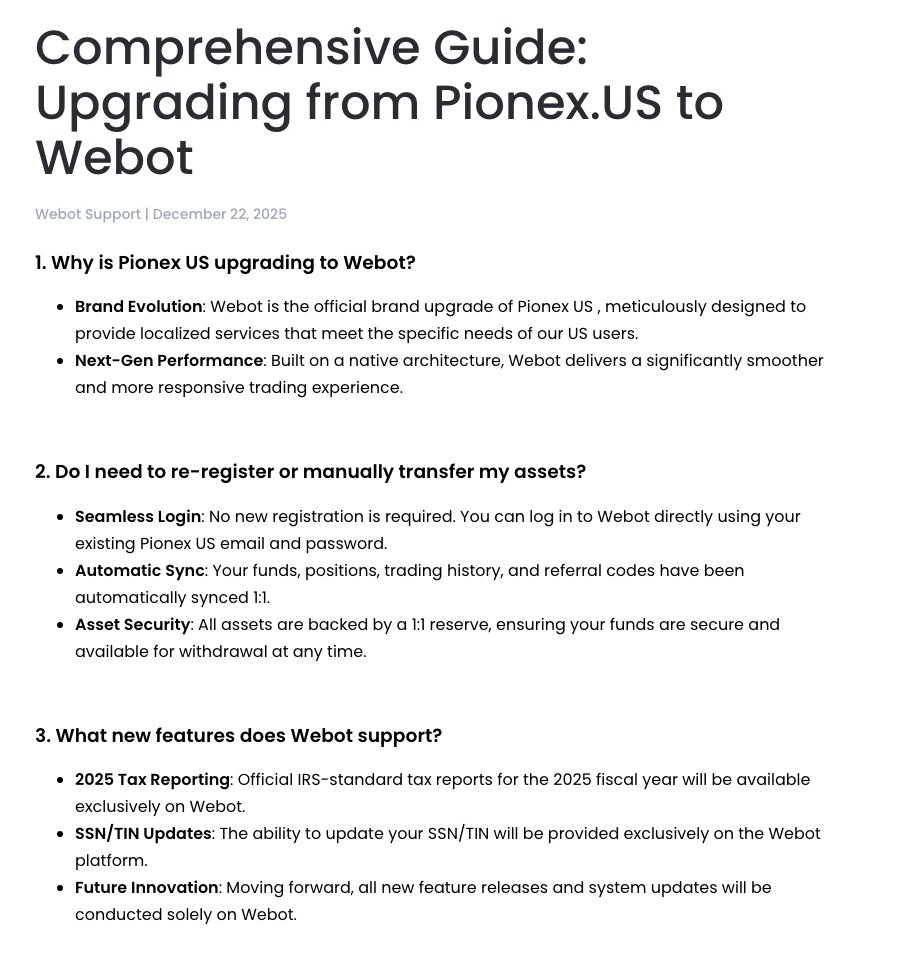
The economic case is still strong. At a 0.05% trading fee, $29 is roughly the fee on $58,000 of spot trading volume. That is the useful comparison against Bitsgap Basic at $29 month to month. If your bot only turns over a few thousand dollars a month, the paid SaaS bill can be heavier than the exchange fee line. This is why my take is conservative: start with the lower fixed-cost setup unless you can name the exact control feature you are buying.
Public r/Pionex threads I checked were not asking for more abstract AI claims. The concrete friction was grid behavior: trailing up, trailing down, and what happens when price leaves the range. That is the right kind of question. It tells me the trader is wrestling with bot mechanics, not marketing. Pionex is a fit when you want fewer setup surfaces and accept the exchange-native custody model.
Pionex removes the recurring SaaS hurdle and third-party API layer from the basic grid/DCA bot decision.
Skip it if you will not hold funds inside the Pionex or Webot exchange context, or if you need one dashboard controlling multiple outside exchanges.
Pionex ranks first because subscription drag is the main failure mode for this reader. The accepted tradeoff is exchange-native custody and the need to verify the U.S. Webot context.
- No separate monthly bot plan to earn back before strategy costs make sense
- Native bot setup avoids handing exchange API keys to a third-party bot layer
- Better default for smaller balances where fixed SaaS fees can crush the math
- Simple grid/DCA-style workflow is easier to understand than multi-exchange control
- Funds have to sit in the Pionex or Webot exchange context
- U.S. users must verify current Webot/Pionex.US fees and product availability
- Not the right fit if you want to automate existing outside-exchange balances
- No bot setup removes market risk, bad ranges, taxable trades, or strategy failure
2. Bitsgap: better control, but the bill has to be earned
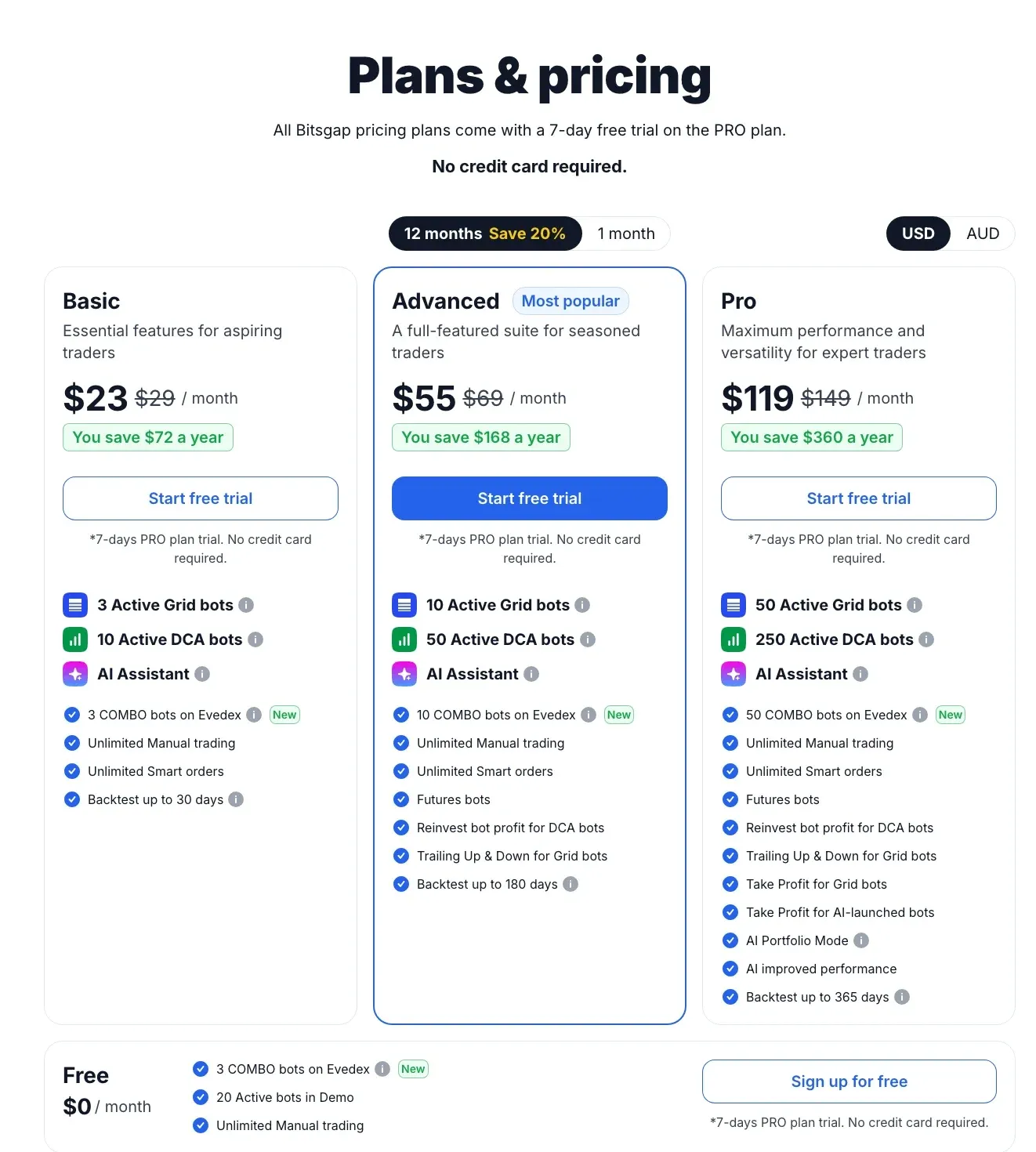
Bitsgap is the better fit when you already understand exchanges and want a bot layer across them. The official pricing page now has a $0 tier with three COMBO bots on Evedex, 20 active demo bots, and manual trading. That is useful for learning the interface, but it is not the same job as running live bots across connected exchanges.
The paid tiers showed annual monthly equivalents of $23, $55, and $119, with monthly prices of $29, $69, and $149. Basic includes 3 active Grid bots and 10 DCA bots, Advanced raises those limits and adds futures bots, and Pro is the high-volume tier. The free tier lowers the cost of evaluating the product; the subscription math still decides whether the live multi-exchange workflow is worth keeping.
The catch is simple: every paid tier creates a hurdle rate. The $29 monthly Basic plan is $348 per year. The $69 plan is $828 per year. The $149 plan is $1,788 per year. On a $5,000 account, those bills are 6.96%, 16.56%, and 35.76% of capital before the bot pays exchange fees or makes a mistake. A trader can still justify Bitsgap, but only if the control is doing a real job.
The security model is different from Pionex. Bitsgap says assets remain in the user's own exchange accounts and that Bitsgap connects through secure API keys only. That is a legitimate advantage if the trader refuses to transfer funds to a bot-native exchange. It also creates a permissions problem. You have to manage exchange API keys, disable withdrawal permissions, understand exchange-side security, and avoid treating "funds stay on my exchange" as the same thing as "no operational risk."
Here is the thing: API risk is not solved by one reassuring sentence. It is reduced by careful permissions, exchange controls, IP restrictions where available, 2FA, hardware-key support, and the discipline to revoke keys when a bot layer is no longer needed. Bitsgap's official security page gives useful evidence for the custody claim. It does not prove that every user will configure keys well.

Use Bitsgap if you know exactly why one exchange-native bot is not enough. Multi-exchange grid control, a larger account, and a repeatable operating routine are good reasons. Curiosity is not. A subscription can turn curiosity into a silent tax.
Bitsgap gives a cleaner multi-exchange bot layer than an exchange-native setup, with visible plan limits and security documentation around API connections.
Skip it if your bot capital is small, you trade on one exchange, or you are not comfortable managing API-key permissions.
Bitsgap ranks second because it solves a real multi-exchange job but adds subscription drag and API-key operations that many smaller accounts do not need.
- Better fit when you want one bot layer across supported exchanges
- Official pricing page makes plan jumps and active Grid bot counts visible
- Security docs say assets remain on connected exchange accounts
- Useful for traders who already understand API permissions and exchange workflows
- Monthly subscription has to be earned back before strategy economics make sense
- API-key management becomes part of the operating burden
- Wrong fit for one small grid on one exchange
- No pricing page or security claim proves live bot profitability
3. 3Commas: the control benchmark, not the default answer
I would not make 3Commas the default answer for this keyword, but it belongs in the decision because it marks the other end of the spectrum. If Pionex is the low-drag exchange-native route and Bitsgap is the grid-focused multi-exchange layer, 3Commas is the paid-control benchmark for traders who care about SmartTrade-style order routing.
That benchmark is useful because it exposes the real operating job. If you need advanced order management across connected exchanges, compare 3Commas. If you are only trying to run a basic grid, this is overkill. The risk is not that the tool has too many controls. The risk is paying for controls that hide a weak strategy behind a better-looking interface.
How to choose without overbuying automation
Pick Pionex if you want the cheapest honest path to trying exchange-native bots. Keep the account small at first, understand the grid range, assume every trade can be taxable, and treat bot profits as unproven until records prove otherwise. Does it actually save time or just look cool? That question matters more than the number of bot templates.
Pick Bitsgap if the exchange-native model is the wrong constraint. Maybe you already trade on multiple exchanges. Maybe you want one bot layer while assets stay on those exchanges. Maybe the plan cost is small relative to capital and process. In that case, the API layer is not a dealbreaker. It is an operating requirement.
Skip both if you want guaranteed returns. Also skip both if you cannot explain the market condition the bot is meant to exploit. A grid bot in the wrong market is not automation. It is a faster way to make the same mistake over and over.
Bad trade.
The expensive mistake is buying the tool before naming the failure mode. For Pionex, the failure mode is custody/context mismatch: you do not want funds inside that exchange product. For Bitsgap, the failure mode is subscription drag plus API operations. For 3Commas, the failure mode is overbuying control when a simpler bot would have forced better discipline.
The fee math I would run before a bot trial
Before picking either tool, I would write down three numbers: capital assigned to the bot, expected monthly turnover, and the maximum fixed software bill I am willing to tolerate. If those numbers are fuzzy, you are not ready for a paid bot layer yet. A free trial can still become an expensive habit when someone forgets to cancel or lets a weak setup run because the dashboard feels productive.
For Pionex, the simple check is whether you are comfortable with the exchange-native model. If the answer is no, the low fixed cost does not matter. The product is wrong for your workflow. If the answer is yes, the next question is whether the trade fee and regional fee schedule still make sense for the amount of turnover the bot will create. A grid bot that churns more than expected can create a bigger fee and tax record than planned.
For Bitsgap, the check starts with the plan bill. Take the monthly cost, multiply by 12, then divide by the capital you actually plan to automate. A $348 yearly bill is not scary on a $50,000 operating account. It is heavy on a $5,000 experiment. This is where people talk themselves into bad math. They compare the tool against imagined future profits instead of the amount they are willing to risk today.
The second Bitsgap check is operational: can you manage API permissions without guessing? If you cannot explain trade-only permissions, withdrawal settings, exchange-side security, 2FA, key revocation, and what happens if you stop using the bot, the product is early. That does not make Bitsgap bad. It means the security work for a paid API bot is not finished.
My rule is boring: prove the workflow at the lowest fixed cost first. Then upgrade only when the bottleneck is real. "I want more controls" is not enough. "I need to run grids across two exchanges I already use, and the plan bill is less than 1% of the capital assigned to the bot" is a real reason.
Also considered
3Commas is the main near-miss because it answers a different control question. It can make sense for traders who already know they need advanced order routing. It should not be the default answer to Pionex vs Bitsgap.
Cryptohopper and Coinrule are credible bot names, but they would turn this comparison into a broad roundup. That job already lives in the crypto trading bots guide. For this page, the sharper problem is Pionex's exchange-native model versus Bitsgap's API-connected SaaS model.
Manual trading is also a valid answer. In r/CryptoCurrency threads, the safest advice often looks boring: understand the strategy before automating it. I agree with that instinct. If you cannot explain the range, fees, tax burden, and exit rule, the bot is early.
Final verdict: start with the cheaper failure mode
Pick Pionex first if you want bot automation with the least subscription drag. It is not risk-free, and the U.S. Webot context deserves a fresh fee check before funding. But for a smaller account comparing bot tools, removing the monthly SaaS bill and the third-party API layer is a real advantage.
Pick Bitsgap when multi-exchange control is the job. The paid plan can make sense if your capital, process, and exchange setup justify it. It is the wrong pick if you are paying $29 per month because a dashboard made a basic grid look more professional than it is.
The bottom line: start with the cheaper failure mode. Pionex's main failure is that you may not want the exchange-native custody context. Bitsgap's main failure is that you may pay for control before the strategy earns the bill. For most readers behind "Pionex vs Bitsgap," I would rather see the need for Bitsgap proven than paid for by default.
Pionex is the better default for smaller bot accounts because it removes the recurring SaaS hurdle. Bitsgap is the stronger fit when multi-exchange API control is the actual job.
Compare PionexFrequently Asked Questions
Ready to check Pionex?
Use the verified route if the trade-offs still fit. If not, jump back to the summary and compare the alternatives.
Crypto and productivity editor focused on cost, custody risk, setup friction, exports, fees, and workflow drag. Prioritizes verifiable numbers and clear skip criteria over hype.
Lucas starts with total operating cost, then ranks tools by setup and recurring friction, custody or export, reversibility, and whether the decision still makes sense when the exit path is included.
Related Articles

Best Tokenized Stock Platforms for EU Users
EU stock-token platforms compared by legal wrapper, total cost clarity, shareholder rights, trading hours, and self-custody exit
Kraken xStocks, Robinhood Classic Stock Tokens, and Crypto.com compared for EU users by ownership, fees, rights, market hours, and wallet withdrawal.

MiCA Deadline: Kraken vs Coinbase vs Crypto.com in EU
Post-deadline EEA exchange verification guide
Kraken, Coinbase, and Crypto.com compared for EEA users after the July 1 MiCA deadline: entities, restrictions, fees, and safe transfer checks.