FTX. Celsius. BlockFi. Voyager. Three years later and I still see people keeping five figures in crypto on exchanges. "It won't happen to mine," they say. It already did. Over $25 billion in customer funds evaporated across those four platforms alone.
Not your keys, not your crypto. You've heard it a thousand times. Here's the less-catchy version: a hardware wallet costing $50-$250 is the difference between "I lost everything" and "I'm fine."
I've been buying hardware wallets since 2019. First a Ledger Nano S that I promptly forgot the PIN to (learned that lesson fast), then a Trezor Model T, and now I rotate between three devices for different holdings. I've also watched the hardware wallet market change more in the past 12 months than the previous three years combined. Trezor shipped a quantum-resistant chip. Ledger got breached again. And a $70 NFC card is somehow giving the incumbents a real fight.
Here are the 6 devices worth your money in 2026 — and one company whose hardware is excellent but whose track record should make you nervous.
-
#1 Trezor Safe 7Best overall — quantum-ready, open source, premium build
-
#2 Trezor Safe 3Best under $100 — same security philosophy, budget price
-
#3 Tangem WalletBest for beginners — NFC card, no seed phrase headaches
My rule: the device matters, but the recovery plan matters more. A cheaper wallet with a backup you understand beats a premium device paired with a seed phrase you can lose, photograph, or accidentally type into a fake website. If the paper card is still your only recovery layer, our seed phrase backup comparison covers the metal plates and capsules worth shortlisting before the wallet becomes the single point of failure.
Open Source vs. Closed Source: The Debate That Actually Matters
Before I get into individual wallets, you need to understand the single most important difference in this market that almost every review glosses over.
Trezor's firmware is fully open source. Every line of code running on your device is published on GitHub, auditable by anyone. Security researchers have examined it. The community has examined it. If there's a backdoor, someone would find it. This is verifiable trust.
Ledger's secure element firmware is closed source. The core chip that handles your private keys runs proprietary code that nobody outside Ledger can audit. Ledger's argument: the secure element (CC EAL6+ certified) requires NDA-protected code for certification. Trezor's counterargument: they built the TROPIC01 chip specifically to be fully auditable without NDAs. Both have valid points — but "trust us, it's secure" hits different after three data breaches.
This doesn't mean Ledger devices are insecure. It means you're making a trust decision. With Trezor, you trust math and public code. With Ledger, you trust a company. Pick accordingly.
If that exact fork is where you're stuck, the focused Trezor vs Ledger comparison goes deeper on recovery model, Ledger Recover, mobile workflow, and which device line actually fits.
The 6 Best Hardware Wallets for 2026
1. Trezor Safe 7 — Best Overall (And It's Not Close)
The Safe 7 is the first hardware wallet I'd describe as "premium" without air-quoting the word. Machined aluminum unibody. IP54 dust and splash resistance. A 2.5-inch color touchscreen that's actually responsive, not the laggy resistive garbage we've been tolerating for years. It feels like a product designed by people who've used Apple devices, not just crypto engineers.
Under the hood: dual secure elements: the proprietary TROPIC01 chip (Trezor's own, fully open-source, NDA-free) paired with an EAL6+ certified chip for redundancy. Both are independently auditable. The TROPIC01 is the headline feature: it implements post-quantum cryptographic algorithms, making it the first mainstream hardware wallet marketing "quantum readiness" with actual hardware to back the claim.
Is quantum computing a real threat to your Bitcoin right now? No. Will it be in 5-10 years? Possibly. Does it hurt to have the protection built in at no extra cost? Not at all. Think of it as insurance you don't need yet but will be very glad you bought early.
Bluetooth connectivity is new for Trezor. The Safe 7 can pair with the Trezor Suite mobile app without cables. Qi2 wireless charging means you never plug it in. Shamir Secret Sharing lets you split your seed into multiple shards (like 3-of-5), so losing one backup or having one stolen doesn't compromise your funds. This is genuinely the most useful security feature in any hardware wallet, and only Trezor offers it.
$249. Same price as the Ledger Flex. But with open-source firmware, better backup options, and a company that's never leaked your home address.
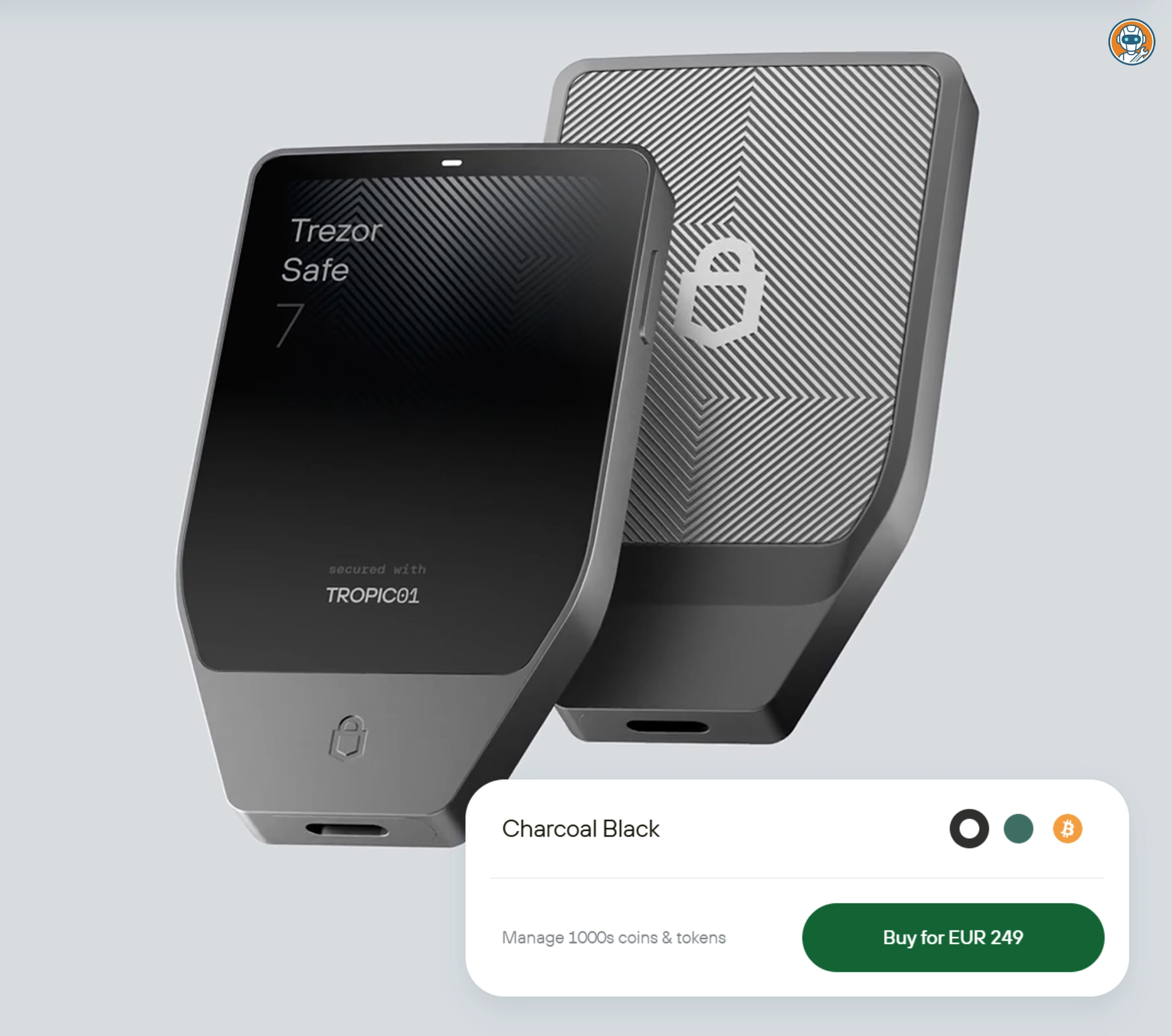
First mainstream hardware wallet with post-quantum cryptography via the fully open-source TROPIC01 chip.
Anyone holding less than a few hundred dollars in crypto — the price is hard to justify for small balances.
- Fully open-source firmware — every line auditable on GitHub, no trust required
- TROPIC01 + EAL6+ dual secure elements with post-quantum cryptography
- Shamir Secret Sharing — split your seed into shards for redundant backup
- Premium aluminum build, IP54 rating, 2.5" color touchscreen, Bluetooth + Qi2 charging
- No data breaches in company history — ever
- $249 is steep if you're just holding a few hundred dollars in crypto
- Supports ~8,000 tokens — excellent, but Ledger's 5,500 native integrations cover more chains
- Bluetooth is new for Trezor — some early reports of pairing hiccups on Android
- No NFC — can't tap-to-sign like Ledger Flex
2. Ledger Flex — Best for Multi-Chain Portfolios (Read the Fine Print)
I need to be upfront about something before talking about the Flex: I have trust issues with Ledger the company. More on that in the dedicated section below. But ignoring the corporate track record for a moment and judging purely on hardware? The Flex is genuinely impressive.
The 2.8-inch E Ink touchscreen is crisp and easy to read, even in direct sunlight, which is a real advantage over LCD screens. NFC means you can tap the device on your phone to sign transactions. Bluetooth 5.2 for wireless pairing. CC EAL6+ secure element. And the coin support is unmatched: 5,500+ cryptocurrencies through Ledger Live. If you're holding an obscure DeFi token or a layer-2 asset that Trezor doesn't support yet, Ledger probably does.
The battery lasts weeks on a single charge thanks to E Ink's efficiency. You can display an NFT on the lock screen even when the device is off, which is either a cool flex (pun intended) or a pointless gimmick, depending on your relationship with JPEGs.
At $249, it's direct competition with the Trezor Safe 7. The coin support advantage is real. The E Ink display is arguably better for a device you check infrequently. And the NFC tap-to-sign is genuinely convenient for mobile users.
The fine print: Ledger Recover is an opt-in $9.99/month service that extracts your seed phrase, splits it into three encrypted shards, and sends them to third-party custodians (Ledger, Coincover, EscrowTech). It requires government ID verification. This feature exists in the firmware of every current Ledger device. Even if you never activate it, the capability for remote seed extraction is baked into the closed-source code you can't audit. This is the core trust problem. More details below.
5,500+ supported cryptocurrencies and NFC tap-to-sign make it the widest-coverage, most convenient mobile experience.
Anyone who values open-source firmware and transparent security over coin coverage and convenience.
- 5,500+ supported cryptocurrencies — widest coin coverage of any hardware wallet
- 2.8" E Ink touchscreen readable in direct sunlight, battery lasts weeks
- NFC tap-to-sign + Bluetooth 5.2 — most convenient mobile experience
- Ledger Live ecosystem is polished with built-in staking, swaps, and DApp browser
- NFT display on lock screen (if that's your thing)
- Closed-source secure element firmware — you trust Ledger's word, not public code
- Ledger Recover capability baked into firmware — seed extraction to third parties is possible
- Three company data breaches (2020, 2021, 2026) exposed customer personal information
- No Shamir backup — single seed phrase is your only recovery option
- CNIL fined Ledger €750,000 for failing to protect user data
3. Trezor Safe 3 — Best Budget Wallet Under $100
$79. That's it. Fully open-source firmware. EAL6+ secure element. Shamir backup support. 8,000+ tokens. The same security philosophy as the $249 Safe 7, minus the touchscreen, Bluetooth, and aluminum body.
The Safe 3 uses a 0.96-inch monochrome OLED display and two physical buttons. Old school, but it works. Navigation is slower than a touchscreen, sure. But you're interacting with a hardware wallet for maybe 5 minutes a week. The rest of the time it sits in a drawer. Do you need a $249 touchscreen for 5 minutes of button presses? Most people don't.
Setup through Trezor Suite takes under 15 minutes. Users on r/CryptoCurrency consistently confirm this. Connect via USB-C, initialize, write down your seed (or set up Shamir if you're serious about it), and you're done. The companion app handles everything from there: portfolio tracking, built-in exchange, transaction signing.
The plastic build feels cheap compared to the Safe 7's aluminum, but the anodized aluminum backplate and laser engraving add a bit of polish. It's not winning any design awards. It's winning on value per dollar of security.
Who it's actually for: someone holding $500 to $10,000 in crypto who wants real security without spending a third of their portfolio on the device. If you're reading our non-custodial exchange guide and swapping through DEXs, this is where those coins should end up.
Same open-source firmware and Shamir backup as the $249 flagship, at a third of the price.
Anyone who wants Bluetooth, touchscreen, or wireless convenience — this is USB-C only.
- $79 — least expensive wallet with EAL6+ secure element AND open-source firmware
- Shamir Secret Sharing support — same advanced backup as the flagship
- 8,000+ supported tokens via Trezor Suite
- Setup reportedly under 15 minutes from unboxing to first transaction
- Open source — same trust model as the Safe 7, just cheaper hardware
- 0.96" monochrome OLED — functional but cramped for verifying long addresses
- USB-C only — no Bluetooth or wireless connectivity
- Plastic body feels budget (because it is)
- No NFC, no touchscreen — interaction is slow compared to modern alternatives
4. Tangem Wallet — Best for Beginners Who Hate Seed Phrases
Here's my contrarian take that'll annoy Bitcoin maximalists: for most normal people, Tangem's "no seed phrase" approach is more secure than writing 24 words on a piece of paper and hiding it in a sock drawer.
Tangem is a set of NFC smartcards: credit card-sized, no battery, no screen, no USB. You tap the card on your phone, the Tangem app handles the interface, and the card's EAL6+ secure chip signs the transaction. Your private key is generated inside the chip and never leaves it. There's no seed phrase to write down because there's no seed phrase at all (by default, though they do support BIP-39 seeds as an option now).
Backup is physical redundancy: your 3-card set ($69.90) contains three cards that all hold the same key. Lose one? Two backups. Lose two? One backup. All three cards would have to be simultaneously lost or destroyed for your funds to be inaccessible. For someone who has never heard of Shamir Secret Sharing and never will, this is brilliantly simple.
The 3-card set costs less than a single Trezor Safe 3. It supports 10,000+ tokens. It connects via NFC, just tap and go. The Tangem app has a built-in DEX aggregator for swaps. And the onboarding? Genuinely the smoothest I've seen in crypto. My partner, who has zero interest in blockchain and thinks "seed phrase" sounds like gardening advice, set up a Tangem wallet in under 5 minutes.
The catch: if all your cards are lost, stolen, or destroyed, and you didn't opt into the seed phrase backup, your funds are permanently gone. No recovery. Period. Also, Tangem requires a smartphone with NFC. No phone? No wallet. And for DApp interactions you're going through WalletConnect, which adds friction compared to Ledger Live's built-in browser.
No seed phrase by default — backup is the physical cards themselves, with 5-minute onboarding anyone can handle.
Anyone without an NFC smartphone or who needs a traditional seed phrase recovery option.
- $69.90 for a 3-card set — cheapest redundant backup system available
- No seed phrase by default — backup IS the physical cards themselves
- EAL6+ secure chip, NFC-only (no Bluetooth/WiFi attack surface)
- 5-minute onboarding — genuinely usable by non-crypto people
- 10,000+ supported tokens with built-in swap aggregator
- Lose all 3 cards without seed backup = permanent fund loss, no recovery possible
- Requires NFC smartphone — no desktop-only workflow
- No screen on the card itself — you're trusting your phone's display for transaction verification
- DApp integration via WalletConnect only — less seamless than Ledger Live
5. SafePal S1 — Best Air-Gapped Wallet on a Budget
$49.99 for a fully air-gapped hardware wallet with a self-destruct mechanism. Let me say that again. Fifty bucks.
The SafePal S1 has zero wireless connectivity. No USB data transfer. No Bluetooth. No NFC. No WiFi. Every transaction is signed via QR code: you scan a QR from the SafePal app, the device signs it offline using the built-in camera, and displays a signed QR code for the app to broadcast. Air gap maintained. The private key never touches an internet-connected device.
The EAL5+ secure element is a step below the EAL6+ in the Trezors and Ledgers, but still solid. The self-destruct mechanism wipes the device if tampering is detected, not something you see at this price point. And the coin support is absurd: 30,000+ tokens and assets, including NFTs, managed through the SafePal app.
Battery lasts up to 420 hours on standby. The form factor is credit card-sized. It's genuinely pocketable in a way that a Trezor Safe 7 or Ledger Flex simply isn't.
The catch: QR-code signing is slower than USB or Bluetooth. Each transaction takes an extra 15-30 seconds of scanning. The small screen makes address verification tedious. And the SafePal app, while functional, isn't as polished as Trezor Suite or Ledger Live. If you're running a crypto trading bot and moving funds frequently, the QR workflow will drive you insane. But for cold storage where you move crypto once and leave it? Hard to beat at $50.
Fully air-gapped QR-code signing with a self-destruct anti-tamper mechanism for just fifty dollars.
Frequent traders who move funds often — the QR-code signing adds 15-30 seconds per transaction.
- $49.99 — cheapest fully air-gapped wallet with a secure element
- 100% offline signing via QR codes — zero wireless attack surface
- Self-destruct mechanism wipes device if physical tampering detected
- 30,000+ supported tokens — widest asset coverage on this list
- Credit card-sized with 420-hour standby battery
- QR-code transaction signing is slow — 15-30 seconds per transaction vs instant USB
- EAL5+ secure element (one level below the EAL6+ in Trezor/Ledger)
- Small screen makes verifying long addresses a squinting exercise
- SafePal app is functional but less polished than Trezor Suite or Ledger Live
6. Coldcard Q — Best for Bitcoin Maximalists
If you just scrolled past five wallets thinking "I only hold Bitcoin, I don't need altcoin support, and I want maximum paranoia," the Coldcard Q was built specifically for you.
This is a Bitcoin-only device. No Ethereum. No Solana. No tokens. No DeFi. Just Bitcoin. And it does Bitcoin with a level of technical depth that makes every other wallet on this list look like a toy.
Full QWERTY keyboard for passphrase entry (no more clicking through an on-screen alphabet). Built-in QR scanner for air-gapped PSBT (Partially Signed Bitcoin Transaction) workflows. Dual microSD card slots for backups and transaction export. Runs on 3 AAA batteries, no USB charging, no built-in battery, no supply chain attack on a charging circuit. Dual secure elements from different vendors, because trusting a single chip manufacturer is apparently insufficient for the Coldcard team (honestly, respect).
The firmware is fully open source. The device supports multisig natively. You can use it with Sparrow Wallet, Electrum, or any PSBT-compatible software. BIP-85 support lets you derive child seeds for different purposes from a single master seed. It's the Swiss Army knife of Bitcoin security, if the Swiss Army only carried one blade and sharpened it to atomic precision.
~$240. Not cheap. Not meant to be. If you hold significant Bitcoin and want the most paranoid, maximally secure, minimally trusting device available, this is it. If you hold a portfolio of 15 different tokens, look elsewhere.
Air-gapped, PSBT-native, dual secure elements from different vendors, and a full QWERTY keyboard — maximum paranoia by design.
Anyone holding altcoins — this is Bitcoin-only with zero token support and a steep learning curve.
- Maximum Bitcoin security — air-gapped, PSBT-native, dual secure elements
- Full QWERTY keyboard — real passphrase entry, not on-screen clicking
- Built-in QR scanner for fully air-gapped transaction signing
- Open-source firmware, multisig support, BIP-85 child seed derivation
- Runs on 3 AAA batteries — no USB data connection needed, ever
- Bitcoin only — zero altcoin/token support by design
- ~$240 for a Bitcoin-only device is hard to justify if you hold small amounts
- Learning curve is steep — this is built for technical users, not beginners
- Bulky form factor with the keyboard — not pocketable like smaller wallets
Full Comparison: Security, Price, and the Details That Matter
| Feature | Trezor Safe 7 | Ledger Flex | Trezor Safe 3 | Tangem | SafePal S1 | Coldcard Q |
|---|---|---|---|---|---|---|
| Price | $249 | $249 | $79 | $69.90 (3-pack) | $49.99 | ~$240 |
| Supported Coins | 8,000+ | 5,500+ | 8,000+ | 10,000+ | 30,000+ | Bitcoin only |
| Connectivity | USB-C, Bluetooth, Qi2 | USB-C, Bluetooth, NFC | USB-C only | NFC only | Air-gapped (QR) | Air-gapped (QR + SD) |
| Secure Element | TROPIC01 + EAL6+ | CC EAL6+ | EAL6+ | EAL6+ | EAL5+ | Dual (2 vendors) |
| Open Source? | ✓ Fully | ✗ Closed | ✓ Fully | ✗ Closed | Partially | ✓ Fully |
| Backup Method | 24-word seed + Shamir | 24-word seed only | 24-word seed + Shamir | Physical card copies | 24-word seed | 24-word seed + BIP-85 |
| Best For | Overall security | Multi-chain portfolios | Budget security | Beginners | Budget air-gap | Bitcoin maximalists |
| Action | Buy Trezor Safe 7 → | Buy Ledger Flex → | Buy Trezor Safe 3 → | Buy Tangem → | Buy SafePal S1 → | Buy Coldcard Q → |
The Ledger Elephant in the Room
I recommended a Ledger device on this list. I have to explain why that required a disclaimer.
Breach #1 (June 2020): A poorly configured API key gave a hacker access to Ledger's e-commerce database. 1 million email addresses and 270,000 customers' full names, phone numbers, and physical home addresses were leaked. The data was posted on hacking forums in December 2020. Customers reported phishing attacks, SIM swaps, and even physical threats referencing their leaked addresses.
Breach #2 (2020-2021): Ledger disclosed that rogue Shopify support staff had stolen customer data from 200 merchants, Ledger included. A second wave of personal data was exposed before anyone could react.
Breach #3 (January 2026): Ledger's e-commerce partner Global-e was compromised. Customer names, emails, and delivery contact details were exposed. No seed phrases or payment data, but another round of personal information in the hands of attackers. That's three breaches in six years.
Then came Ledger Recover. An opt-in service ($9.99/month) that extracts your seed phrase from the device, splits it into three encrypted shards, and sends them to third-party custodians: Ledger, Coincover, and EscrowTech. Recovery requires government ID verification. The crypto community erupted. Ledger later admitted on r/ledgerwallet that a government could potentially subpoena the custodians and reconstruct your seed.
France's data watchdog (CNIL) fined Ledger €750,000 for failing to protect user data.
So why include a Ledger device at all? Because the hardware has never been compromised. The Flex's CC EAL6+ secure element, the coin support, the NFC convenience. Those are genuinely best-in-class. The engineering team builds excellent devices. The corporate side leaks your data, introduces seed extraction features the community didn't ask for, and charges $9.99/month for the privilege.
If you buy a Ledger: use a burner email, ship to a P.O. box or pickup point, never activate Ledger Recover, and understand that your personal information may end up on a hacking forum. The device will protect your crypto. The company may not protect your identity.
The Verdict: Match the Wallet to Your Situation
Holding $500-$5,000 in mixed crypto: Trezor Safe 3 at $79. Open source, EAL6+, Shamir backup for when your holdings grow. Best value in the entire market.
Serious portfolio, want maximum security: Trezor Safe 7 at $249. Quantum-ready, dual secure elements, premium build. The one I'd buy for myself, and did.
Hold 20+ different tokens across DeFi: Ledger Flex at $249. Best coin support, best DApp ecosystem. Just go in with eyes open about the company's data track record.
Setting up a non-technical family member: Tangem at $69.90 for three cards. Five-minute setup, no seed phrase to lose, NFC tap to transact. It's the hardware wallet for people who don't want to think about hardware wallets.
Bitcoin only, maximum paranoia: Coldcard Q at ~$240. Air-gapped, PSBT-native, open source, dual secure elements from different vendors. The bunker of Bitcoin wallets.
Absolute minimum budget: SafePal S1 at $49.99. Air-gapped security with a self-destruct chip for fifty bucks. It's slow and the app isn't great, but your coins are offline and that's what matters.