

Most AI resume builders are impressive for five minutes. The real test arrives at application twelve.
That is when the first draft stops mattering. You need a clean master resume, a fast way to create job-specific versions, and payment terms that do not punish a short burst of job hunting. A large template library cannot rescue a weak tailoring workflow.
Teal is my default pick because its no-cost access covers unlimited resumes and job tracking, while the paid layer adds deeper matching, analysis, and AI help without forcing a yearlong contract. Huntr is better when the application tracker is as important as the resume. Rezi is the rational alternative for anyone who wants to pay once.
This is an evidence-led buyer guide. I checked all six official purchase pages, public feature descriptions, current rendered evidence, and active GDT affiliate routes on August 24, 2026. I did not create accounts, submit a resume, compare generated bullets, test ATS parsing, contact support, request a refund, or run a hiring-result experiment.
If the document itself is not the bottleneck, start with our project management tools roundup for application tracking, our AI note-taking apps guide for interview research, or our free AI writing tools comparison for a one-off cover-letter draft.
-
#1 TealBest default for repeated tailoring: unlimited free resumes and tracking, plus paid job matching and analysis
-
#2 HuntrBest all-in-one job search workspace: base resumes, tailored resumes, job matching, and tracking
-
#3 ReziBest one-time option: ATS-focused workflow with a $149 lifetime plan
How I ranked these AI resume builders
This guide uses four shared criteria: Tailoring Fit, Workflow Depth, Price Clarity, and First-Draft Ease. Tailoring Fit asks whether the product helps maintain job-specific versions rather than merely restyle one document. Workflow Depth covers job matching, tracking, and the supporting process around the resume. The commercial criterion rewards explicit charges and penalizes trial structures that are easy to misunderstand. First-Draft Ease measures how approachable the public product path looks for someone starting from a blank page.
The order is built for an active job seeker, not a template collector. Teal wins by balancing tailoring and low commitment. Huntr has the deepest broader workflow but asks more upfront. Rezi gives up some workflow depth in exchange for a rare lifetime purchase. Kickresume is friendlier for a first resume. VisualCV is the design-led specialist. Resume.io is fast, but its four-week charge schedule is the hardest here to recommend.
Scores are buyer-fit judgments from public evidence, not lab measurements. An attractive score cannot tell you whether a generated bullet is truthful, whether a particular employer's ATS will parse your file, or whether the tool improves interview rates.
The buying trap: paying for a first draft when you need a system
A one-time resume project and a six-week job search are different purchases. If you need one clean PDF, a no-cost template in Google Docs or Word may be enough. Paid builders become useful when every application creates another version, another job description, and another set of changes to remember.
Payment cadence matters for the same reason. A weekly option can be sensible for an urgent sprint and expensive when forgotten. Prepaying for a quarter can lower the monthly equivalent while increasing the amount due today. A four-week schedule creates thirteen payment periods in a year, not twelve. Compare the charge and cadence, not the largest number on the card.
What the public evidence cannot prove
An official product page can show which workflow exists, what limits the company states, and how much the visible checkout asks you to commit. It cannot show whether the first generated bullet sounds like you, whether suggestions preserve the meaning of your experience, or whether the editor becomes frustrating after the tenth tailored version. Those questions require controlled account-level testing, and this guide does not pretend otherwise.
An “ATS checker” label is not universal parsing proof. Employers use different systems, configurations, and application forms. A score inside one builder may still be useful as a prompt to check keywords or missing sections, but it is not evidence that every employer will read the file correctly. The safer workflow is to keep the structure simple, export the format requested by the employer, reopen the file, and verify every heading, date, and bullet before submission.
The same caution applies to AI writing. A polished sentence can be less trustworthy than an awkward truthful one. Generated numbers, tools, leadership scope, or business impact should never survive because they sound plausible. Use suggestions to shorten, reorganize, and target language; keep the factual burden on the person whose name appears at the top of the resume.
Five questions that shrink the shortlist
How many job-specific versions will you maintain? One or two versions favor a simple editor. A sustained search favors Teal or Huntr because the organization around the document becomes part of the job.
Do you already track applications elsewhere? If a spreadsheet or project manager already works, Huntr may duplicate a solved problem. If follow-ups and status are scattered across tabs, its broader workspace becomes more valuable.
When should the commitment end? Teal’s fixed short windows suit a concentrated sprint. Rezi’s lifetime purchase suits someone who expects repeated use and already likes its structured approach. Longer prepayment is not automatically better value.
Which export must the employer receive? Check PDF, DOCX, and plain-text availability before building the document. Resume.io’s no-cost TXT output is a meaningful limit, while Rezi caps PDF downloads on its entry path.
What does your local checkout actually say? Currency, tax, cadence, and trial follow-up can change by region. Kickresume and Resume.io demonstrate why the localized total matters more than a converted headline from another market.
| Feature | Teal | Huntr | Rezi | Kickresume | VisualCV | Resume.io |
|---|---|---|---|---|---|---|
| Best job | Repeated job-specific tailoring | Resume plus application tracking | ATS-focused resumes without a long subscription | A guided first professional resume | Design-forward resumes and online sharing | Fast first resume and cover letter |
| Free path | Unlimited resumes and job tracking | Base resumes, basic matching and scoring | One resume and three PDF downloads | Four basic templates and unlimited downloads | First resume and template previews | One resume; TXT download only |
| Current paid reference | $13/7 days; $29/30 days; $79/90 days | $40 monthly; $90/3 months; $160/6 months | $29/month or $149 lifetime | EU view: €24 monthly; €54/quarter; €96/year | $16/month billed quarterly | EU view: €2.95/7 days, then €24.95/4 weeks |
| Tailoring model | Versions, keyword matching, analysis, AI help | Base and AI-tailored resumes inside a tracker | Keyword targeting, scoring, AI writer and editor | Builder, AI writer, ATS checker, import tools | Unlimited resumes, PDFs, links, analytics | Template-led resume and cover-letter builder |
| Main billing risk | Weekly plan renews quickly | Lower equivalent needs prepayment | Lifetime omits the monthly review | Best equivalent requires one year upfront | Displayed rate is quarterly | Trial auto-renews every four weeks |
| Skip if | You only need one final document | You do not need the tracker | Visual design is the priority | Version control is the bottleneck | Job matching matters more than presentation | You may forget to cancel |
| Action | Try Teal | Try Huntr | Try Rezi | Try Kickresume | Try VisualCV | Try Resume.io |
1. Teal: best default for repeated tailoring
Teal is the only default here that does not require the buyer to choose between a usable no-cost path and a serious job-search workflow. Its official page lists unlimited resumes and unlimited job tracking on Free Forever. It also shows limited keyword matching, basic analysis, and small AI allowances before Teal+ removes the main caps.
The paid ladder is unusual but explicit: $13 every seven days, $29 every 30 days, or $79 every 90 days. The same official section says no card details are required to start and describes Teal+ as adding deeper feedback, full job-description keywords, a Match Score, and broader AI and design controls. That combination is why Teal stays first: the workflow can be evaluated before the buyer accepts a quick recurrence.
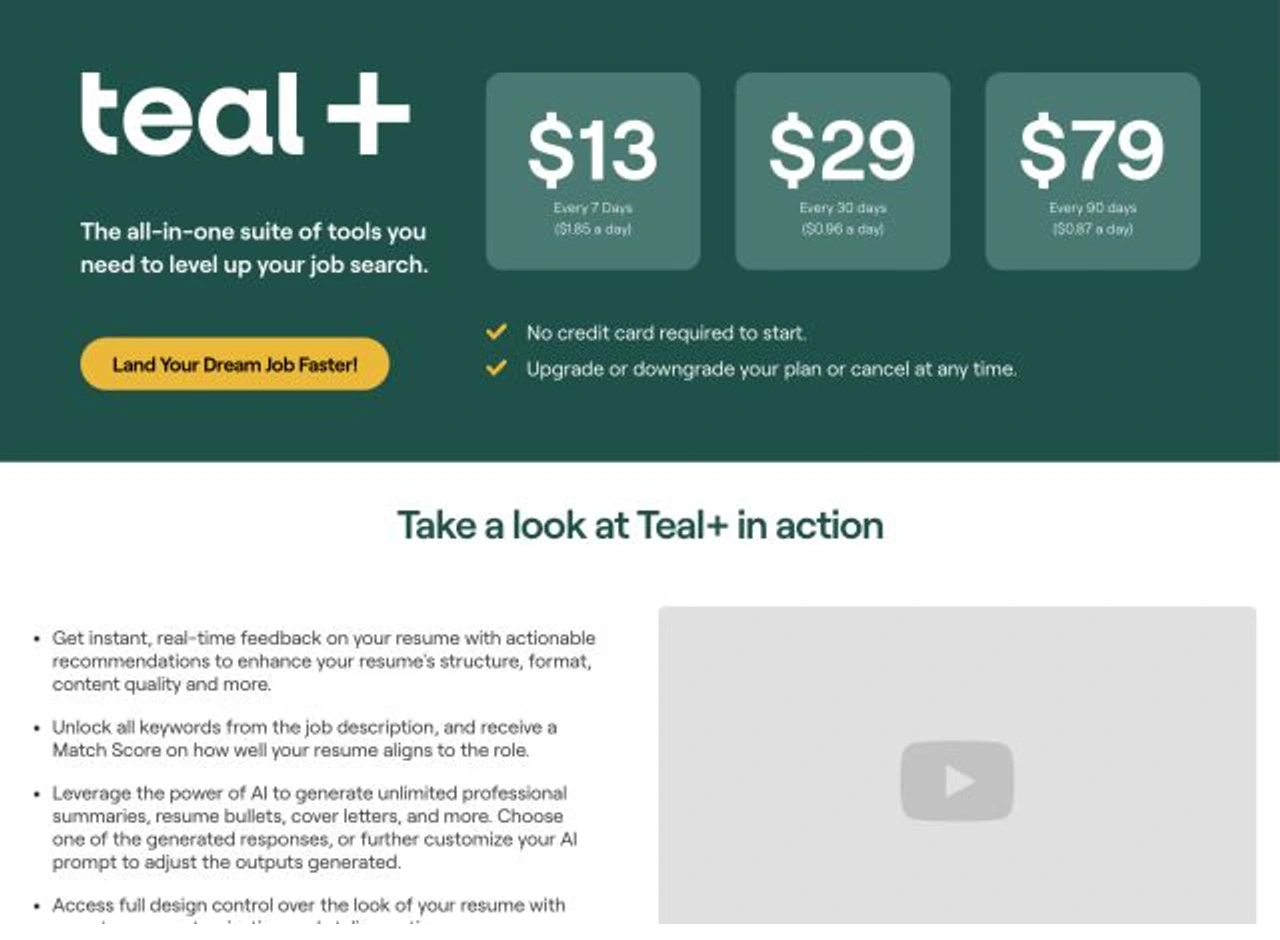
The tradeoff is that the seven-day option has almost no room for inattention. I would start at no cost, make sure the versioning and job-match approach fit, then choose 30 days for an active application sprint. The 90-day option only makes sense when the search is likely to run across a full quarter.
Unlimited free resumes and tracking make the real workflow testable before payment.
Skip it if you only need one polished document and do not want a continuing job-search system.
Teal ranks first because it combines the strongest repeat-tailoring fit with a usable free path, despite a fast weekly renewal option.
- Free Forever includes unlimited resumes and unlimited job tracking
- Paid plans unlock full keyword matching, analysis, AI help, and design controls
- Seven, 30, and 90-day choices fit a short or medium job-search sprint
- No credit card is required to start
- The seven-day billing cadence can renew before an inattentive buyer notices
- The strongest analysis and AI limits remain behind Teal+
- A one-resume buyer may find the wider job-search system unnecessary
- Public evidence does not prove output quality or ATS performance
2. Huntr: best when the tracker is part of the purchase
Huntr makes more sense when the resume is one object inside a larger application pipeline. The official page separates base resumes from AI-powered tailored resumes and places both next to job tracking, matching, scoring, cover letters, and job insights.
The current choices are $40 monthly, $90 every three months, or $160 every six months. That is an effective $30 or about $26.67 monthly after prepayment. The current official page does not list a yearlong option, so these three visible cadences are the basis here.
Huntr loses the default slot because a resume-only buyer pays for a tracker they may not use. It beats Teal when the actual pain is operational: too many jobs, follow-ups, versions, and notes spread across tabs. That is a valid reason to pay more, not a bonus feature.
Base resumes, tailored resumes, tracking, matching, scoring, and cover letters share one workflow.
Skip it if the application tracker would sit unused after the first resume export.
Huntr has the deepest surrounding workflow, but its price and tracker-first model make it a narrower default than Teal.
- Free plan includes unlimited base resumes, basic matching, scoring, and job insights
- Pro adds AI-tailored resumes, cover letters, advanced matching, and unlimited tracking
- Quarterly and six-month options lower the effective monthly cost
- Useful when follow-ups and application state are part of the same problem
- $40 monthly is expensive for a resume-only buyer
- The lower equivalent prices require $90 or $160 upfront
- No Pro free trial is listed; only complimentary AI credits on Free
- The tracker is wasted value if a separate system already works
3. Rezi: best one-time purchase
Rezi has the cleanest answer to subscription fatigue. Its current official page lists $0 access, Pro at $29 monthly, and Lifetime at $149. The no-cost option is deliberately narrow: one resume, one AI interview, and three PDF downloads. Pro adds unlimited resumes, interviews, PDF downloads, templates, and the broader writing and scoring tools.
The lifetime purchase pays back against Pro after a little more than five months. That arithmetic is useful only if Rezi fits the buyer. A one-time payment for the wrong workflow is still wasted money. The public page also distinguishes the options: Pro mentions a complimentary monthly review, while Lifetime is presented as all features for one payment. Check the live comparison before assuming every service benefit carries over.
Rezi ranks below Huntr because ATS-focused writing and scoring do not replace a complete application workflow. It remains the strongest specialist for someone who values structured tailoring and wants the subscription to end.
The $149 lifetime option is rare in a category built around recurring job-search subscriptions.
Skip it if presentation flexibility matters more than ATS-focused structure and keyword targeting.
Rezi ranks third because its lifetime value is excellent, but its broader job-search workflow is thinner than Teal or Huntr.
- $149 lifetime plan offers a clear exit from recurring billing
- Free plan exposes the core builder before purchase
- Pro lists unlimited resumes, AI interviews, downloads, and templates
- Keyword targeting and scoring fit conventional application workflows
- Free is limited to one resume and three PDF downloads
- Lifetime and Pro service details should be checked carefully before purchase
- ATS-focused output still needs a human truth and voice pass
- Less useful than Huntr when tracking is part of the problem
4. Kickresume: best first-resume experience
Kickresume is the approachable one. The public page lists four no-cost resume templates, four matching cover-letter templates, a basic website template, pre-written phrases, resume examples, and unlimited downloads. Premium adds more than 40 resume and cover-letter templates, AI writing, an ATS checker, import tools, mobile apps, and design controls.
Amounts are localized. In the Croatia/EU view checked on August 24, 2026, Premium showed €24 monthly, €18 monthly with €54 charged every three months, or €8 monthly with €96 charged every twelve months. The yearly card has the lowest equivalent, but the full year's charge belongs in the decision.
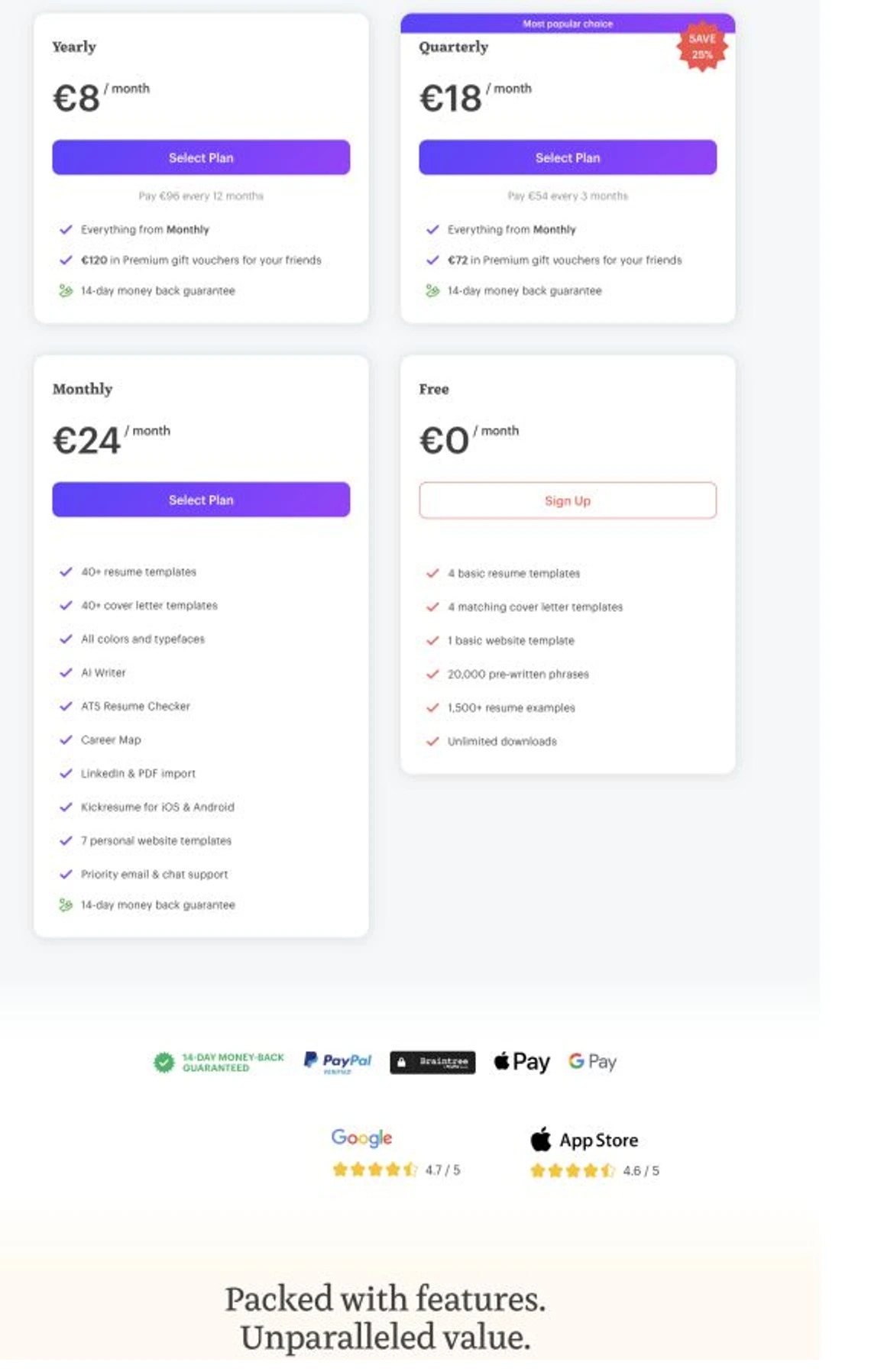
Kickresume ranks fourth because it solves blank-page fear better than version-control fatigue. I would choose it for a student or early-career applicant who needs structure and a forgiving starting point. I would not choose it for someone producing a new tailored resume several times a week.
The free path includes basic templates and unlimited downloads, while Premium adds a broad guided toolkit.
Skip it if the hard problem is maintaining many job-specific versions rather than creating the first document.
Kickresume ranks fourth because it is the easiest starting point, but its workflow is less suited to repeated application-by-application tailoring.
- Free plan includes basic templates and unlimited downloads
- Premium combines templates, AI writing, ATS checking, and import tools
- Monthly, quarterly, and annual charges are shown together
- Strong fit for students and early-career applicants
- The €8 monthly equivalent requires €96 upfront in the EU view
- Pricing and currency can change by region
- Template breadth does not equal a strong versioning workflow
- No public evidence here proves ATS or hiring outcomes
5. VisualCV: best design-led specialist
VisualCV is the better specialist when the document doubles as a presentation layer. Its official page lists a no-cost account, more than 30 professional templates to explore, and Pro Quarterly at $16 monthly, billed quarterly. Pro includes unlimited resumes and PDF downloads, shareable links, performance analytics, a personal website, a cover-letter builder, and Career Journal access.
That is a distinct purchase job. A designer, consultant, or portfolio-led candidate may care more about presentation and shareable documents than deep job matching. VisualCV should not be ranked above Teal for an application sprint, but it should not be treated as a weak Teal clone either.
The payment caution is simple: $16 is a monthly equivalent attached to a quarterly schedule. Confirm the amount due in the live checkout and the local amount before committing.
Unlimited resumes, PDFs, shareable links, analytics, and a personal site serve a different buyer than an ATS-first tool.
Skip it if job matching and high-volume version control matter more than visual presentation.
VisualCV ranks fifth because it is a credible design specialist, but it does not match the tailoring depth of the higher-ranked tools.
- Free account provides a practical evaluation path
- Pro includes unlimited resumes and PDF downloads
- Shareable links, analytics, and personal website features suit portfolio-led work
- The quarterly billing basis is stated on the official page
- $16 per month is billed quarterly, not month to month
- Job matching is not the central product advantage
- Design choices still need to remain recruiter- and parser-friendly
- A high-volume applicant will get more workflow depth from Teal or Huntr
6. Resume.io: fastest-looking path, hardest payment schedule
Resume.io has a clear appeal: one product surface for resumes, cover letters, templates, and downloads. Its no-cost access is much narrower than the headline suggests, though. The official page says one resume and cover letter, TXT-only downloads, and limited sharing and analytics.
The Croatia/EU view showed €2.95 for a seven-day trial, followed automatically by €24.95 every four weeks. Quarterly access showed €49.95 every three months, while the no-cost option showed €0. A four-week cadence can create thirteen charges across a year. That does not make the product unusable; it makes cancellation timing part of the purchase.
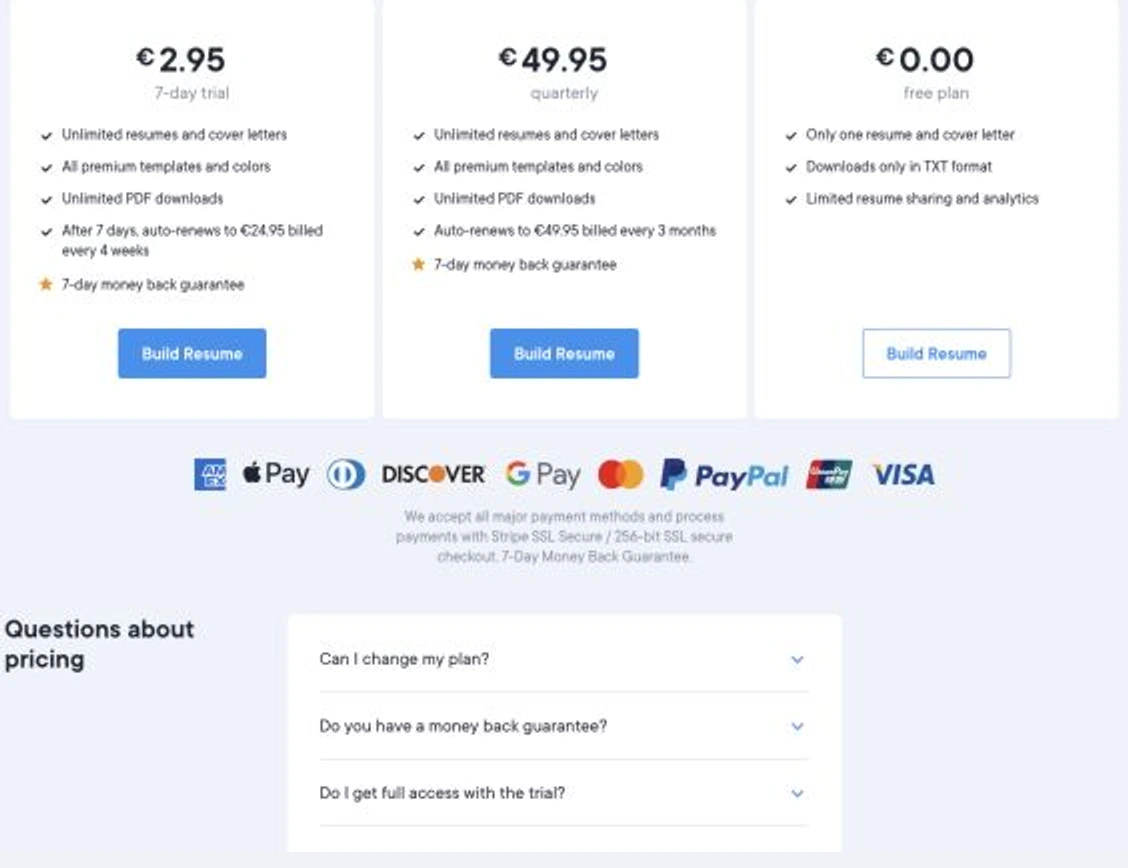
I would use the no-cost path to judge the editor, then choose a paid option only with a cancellation reminder already set. Buyers who dislike that requirement should pick another tool. Resume.io ranks last because the bill creates more risk than the public workflow removes.
The trial opens the premium resume and cover-letter flow, but the renewal line changes the value calculation.
Skip it if a four-week auto-renewal or cancellation deadline will create stress during a job search.
Resume.io ranks sixth because first-draft ease cannot offset a low-friction trial that renews every four weeks.
- One flow covers resumes, cover letters, templates, and PDF downloads on paid access
- Seven-day trial offers a low initial evaluation cost
- Quarterly option is visible beside the trial
- Free plan exists for judging the basic product surface
- EU trial auto-renews to €24.95 every four weeks
- Free downloads are limited to TXT format
- Four-week billing can create thirteen annual charges
- Localized pricing means readers must verify their own currency and amount
How to choose without buying the wrong workflow
Start with application volume. If you expect to tailor repeatedly, choose between Teal and Huntr. Teal is the lower-commitment default; Huntr is the stronger choice when tracking, follow-ups, and job state belong in the same system.
If recurring charges are the objection, compare Rezi's $149 lifetime purchase against the number of months you realistically need. If the blank page is the problem, Kickresume gives a clearer beginner path. If presentation is part of the work, VisualCV has a defensible specialist role.
Do not choose Resume.io because €2.95 looks cheaper than everything else. Choose it only if the seven-day premium window is genuinely useful and the four-week recurrence is acceptable. The visible trial amount and the continuing spend answer different questions.
Finally, treat every AI-generated bullet as a draft. A builder can reorganize facts and suggest phrasing; it cannot know which achievements are true. Verify every number, remove invented claims, keep the language specific, and make sure you can defend each line in an interview.
Final verdict: Teal wins, but only for repeated applications
Choose Teal if you want the best balance of no-cost evaluation, resume versions, matching, analysis, and short-term payment options. Choose Huntr if the resume belongs inside a full application tracker. Choose Rezi if ending the subscription matters more than owning the deepest workflow.
Kickresume and VisualCV remain useful specialists. Resume.io is the wrong default for anyone who dislikes automatic charges, even if its first draft feels easier.
The strongest counterargument against Teal is simple: a buyer who needs one polished document does not need Teal at all. In that case, use a no-cost template, keep the formatting plain, and spend the saved money on the part no builder can automate: better evidence of what you actually accomplished.
Frequently Asked Questions
Ready to check Teal?
Use the verified route if the trade-offs still fit. If not, jump back to the summary and compare the alternatives.
Crypto and productivity editor focused on cost, custody risk, setup friction, exports, fees, and workflow drag. Prioritizes verifiable numbers and clear skip criteria over hype.
Lucas starts with total operating cost, then ranks tools by setup and recurring friction, custody or export, reversibility, and whether the decision still makes sense when the exit path is included.
Related Articles

Hey Noah vs Lindy vs Fyxer: Best AI Executive Assistant
AI executive assistants compared by action authority, reversibility, workflow fit, cost predictability, context reach, and trust readiness
Compare Hey Noah, Lindy, and Fyxer by approvals, email sending, scheduling, calls, integrations, security, and current entry prices.

Paste vs Maccy vs Raycast: Which Mac Clipboard Manager Fits?
Mac clipboard managers compared by local history, Apple-device sync, privacy posture, launcher fit, setup burden, and subscription value
Paste, Maccy, and Raycast compared by clipboard history, Apple-device sync, local storage, privacy posture, pricing, and workflow fit.