

The expensive on-ramp mistake is thinking the checkout provider is the whole bill. It is not. MoonPay, Transak, and Ramp can all get fiat into crypto, but the delivered amount depends on payment method, spread, network fees, partner markups, bank charges, and whether the quote changes before settlement.
My default pick is Ramp Network if you are buying directly and want the clearest public breakdown before you start. Ramp publishes method-specific fee caps for direct purchases and separates its provider fee, network fee, optional partner fee, and bank-side charges in plain sight.
MoonPay is the better fit when the product you already use has a polished MoonPay-powered checkout, especially after its May 2026 Headless Onramps launch. Transak is the practical fallback when your wallet, dApp, country, or asset support lines up better there. But if the question is "which one lets me inspect the cost structure fastest?", Ramp remains the cleanest starting point.
I checked official fee disclosures, the current MoonPay Headless Onramps announcement, Ramp and Transak help/docs pages, public evidence screenshots, current SERP competitors, GDT operator data, and concrete public buyer-question patterns. I did not create accounts, submit KYC, link a card, run a bank transfer, accept a quote, receive crypto, test sell/off-ramp flows, or contact support. This is a buying-decision guide, not a live transaction test.
If you are choosing an exchange instead of a wallet-first checkout, start with our crypto exchange guide or the narrower Kraken vs Coinbase comparison. If you already hold coins and only need swaps, our non-custodial exchange roundup is the better next read. And if this is a long-term balance, sort out hardware wallet storage before checkout convenience becomes a custody plan.
-
#1 Ramp NetworkBest direct-fee visibility: explicit fee table, direct wallet delivery, and clear partner-fee caveat
-
#2 MoonPayBest embedded checkout momentum: strong wallet/app partner story and new headless on-ramp flow
-
#3 TransakBest when your wallet or dApp already routes through it and you need asset/country fit more than a fixed fee table
If I were buying straight to a self-custody wallet today, I would start by checking Ramp Network . If the wallet I was already inside offered a native-looking MoonPay route, I would compare the quote instead of reflexively leaving the flow. If the available route was Transak , I would inspect the exchange rate, third-party fees, and quote validity before accepting.
How I ranked these on-ramps
I ranked this as a buyer decision, not as a brand-size contest. The question is not which company has the largest partner list or the nicest checkout. The question is which route gives a normal buyer enough information to decide before money leaves the bank.
Fee clarity came first. A provider that separates its provider fee, network fee, partner fee, bank-side risk, and exchange-rate behavior is easier to assess than one that makes the buyer infer everything from the final quote.
The delivered amount wins.
Payment rails came next because the rail often changes the price. Card, bank transfer, Apple Pay, Google Pay, PayPal, and Pix are not interchangeable. A cheap bank route can lose to a card route if the transfer is unavailable, slow, or unsupported in your country. A card route can lose badly if issuer fees or foreign-transaction fees show up later.
Wallet delivery was the third filter. The best on-ramp should get the asset to the right wallet on the right chain with the least confusion. A clean provider fee is not useful if the checkout nudges buyers into the wrong network or makes the destination hard to verify.
The route matters.
Partner markup risk was the fourth filter. Direct provider pages tell one story; an embedded wallet, marketplace, or dApp checkout can tell another. Ramp ranks well because its fee page explicitly calls out optional partner fees. MoonPay's disclosure also separates a possible ecosystem fee set by partners. Transak publishes its current spread and rail fees, although the buyer still has to watch the clock.
Buyer fit came last because the "best" provider is still conditional. Ramp is my default starting quote. MoonPay can be the better pick inside a trusted app. Transak can be the better pick when your country, asset, chain, or wallet path lines up there first.
Cheapest is not enough.
MoonPay vs Transak vs Ramp comparison table
| Feature | Ramp Network | MoonPay | Transak |
|---|---|---|---|
| Best job | Direct wallet-first purchase with the clearest public fee breakdown | Embedded wallet/app checkout and broad partner distribution | Wallet/dApp route where Transak already has the best local support |
| Fee proof | Publishes method-specific direct fee caps plus network, partner, and bank-fee caveats | MoonPay USA LLC discloses up to 4.5%, minimum-fee caveats, spread, network fee, and possible ecosystem fee | Help article lists a 2.5% spread plus method-specific on-ramp fees and third-party costs |
| Payment rails | Cards, bank transfers, Apple Pay, Google Pay, Pix in supported regions | Cards, Apple Pay, Google Pay, bank transfer, PayPal where supported | Published EU examples range from 0.99% SEPA to 5.5% non-EUR card or wallet rails, with minimums or fixed fees |
| Hidden-cost check | Partner fees can appear in embedded flows; direct Ramp pricing is not always partner pricing | The 4.5% cap is US-specific; spread, network, ecosystem, bank, and non-USD minimum-fee adjustments can still apply | The quote lasts 5–10 seconds; the final rate is set at transaction finality and third-party costs may apply |
| Delivery shape | Buy crypto directly to your wallet | Hosted or embedded purchase route; Headless Onramps launched May 2026 | Fiat-to-crypto inside partner apps and direct purchase flows |
| Skip if | Your region, asset, or wallet integration routes cheaper through another provider | You need one globally applicable fee table or the partner route obscures the delivered amount | You want the easiest direct public fee table or hate quote-refresh risk |
| Action | Compare Ramp | Compare MoonPay | Compare Transak |
Also considered: Coinbase Onramp
Coinbase Onramp is the obvious omission. Its official developer documentation describes hosted and headless routes that can move fiat into crypto and send it to a wallet, using a Coinbase account or supported guest payment methods.
I left it outside the ranking because this page answers a narrower MoonPay-versus-Transak-versus-Ramp decision. Coinbase Onramp also brings Coinbase-account and guest-checkout context that deserves a separate route comparison rather than a fourth card added without matched public evidence. Buyers deciding whether to use a full exchange account should start with the Kraken vs Coinbase comparison.
The real on-ramp bill has five moving parts
Crypto on-ramp pages make buying feel like a single button. The cost model is closer to an airline booking: the provider fee is one line, the payment method changes another, spread can be baked into the quoted rate, and the network fee moves by chain and congestion. A wallet, marketplace, or dApp may add markup. Your bank can still add a foreign-transaction, card, or currency-conversion fee.
The trap is that the cleanest checkout can be the least comparable one. A native wallet button feels safer because it is already inside the app. But the route behind that button may bundle provider, partner, and payment-rail costs in a way that makes a direct quote look different.
That is why "MoonPay is expensive" or "Ramp is cheap" is too blunt to be useful. The right question is: who shows enough of the bill before I authorize payment, and does the route match the job?
The real comparison is delivered crypto under identical route conditions.
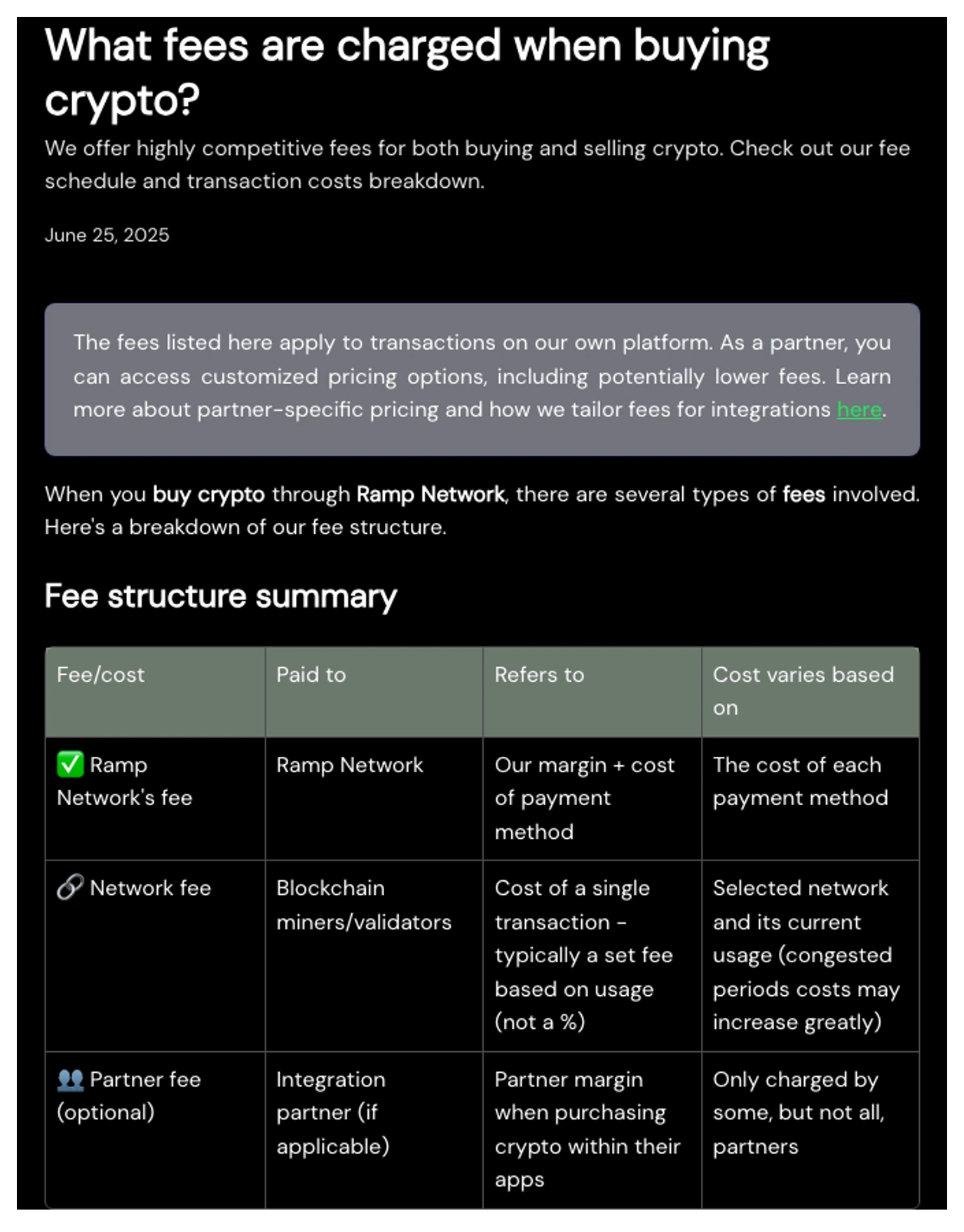
Ramp is strongest on that first question because its support page exposes the direct cost structure: Ramp's own margin and payment-method cost, the blockchain network fee, and any optional partner charge. MoonPay is strongest when the product experience matters. Transak now gives buyers more exact public numbers, but its 2.5% spread and short quote window still demand attention.
1. Ramp Network: best default when fee visibility matters most
Ramp wins the default slot because its public fee page is the easiest one to reason about before you open a checkout. It separates Ramp Network's fee, network fee, optional partner fee, and bank-side charges. It also says the direct fees apply to Ramp's own platform, while partners can have customized pricing.
That last caveat is important. If you buy through Ramp directly, you are looking at Ramp's direct setup. If you buy inside a wallet or marketplace that embeds Ramp, the partner may add a fee. That does not make Ramp bad. It makes the exact checkout context matter.
The fee table is still useful. Manual bank transfers run up to 1.40%, Easy Bank up to 2.40%, and USD, EUR, or GBP card payments up to 3.9%, each with a possible minimum up to €2.49. Other-currency cards reach 5.45%, while Pix reaches 2.90%. Apple Pay and Google Pay follow the underlying card. These are direct Ramp figures; network and bank-side currency charges can still sit outside them.
Ramp also says the crypto exchange rate is fixed when the payment reaches Ramp, not when the order is first placed. That settlement detail matters most for a manual transfer: a low rail fee does not freeze the market price while the money is on its way.
That is the level of disclosure I want from an on-ramp. Not because it guarantees the cheapest quote, but because it gives the buyer a checklist before they click. If a partner checkout hides the partner fee or makes the delivered crypto amount hard to compare, you can back out and run the same amount through direct Ramp, MoonPay, or Transak.
The weakness is coverage and context. Ramp can be the best direct purchase route for one buyer and not available, not cheapest, or not the smoothest for another. Your country, fiat currency, asset, chain, payment method, and wallet destination still decide the final quote.
Ramp publishes the clearest direct fee breakdown here, separating its fee, network fee, optional partner fee, and bank-side charges.
Skip it if your exact country, asset, or wallet route is better supported through MoonPay or Transak, or if an embedded partner route adds a markup you cannot justify.
Ramp ranks first because direct fee visibility and wallet-first delivery make it the safest default starting quote, even though availability and partner pricing can change the answer.
- Clearest public direct fee table among the three providers checked
- Separates provider fee, network fee, optional partner fee, and bank-side charges
- Strong fit for buying directly to a self-custody wallet
- Apple Pay and Google Pay support follow the underlying card logic
- Partner checkout pricing can differ from direct Ramp pricing
- Final quote still depends on region, currency, asset, chain, and payment method
- Network fees and bank-side currency/card charges can sit outside Ramp control
- Manual transfers can settle at a later exchange rate than the one visible when the order starts
2. MoonPay: best embedded checkout story
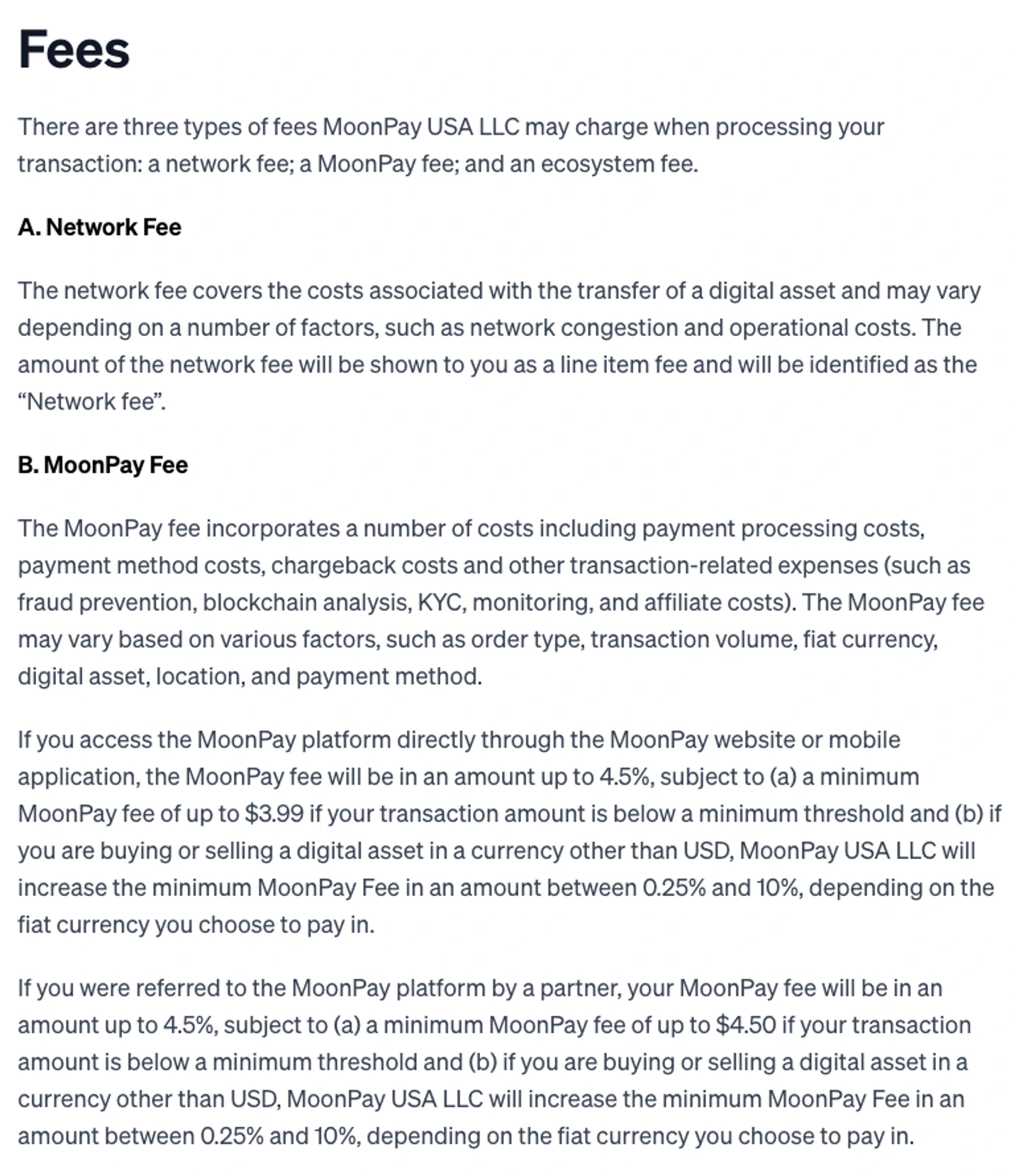
MoonPay is not second because it is weak. It is second because the buyer question here is cost visibility, and the most concrete public figures are tied to MoonPay USA LLC. Its current disclosure caps the MoonPay fee at 4.5% for direct and partner-referred orders. A minimum fee can reach $3.99 on MoonPay's own site or app and $4.50 on a referred order; non-USD orders can increase that minimum by 0.25% to 10%, depending on the fiat currency.
The upside is distribution and checkout experience. MoonPay's May 14, 2026 Headless Onramps launch is a real product-context shift: the company says partners can embed native Apple Pay, card, and Google Pay purchases across the US, EEA, and 100+ countries while MoonPay handles payment rails, compliance, and identity verification underneath.
That matters because many buyers never choose an on-ramp from a blank search page. They are inside a wallet, marketplace, game, exchange-adjacent app, or DeFi product. If that app presents a MoonPay route that is native, fast, and easy to confirm, the winning move might be to compare the delivered crypto amount rather than leave the app to chase a theoretical cheaper provider.
MoonPay's reach creates its main complication: partner context. The published cap does not mean 4.5% is the entire bill or a global rate. MoonPay says spread is included in the asset price, blockchain fees can apply, and some partners set an ecosystem fee. Cash App Pay has a separate disclosed rate of 2.9% plus $0.30, while purchases and sales using MoonPay Balance carry no MoonPay fee. Treat MoonPay as a strong checkout network, not a promise that every MoonPay-powered button has the same economics.
MoonPay's Headless Onramps launch makes the embedded partner checkout story stronger, especially for wallet and app flows where leaving the product adds friction.
Skip it if you need a public method-by-method fee table before entering checkout, or if the partner route makes the delivered crypto amount hard to compare.
MoonPay scores high for payment reach and embedded UX. Its US disclosure now gives a useful cap, but regional, minimum-fee, spread, and partner conditions keep it behind Ramp for a direct global sanity check.
- Strong wallet, app, and partner checkout distribution
- Headless Onramps launched in May 2026 with Apple Pay, card, and Google Pay support
- MoonPay USA LLC now publishes a 4.5% cap and direct-versus-partner minimum-fee details
- Good fit when the product you already use exposes MoonPay cleanly
- Published percentage and minimum-fee figures are jurisdiction- and route-specific
- Partner context can make one MoonPay checkout different from another
- Bank-related and network fees can sit outside the visible provider fee
- A partner-set ecosystem fee can add another line to an embedded checkout
3. Transak: best when route availability is the deciding factor
Transak is the one I would not dismiss just because it ranks third. If your wallet, dApp, or country has a better Transak route than the alternatives, the practical answer can be Transak. The docs position it as a fiat on-ramp/off-ramp layer for buying crypto inside applications, and the help center gives a useful breakdown of how prices and fees are calculated.
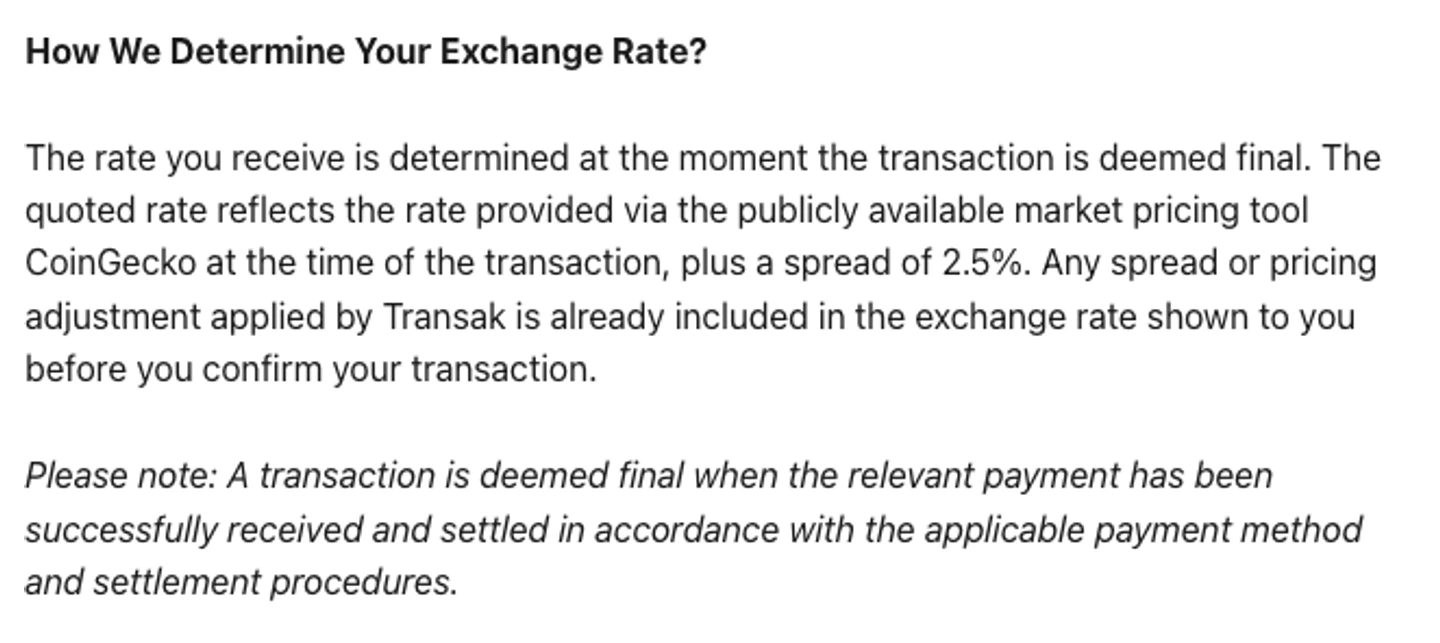
The important disclosure is quote mechanics. Transak says its exchange rate starts from CoinGecko market pricing and adds a 2.5% spread before confirmation. A quote is generally valid for only 5 to 10 seconds. The transaction becomes final when payment is received or settled, so a delayed payment can receive the rate available at finality rather than the first number shown.
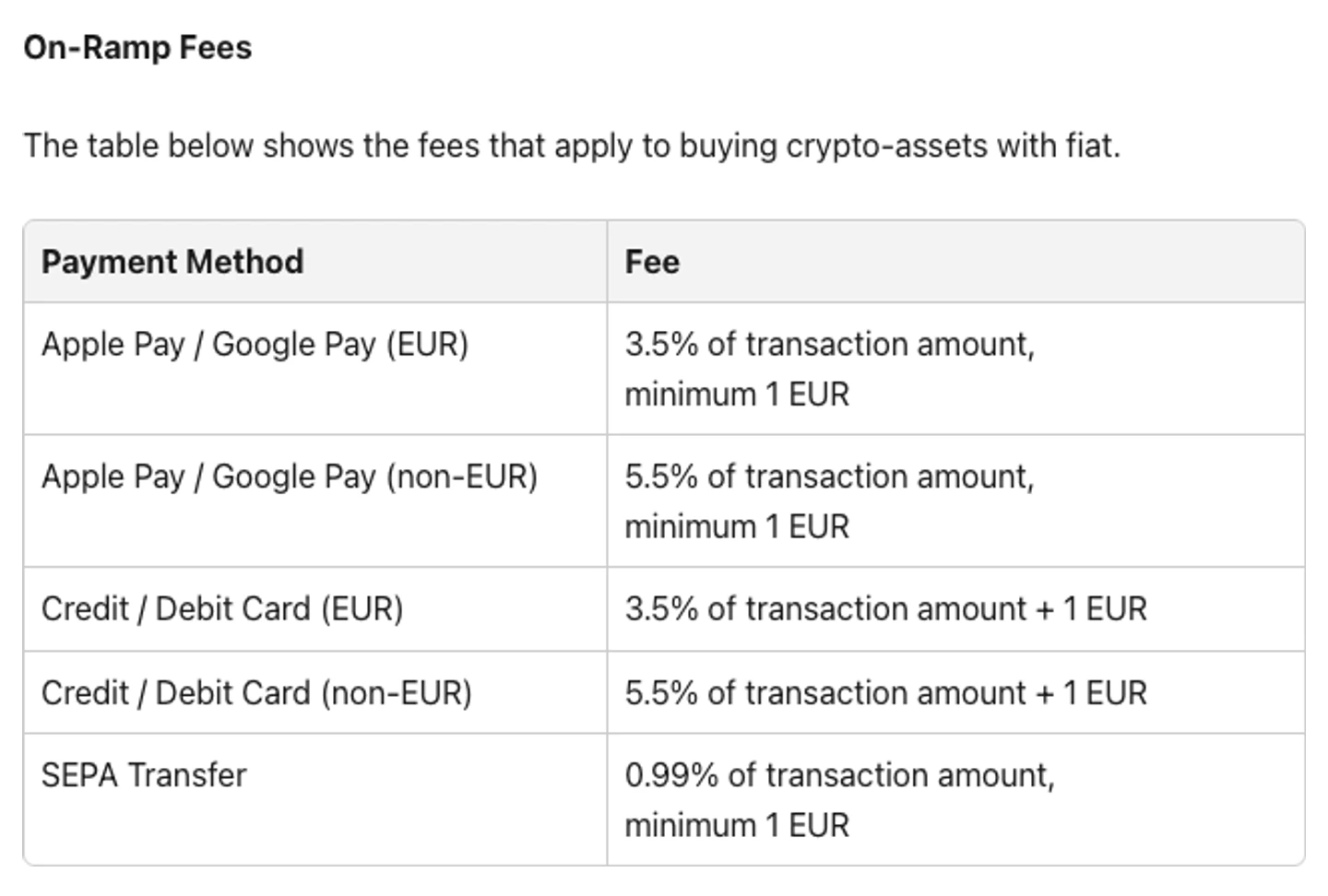
Transak also publishes a concrete on-ramp table. SEPA is 0.99% with a €1 minimum. EUR cards and Apple Pay or Google Pay are 3.5%, while non-EUR versions are 5.5%; cards also carry a fixed €1 charge. These are published rail examples, not a promise that every country, asset, or checkout will expose the same route. Network and other third-party fees may still apply.
Where Transak can win is support fit. On-ramp providers are not interchangeable if one supports your asset, chain, local payment method, and wallet path better than the others. A less elegant fee disclosure can be worth it if the alternative is a failed card route, unsupported currency, or unavailable asset.
Transak now publishes a 2.5% spread and a concrete on-ramp fee table alongside third-party fee and quote-validity caveats.
Skip it when Ramp or MoonPay gives you a clearer delivered-amount comparison for the same country, asset, chain, and payment method.
Transak's updated disclosure is much clearer, but the 2.5% spread sits on top of its payment-rail fee. It remains valuable when asset, country, wallet, or dApp support lines up better.
- Useful in wallet and dApp flows where Transak has better local support
- Official help material publishes its 2.5% spread, rail fees, and quote-validity rules
- SEPA and EUR/non-EUR card or mobile-wallet costs are separated
- Strong fit when asset, chain, fiat currency, and payment method coverage decide the purchase
- Short quote-validity window can refresh the exchange rate if you hesitate
- The 2.5% spread is added before payment-rail and third-party fees
- Final cost still depends on method, asset, currency, region, and settlement timing
- A delayed payment can settle at a later exchange rate
How to choose without getting clipped
Run the same amount through all available routes and compare the delivered crypto amount, not the headline fee. Use the same asset, chain, payment method, fiat currency, and wallet destination. If one quote uses card and another uses bank transfer, you are not comparing providers anymore. You are comparing rails.
Then check the partner context. Direct Ramp can be different from Ramp inside a wallet. MoonPay inside a partner app can differ from MoonPay's hosted route. Transak inside a dApp can be the only route that supports your local method. The partner surface is part of the product.
Finally, decide what happens after the buy. If the crypto lands in your own wallet, verify the address, chain, and recovery setup before sending a meaningful amount. If you are buying through an exchange instead, you may want Bitcoin DCA apps, stablecoin card spending, tax software, or seed phrase backup hardware more than another on-ramp comparison.
The quote check I would run before paying
Do this before you authorize anything. Open the same purchase in every route you can access. Use the same fiat amount, same asset, same chain, same destination wallet, and same payment method. If one provider is using debit card and another is using bank transfer, stop. You are not comparing MoonPay vs Transak vs Ramp anymore. You are comparing card rails against bank rails.
The buyer is not trying to admire a payments stack; the buyer is trying to avoid a bad surprise. A familiar wallet button can lower that guard before the quote earns it.
Beginners rarely lose money because they forgot the provider name. They lose it because the chain, rail, partner markup, or bank charge changed, and the last one may not appear until statement day.
Many on-ramp comparisons go sideways by comparing provider names instead of route conditions.
First, write down the delivered amount rather than the headline label. If you are spending $250, the useful comparison is how much BTC, ETH, SOL, USDC, or another asset reaches the destination after the provider deduction, spread, network charge, and partner markup. A prettier label can still deliver less crypto.
Second, open the details drawer before you approve the quote. A good checkout identifies the payment method, provider charge, network deduction, exchange rate, destination network, and any partner or service markup. If those lines are absent or bundled into one vague total, compare another route before buying.
The hard part is not finding a buy button. The hard part is knowing what that button bundles.
Third, check whether the quote is direct or embedded. Direct Ramp is one route. Ramp inside a wallet is another. MoonPay in a partner app is not always the same as MoonPay's hosted flow. Transak inside a dApp can be the best local option even if its public disclosure looks less table-friendly. The app around the on-ramp can change the bill.
Fourth, use the smallest first transaction that still makes sense. I do not like sending a meaningful amount through any new on-ramp until I have seen the wallet delivery path, receipt detail, and chain selection behave the way I expect. That is not paranoia. It is just cheaper than learning you bought the wrong asset on the wrong network after the real money moved.
The boring move is to reject any quote you cannot break apart.
Fifth, save the receipt and transaction details. On-ramp buys can create tax records, wallet histories, and proof-of-funds questions later. If this purchase becomes part of a larger stack, your future self will care which route you used, what the delivered amount was, and which wallet received it.
How Reddit question patterns were handled
Reddit was checked because on-ramp pain usually shows up as questions before it shows up in clean documentation. The useful pattern was not "people like or dislike MoonPay." That would be too sloppy. The useful pattern was concrete: r/BitcoinBeginners questions around delivered amount, r/Moonpay questions around bank-side charges, and r/sgcrypto questions around pending or failed Ramp routes.
Reddit is bad evidence for ranking sentiment. A thread can overrepresent angry users, unlucky failures, regional quirks, or scams that used a provider name in the story without proving the provider caused the loss. So Reddit did not become a popularity score, trust score, support score, or failure-rate estimate. It became a checklist for the doubts this article needed to answer: delivered amount, bank charges, quote timing, pending states, and partner context.
That is why the article keeps returning to the same boring test: compare delivered crypto for the same route conditions. If a Reddit question says the buyer received less crypto than expected through MoonPay, the professional response is not to declare MoonPay good or bad from one thread. Ask which payment method, partner app, asset, chain, bank charge, network charge, and quote details were involved.
The same applies to Ramp and Transak. A pending or failed payment story can be a provider issue, a bank issue, a compliance hold, a chain/network delay, a scam website impersonating a route, or a user sending funds to the wrong destination. Without transaction receipts and support records, you cannot responsibly turn those stories into performance claims. You can, however, turn them into buyer protections: use official URLs, start small, check the destination network, save receipts, and do not confuse a wallet's embedded button with universal provider terms.
The verdict
Choose Ramp Network first when you want the fastest public quote sanity check and direct wallet delivery. Choose MoonPay when the checkout is already embedded in a product you trust and the delivered amount is competitive. Choose Transak when route availability, country support, asset support, or wallet integration beats the other two.
The best habit is boring: compare the delivered crypto amount, confirm the payment rail, check partner markup, account for your bank, and do a small first transaction before moving real money. The on-ramp is the bridge. It should not become the part of the stack you trust blindly.
Frequently Asked Questions
Ready to check Ramp Network?
Use the verified route if the trade-offs still fit. If not, jump back to the summary and compare the alternatives.
Crypto and productivity editor focused on cost, custody risk, setup friction, exports, fees, and workflow drag. Prioritizes verifiable numbers and clear skip criteria over hype.
Lucas starts with total operating cost, then ranks tools by setup and recurring friction, custody or export, reversibility, and whether the decision still makes sense when the exit path is included.
Related Articles

Best Tokenized Stock Platforms for EU Users
EU stock-token platforms compared by legal wrapper, total cost clarity, shareholder rights, trading hours, and self-custody exit
Kraken xStocks, Robinhood Classic Stock Tokens, and Crypto.com compared for EU users by ownership, fees, rights, market hours, and wallet withdrawal.

MiCA Deadline: Kraken vs Coinbase vs Crypto.com in EU
Post-deadline EEA exchange verification guide
Kraken, Coinbase, and Crypto.com compared for EEA users after the July 1 MiCA deadline: entities, restrictions, fees, and safe transfer checks.