
The reward number is the least useful part of a stablecoin card comparison. A card can advertise 5% back and still be a bad everyday spender if the buyer has to lock a platform token, eat FX padding, keep assets on an exchange, or sell volatile crypto every time they tap.
My default pick is Coinbase Card for US users who want the simplest stablecoin-spending lane. The reason is boring, which is good here: Coinbase says there are no fees for spending USD or USDC with Coinbase Card, and its FAQ says spending USD or USDC generally has no tax implications. That is cleaner than chasing a bigger cashback number that only works after a lockup, loyalty tier, or regional fee table.
Bybit is the better card to inspect if your country is supported and you want a clear fee table before applying. Crypto.com is the rewards-maximizer, but only if the Level Up/CRO mechanics actually fit your spending. Nexo is the EU/UK specialist when dual credit/debit mode and ATM allowance matter more than a US card.
I checked official card pages, help-center fee disclosures, current SERP competitors, GDT affiliate-click demand, and public evidence screenshots on July 21, 2026. I did not apply for any card, submit KYC, top up funds, make a purchase, test FX settlement, trigger rewards, withdraw at an ATM, or contact support. This is an evidence-led buyer guide, not a live card test.
If you still need to buy crypto before you spend it, start with our crypto exchange guide, the MoonPay vs Transak vs Ramp on-ramp comparison, or the River vs Strike vs Swan Bitcoin DCA comparison. If you are trying to keep crypto off custodial platforms, this card category may be the wrong starting point; read our non-custodial exchange roundup and hardware wallet guide first.
-
#1 Coinbase CardBest US stablecoin-spending default: no Coinbase transaction fee for USD or USDC spending, with tax caveats spelled out
-
#2 Bybit CardBest fee-table check for supported regions: clear FX, conversion, issuance, ATM, and spending-limit disclosures
-
#3 Crypto.com Prepaid CardBest rewards ladder if CRO exposure, Level Up terms, and reward caps fit your actual monthly spend
If I were advising a US reader who wants to spend stablecoins without turning every grocery run into a crypto-sale puzzle, I would start with Coinbase Card . If that reader is outside the US or wants a more explicit regional fee grid, I would compare Bybit Card . If the whole point is to stack platform rewards, I would make Crypto.com prove the cap and lockup still work after the first month.
Stablecoin card ranking method
The rubric has five parts: Spend Cost, Reward Reality, Custody Risk, Region Fit, and Caveat Clarity. Spend Cost looks at transaction, conversion, FX, top-up, ATM, and membership friction. Reward Reality asks whether the advertised cashback survives caps, eligibility rules, token exposure, and excluded categories. Custody Risk asks what the buyer must keep on-platform to use the card. Region Fit matters because these products are not interchangeable across the US, EEA, UK, Brazil, Australia, and APAC. Caveat Clarity rewards pages that put the awkward details where a buyer can find them.
That weighting is why Coinbase beats higher headline rewards for the default US case. I do not want the average card shopper optimizing for a cashback rate before checking whether the card spends USDC cleanly, whether crypto conversion creates a taxable sale, or whether a platform-token tier is doing the real work.
The other rule: do not compare rewards without subtracting the card's friction.
Stablecoin cards compared by fees, rewards, custody, and region
| Feature | Coinbase Card | Bybit Card | Crypto.com Prepaid Card | Nexo Card |
|---|---|---|---|---|
| Best job | US cardholder spending USD or USDC through Coinbase | Supported-country spender who wants the fee grid before applying | Rewards-focused user already comfortable with CRO and Crypto.com app custody | EEA/UK user choosing between debit spending and crypto-backed credit mode |
| Stablecoin spend angle | Coinbase says USD and USDC spending has no card spending fee | Funding account assets can convert at spend time | Crypto must be converted/toppped up into the prepaid card setup | Debit Mode can spend digital assets; Credit Mode borrows without selling |
| Reward reality | Rotating crypto rewards are variable and app-dependent | Cashback is promoted, but regional fees decide the net result | Up to 5% back, but reward caps and Level Up plan rules matter | Up to 2% in NEXO token or lower BTC rates depending on loyalty tier |
| Main fee risk | Spread can apply when Coinbase buys, sells, or trades crypto | FX, crypto conversion, ATM, physical-card, and minimum conversion rules vary by region | Top-up, FX, ATM, inactivity, issuance, and region-specific terms | Credit-line interest, FX, eligibility, loyalty tier, and collateral risk |
| Region fit | US customers, excluding Hawaii in the checked FAQ | Selected countries; official page excludes EEA participation | Multiple regional programs with different fee documents | Selected European countries, including EEA and UK |
| Skip if | You need a non-US card or do not want Coinbase custody | Your country is unsupported or you need a US-friendly default | You want the simplest stablecoin spend path without token-tier homework | You are in the US or do not want borrowing/collateral mechanics near spending |
| Action | Compare Coinbase Card | Compare Bybit Card | Compare Crypto.com | Compare Nexo |
The stablecoin-card trap is counting rewards before fees
A stablecoin card looks like a debit card until the funding path shows up. One product spends USD or USDC through an exchange account. Another sells or converts crypto from a funding account at transaction time. Another asks you to top up a prepaid balance. Another lets you borrow against assets instead of selling them.
Those are different risk models. They should not be ranked by one cashback column.
The cleanest card for a US buyer is the one where the spending asset, fee language, and tax note are easiest to understand before the first swipe. The cleanest card for a non-US buyer may be the one with the most explicit regional fee table. The best rewards card may be the one you should avoid if the reward requires platform-token exposure you would not hold otherwise.
Stablecoin regulation adds one more reason to be picky. Treasury's April 2026 GENIUS Act proposed-rule material is about payment-stablecoin compliance, AML, and sanctions obligations, not consumer card rewards. But it is a reminder that "stablecoin spending" is moving closer to regulated payments infrastructure. That makes the boring operational questions more important, not less: who holds the funds, what gets converted, what fees show before approval, and how easy is it to leave?
1. Coinbase Card: best US default for simple USD or USDC spending
Coinbase Card wins the default slot for US readers because its official FAQ gives the most useful stablecoin sentence in this comparison: no fees for spending USD or crypto, including USDC, with Coinbase Card. The Coinbase fee disclosure adds the caveat that there are no Coinbase transaction fees for card spending, but a spread applies when Coinbase buys, sells, or trades crypto.
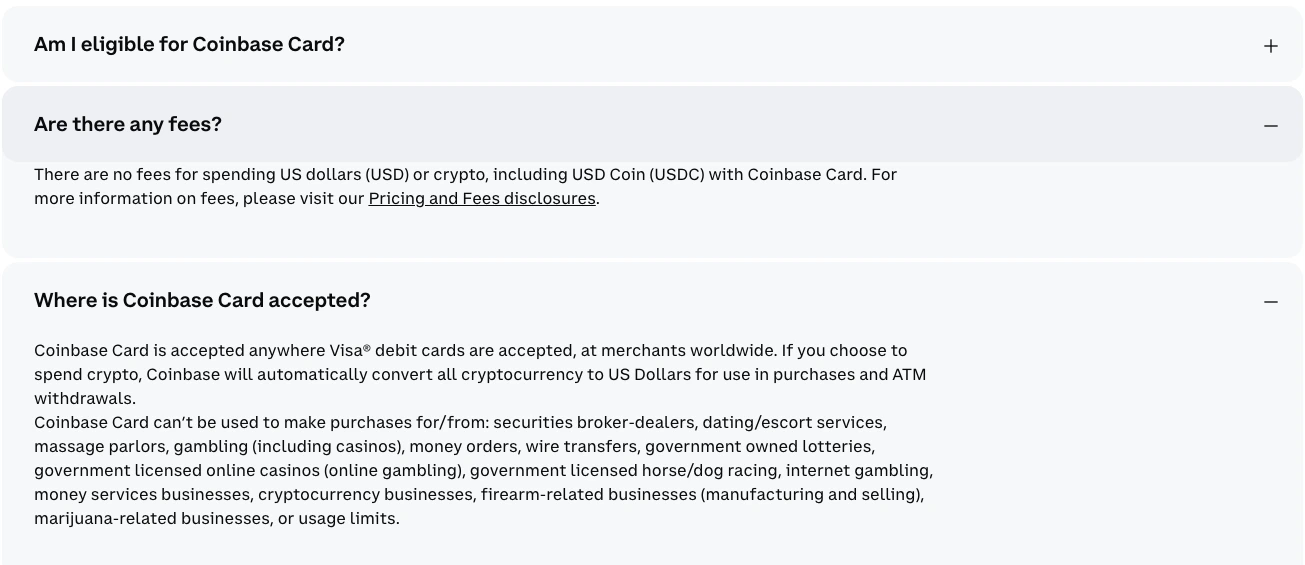
The second Coinbase advantage is tax clarity. The same FAQ says spending USD or USDC generally has no tax implications, while spending other crypto involves selling assets and can be taxable. That is exactly the distinction a stablecoin-card buyer needs before choosing a funding asset.
The tradeoff is custody and availability. Coinbase Card is a Coinbase account product, not a self-custody card. The card page says it is available to US customers except Hawaii in the checked FAQ. If you do not want to keep spending funds at Coinbase, this is not your philosophical winner. If you are outside the US, it is probably not your practical winner either.
The rewards are also not the reason I rank it first. Coinbase says rewards are optional, variable, US-only, and should be checked in-app for the current rate. That is weaker than a fixed public rewards table, but it is also honest enough to keep the buyer from doing fake math.
Coinbase makes the USDC spending distinction clearer than the higher-reward cards: no Coinbase card spending fee for USD or USDC, with spread caveats for crypto trades.
Skip it if you are outside the supported US footprint, do not want Coinbase custody, or need a fixed public cashback rate.
Coinbase ranks first because simple USDC spend and tax/fee language beat bigger but more conditional reward ladders for the default US buyer.
- Official FAQ says USD and USDC spending has no Coinbase Card spending fee
- Fee disclosure names spread as the caveat when Coinbase buys, sells, or trades crypto
- Tax FAQ separates USD/USDC spending from spending other crypto assets
- No staking or platform-token lockup requirement appears in the card eligibility FAQ
- US-only footprint in the checked FAQ, excluding Hawaii
- Rewards are variable and app-dependent rather than a fixed public table
- Still requires Coinbase custody for the spending account
- Spending non-USDC crypto can trigger a sale and tax reporting burden
2. Bybit Card: best if your region is supported and you want the fee grid first
Bybit is the card I would inspect first outside the Coinbase US use case because its help center exposes the ugly details most reward pages hide. The Bybit Card fee article, updated June 25, 2026, breaks out card issuance/replacement, FX fee, crypto conversion fee, FX padding, ATM fee, spending limits, and ATM limits by region.
That does not make Bybit cheap. It makes the math visible. In the official table, Australia shows a 1% FX fee on top of Mastercard's rate, a 0.9% crypto conversion fee, 0% FX padding, and a 2% ATM fee after the first $100 monthly. Argentina shows different numbers. Brazil, Georgia, Asia Pacific, Mexico, Kazakhstan, and Peru differ again. The product page's cashback headline is not enough; your region's fee row decides whether the card is worth using.
The other Bybit caveat is availability. The product page says the card is available only in certain countries and is not meant for European Economic Area customers, with EEA participation prohibited. That single sentence should stop a lot of bad comparisons. A card you cannot legally or practically use is not second best; it is not in your shortlist.
Use Bybit if you are in a supported region, already understand Bybit custody, and want a card whose conversion/ATM/FX terms are inspectable before you apply. If the broader exchange account is still part of the decision, read the Bybit review before treating the card as a standalone product. Skip it if the reward headline is doing more work in your decision than the regional fee table.
Bybit publishes a region-by-region fee and limit table that makes FX, conversion, ATM, and physical-card costs easier to inspect before applying.
Skip it if your country is unsupported, you are in the EEA, or you need a US card default.
Bybit ranks second because the official fee grid is useful, but regional availability and conversion/FX layers make it less universal than Coinbase for USDC spending.
- Official fee page breaks out FX, crypto conversion, FX padding, ATM, and issuance rules by region
- Product page advertises 2% to 10% cashback on everyday spending
- Virtual card issuance is listed as no-fee until further notice in several regions
- Spending and ATM limits are public enough to check before funding the card
- Regional fees differ enough that one global cashback calculation is misleading
- Product page says EEA participation is prohibited
- Crypto conversion fee can apply when spending non-fiat assets from the funding account
- ATM and physical-card costs can erase rewards for light or travel-heavy spenders
3. Crypto.com Prepaid Card: best only if the Level Up reward ladder fits
Crypto.com is the tempting one because the headline reward ceiling is higher. Its card page promotes up to 5% back on daily spending, while the help center says Level Up users with an active CRO lockup/stake or subscription can receive benefits based on plan. The important table is not the headline. It is the monthly spending cap eligible for rewards: N/A for Basic, $1,250 for Plus, $2,500 for Pro, and unlimited for Private.
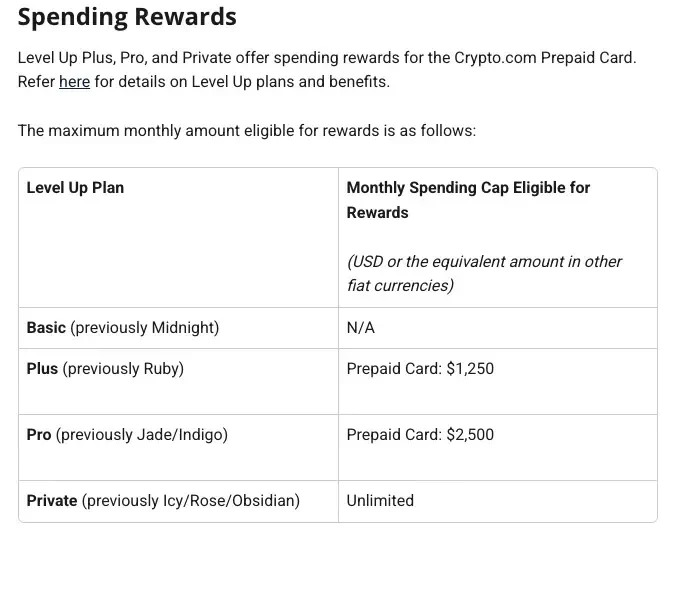
This is where a lot of cashback math dies. If you are not already comfortable with CRO exposure, a subscription or lockup, plan downgrades, and regional fee documents, Crypto.com can become a hobby disguised as a payment card. The US fee page also lists top-up, ATM, reissue, physical issuance, foreign transaction, and inactivity fees. In other regions, the fee table changes.
That said, Crypto.com is not filler. If you already use the app, understand Level Up, and spend enough in eligible categories to make the cap matter, it can beat simpler cards on rewards. The mistake is treating the top reward rate as free money. It is a loyalty-program calculation, not a stablecoin-spending default.
Crypto.com has the strongest reward ceiling here, but the useful decision is whether Level Up, CRO exposure, caps, and regional fees fit your actual spend.
Skip it if you want a simple stablecoin card without subscriptions, lockups, top-up rules, or platform-token exposure.
Crypto.com ranks third because the rewards can be attractive, but caps, Level Up rules, and regional fee documents add more homework than Coinbase or Bybit.
- Official help page shows up to 5% spending rewards for qualifying Level Up users
- Reward caps are published by plan instead of hidden after signup
- Useful if you already live inside the Crypto.com app and understand CRO tradeoffs
- Multiple regional fee pages make local card rules checkable before application
- Rewards depend on Level Up, CRO lockup/stake, or subscription context
- Plus and Pro prepaid-card rewards have monthly eligible-spend caps
- US fee page includes debit/credit top-up, ATM, foreign-transaction, physical issuance, and inactivity fees
- Prepaid top-up mechanics are less clean than spending USD or USDC directly
4. Nexo Card: best EU/UK specialist for credit/debit mode
Nexo belongs in the comparison because it is not trying to be just another prepaid exchange card. Its public card page says the card can switch between Credit Mode and Debit Mode. Credit Mode lets users make purchases without selling crypto, while Debit Mode spends digital assets directly. That dual-mode design is useful, but it also means the buyer must understand whether they are spending, borrowing, or using assets as collateral.
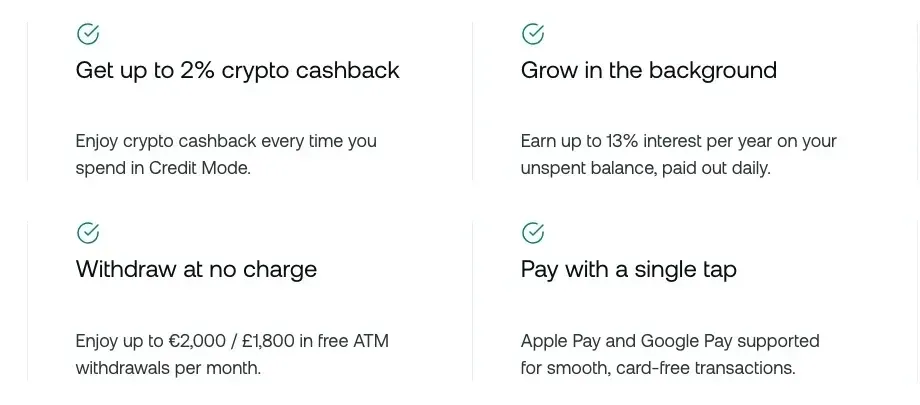
The reward pitch is also tiered. Nexo says cashback in Credit Mode is available when the account balance is above $5,000 worth of digital assets, with rates by loyalty tier: up to 2% in NEXO tokens or lower BTC percentages. The card page also says the virtual card can be activated once you have at least $50 in the account, while the physical card requires an account balance above $5,000 and at least Gold Loyalty Tier.
The biggest reason Nexo ranks fourth is region fit. Its FAQ says the card is currently available only to citizens and residents of selected European countries, including the EEA and UK, with supported identity documents. For that buyer, Nexo may be the most interesting card here. For a US buyer, it is not a backup Coinbase Card.
Nexo is the specialist when switching between Debit Mode and crypto-backed Credit Mode matters more than a simple USDC debit-card setup.
Skip it if you are outside the selected European footprint or do not want collateral, credit-line, and loyalty-tier mechanics near daily spending.
Nexo ranks fourth for this article because the dual-mode design is useful but too region- and loyalty-dependent for the default stablecoin-card buyer.
- Dual Credit Mode and Debit Mode create more flexibility than a basic prepaid card
- Public page lists no monthly, annual, or inactivity card fees
- ATM allowance and Apple Pay/Google Pay support are visible before signup
- Strong fit for selected EEA/UK users already using Nexo balances
- Not available as a US card in the checked public FAQ
- Credit Mode introduces collateral and borrowing risk rather than simple spending
- Cashback depends on account balance, loyalty tier, and reward currency choice
- Physical-card access requires higher balance and loyalty-tier conditions
Also considered: Wirex, MetaMask Card, and Coinbase One Card
Wirex and MetaMask Card were credible near-misses because they speak directly to stablecoin and crypto spending. I left them outside the ranked four because the selected GDT opportunity named Bybit, Coinbase, Crypto.com, and Nexo as the evidence-backed set, and because adding more cards would have made the region problem worse instead of clearer.
Coinbase One Card is a different product from Coinbase Card. It is a Coinbase One member credit card with bitcoin rewards, not the older Visa debit card spending USD or USDC through Coinbase. Coinbase says the One Card is available to Coinbase One members starting with the $49.99 annual plan and up. That deserves a separate credit-card rewards review rather than being mixed into a stablecoin debit-card table.
How to choose a stablecoin card without fooling yourself
Start with jurisdiction. If the card is not available where you live, remove it. Then decide whether you are spending stablecoins, selling volatile crypto, topping up a prepaid balance, or borrowing against collateral. Those four actions can look identical at checkout and behave very differently after the statement closes.
Pick Coinbase Card if you are a US reader and the job is plain USD/USDC spending through Coinbase. Pick Bybit if you are in a supported country and want to inspect a regional fee grid before applying. Pick Crypto.com only when the Level Up reward cap, CRO exposure, and regional fee page still make sense after you run your real monthly spend. Pick Nexo if you are in the selected European footprint and actually want the credit/debit toggle.
The wrong buyer should avoid all four. If you want self-custody as the default, a card attached to a custodial platform is a convenience tradeoff, not a sovereignty upgrade. If you want rewards, calculate them after FX, conversion, ATM, top-up, inactivity, membership, lockup, and tax friction. And if you cannot explain what asset is sold, converted, borrowed against, or held by the platform when you tap the card, do not fund it yet.
Frequently Asked Questions
Stablecoin cards verdict: choose the card with the least hidden conversion
My default recommendation is Coinbase Card for US readers who want to spend USD or USDC with the fewest moving parts. It does not win because its reward pitch is the loudest. It wins because the official fee and tax language is easier to understand before you fund the account.
Bybit is the strongest alternative when Coinbase is not your region or when you want to audit the fee table first. Crypto.com is the card I would use only after doing the Level Up math on real monthly spend. Nexo is a serious EU/UK specialist, but its credit/debit toggle is a product design choice you need to understand, not a free upgrade over a debit card.
The counter-intuitive answer is that a stablecoin card should feel less exciting than the marketing wants it to feel. The more the pitch depends on rewards, tiers, and "up to" language, the more you should slow down and trace the spend path. A card that makes USDC boring can be better than a card that makes rewards look generous while conversion risk does the accounting in the background.
Coinbase Card wins the default US recommendation because the official USD and USDC spend language is clearer than higher-reward card ladders that depend on region, token exposure, caps, or conversion math.
Compare Coinbase CardReady to check Coinbase Card?
Use the verified route if the trade-offs still fit. If not, jump back to the summary and compare the alternatives.
Crypto and productivity editor focused on cost, custody risk, setup friction, exports, fees, and workflow drag. Prioritizes verifiable numbers and clear skip criteria over hype.
Lucas starts with total operating cost, then ranks tools by setup and recurring friction, custody or export, reversibility, and whether the decision still makes sense when the exit path is included.
Related Articles

MoonPay vs Transak vs Ramp: Which Crypto On-Ramp Costs Less?
3 crypto fiat on-ramp providers compared by fee clarity, payment rails, wallet delivery, partner markup risk, and buyer fit
MoonPay, Transak, and Ramp Network compared by official fee disclosures, payment rails, partner markups, KYC caveats, and wallet-delivery fit.
River vs Strike vs Swan: The Bitcoin DCA Fee Trap
3 Bitcoin DCA apps compared by recurring-buy cost, custody clarity, withdrawal path, buyer fit, and caveat clarity
River, Strike, and Swan compared by official recurring-buy fees, custody signals, withdrawal path, and Bitcoin DCA buyer fit.